

Dropshipping Supplier Communication is not just about sending polite messages to a factory; it is the operating system behind product availability, order changes, packaging details, cancellation timing, and issue recovery. If you sell through Shopify and rely on overseas suppliers, the real risk is not only language. It is unclear confirmation, slow escalation, different assumptions about “yes,” and missing proof before the order moves to packing or dispatch.
Core Summary: Treat supplier conversations as a controlled workflow, not a casual chat thread. Define what must be confirmed, who owns each decision, how urgent changes move, and when a local China-side team should step in. Build a repeatable checklist for quotes, samples, production, packing, shipping, and exceptions before mistakes become expensive.
A typical Shopify seller feels this problem only after the store starts moving. A product sells well, the supplier says stock is available, ads keep running, and then a late message reveals that the color is out, the packaging changed, or the parcel has not been handed to the carrier. By the time your customer asks for an update, the issue is no longer a translation problem. It is a support, margin, and dispute-risk problem. The solution is to move from reactive messaging to a clear operating rhythm.
The Silent Profit Killer: Dropshipping Supplier Communication

Weak supplier coordination turns small uncertainties into costly operational errors. One unclear answer about stock, SKU variation, packaging, or dispatch timing can affect ads, customer promises, refund pressure, and support explanations.
For a Shopify store, supplier messages touch five sensitive areas:
- Product availability before you keep selling.
- Variant accuracy before the item is packed.
- Sample or photo confirmation before scaling.
- Order amendment and cancellation timing.
- Tracking, exception, and after-sales updates.
For a growing store, the problem is not only whether a supplier exists. The real question is whether the supplier can confirm stock, variants, packing details, dispatch timing, and exceptions quickly enough for your team to make customer-facing decisions. For Shopify sellers, this is where a structured Shopify dropshipping agent workflow can help connect supplier communication with order execution, packing checks, tracking updates, and after-sales support.
The cost appears when your team repeats the same clarification twenty times or discovers that “ready soon” meant a different timeline than your ad campaign assumed.
Key Takeaway: If a supplier answer does not produce a clear business decision, it is not a finished answer. Ask for status, timing, proof, responsible person, and next action before you treat the message as confirmed.
Turn Supplier Replies Into Store Decisions

A supplier reply is only useful when it helps your store decide what to do next. Words like “yes,” “available,” “soon,” or “no problem” may sound positive, but they are not enough if your team still cannot decide whether to keep selling, pause ads, approve packing, update the customer, cancel the order, request proof, or prepare a substitute.
Before treating a message as confirmed, connect it to one clear business action. For stock, the supplier should confirm the exact SKU, variation, available quantity, and whether the item is physically ready or only expected later. For order changes, the supplier should confirm whether the order is still before packing, label creation, or carrier handoff. For packaging, the supplier should confirm the actual packout, especially when inserts, accessories, custom packaging, fragile parts, labels, sizing, or plug types affect customer expectations. For shipping, the supplier should confirm the real handoff stage, because a tracking number alone does not prove the parcel has moved.
For shipping, the supplier should confirm the real handoff stage, because a tracking number alone does not prove the parcel has moved. Clear real-time tracking update support can then help your team explain whether the order is packed, picked up, scanned, delayed, returned, or waiting for carrier collection.
The mistake is asking for a general update when your store needs an action-ready answer. A better supplier question should clarify the decision needed, the exact detail to confirm, the proof required for higher-risk orders, the reply deadline, and the fallback plan if the first option is not available. At scale, supplier communication becomes part of backend execution, not just messaging.
A better workflow is to ask each supplier question in this format:
“What decision do we need to make?”
“What exact detail must the supplier confirm?”
“What proof is needed if the risk is high?”
“What is the deadline for this answer?”
“What should we do if the first option is not available?”
This is especially important for Shopify sellers once supplier replies begin affecting customer promises, support tickets, tracking updates, and repeat-order accuracy. At that stage, supplier communication is no longer just messaging. It becomes part of the backend execution workflow that connects product availability, order handling, packing checks, shipping updates, and after-sales response.
Beyond Translation: Why Context Gets Lost

Translation tools can convert words, but they cannot always convert production context, buyer expectations, or urgency. The biggest misunderstandings happen when each side is answering a different version of the question.
For example, a seller might ask, “Can you ship this product tomorrow?” A supplier may hear, “Can the product leave your facility soon?” The seller may mean, “Will a valid tracking number update quickly enough for my customer promise?” Those are different questions.
Useful supplier coordination requires a fuller message:
- SKU, color, size, plug type, bundle, or accessory list.
- Quantity and destination market.
- Required ship-by or cancel-by deadline.
- Packaging and label requirements.
- Whether photo proof, sample approval, or packing confirmation is needed.
- What should happen if the item is unavailable.
Without those details, a supplier may answer the visible question while missing the business consequence.
Turn open questions into confirmation blocks
Instead of asking, “Is this product available?”, use a confirmation block:
| Field | Example |
|---|---|
| Product | Black handheld massager, EU plug, retail box |
| Quantity | 80 units this week |
| Confirmation needed | Stock available, no packaging change, dispatch-ready date |
| Proof requested | Shelf photo or supplier stock screenshot if available |
| Decision deadline | Reply before 10:00 China time tomorrow |
| Fallback | Confirm next available date or alternate model |
This format reduces guessing and gives a China sourcing team or private agent workflow a clear handoff record.
Cultural Signals That Change the Meaning of Yes

In cross-border sourcing, “yes” may mean “I understand,” “I will try,” “probably,” or “confirmed.” You need to know which one you received before you make customer-facing promises.
This does not mean Chinese suppliers are dishonest. It means business communication often carries relationship, politeness, and face-saving pressure. Concepts such as guanxi and mianzi are widely discussed in Chinese business culture because relationships and preserving face can influence how disagreement is expressed.
For a Shopify seller, the safe response is simple: do not force the supplier to say “no.” Give them an easy way to report constraints.
Better question:
“Please confirm one of these three options: A. ready to ship tomorrow; B. not ready, but ready on a specific date; C. not available, please suggest a substitute.”
This style protects both sides. The supplier can give a realistic answer, and you receive a usable decision. It is especially helpful for urgent order amendments, replacement parts, custom packaging, and temporary stock shortages.
Ask for the operational proof behind agreement
When the answer matters, ask for the proof that matches the risk:
- For stock: quantity, batch, or shelf confirmation.
- For samples: photo, video, or physical sample approval.
- For packaging: image of the actual packout, not just a catalog mockup.
- For shipping: pickup status, tracking handoff stage, or exception reason.
- For defects: photo evidence and replacement plan.
Proof does not need to be aggressive. It should feel like normal operating discipline.
Key Takeaway: Do not treat “yes” as confirmation until it answers the exact operational question. A useful confirmation includes what is ready, when it is ready, what proof exists, and what happens if the first plan fails.
Time Zones Can Break Urgent Order Decisions
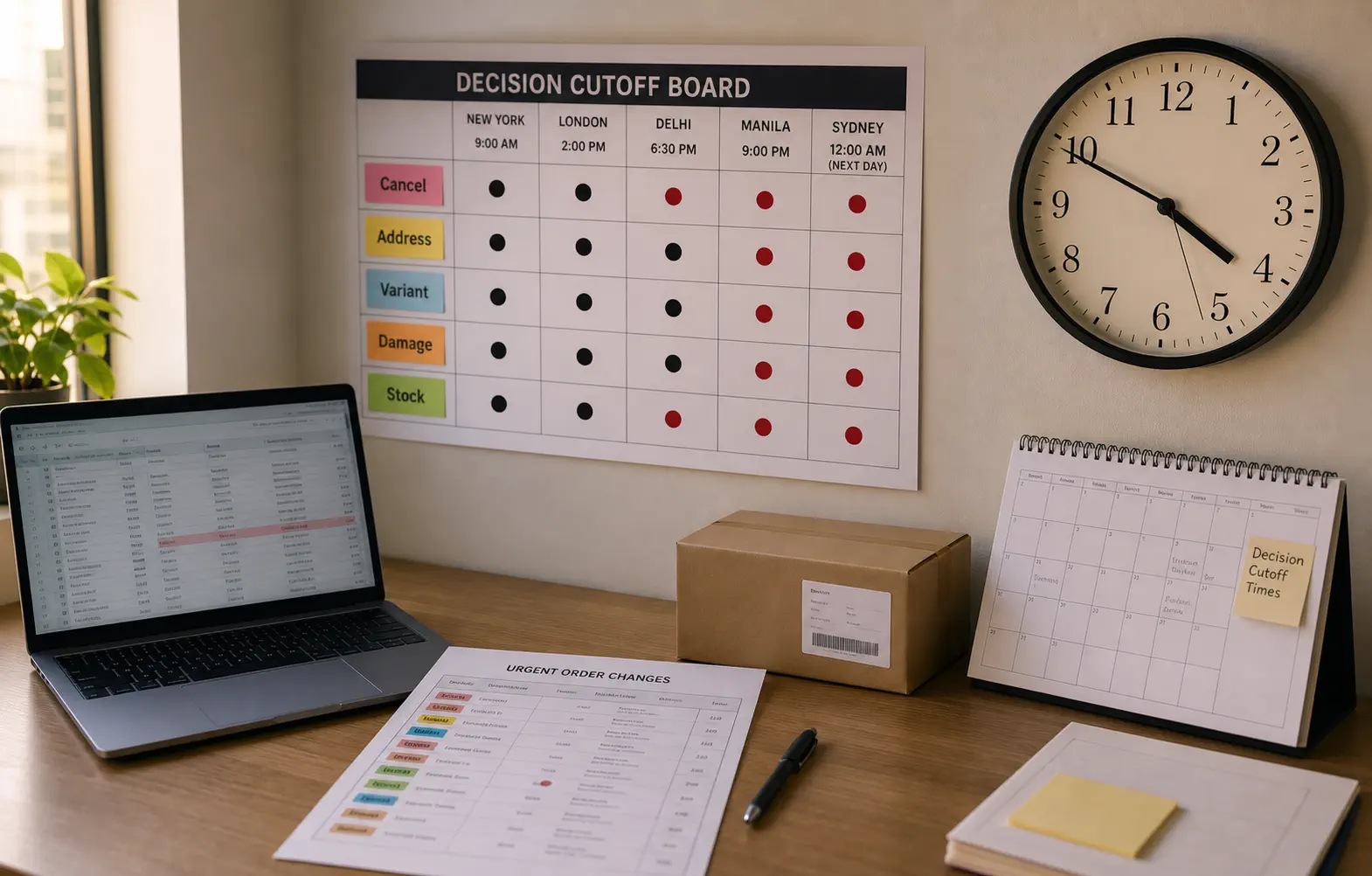
The time-zone gap becomes painful when a customer requests a cancellation, address change, variant correction, or urgent replacement while your supplier is offline. By the time the supplier replies, the parcel may already be packed or handed to the carrier.
This is why supplier conversations become harder as order volume grows. At low volume, you can manually chase a reply. At higher volume, the same delay creates repeated support tickets and unclear promises.
Your workflow should define decision windows before the issue happens:
| Issue type | Seller-side rule | Supplier-side confirmation needed |
|---|---|---|
| Cancellation request | Cutoff before packing begins | Whether order has entered packing or dispatch |
| Address change | Cutoff before label creation | Whether label can still be changed |
| Variant correction | Cutoff before SKU pick | Whether correct item is still available |
| Damaged item found | Hold order before dispatch | Replacement or refund route |
| Stock shortage | Pause selling or switch SKU | Confirm replenishment date or substitute |
The key is to stop treating urgent changes as ordinary chat messages. They need a separate path, a faster response expectation, and a clear record of whether the change was accepted or missed.
If your support team often answers “we are checking with the supplier,” you need a better escalation rule. The customer cares whether you can give a clear next step.
The Dangerous Gap Between Software Sync and Physical Reality
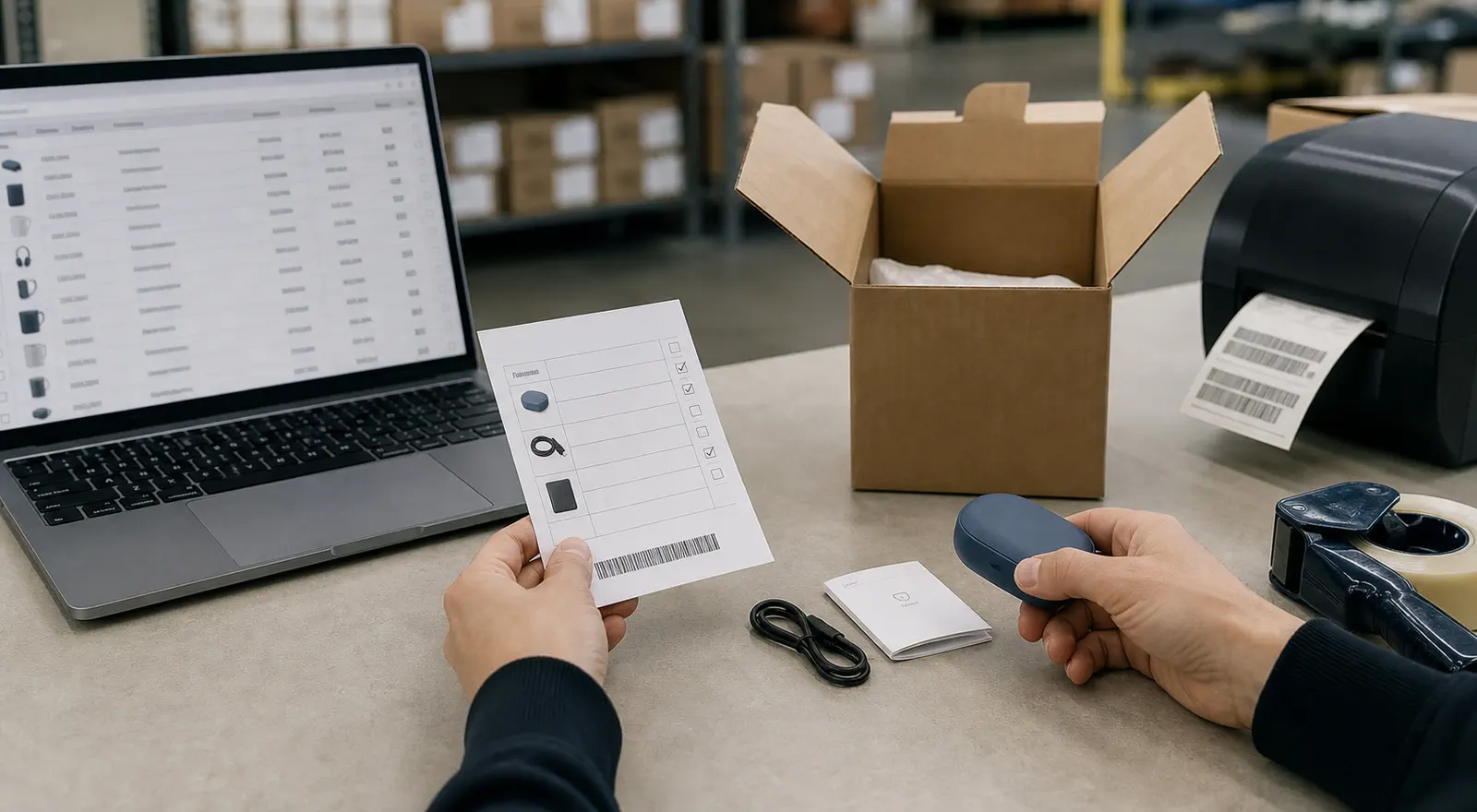
Shopify automation can move data, but it cannot confirm whether the actual product, label, accessory, insert, or carton is correct. Shopify’s Shopify order tracking guidance explains how tracking information can appear through the order status page, shipping emails, and the Shop app after tracking is added, but the physical layer still depends on accurate supplier dispatch, carrier acceptance, and exception review.
This is where many stores misunderstand their tools. An app may sync a paid order, product name, SKU, address, and tracking field. But it cannot notice that the supplier changed the color tone, removed an accessory, used old packaging, or prepared the wrong plug type.
For physical supply-chain control, your messages need to cover the details software cannot verify:
- Does the supplier have the correct variant in the correct batch?
- Is the packaging the same as the approved sample?
- Are any accessories missing?
- Did the supplier substitute a part without approval?
- Is the shipping label created for the correct destination?
- Is the order already beyond the amendment cutoff?
If the problem is app-level automation rather than physical confirmation, the DSers vs AutoDS comparison is a better place to evaluate order import, supplier mapping, and workflow automation.
Build a pre-dispatch message routine
For higher-risk products, use a short pre-dispatch routine:
- Confirm SKU and variant against the order record.
- Confirm included accessories or bundle parts.
- Check visible packaging condition.
- Confirm label and destination country.
- Hold exceptions before dispatch.
- Record evidence if a later customer dispute appears.
This does not mean every low-risk order needs heavy inspection. It means your supplier conversation should match the risk level. High-ticket items, fragile products, electronics, cosmetics, apparel sizing, and branded packaging deserve more structured confirmation.
When the risk involves visible defects, wrong variants, missing accessories, or packaging problems, a dropshipping quality control process should support the supplier message routine before dispatch.
A Practical Message Framework for Suppliers

The best supplier messages are short, specific, and easy to answer. They reduce back-and-forth by naming the decision you need.
Use this five-part framework:
State the order, product, or request clearly. Include the SKU, product link, variation, quantity, and relevant customer deadline.
Example: “For order 10482, please check the black 2-pack version with EU plug. Customer requested cancellation if it cannot ship this week.”
Ask for a decision, not a general update.
Example: “Can this still be cancelled before packing, or has the label already been created?”
Request proof only when it affects the business decision.
Example: “If it is already packed, please send a packing-table photo showing the correct variation.”
Make the time requirement visible.
Example: “Please reply before 16:00 China time today so we can update the customer.”
Tell the supplier what to do if the first answer is negative.
Example: “If this version is out of stock, confirm the nearest available model and earliest dispatch date.”
This structure respects the supplier’s time and protects your team because every conversation has a decision trail.
Key Takeaway: A good supplier message should make the next action obvious. If the supplier must guess the deadline, proof requirement, or fallback option, your message is not specific enough.
When a Local China Sourcing Team Becomes Necessary

A local team becomes useful when supplier conversations require verification, negotiation, and exception handling that ordinary chat cannot reliably cover. This usually happens when your store has regular orders, multiple suppliers, higher-risk SKUs, custom packaging, or urgent customer-service pressure.
Direct messaging can work for simple testing. But as the operation scales, you may need someone who can:
- Contact factories during China business hours.
- Clarify product details in the supplier’s working language.
- Compare supplier claims against samples or physical stock.
- Push for a real answer when a reply is vague.
- Coordinate sample approval, packaging confirmation, and dispatch timing.
- Escalate exceptions before they become customer-facing problems.
This is where Runtodropship’s position as a private dropshipping agent matters. The value is one accountable private-agent workflow that connects supplier messages, product checks, packing confirmation, order execution, shipping arrangement, and after-sales support.
Before handing that workflow to a private agent, use these questions to ask a dropshipping agent to verify sourcing ownership, QC evidence, shipping logic, system access, escalation, and after-sales responsibility.
If the issue starts before daily orders, such as supplier screening, quote comparison, sample approval, or factory shortlisting, a sourcing agent workflow is the better fit.
How to Prevent Disputes Before They Become Expensive

Most supplier disputes become expensive because the original agreement was not clear enough. The safest time to prevent a dispute is before the sample, production batch, packaging change, or dispatch decision.
Use written confirmation for anything that affects customer experience or margin:
- Product version and material.
- Color tolerance or size range.
- Included parts, manuals, chargers, cables, or accessories.
- Packaging type, insert, label, or branding requirement.
- Defect handling and replacement route.
- Lead time and dispatch cutoff.
- Shipping method and tracking handoff expectation.
Use written confirmation for anything that affects customer experience or margin. The FTC shipping delay guidance also shows why sellers should avoid making shipment promises without a reasonable basis and why delay communication must match the real fulfillment situation.
When a supplier issue appears, keep the discussion professional and evidence-based. Share the order number, confirmed requirement, visible problem, requested resolution, and deadline. If the supplier cannot resolve it, record the reason and decide whether to continue, pause, or replace that source.
For multi-supplier orders, communication risk increases because one delayed item can hold the customer experience hostage. When one customer buys products from different supplier sources, dropshipping order consolidation can reduce split-parcel confusion by bringing receiving, checking, and supplier timeline coordination into one workflow.
Real Case Lesson: KFC UK’s 2018 Supply Chain Failure

A public supply-chain case shows why communication and handoff design matter even outside ecommerce dropshipping. In 2018, KFC UK experienced a major chicken shortage after changing its delivery arrangement, forcing many restaurants to close temporarily. Wired’s reporting on the incident described how a logistics change created operational disruption across the network.
This was not a Shopify supplier chat problem. The useful lesson is broader: when a company depends on a time-sensitive physical supply chain, the handoff between supplier, operator, logistics, and customer-facing promise must be designed before volume pressure arrives.
For a growing dropshipping store, the parallel is practical:
- Do not switch suppliers without mapping open orders.
- Do not rely on verbal agreement for time-sensitive products.
- Do not assume one party owns the full handoff unless that responsibility is explicit.
- Do not wait for customers to discover the issue first.
The best operators know who confirms stock, checks packing, handles shipping exceptions, updates tracking, and makes the final customer-support decision.
The lesson is practical: supply-chain communication is not soft skill decoration. It is business infrastructure.
Your Supplier Communication SOP

A simple SOP gives your team a repeatable standard and makes it easier to train assistants, managers, coaches, or agency staff.
Use the following template:
| Stage | Required confirmation | Evidence level | Escalation trigger |
|---|---|---|---|
| New product quote | MOQ, price, lead time, available variations | Written supplier reply | Quote missing key cost or timing |
| Sample | Real sample, packaging, function, variation | Photos, video, or physical sample | Sample differs from listing |
| Pre-scale | Stock, backup supplier, production capacity | Supplier confirmation and optional proof | Product begins selling faster than expected |
| Daily orders | SKU, quantity, label, dispatch status | System record plus exception notes | Wrong variant, shortage, address change |
| Packing | Accessories, inserts, package condition | Photo proof for high-risk orders | Missing part or visible defect |
| Shipping | Tracking handoff, exception status | Tracking update and carrier note | No scan, returned parcel, delayed handoff |
| After-sales | Replacement, refund route, defect evidence | Order record and issue photo | Repeated issue with same SKU |
You do not need the entire table from day one. Start with the highest-risk stage: wrong items, late replies, or ambiguous confirmations.
The point is to turn supplier conversation into an operating asset. Once the SOP exists, every new team member can follow the same logic instead of improvising in chat.
Key Takeaway: The best supplier system is not the longest checklist. It is the shortest repeatable process that catches the mistakes most likely to hurt your customers, margins, or support workload.
FAQ
Why do suppliers sometimes give vague answers?
Suppliers may give vague answers because the request is missing details, the answer depends on another department, or they want to avoid a blunt refusal before checking. Make your questions easier to answer by offering clear options, deadlines, and fallback choices.
Should I communicate with suppliers by email, WhatsApp, WeChat, or Alibaba?
Use the channel your supplier responds to reliably, but keep important decisions in a written record your team can search later. Fast chat is useful for urgent updates, while structured written confirmations are safer for price, stock, sample, packaging, and dispatch decisions.
Can translation software solve supplier misunderstandings?
Translation software can help with basic wording, but it cannot confirm production context, urgency, proof, or responsibility. You still need clear fields, decision deadlines, and evidence when the order risk is high.
When should I stop handling supplier messages myself?
You should consider support when supplier replies start slowing customer service, causing repeated order errors, blocking scaling decisions, or requiring China-side verification you cannot perform directly. The trigger is not a fixed order number; it is operational risk.
How do I keep supplier conversations professional during disputes?
Use evidence, not emotion. Share the agreed requirement, the visible issue, the affected order, the resolution you need, and the reply deadline. Professional dispute handling makes it easier to recover the current issue and decide whether the supplier should remain in your system.
Conclusion
Supplier conversations decide whether your Shopify backend runs on clear confirmation or hopeful guessing. When you define the exact decision, deadline, proof, fallback, and escalation path, you turn scattered messages into a supply-chain control system. That helps you protect customer promises, reduce avoidable support confusion, and decide when direct supplier chat is no longer enough.
Runtodropship can help qualified ecommerce sellers, mentors, agencies, and multi-store operators connect supplier coordination with sourcing, product checks, packing confirmation, order execution, shipping arrangement, and after-sales support through one private-agent workflow. The future of dropshipping is not just finding cheaper suppliers; it is building a backend where every physical step has an accountable confirmation. If your supplier messages are starting to slow down growth, contact Runtodropship with your product links, current supplier process, and the communication problems you want to fix first.