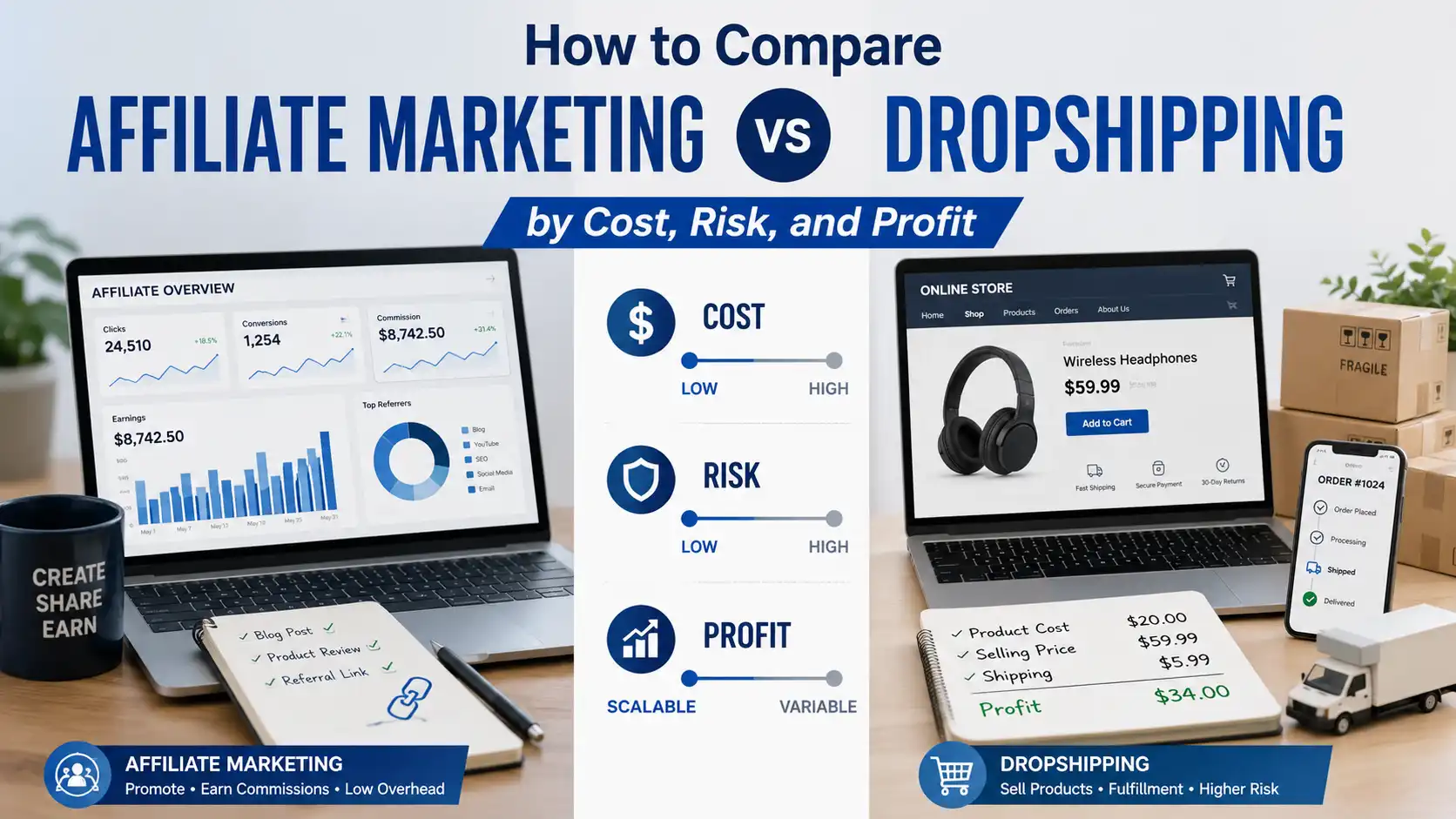
Dropshipping is ultimately more profitable if you want to build a high-revenue asset with pricing control, while affiliate marketing provides higher net margins on lower overhead. You sit at your desk, ready to escape the 9-to-5 grind, staring at two massive e-commerce pathways that promise financial freedom. Unfortunately, the fear of burning through your hard-earned savings on unprofitable ads or wasting months building a niche site that generates zero commissions keeps you frozen in place. To bypass this analysis paralysis, we have constructed this definitive guide on Affiliate Marketing vs Dropshipping to give you a clear, data-backed roadmap to your next venture.
Affiliate Marketing vs Dropshipping: Quick Comparison
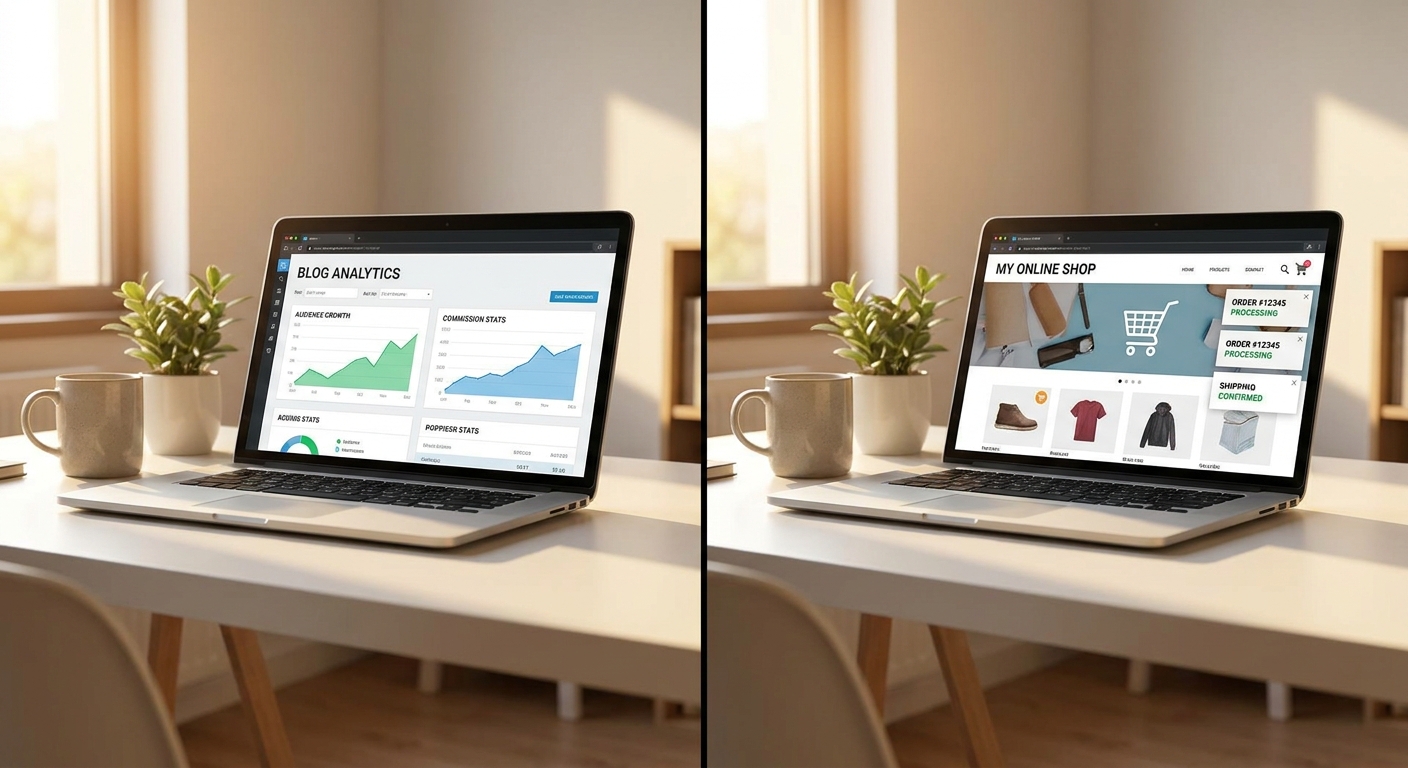
Determining whether Affiliate Marketing vs Dropshipping is better depends heavily on your capital, marketing experience, and desire for operational control. Both business models offer exceptional pathways to generate digital income without requiring you to manufacture goods or rent retail warehouses. However, they demand entirely different skill sets and day-to-day responsibilities.
If you prefer a hands-off lifestyle business, referring visitors to established brands might be your ideal path. Conversely, if your goal is to build an independent brand, launching a custom storefront is the clear choice.
What is affiliate marketing?
Think about it: you are acting as a digital matchmaker between buyers and established brands. When you join a referral network, you receive unique tracking links to promote specific products or services. Your primary job is to create high-value content that convinces your audience to click those links and make a purchase.Because affiliate marketers earn commissions from recommendations, they should clearly disclose that relationship to readers. The FTC’s endorsement disclosure guidance explains why paid relationships, affiliate commissions, and other material connections should be disclosed clearly.
Here is the thing:
- You earn a set commission percentage on every sale generated through your referral link.
- You have zero responsibility for inventory management, product packaging, or shipping logistics.
- The merchant handles all customer service inquiries and return requests directly.
This setup allows you to focus 100% of your energy on audience building, copywriting, and search engine optimization.
What is dropshipping?
Let’s face it: you are running a fully branded online retail store without holding any physical stock. When a customer places an order on your storefront, you buy the item from a third-party supplier at wholesale prices. The supplier then packages and ships the product directly to your customer’s doorstep.Shopify also defines dropshipping as a way to sell products without storing inventory or shipping products yourself, which is why the model can be easier to start but still requires reliable supplier and shipping control.
Think about it:
- You establish your own retail prices and control your profit margins.
- You design a custom shopping experience that builds long-term brand equity.
- Your third-party supplier handles the fulfillment process on your behalf.
This model gives you complete ownership of your customer list, allowing you to run retargeting ads and email marketing campaigns.
| Business Metric | Affiliate Marketing | Dropshipping |
|---|---|---|
| Inventory Ownership | None | None (Held by Supplier) |
| Operational Control | Low | High |
| Primary Skill Required | Audience Building / SEO | Store Optimization / Paid Ads |
While both models eliminate physical warehouse management, dropshipping requires actively coordinating with suppliers, whereas affiliate marketing allows you to focus solely on sending traffic to external offers.
Key Takeaway: If you want a zero-overhead business where you never have to deal with customers or suppliers, choose affiliate marketing; if you want to control your margins and build a real brand, dropshipping is your best bet.
How Each Business Model Works
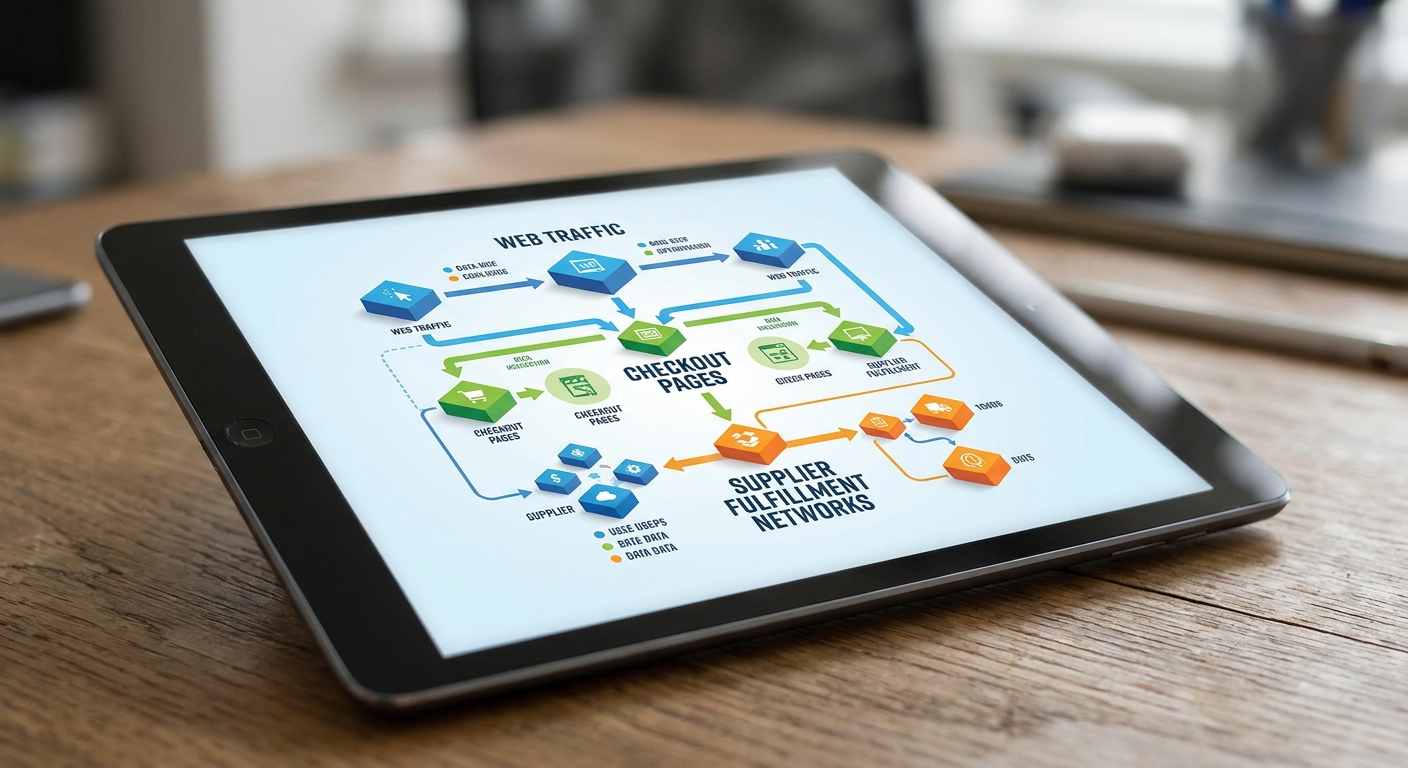
Understanding how Affiliate Marketing vs Dropshipping works requires looking closely at the digital transaction flow and backend technology. In one system, you act as an outsourced marketer sending leads away from your site, while in the other, you act as the central merchant processing payments.
These differences dictate how you handle checkout pages, collect revenue, and automate fulfillment. Let’s look at how these technical mechanisms function behind the scenes.
How do affiliate cookies track sales?
When a user clicks your tracking link, a small piece of code called a cookie is stored in their browser. This cookie remains active for a set period, ranging from 24 hours to 90 days depending on the program. If the user makes a purchase before the cookie expires, the system automatically attributes the sale to you.
Here is the kicker:
- The tracking process operates entirely in the background without interrupting the buyer’s experience.
- You receive a dashboard to track clicks, conversion rates, and pending commission payouts.
- Multiple sales from a single referred customer can accumulate within the cookie window.
This tracking technology ensures you get paid for your marketing efforts without manual invoicing.
What is the dropshipping order loop?
The dropshipping loop begins when a shopper buys an item directly on your branded storefront. Once the payment clears, you or your store software sends the order details to your supplier. To see this setup in action, you can follow a step-by-step Shopify dropshipping tutorial to learn how easily the backend can be integrated.
As it turns out:
- The customer pays you the retail price, and you pay the supplier the wholesale cost.
- Your supplier ships the product directly to the customer under your store’s name.
- The software automatically syncs shipping tracking numbers back to your buyer.
This automated flow allows you to sell thousands of products without touching a single cardboard box.
| Operational Step | Affiliate Marketing | Dropshipping |
|---|---|---|
| Checkout Location | External Merchant Site | Your Branded Storefront |
| Payment Handling | Handled by Merchant | Handled by Store Owner |
| Fulfillment Trigger | Automatic via Referral Link | Manual/Automated Order Routing |
Success in dropshipping relies on seamless store software integrations, while affiliate success hinges on keeping visitors engaged enough to click your custom referral links.
Key Takeaway: Affiliate marketing maps a direct line from traffic to commissions, whereas dropshipping acts as a three-way loop connecting store owners, suppliers, and customers.
Startup Costs: Affiliate Marketing vs Dropshipping

Comparing what costs more between Affiliate Marketing vs Dropshipping reveals a massive gap in required startup capital and recurring monthly software fees. Launching an online store requires a financial buffer for domain registration, platform fees, and marketing budgets.
Understanding these numbers prevents you from running out of cash before your business becomes profitable. Let’s break down the essential expenses you will encounter on both pathways. If you plan to go the store route, learning how to start a dropshipping business will help you budget your startup costs perfectly.
What are the real costs of affiliate setups?
Starting an affiliate marketing business requires incredibly low upfront capital. Your primary investments are a professional domain name, reliable web hosting, and a fast, clean website theme. If you choose to write all your own articles and build organic traffic, your operational costs remain virtually zero.
Let’s face it:
- Domain names cost less than fifteen dollars per year to register.
- Basic web hosting plans range from three to ten dollars per month.
- You can use free keyword research tools and design platforms to start.
This low-cost entry makes it the perfect option for anyone starting with limited savings.
What capital is required for dropshipping storefronts?
Running a successful storefront requires a larger financial commitment to cover software subscriptions, processing fees, and advertising campaigns. You need a platform subscription, imported product tools, and an active budget to test paid ads on Meta or TikTok. Additionally, you must pay your supplier for products before your customer payment clears your bank.
To be honest:
- Storefront software subscriptions cost around thirty to forty dollars per month.
- Paid advertising testing budgets require at least one hundred to five hundred dollars.
- Payment processors charge a standard transaction fee on every sale you make.
This model demands consistent cash flow to fund your supplier purchases and keep your ads running.
| Expense Category | Affiliate Marketing Est. Cost | Dropshipping Est. Cost |
|---|---|---|
| Software & Hosting | Low ($5 – $20/mo) | Medium ($39 – $90/mo) |
| Marketing & Ads | Variable (Mostly Organic SEO) | High ($200+ testing phase) |
| Transaction Fees | $0 | 2.9% + $0.30 per sale |
If you are working with a tight budget, affiliate marketing lets you build content organic traffic for free, whereas dropshipping usually requires paid ads to gain traction quickly.
Key Takeaway: Affiliate marketing is highly cost-effective to set up, while dropshipping requires a financial buffer for software subscriptions and paid marketing campaigns.
Risk and Profit Potential: Affiliate Marketing vs Dropshipping

Affiliate marketing is lower risk because you do not handle products, shipping, refunds, or customer support. Dropshipping has higher profit potential because you control pricing, customer orders, and brand growth, but it also brings more costs and responsibility.
What risks do affiliate marketers and dropshippers face?
Affiliate marketing risks mainly come from traffic, affiliate program rules, commission changes, and tracking issues. If a program reduces commissions or your SEO traffic drops, your income can fall quickly.
Dropshipping risks come from daily operations. If a supplier ships late, sends the wrong item, or the product arrives damaged, choosing the best dropshipping suppliers becomes critical before you scale paid ads., your store must handle the customer complaint, refund, return, or chargeback.
| Risk Factor | Affiliate Marketing | Dropshipping |
|---|---|---|
| Financial Risk | Low | Higher |
| Customer Support | Merchant handles it | Store owner handles it |
| Main Risk | Traffic and program changes | Suppliers, shipping, refunds, chargebacks |
| Operational Work | Low | High |
Which model has better profit potential?
Affiliate marketing usually has higher net margins because costs are low. You earn a fixed commission, but you cannot control the product price, checkout page, customer data, or repeat sales.
Dropshipping has more costs, including product cost, shipping, ads, platform fees, refunds, and customer support. But it gives you more control over pricing, bundles, upsells, customer emails, and long-term brand value.
| Profit Factor | Affiliate Marketing | Dropshipping |
|---|---|---|
| Revenue Control | Low | High |
| Main Cost | Content and traffic | Product, shipping, ads, refunds |
| Net Margin | Usually higher | Usually lower |
| Customer Data | Merchant owns it | Your store owns it |
| Brand Value | Limited | Stronger |
Key Takeaway: Affiliate marketing is lower risk and easier to manage. Dropshipping has higher revenue and brand potential, but only if sourcing, product quality checks before dispatch, shipping, and customer experience are well controlled.
Can Affiliate Marketing vs Dropshipping scale fast?

Analyzing whether Affiliate Marketing vs Dropshipping can scale fast reveals two completely different engines for business growth. One model scales slowly through organic content and authority building, while the other can launch into massive profitability overnight through paid advertising.
Understanding these growth patterns helps you align your business choice with your financial timelines and scaling goals. Let’s look at the mechanics of scaling both models.
How affiliate scaling builds compounding authority?
On the plus side: organic scaling builds a highly stable, recurring revenue engine that continues to grow month after month. As you publish more search-optimized content, your website’s domain authority increases, allowing you to rank for higher-competition, high-commission keywords. This compounding growth does not require you to pay for expensive advertising campaigns.
Think about it:
- Your older articles continue to generate passive affiliate sales with zero extra work.
- You can easily add new referral links to your highest-traffic blog posts.
- Your business overhead costs remain tiny even as your traffic scales up.
This gradual, compounding growth builds a highly valuable, low-risk digital asset.
How paid ads scale dropshipping stores instantly?
Launching paid advertising campaigns on TikTok, Meta, or Google allows dropshippers to scale their sales extremely quickly. If you find a trending, high-demand product and design a high-converting landing page, you can generate thousands of dollars in sales within your first week. However, this rapid growth requires significant upfront capital to purchase inventory and scale your ad budgets.
The catch is:
- You can instantly increase your daily ad budgets to reach millions of prospective buyers.
- You must grow your customer support team quickly to match the sudden influx of orders.
- You need healthy cash flow to pay your suppliers before your storefront payouts clear.
This rapid scaling model is exciting but demands strong financial management and operational discipline.
| Scaling Vector | Affiliate Marketing | Dropshipping |
|---|---|---|
| Scaling Mechanism | Content creation & SEO rankings | Paid ad spend & budget increases |
| Scaling Speed | Slow (Months of work) | Fast (Days/Weeks) |
| Operational Friction | None (Commissions scale automatically) | High (Must coordinate logistics and inventory) |
While paid ads let you scale dropshipping sales in days, doing so requires strong cash flow to pay suppliers and handle the flood of new customer emails.
Key Takeaway: Dropshipping scales rapidly with paid marketing, while affiliate marketing scales more gradually through organic search rankings.
Final Verdict: Which Business Model Should You Choose?

Deciding what is best between Affiliate Marketing vs Dropshipping ultimately depends on your budget, risk tolerance, and long-term business vision. There is no single correct answer, as both business models offer highly profitable, low-risk paths to escape the traditional nine-to-five.
By analyzing your personal strengths and resources, you can choose the path that gives you the highest chance of success. Let’s make a final, structured comparison to help you take action today.
Is affiliate marketing the right choice for you?
The bottom line is: affiliate marketing is the perfect business model if you want a low-overhead, location-independent lifestyle with zero customer support duties. If you love writing, creating content, and building online communities, you will thrive as an affiliate. This model allows you to start for less than one hundred dollars and build stable, highly passive streams of income.
Think about it:
- You can start without any previous web development or paid advertising experience.
- You avoid all the financial and operational risks of managing physical suppliers.
- You have the freedom to work from anywhere in the world without checking customer emails.
This makes it an incredibly low-stress business model for beginners and creative publishers.
If your content already reaches active ecommerce sellers, Shopify operators, TikTok Shop sellers, or dropshipping communities, affiliate marketing does not have to stay limited to generic product links. A targeted dropshipping affiliate program for ecommerce creators and partners can be a better fit when your audience needs sourcing, QC, shipping, or private agent execution support.
Is dropshipping the right choice for you?
Now it’s your turn: dropshipping is the ideal model if you want complete control over your product selection, pricing, and retail branding. If you enjoy landing page design, conversion rate optimization, and running paid marketing campaigns, this pathway fits you perfectly. While it requires more startup capital and active management, it allows you to build a highly valuable retail brand that you can eventually sell for a large payout.
Think about it:
- You have the power to create unique product bundles and establish high profit margins.
- You build and own an active customer list for free, long-term email marketing.
- You can transition your successful store into a private-label brand over time.
This hands-on model offers high revenue potential and builds a real, sellable business asset.
| Core Decision Criteria | Affiliate Marketing | Dropshipping |
|---|---|---|
| Ideal Startup Budget | $50 – $200 | $500 – $1,500 |
| Primary Focus Area | Informative Content & Audience Trust | Landing Page Design & Conversion Rates |
| Business Model Goal | Passive Referral Commission Income | Building an E-Commerce Brand |
To take action on your goals, explore our resources or contact us today to find the right path for your online business.
Key Takeaway: Choose affiliate marketing for a low-cost, content-focused business, or select dropshipping if you want to build and scale a branded storefront.
Conclusion
Affiliate marketing is easier to start if you want a low-cost content business with fewer daily operations. Dropshipping is better if you want more control over pricing, customer data, product selection, and long-term brand value.
However, dropshipping is not only about building a store. To make it work, you need reliable product sourcing, product checks before dispatch, packaging confirmation, tracking updates, and clear return handling.
RuntoDropship works as a China private dropshipping agent team for Shopify, TikTok Shop, and DTC sellers who want to reduce supplier mistakes, shipping delays, refund disputes, and after-sale risks before orders reach customers.
FAQs
Can I combine affiliate marketing and dropshipping on the same website?
Yes, running a hybrid model is highly effective. You can monetize your highest-volume keyword articles with affiliate links to physical products, while selling high-margin, related goods directly through your own integrated dropshipping checkout page.
What’s the best option for a complete beginner with no budget?
Affiliate marketing is the best model for this scenario. Starting an affiliate business requires almost zero initial capital, as you can write helpful content on free blogging platforms or social media without paying for storefront subscriptions or running paid advertising.
How do I know if dropshipping is right for me?
Dropshipping is right for you if you enjoy conversion rate optimization, direct product branding, and running paid advertising. Unlike affiliate marketing, dropshipping requires you to actively manage customer support and shipping issues, making it a great fit for hands-on, growth-minded operators.
Can I launch a successful dropshipping business without Shopify?
Yes, you can use alternative platforms. While Shopify is the industry standard, you can build a dropshipping storefront using WooCommerce, Wix, or BigCommerce, allowing you to tailor your technical setup to your budget.
What’s the best way to choose a profitable niche for either model?
The best way is to find a niche that balances healthy search volume with solid product pricing and strong customer passion. High-ticket niches allow you to earn larger affiliate commissions or set higher retail markups, ensuring your marketing efforts yield a strong return on investment.