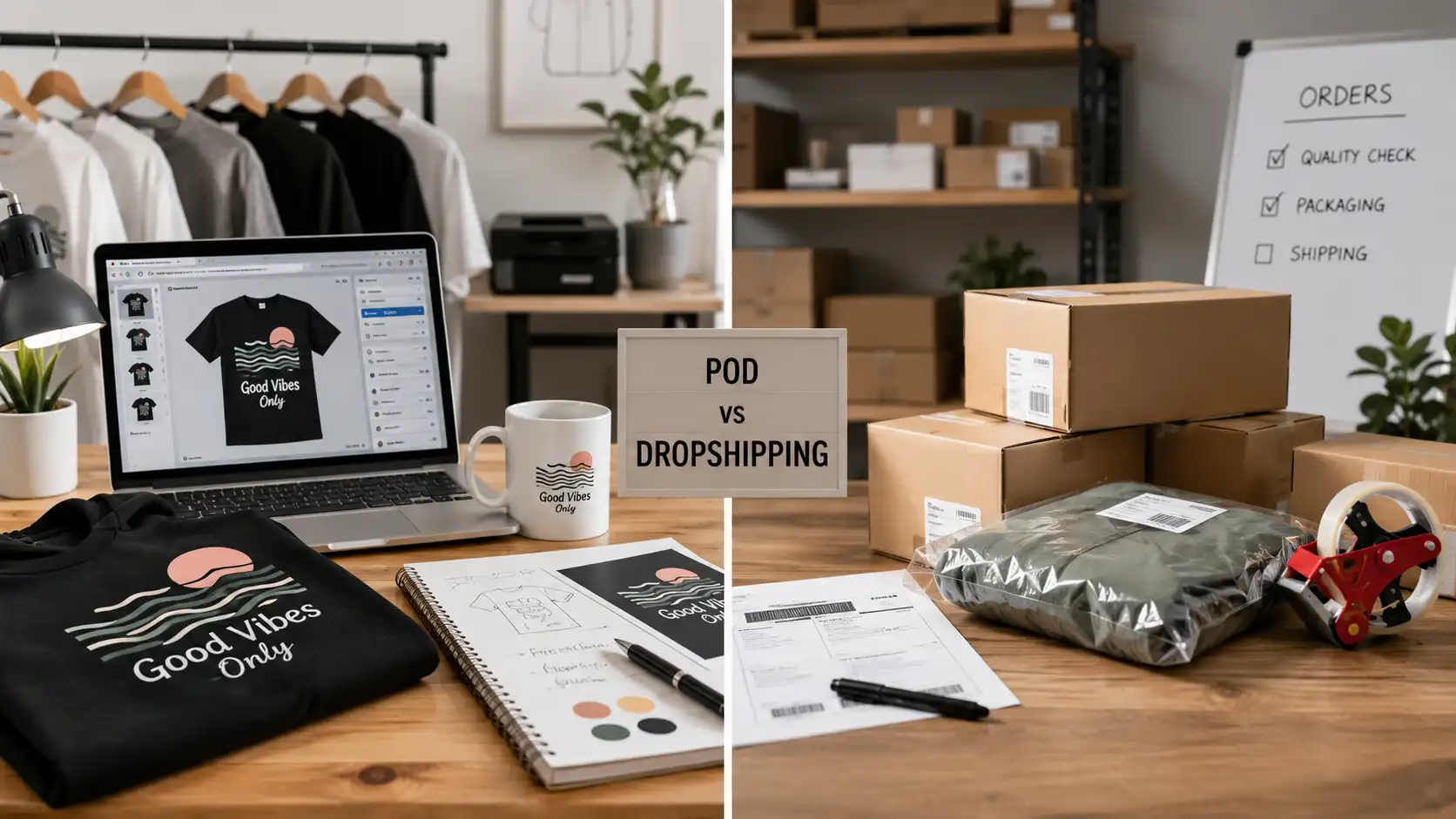
Choose print-on-demand if your edge comes from original designs and niche brand taste; choose dropshipping if your edge comes from faster product testing, broader SKU choice, and sharper supply execution. Print-on-demand vs Dropshipping matters because both models reduce inventory pressure, but they create very different problems after orders begin.
You might be launching a store with limited capital, a few product ideas, and no warehouse. Then the hard part starts: POD can feel slow or narrow, while dropshipping can feel crowded or supplier-dependent. Here’s the practical answer: this guide compares both models through product fit, branding control, cost logic, risk, and scaling choices so you can pick a model that matches how you actually plan to sell.
What Do Print-on-demand vs Dropshipping Models Have in Common?
Print-on-demand and dropshipping both let you sell online without buying bulk inventory before customers place orders. In both models, you build the storefront, manage product pages, attract traffic, collect payment, and rely on a supplier or production partner to complete the physical order. Here’s the useful part: both models reduce upfront stock pressure, but neither removes operational responsibility. Your customer still expects clear product information, reliable delivery, and support when something goes wrong.
Can both models work without holding inventory?
Yes, both models can work without holding inventory because production or dispatch happens after a customer order. With POD, the item is printed or customized after purchase; with dropshipping, the supplier ships an existing product after the order is placed. This makes both models attractive for sellers who want to test demand before committing cash to stock. The difference comes later, when you compare product flexibility, quality control, shipping speed, and branding options.
Where do both models still create seller responsibility?
Both models still make you responsible for the buyer experience, even if another company produces or ships the item. You need accurate product pages, realistic shipping language, clear return rules, and a process for handling complaints. A POD supplier may create print or sizing issues, while a dropshipping supplier may create variant, packaging, or dispatch issues. That means you cannot treat either model as fully hands-off once orders begin.
| Shared Factor | What It Means for POD | What It Means for Dropshipping |
|---|---|---|
| No bulk inventory at launch | Products are printed after purchase | Products are shipped after purchase |
| Supplier dependency | Print quality and production time matter | Product quality and dispatch control matter |
| Online storefront control | You manage designs, mockups, and positioning | You manage product pages, offers, and pricing |
| Customer service burden | You handle print, size, or delivery complaints | You handle defect, tracking, or wrong-item issues |
| Testing flexibility | You can test new designs quickly | You can test new products quickly |
This comparison shows why both models lower startup pressure, but neither model removes the need for clear operations and customer-facing control.
How Does Print-on-demand Actually Work?
Print-on-demand works by creating or uploading designs, listing custom products, and producing each item only after a customer orders. You do not normally buy bulk stock before sales, which matches how Shopify defines print-on-demand works: products are designed by the seller and produced by a supplier once an order is received. What’s useful here: the model ties production directly to demand, which lowers inventory exposure but adds production time and supplier dependency. Your main job becomes design selection, niche positioning, mockup quality, pricing, and customer expectation control.
What products fit POD best?
POD fits products where design carries value: shirts, hoodies, mugs, wall art, tote bags, notebooks, phone cases, and niche gift items. A pet quote shirt, gym-themed mug, or artist-designed poster can feel personal even when base products are common. Since design drives perceived value, weak artwork can make the whole offer feel generic.
Where does POD become harder?
POD becomes harder when customers expect premium fabric, exact color consistency, fast delivery, or complex personalization. A custom item may also be harder to resell after return because another buyer may not want that same design or name. That means you need clear mockups, realistic shipping language, and strong product-page details before traffic grows.
| POD Factor | What It Means | Seller Risk |
|---|---|---|
| Design value | Artwork creates differentiation | Weak designs reduce demand |
| Made after order | No bulk stock needed | Production adds time |
| Narrow catalog fit | Works best in design-led niches | Harder to rotate fast |
| Return handling | Custom goods can be harder to resell | Refund rules need clarity |
This table shows why POD can be brand-friendly but less flexible when product quality or delivery timing becomes a buyer concern.
How Does Standard Dropshipping Actually Work?
Standard dropshipping works by listing supplier-made products, taking customer orders, and having those products shipped without holding bulk inventory yourself. The product usually exists before your order arrives, so you are not waiting for custom printing. Here’s the trade-off: you gain wider product choice, but you need better supplier control. If product versions, packaging, or stock reality change without notice, your store absorbs the customer complaint.
What products fit dropshipping best?
Dropshipping fits products where function, trend, convenience, or problem-solving value drives demand. Examples include small electronics, beauty tools, home gadgets, pet accessories, fashion items, or seasonal products. If you need many supplier options or want to test product angles quickly, a China dropshipping sourcing agent can help compare suppliers before you scale a SKU.
Where does dropshipping become harder?
Dropshipping becomes harder when many sellers push similar items with similar ads. You may win traffic, then lose margin through price competition, slow dispatch, or inconsistent product quality. You need supplier checks, sample review, packaging rules, and shipping visibility because customers judge your store, not your supplier.
| Dropshipping Factor | What It Means | Seller Risk |
|---|---|---|
| Product range | Many SKUs can be tested | Catalog can become messy |
| Supplier-made items | Products already exist | Less creative control |
| Faster rotation | New offers can launch quickly | More supplier checks needed |
| Scaling path | Works for broad ecommerce testing | Backend issues grow with volume |
This model gives you speed, but speed only helps if supplier quality, stock, and dispatch stay under control.
Which Model Gives You Better Branding Control?
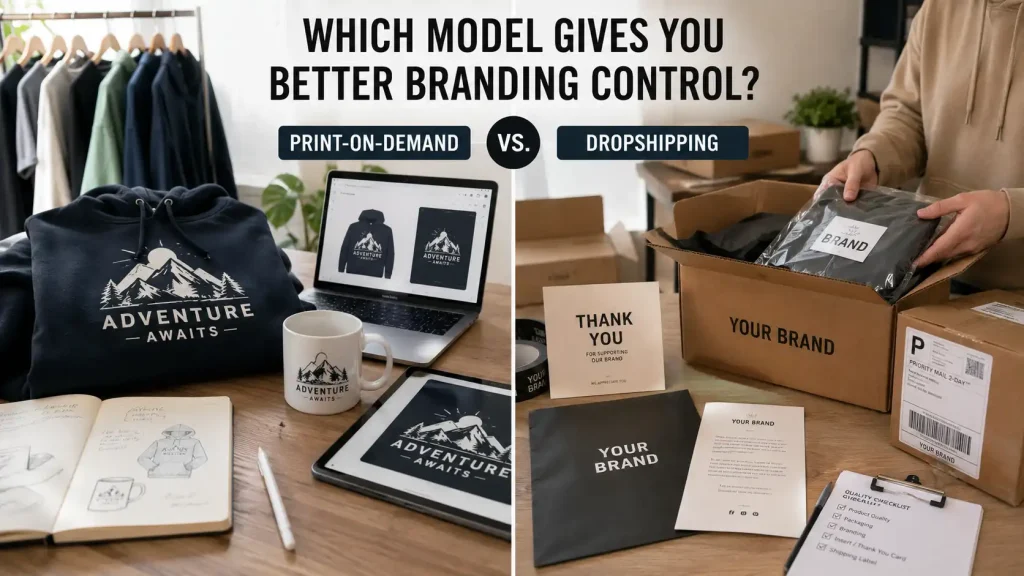
POD usually gives stronger design control, while dropshipping can still build brand control through packaging, sourcing, QC, and customer-facing presentation. If your brand identity lives on artwork, POD has a natural advantage. If your brand identity comes from better products, cleaner packaging, and reliable delivery, dropshipping can still support a brand path. The key point: branding is not only a logo; it is the full delivery experience.
Can dropshipping become brand-ready?
Yes, dropshipping can become brand-ready once a product has proven demand and you stop shipping generic parcels. A private label dropshipping workflow can support inserts, custom mailers, blind shipping, and SKU-level packaging rules after validation, while a broader branded dropshipping strategy helps you connect product choice, packaging, customer experience, and repeat purchase potential. That helps you move from “testing products” to “building customer recall” without jumping into full product development too early.
Can POD branding feel stronger?
Yes, POD branding can feel stronger when designs match a tight niche and customers feel seen. A cycling community shirt, small-business owner mug, or breed-specific pet poster can create emotional value. Still, poor print quality, slow production, or cheap base products can damage brand trust, so design alone cannot carry the store.
Key Takeaway: choose POD for design-led brand identity, but choose dropshipping when you want product-led branding supported by sourcing, packaging, and delivery control.
Which Model Has Better Costs, Margins, and Cash Flow?
Dropshipping can offer more pricing flexibility across product categories, while POD can protect perceived value through original design and niche appeal. Neither model automatically gives better profit. Here’s what matters: margin depends on product cost, shipping cost, ad cost, refund rate, repeat purchase potential, and how much customers value your offer. A cheap product with many complaints may be less profitable than a higher-cost product with fewer refunds.
What costs should you calculate?
You should calculate base product cost, shipping, platform fees, payment fees, ad spend, replacement cost, return loss, packaging, and support workload. POD sellers should also review design cost and sample checks. Dropshipping sellers should review sourcing cost, QC needs, route choice, and supplier stability before pushing volume.
Which model protects cash better?
POD protects cash by avoiding bulk production, but each order may carry higher unit cost. Dropshipping also avoids bulk inventory during testing, but scaling may require stock preparation for speed and stability. If your store reaches steady order volume, prepared stock can reduce dispatch risk, while random supplier buying can create delays.
| Cost Area | POD Pattern | Dropshipping Pattern |
|---|---|---|
| Startup stock | Usually low | Usually low during testing |
| Unit cost | Often higher per item | Can vary by supplier |
| Branding cost | Design-heavy | Packaging and execution-heavy |
| Refund exposure | Custom item return limits | Product defect and mismatch risk |
| Scaling cash need | Samples, designs, product tests | Stock prep, QC, shipping route control |
This comparison shows why profit should be judged by full order economics, not only by base product price.
Key Takeaway: pick the model whose cost structure matches your selling skill, then calculate profit after shipping, refunds, support, and repeat purchase potential.
What Risks Can Hurt Each Model After Orders Start?
POD risks usually come from production quality, print accuracy, product feel, and delivery time; dropshipping risks usually come from supplier changes, product defects, wrong variants, poor packaging, and slow dispatch. This is where many beginners misjudge both models: the risk does not appear on launch day. It appears after buyers pay, tracking delays, and support messages begin.
What can go wrong with POD orders?
A design can print smaller than expected, colors can look different from mockups, or base product quality can disappoint buyers. Production queues can also slow delivery during peak seasons. Since many POD items are personalized or design-specific, returns may need strict policy language and careful customer communication.
What can go wrong with dropshipping orders?
A supplier can ship the wrong variant, change product materials, skip accessory checks, or pack items poorly. For scaling stores, a dropshipping quality control service can reduce avoidable defects before dispatch. Shipping also matters: a fast shipping dropshipping agent can help with route matching, first-scan visibility, and tracking updates when order volume grows.
| Risk Type | POD Risk | Dropshipping Risk |
|---|---|---|
| Product quality | Print and base item mismatch | Supplier version changes |
| Delivery timing | Production queue delays | Dispatch and carrier handoff delays |
| Returns | Custom goods harder to resell | Defect or wrong item claims |
| Brand trust | Mockup versus real item gap | Generic packaging or poor QC |
Key Takeaway: the safer model is not the one with fewer tasks; it is the one where your team can control the risks buyers actually feel.
How Should You Choose the Right Model for Your Store?
You should choose based on your product advantage, customer promise, budget, creative ability, and operational tolerance. If your strength is design, audience taste, and niche storytelling, POD fits better. If your strength is product research, supplier coordination, ad testing, and backend execution, dropshipping fits better. A better question is this: what do you want to be hard for competitors to copy?
What if you are a creative seller?
Choose POD if you can produce designs that connect with a defined audience. Your advantage should come from taste, humor, identity, art style, or personalization. You still need samples, product-page accuracy, and delivery clarity because buyers expect the real item to match the mockup.
What if you are a product-testing seller?
Choose dropshipping if you want to test several physical products and react quickly to market signals. Your advantage should come from finding better products, negotiating better supply, and making order execution more reliable than generic sellers. Once a SKU wins, you can add brand packaging, better QC, and tighter dispatch rules.
| Seller Situation | Better Starting Model | Reason |
|---|---|---|
| Strong design skill | POD | Design creates value |
| Many product ideas | Dropshipping | Wider testing range |
| Niche community audience | POD | Identity drives buying |
| Scaling product ads | Dropshipping | Supplier control matters |
| Brand packaging plan | Dropshipping or hybrid | Execution can be staged |
Can You Combine Both Models Without Creating Chaos?
Yes, you can combine both models, but only if each SKU has clear rules for supplier, production time, packaging, shipping, returns, and customer communication. Hybrid stores fail when every item follows a different hidden process. Here’s the cleaner way: treat POD and dropshipping as separate operating tracks inside one brand, not as a random product mix.
What should stay separate?
Keep POD products, supplier-made products, shipping expectations, return rules, and support scripts separate. A custom shirt may need production time, while a sourced gadget may need QC and dispatch checks. If both appear in one order, your product page and confirmation email should set realistic delivery expectations.
When does a hybrid model make sense?
A hybrid model makes sense when products serve the same customer group. For example, a pet store can sell POD breed posters plus sourced grooming tools. A fitness brand can sell motivational shirts plus resistance bands. The product family should feel connected, not random, or your store positioning weakens.
Key Takeaway: combine both models only when your SKU rules are clear enough that buyers receive a consistent brand experience.
Conclusion
This article answered how both models work, where each model wins, what risks appear after orders start, and how to choose based on your real selling advantage. If you want a design-led store, start with POD and protect quality through samples. If you want a product-led ecommerce store, start with dropshipping and build stronger sourcing, QC, shipping, and packaging control as volume grows. Runtodropship supports sellers who want a more controlled private dropshipping agent workflow from China, especially when product testing starts turning into repeat orders. Our position is simple: the future of dropshipping should not depend on supplier luck; it should be built around visible control before the customer ever opens the parcel.
FAQ
Q1: Can I start with POD and move into dropshipping later?
Yes, you can start with POD and add dropshipping later if both product lines serve the same audience. Keep shipping times, return rules, and product expectations clear so customers do not feel confused after ordering.
Q2: What’s the best model for a beginner with no design skills?
Dropshipping is usually better if you lack design skills but can research products, test ads, and manage supplier risk. POD depends heavily on creative fit, so weak designs can make customer acquisition harder.
Q3: How do I know if POD fits my niche?
POD fits if your niche has strong identity, humor, hobbies, communities, or personalization demand. If customers buy because the design speaks to them, POD can work; if they buy because the product solves a practical problem, dropshipping may fit better.
Q4: Can I brand a dropshipping product like a POD product?
Yes, but the branding path is different. POD brands through design on the item, while dropshipping brands through product selection, packaging, inserts, blind shipping, QC, and delivery experience.
Q5: What’s the best choice for scaling in 2026?
The best choice is the model you can control after orders increase. POD needs design quality and production reliability; dropshipping needs sourcing, QC, packaging, dispatch, and tracking control.