

Etsy dropshipping is not a general permission to list ready-made products from a wholesaler and send them directly to buyers. Etsy currently allows only a narrow craft-and-party-supply exception for traditional direct shipping, while original seller designs or buyer-personalized items may be made and shipped by a disclosed production partner.
The practical rule is simple: decide why the product belongs on Etsy before choosing a supplier or automation tool. A connection app can move orders, but it cannot make an ineligible product compliant.
A common failure starts when a seller imports an attractive catalog item before checking who created it or why it belongs on Etsy. The safer sequence is to verify the product category and creative contribution first, then test the production and delivery workflow before publishing the listing.
Is Etsy Dropshipping Allowed?
Traditional direct shipping of an unchanged, commercially available product is generally not allowed on Etsy. Etsy defines this model as selling a ready-made item that a third-party supplier sends to the customer without seller alteration or customization, and its current Help page names only a limited exception for qualifying craft and party supplies.
Etsy separates permitted items into four Creativity Standards categories: made by a seller, designed by a seller, handpicked by a seller, and sourced by a seller. For a seller who does not want to hold finished inventory, the two most relevant paths are an original design made by a production partner and a qualifying item sourced to support buyer creativity.
| Product path | Etsy fit | First check |
|---|---|---|
| Ready-made wholesale product shipped unchanged | Generally prohibited | Do not list it merely because a supplier can ship it |
| Your original design made by a production partner | Permitted when all policy conditions are met | Prove your creative input and disclose the partner |
| Product personalized to the buyer’s text or image | May qualify as sourced by the seller | Confirm that the buyer customization is real and accurately shown |
| Qualifying craft or party supply | Limited direct-shipping exception | Confirm that the exact item meets Etsy’s sourced-item rules |
The label you give the model does not control the result. Etsy looks at what you contributed, what the partner does, what the buyer receives, and whether the listing represents that relationship accurately. Review Etsy’s current dropshipping and reselling rule and Creativity Standards against the exact product before you spend money on samples or listings.
Key Takeaway: If your plan begins with selecting an unchanged catalog product and ends with a retailer or wholesaler shipping it to the buyer, stop. Choose a product that qualifies through your original design, meaningful buyer personalization, or Etsy’s narrow craft-and-party-supply exception.
Choose a Compliant No-Inventory Model
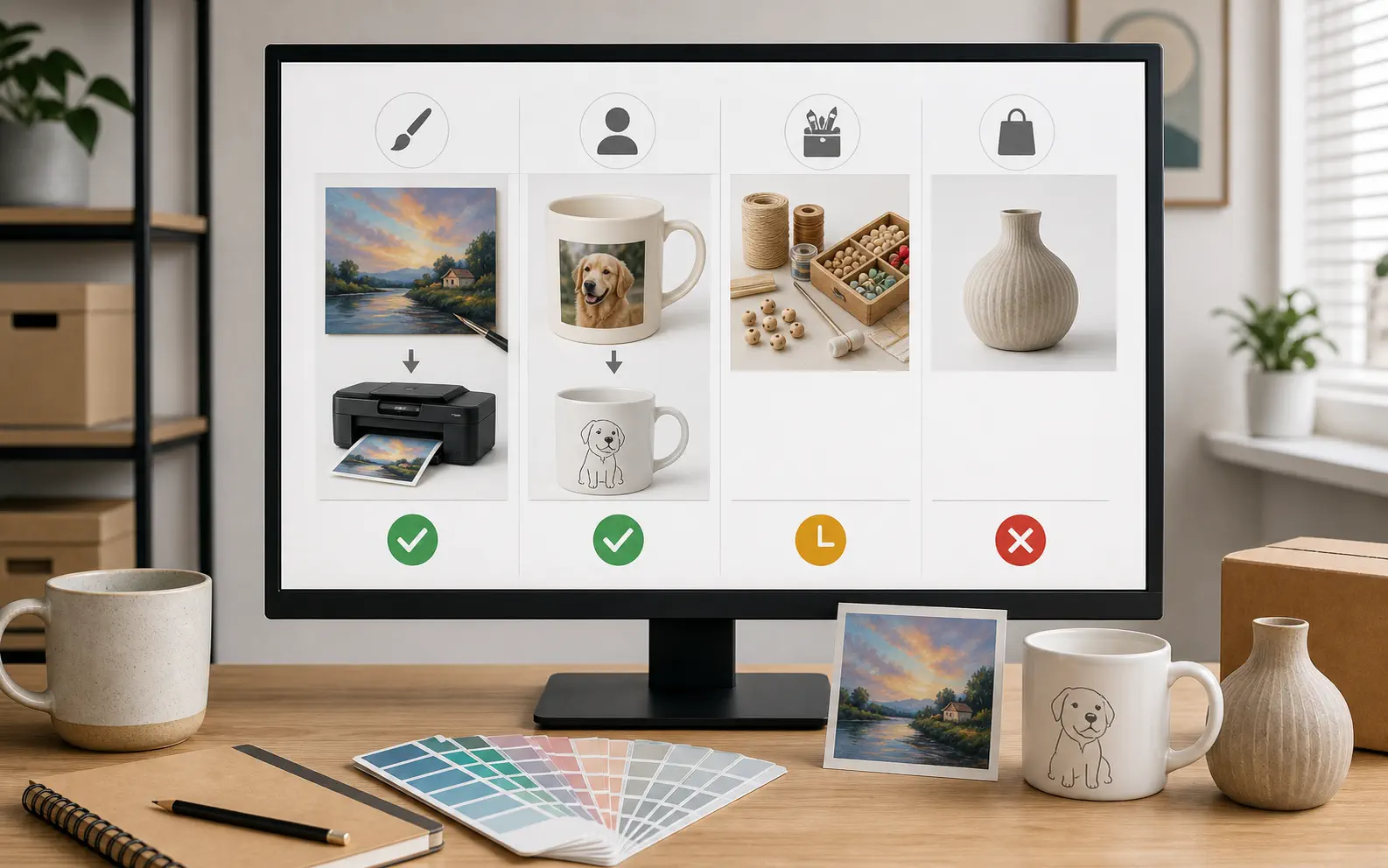
Choose the operating model that matches your real creative contribution, not the model with the easiest integration. Each permitted path gives you different design, evidence, supplier, listing, and customer-service responsibilities.
Original design with a production partner
You create the artwork, pattern, product design, or meaningful specification, and another business physically produces the item. Print-on-demand is the most familiar example: you supply original artwork, the printer applies it to a base product, and the printer may send the finished item directly to the buyer.
Etsy says production partners apply only to items you designed or to sourced items customized by the buyer. Its production-partner Help page specifically excludes white-label manufacturers, original equipment manufacturers, original design manufacturers, commercial retailers, and wholesalers when they provide standard products without the seller’s qualifying creative input.
Direct shipping is therefore only one part of the workflow. Your design authorship, accurate disclosure, shipping origin, listing images, and buyer promise all still matter. If you are deciding between common models, compare the responsibility split between print on demand and conventional dropshipping before committing to a product catalog.
Buyer-personalized products
A production partner may make an item that uses the buyer’s custom text or image. The personalization must affect the product the buyer receives; adding a gift note, card, or tag to an otherwise unchanged commercial item does not turn that item into a permitted creative product.
Your listing should show how customization works, identify the choices the buyer must provide, and avoid implying that you personally manufacture an item made by someone else. Etsy also requires the first image for a personalized or custom item to show a finished, customized example rather than a blank product with placeholder text.
Qualifying craft and party supplies
Etsy permits direct shipping for craft and party supplies that enable buyer creativity or help create an event. This is a category test, not a blanket permission for general household goods, fashion accessories, or commercially available gifts.
Check the exact definition and examples in the Creativity Standards. If the product’s main purpose is simply to be used as sold, rather than to help the buyer make or personalize something, do not force it into the supply exception.
Key Takeaway: Start with the product’s Etsy eligibility, then find a partner capable of making and shipping it. Never assume that print-on-demand software, an Etsy integration, or supplier-side customization automatically proves compliance.
Validate the Product, Design, and Demand
Validate the offer before building a large catalog. A policy-compliant item can still fail because the design is unoriginal, the buyer does not want it, the sample is poor, or the delivered-order economics do not work.
Confirm that you own the creative input
Keep dated source files, sketches, editable artwork, design briefs, and licenses for any assets you are allowed to use. Do not use a movie character, sports logo, song lyric, celebrity image, brand name, or another creator’s artwork merely because similar listings remain visible.
Etsy states that sellers are responsible for the necessary rights to their listing content and products. A production partner printing the item does not transfer intellectual-property responsibility away from you.
Research a specific buyer need
Start with a defined use, occasion, style, hobby, or personalization problem. Compare current Etsy listings for price positioning, review themes, presentation, delivery expectations, and signs that several sellers—not just one outlier—receive continuing buyer interest.
Do not copy a best seller’s design or conclude that a crowded result proves room for another near-identical listing. A stronger test combines an identifiable buyer, an original creative angle, acceptable competition, and a contribution margin that survives realistic costs. The same decision discipline used for profitable product selection applies here, but Etsy adds a stricter originality and category-fit test.
Order a physical sample
Order a product sample in the exact variant, print method, material, size, and destination route you plan to sell. Check color, print placement, material feel, sizing, included parts, packaging, production time, tracking, and whether the parcel exposes unexpected supplier branding.
Use the sample to create accurate listing information and to write product-specific acceptance standards. When visible defects, wrong variants, or weak packaging could reach the buyer, pre-dispatch product checks give the production discussion a concrete pass-or-fail standard.
Calculate the Real Cost Before Listing

Calculate the amount left from a delivered order, not the difference between the selling price and the supplier quote. A design can attract sales and still lose money once platform fees, production, delivery, advertising, refunds, and replacements are included.
Use this planning formula:
Order contribution = sale revenue - Etsy fees - production cost - packaging - shipping - advertising - refund and replacement allowance - other variable costs
Order contribution is not final business profit. It is the amount left to cover fixed tools, design work, accounting, taxes, and your time before profit remains.
Include every Etsy charge that can apply
Etsy’s current fee Help page lists a one-time shop set-up fee that varies by location, a USD 0.20 listing fee, and a 6.5% transaction fee on the total order amount. Etsy Payments processing rates vary by country, while currency conversion, regulatory operating fees, Offsite Ads, Etsy Ads, and other services can add costs in applicable situations.
Check the current Etsy fees and taxes page for your seller country and account before pricing. Do not copy a fee total from a video or calculator that does not show which charges it includes.
Model a normal order and a problem order
A normal order may need one production payment and one shipment. A problem order may need a reprint, reshipment, refund, extra messages, or unrecovered advertising cost.
Create both scenarios using your actual sample quote and destination. Then test changes in selling price, discount, shipping charge, ad cost, and replacement rate one at a time. If a modest problem allowance removes the contribution, the product needs a different price, cost structure, or operating model before launch.
Key Takeaway: Approve a product only when its contribution remains acceptable after all current platform charges and a realistic exception allowance. Revenue, markup, and gross margin alone do not show whether the order is worth taking.
Set Up the Shop and Production Relationship
Set up the account only after the product passes the eligibility, originality, sample, and cost checks. This order prevents you from building a storefront around a model that Etsy does not permit or that you cannot operate responsibly.
- Confirm that new Etsy shops can open in your seller country and that you can use Etsy Payments.
- Create the shop on a desktop browser and complete identity, bank, billing, language, country, and currency steps.
- Add your shop name, visual identity, About section, policies, and accurate description of how products are designed and made.
- Add the production partner in Shop Manager and connect that partner to every relevant listing.
- Enter the partner’s real location and explain what the partner does and what you contribute.
- Set the dispatch location, processing time, delivery estimate, return policy, and listing images to match the real workflow.
Disclosure does not remove your responsibility for the listing. You must still describe your role accurately, enter the partner’s real location and work, and avoid suggesting that you personally made an item produced by another business.
Seller-country availability is a separate gate. Check Etsy’s current Etsy Payments country list before you plan the shop, and never use an address, bank account, or identity that does not truthfully belong to you.
Run the Order From Checkout to Delivery
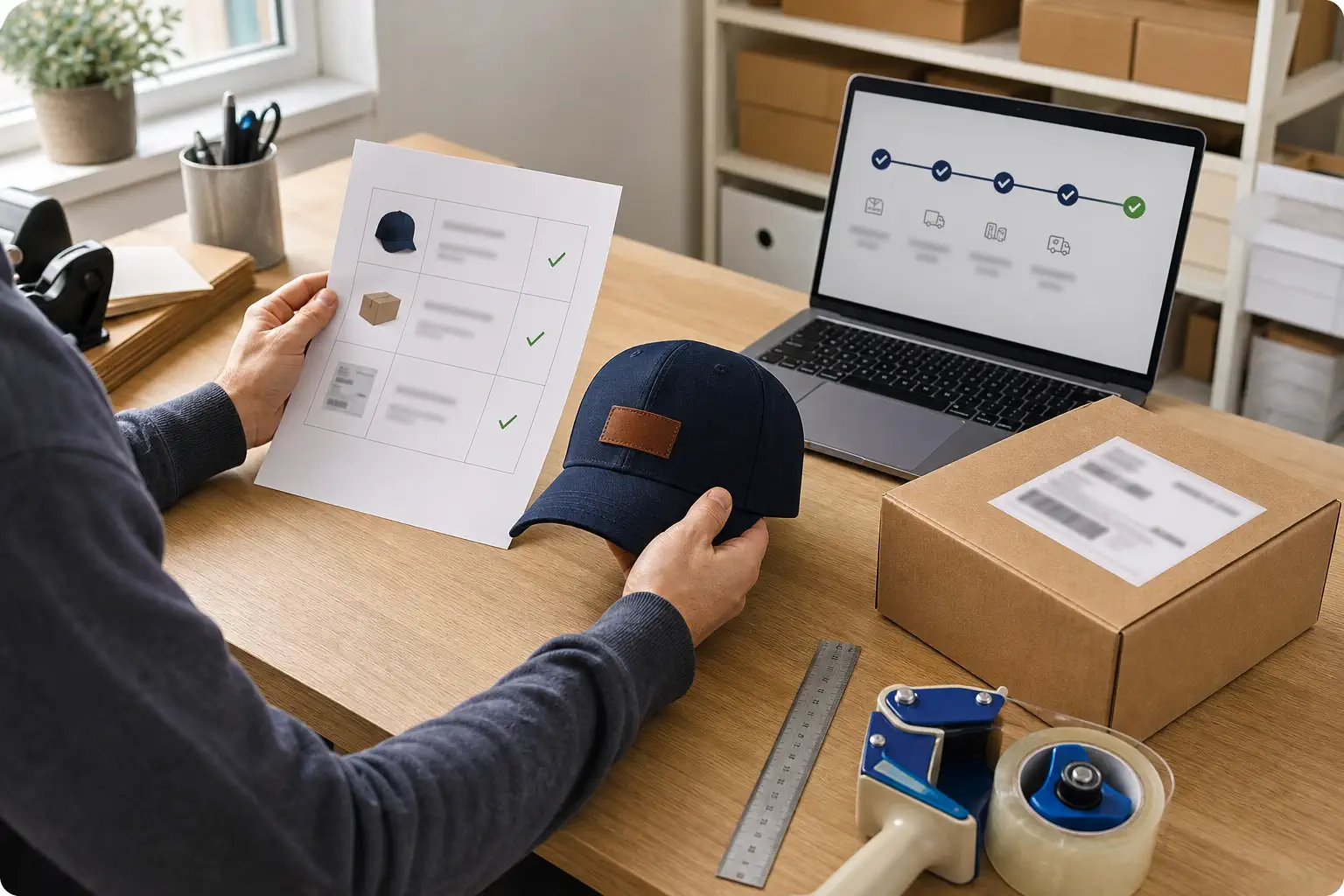
Run one complete test order before accepting normal buyer traffic. The test should prove that the correct design, variant, address, production instructions, shipping method, tracking number, and customer message move through the workflow without manual guesswork.
Before the order goes live
Freeze the approved artwork and product specification by SKU or listing variation. Confirm the production cost, packing method, return address, processing time, destination coverage, tracking service, reprint rules, and what happens when a variant is unavailable.
Do not assume an integration handles every task. Some tools create products and pass orders but still require manual approval, tracking entry, buyer messages, cancellations, or exception handling.
After the buyer pays
Review the buyer’s personalization, variant, and delivery address before releasing the order when the product is custom. Send the correct production file and preserve a record of the version used.
Add valid tracking when available and keep the estimated delivery window accurate. Etsy’s current Purchase Protection requirements include on-time shipping, valid tracking or an Etsy shipping label, an estimated delivery date, an item matching the listing, and timely responses to buyer help messages. Eligibility has conditions and value limits, so treat protection as a backstop rather than a substitute for operational control.
When something goes wrong
Keep one named owner for supplier contact and one response path for the buyer. Define in advance who pays for a misprint, damage, lost parcel, incorrect address, late delivery, or buyer-requested change after production begins.
Do not tell a buyer that the supplier is responsible and leave the issue there. The Etsy shop accepted the order, so you remain responsible for accurate communication, the listing promise, and the resolution required by your policies and applicable law.
Key Takeaway: A working integration is not a completed test. Approve the workflow only after a real order proves product accuracy, partner handoff, tracking, buyer communication, and exception ownership from checkout through delivery.
Weigh the Benefits, Risks, and Long-Term Fit
This model can reduce finished-inventory commitment, but it transfers work into design, partner control, listing accuracy, and customer service. It fits best when your creative contribution is real, your partner can reproduce the approved item, and the numbers leave room for problems.
Potential advantages
- You can test original designs without buying a large finished-goods batch.
- A production partner can add methods or equipment you do not own.
- Direct delivery removes a separate seller-to-buyer reshipping step.
- Personalization can create a clearer reason to buy than a generic catalog item.
- A proven design may later move into more controlled packaging or production.
Main disadvantages
- Etsy policy fit is narrower than on a seller-controlled storefront.
- You do not personally see every item unless the workflow includes checking.
- Production and shipping costs can leave a thin contribution.
- Delivery and reprint problems still become your customer-service problem.
- Design theft, accidental infringement, and inconsistent production can threaten listings or the shop.
The right time to add deeper supply-side support is after you have evidence of demand and a repeatable product specification. A growing seller may need supplier coordination, samples, agreed checks, packaging, and issue follow-up that a basic catalog integration does not provide. If you move toward custom specifications or controlled brand presentation, keep Etsy’s original-design and disclosure rules separate from the commercial options available through private-label order execution.
Do not use a private agent to disguise an ineligible ready-made product. Use one only when the product itself belongs on Etsy and the added coordination makes the permitted design-to-delivery process more controllable.
FAQ
Can I keep my production partner’s name private from buyers?
Yes, Etsy currently lets you use a descriptive public title for the partner while providing the real business information to Etsy. You must still disclose the relationship on relevant listings, give the correct location, and describe what the partner does.
Can a production partner be in another country?
Yes, Etsy’s rules focus on qualifying creative input and accurate disclosure rather than requiring the partner to be in the seller’s country. Enter the real partner location and dispatch origin, then set delivery estimates, customs information, and buyer expectations around the actual route.
When can I use a mockup instead of a real product photo?
Etsy currently allows a mockup for an original artwork or pattern printed onto a base item, but a uniquely manufactured item should use a real photo of the physical finished product. For personalized products, the first image must show a finished customized example, not a blank product with placeholder text.
Can a seller in China open a new Etsy shop?
Not at present, according to Etsy’s current Etsy Payments country page. It says new shops cannot open in China, while sellers with an already-open shop may continue to use Etsy Payments; check the live page before acting because country availability can change.
Conclusion
The safe starting point is product eligibility, not supplier convenience. Confirm that the item qualifies through your original design, meaningful buyer personalization, or the limited craft-and-party-supply exception; then validate ownership, demand, samples, costs, disclosure, listing accuracy, and the full test-order workflow.
For a qualified seller with an Etsy-permitted product and growing order needs, Runtodropship can support supplier communication, samples, product checks, packaging confirmation, order execution, shipping arrangement, and after-sales follow-up through a private dropshipping agent workflow. Sustainable creative commerce needs both an original customer promise and accountable work behind the parcel; send your product link, design brief, target market, current order volume, and main operating concern to discuss the next test.