

YunExpress shipping cost is not one fixed rate: it changes with chargeable weight, destination, route, product type, parcel dimensions, and the fees included in the current quote. To protect your margin, price a representative packed order—not a product’s bare weight—and confirm the quote’s validity before you set customer shipping charges.
Quick Answer: Expect a rate made from a per-kilogram charge, a per-parcel or registration fee, and any applicable service charges. The heavier of actual and volumetric weight normally becomes the chargeable weight. Use the official calculator for planning, then request a current account-level quote for the exact origin, postcode, packed dimensions, product attributes, and route before committing your margin.
Basic cost logic:
YunExpress shipping cost = chargeable weight × route rate + registered/per-parcel fee + other conditional fees.
The chargeable weight is usually the higher of actual weight and volumetric weight, while the final total still depends on route availability, product category, destination postcode, quote date, and account terms.
A common seller mistake starts with a sample on a kitchen scale. The item weighs 420 g, so the store models freight at 420 g and launches. The dispatch parcel later includes a box, filler, cable, insert, and label; its dimensions trigger volumetric billing, while a battery classification narrows the available routes. A few dollars of unmodeled cost per order can erase the contribution margin that looked comfortable in the spreadsheet. The cure is not a mythical universal price list. It is a repeatable quote specification and a margin buffer tied to the packed parcel.
YunExpress Shipping Cost Is a Quote, Not a Fixed Price List

The amount you pay depends on shipment inputs and current commercial terms, so a static public table cannot accurately price every order. The official YunExpress shipping calculator asks for origin area, destination country, postcode, item category, weight, dimensions, and delivery category. Its results separate shipping fee, registered fee, other fees, and total fee, while the page still makes clear that the actual order determines the final price.
That design explains why two sellers can receive different-looking answers without either quote being automatically wrong. They may use different origin areas, routes, product classifications, account agreements, destination postcodes, or quote dates. One quote may include a fee that another displays separately. A public estimate is therefore a useful screening tool, not an invoice promise.
If you first need the carrier model, handoffs, tracking flow, and route context, start with what YunExpress is and how it works. That broader reference gives you the operating context; here, the narrower job is to build a cost you can reproduce.
What a comparable quote must specify
Every request should use the same shipment profile:
- dispatch origin and collection arrangement;
- destination country and postcode;
- product name, material, use, and declared attributes;
- packed actual weight and outer dimensions;
- general cargo, built-in battery, standalone battery, liquid, powder, magnetic item, or another sensitive attribute;
- requested route and tracking level;
- declaration value and tax arrangement where relevant;
- daily or monthly parcel volume; and
- quote date, currency, and validity period.
Without those fields, “What are YunExpress prices?” is like asking the cost of a flight without a route or date. The number may sound precise while describing a different service.
Key Takeaway: Never build a selling price from a screenshot or an old rate card. Build it from one fully specified packed-order scenario and keep the quote date and inclusions beside the number.
Actual Weight and Volumetric Weight Decide the Billing Base
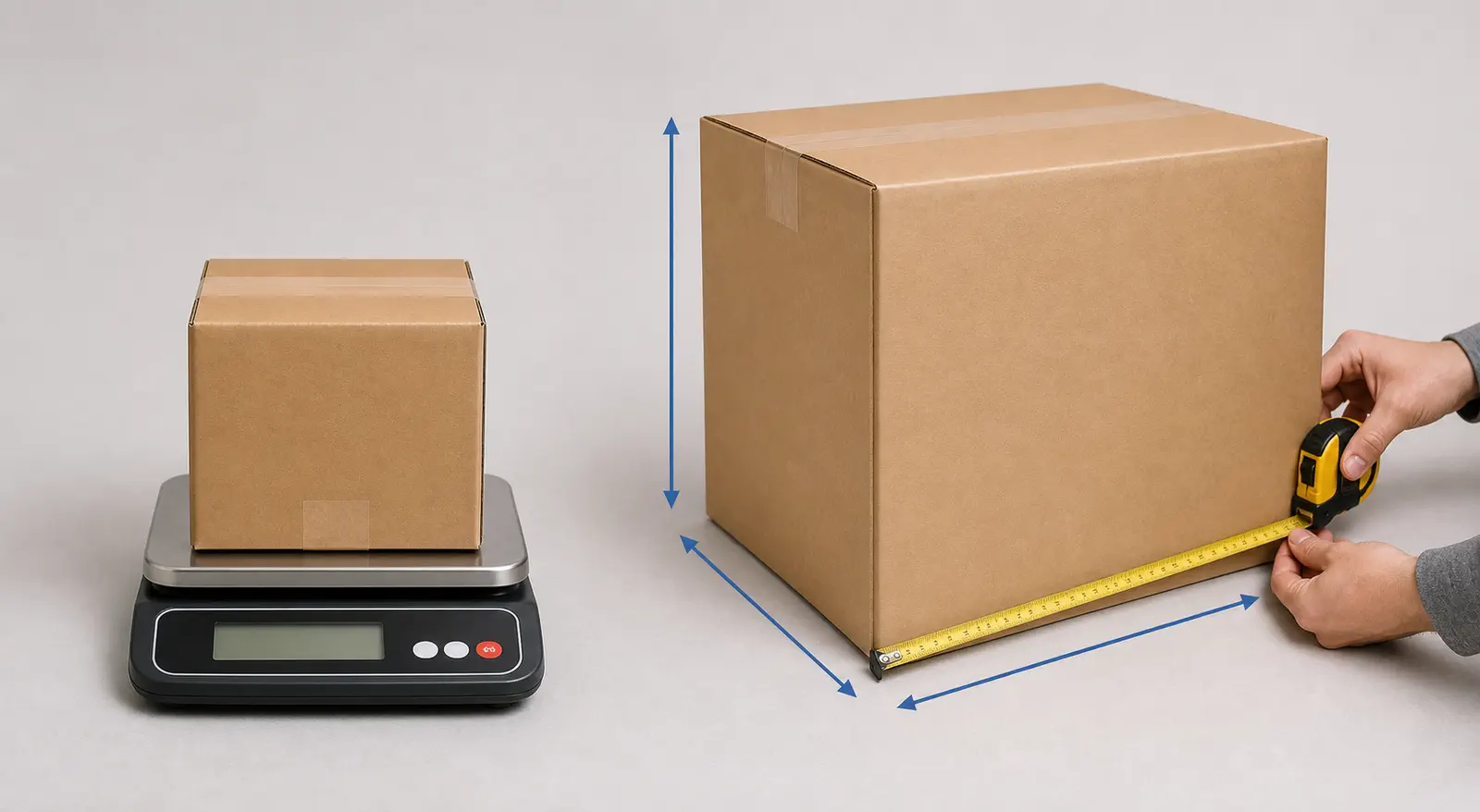
Chargeable weight is normally the greater of actual weight and volumetric weight for the selected route. Actual weight comes from the packed parcel on a calibrated scale. Volumetric weight converts the space a parcel occupies into a billing weight, usually with this structure:
length × width × height ÷ volumetric divisor
Use centimeters and the route’s stated divisor to produce kilograms. Do not assume one divisor across every country or service. The published YunExpress Standard Express rules show why sellers should not assume one divisor for every destination. For example, the listed Standard Express calculation rules use /6000 for Canada and /8000 for other listed destinations, but the current route document or account quotation should always control your calculation. Product rules can change, so the route document or current quotation should control your calculation.
A worked packaging example
Suppose a packed item measures 35 × 25 × 15 cm and actually weighs 0.90 kg.
- At a divisor of 8,000, volumetric weight is about 1.64 kg.
- At a divisor of 6,000, volumetric weight is about 2.19 kg.
- In either case, volumetric weight exceeds 0.90 kg, so it becomes the likely billing base.
This is an illustrative calculation, not a current rate. It shows why product weight alone can materially understate freight. The same item placed in a tighter 30 × 20 × 12 cm carton produces 0.90 kg at /8000, bringing volumetric and actual weight into balance without changing the product.
Packaging optimization is not simply “use the smallest bag.” Fragile goods need enough protection, premium products may need presentation packaging, and compression can deform apparel or product boxes. The right target is the smallest safe outer volume that still delivers the product condition your customer expects.
Measure the parcel that will actually leave
Record the packed SKU after inserts, protective material, accessories, and the shipping container are added. For variable products, measure each meaningful size or bundle. A two-unit order may need a different box rather than exactly double the single-unit figure. Recheck after a packaging change, supplier change, or bundle launch.
Key Takeaway: Margin planning should use chargeable weight, not catalog weight. Measure a production-ready parcel and confirm the divisor for the exact route before you approve packaging.
Destination Country, Postcode, and Route Change the Rate

The destination changes the available line, pricing zone, last-mile network, size rules, and possible remote-area treatment. A country-level average can help with early product screening, but it is too coarse for final pricing when your orders span metropolitan and remote postcodes.
YunExpress is not a single door-to-door product with one worldwide tariff. Its published services have distinct coverage, weight limits, package attributes, and calculation rules. A route that accepts a lightweight parcel to the United Kingdom may not accept the same weight, dimensions, or product attribute to another destination. Even within one country, a postcode can affect service availability or an additional fee.
Compare routes by total operating fit
The cheapest available line is not always the lowest-cost business choice. Compare:
| Decision field | Why it changes the commercial result |
|---|---|
| Base freight and per-parcel fee | Establishes the visible transport charge |
| Chargeable-weight rule | Determines which parcel dimension drives the bill |
| Destination coverage | Prevents pricing a route that cannot serve the address |
| Tracking and last-mile handoff | Affects support workload and delivery visibility |
| Size and weight limits | Can force a different line after packing |
| Product eligibility | May exclude batteries or other sensitive goods |
| Tax and customs arrangement | Changes what is prepaid and what remains conditional |
| Quote validity | Shows how long the estimate is safe to use |
The table makes route selection a complete operating decision rather than a race to the smallest headline number. If delivery expectations are also part of the decision, keep them separate from cost and evaluate the full YunExpress shipping timeline from processing through local delivery.
For stores selling to several markets, maintain a small destination matrix based on actual order concentration. Model your top countries and postcode groups first, then place low-volume destinations in a conservative “quote before launch” category. This is more defensible than averaging a cheap US rate across a global free-shipping offer.
General Cargo, Batteries, and Sensitive Goods Price Differently

Product classification can change both the eligible route and the price because sensitive goods require different handling and transport conditions. YunExpress’s own calculator asks you to choose between regular cargo and goods with batteries, while published product pages identify whether a service accepts general cargo, battery-powered items, or both.
“Electronics” is not a sufficient declaration. A USB cable, a watch with a built-in cell, a power bank, a spare lithium battery, a cosmetic liquid, and a magnetic accessory can require different answers. The exact composition, battery configuration, watt-hour rating where applicable, packaging, and destination matter.
Sellers doing consumer electronics dropshipping should confirm battery type, accessory configuration, plug version, protective packing, and route eligibility before comparing YunExpress prices with ordinary-goods rates.
Classification mistakes create repricing risk
If a supplier quotes a product as general cargo but the packed item contains a battery, the parcel may be rerouted, rejected, returned, or repriced after inspection. That cost can arrive after the store has already collected payment from the customer. A low initial quote is not valuable if it depends on an incomplete product description.
Before requesting a YunExpress shipping price, collect:
- clear product and packaging photos;
- materials and functions;
- battery type, quantity, configuration, and capacity;
- liquid, powder, paste, magnet, motor, or pressurized components;
- relevant product documentation requested by the route; and
- exact destination markets.
Do not describe a sensitive item as ordinary goods merely to obtain a cheaper line. Accurate classification protects the parcel, the account, and the quote’s validity. It also lets you compare like with like: a compliant battery route should not be judged against an ineligible general-cargo rate.
Key Takeaway: Treat product attributes as pricing inputs, not paperwork added after the sale. Confirm the exact packed item before comparing lines, especially for batteries, liquids, powders, magnets, and other restricted or sensitive goods.
The Full Price Includes More Than a Per-Kilogram Rate

A complete quote can contain a weight-based freight charge, a per-parcel registration or handling component, and conditional service fees. The official YunExpress calculator visibly separates shipping fee, registered fee, other fee, and total fee, which is a useful reconciliation pattern even when your account quotation uses different labels.
Read the fee stack line by line
Ask whether each of these is included, excluded, or conditional:
- base freight by chargeable-weight band;
- registration or per-shipment fee;
- collection or domestic transfer to the carrier;
- remote-area charge or another out-of-area fee;
- oversized, irregular, or over-limit handling;
- address correction, return, redelivery, or disposal;
- insurance or declared-value service;
- tax prepayment or customs-related service fee;
- currency conversion and payment fee; and
- temporary capacity, fuel, or peak-related adjustments if applicable to the quoted product.
Do not assume a fee common to DHL, UPS, or FedEx is charged identically by YunExpress. Conversely, do not assume an old statement that a fee is included remains true for every product, market, and contract. Ask for the current all-in logic and the conditions that reopen the price.
When the quote includes tax prepayment or a customs-related service, verify what the route actually covers through the YunExpress customs and DDP workflow before treating that charge as a complete landed-cost solution.
Quote volatility needs an operating rule
Cross-border parcel rates can move with capacity, line-haul cost, destination conditions, exchange rates, and commercial agreements. A disciplined quote should therefore include an issue date and validity period. Your store then needs a refresh trigger—for example, before a major campaign, when packaging changes, when the destination mix shifts, or when the provider issues a rate update.
Hidden cost is often less dramatic than a surprise surcharge. It can be a recurring mismatch between the forecast carton and the actual carton, or a per-parcel fee omitted from a product-margin sheet. If you need to trace those adjacent margin leaks, the breakdown of hidden Shopify dropshipping costs separates product, payment, return, and operating costs from freight.
Use a YunExpress Calculator Without Mistaking It for an Invoice

A YunExpress calculator is best used to shortlist routes and test scenarios, then followed by a current commercial quote. The official tool’s input fields reveal the minimum data needed for a meaningful estimate, and its disclaimer makes the boundary explicit: the actual order controls the final amount.
A six-step quote workflow
- Pack a representative order exactly as it will ship.
- Weigh it and measure the longest outer dimensions in centimeters.
- Confirm product attributes with the supplier or inspection record.
- Enter origin, destination country, postcode, category, weight, dimensions, and service preference.
- Save the result with the date and all inputs, not only the total.
- Request an account quote and reconcile any difference before using it in your margin model.
Run at least three scenarios: the normal order, a heavier bundle, and a larger-volume parcel. If you sell across countries, repeat them for the destinations that generate most of your orders. This reveals threshold effects that a single “average order” hides.
How to compare two quotations
Normalize the currency and place both quotes in a shared table. Recalculate volumetric weight using each route’s divisor. Confirm whether per-parcel fees and tax services are inside or outside the shown total. Then compare the same postcode, date, product classification, and tracking level.
When a supplier or agent sends only one total, ask for the inputs and inclusions. Transparency does not require exposing a carrier’s confidential contract. It requires enough detail for you to understand what changes the billed amount and to reconcile your representative order.
Key Takeaway: Use calculators for planning and sensitivity tests, not as a promise to customers. The number becomes commercially usable only after its inputs, fee inclusions, validity, and account terms are confirmed.
How Runtoropship Checks YunExpress Quotes in Practice

RuntoDropship evaluates the product, packed parcel, destination mix, and current route terms together rather than presenting a stale universal rate card. As a private dropshipping agent, the team can connect product sourcing, physical parcel checks, packaging decisions, route comparison, order execution, and after-sales coordination in one workflow.
A real eight-year carrier relationship
RuntoDropship has worked with YunExpress for eight years, which helps the team access negotiated account-level YunExpress pricing and coordinate collection, transport, and quote checks more efficiently. This is not a public price guarantee or a promise that one route will always be the cheapest. The payable amount still depends on the current route, destination, packed parcel, product classification, and quote validity.
The practical value is the verification loop. A quoted SKU can be weighed and measured after final packing; sensitive attributes can be checked before route selection; and an account-level price can be compared with alternatives using the same parcel specification. That reduces the distance between a spreadsheet assumption and the parcel that actually leaves China.
For growing sellers, mentors, agencies, and multi-store operators, the same method can be repeated across products and projects. Provide a product link, expected order range, target countries, packaging requirements, and any battery or sensitive-goods information. The resulting quotation should show the route, chargeable-weight logic, fee inclusions, and validity instead of offering one unexplained shipping number.
This is also where internal channel discounts should be handled responsibly. A negotiated rate may be lower than a public estimate, but it should never be marketed as the lowest possible price for every shipment. The useful promise is a clear quotation based on current inputs, followed by rechecking when those inputs change.
Build Shipping Cost Into Margin Before You Scale

Your final decision should use contribution margin under several freight scenarios, not the cheapest current quote. Shipping is only one variable, but it is often paid on every order and can change when a parcel crosses a size, weight, destination, or product threshold.
Use a simple model:
selling price − product cost − shipping − payment fees − expected variable service costs = contribution margin
Keep taxes and duties consistent with your selling arrangement. If they are collected separately or handled by a marketplace, do not mix them into the carrier line without explanation. If a route includes a tax service, record the fee and basis separately so the model remains understandable.
Do not push an unverified YunExpress quote directly into Shopify checkout
For Shopify dropshipping stores, a YunExpress quote should usually become part of your product pricing, shipping rule, or free-shipping threshold only after the packed parcel has been verified. Do not show a customer-facing shipping promise based on bare product weight or an old supplier screenshot. If you offer free shipping, the freight cost still needs to be absorbed inside the product margin. If you charge shipping separately, the rule should reflect the destination group, product size, and route eligibility rather than one global flat number.
Test downside cases before setting your offer
At minimum, model:
- the expected packed parcel and top destination;
- a volumetric-weight case after protective packaging;
- a battery or sensitive-goods route where relevant;
- a remote or higher-cost postcode group;
- a modest rate increase after the quote expires; and
- a return, reshipment, or address-correction case as a separate risk reserve.
The goal is not to predict every exception perfectly. It is to learn whether the offer survives plausible changes. If margin disappears after a small freight movement, you can adjust packaging, product price, shipping charge, free-shipping threshold, destination coverage, or product selection before paid traffic scales the exposure.
For a portfolio, track forecast freight against billed freight by SKU and country. Investigate recurring differences instead of averaging them away. The cause may be dimensions, classification, postcode, an outdated quotation, or a fee mapping error. Once identified, the correction belongs in the product specification and pricing model—not only in an accounting note.
Key Takeaway: Approve the offer only when its margin survives a realistic packed-parcel quote and a reasonable downside scenario. A transparent rate is useful; a resilient unit-economics model is what keeps the rate from controlling the business.
Frequently Asked Questions
How much does YunExpress cost per kg?
There is no universal YunExpress cost per kg because the rate depends on route, destination, item category, chargeable weight, parcel dimensions, fee inclusions, and account terms. Use the official calculator for a planning estimate, then confirm a current quote before setting product margins or customer-facing shipping charges.
Does YunExpress publish a price list?
Not one universal list that can price every shipment accurately. YunExpress provides a calculator and account quotations because origin, destination, postcode, category, route, weight, dimensions, and commercial terms affect the result. Treat downloadable or shared rate cards as dated, conditional inputs.
How is YunExpress pricing calculated?
It is commonly calculated from chargeable weight multiplied by the applicable weight-band rate, plus a per-parcel or registration fee and any conditional charges. The exact structure depends on the selected product and current quotation.
Does YunExpress use actual or volumetric weight?
Usually the greater of the two for routes that apply volumetric billing. Confirm the divisor in the current product rules because it can differ by destination or service.
Are battery products more expensive to ship?
They can be, because batteries change route eligibility, handling, documentation, and available capacity. Request a quote using the exact battery configuration rather than comparing it with an ordinary-goods rate.
How often should I refresh a shipping quote?
Refresh it whenever the quoted validity ends and before material changes such as a campaign, new destination mix, supplier or packaging change, bundle launch, or carrier rate notice. High-volume products deserve scheduled checks against billed results.
Conclusion
YunExpress pricing becomes manageable when you stop searching for one permanent number and start controlling the quote inputs. Measure the finished parcel, calculate chargeable weight, verify the destination and postcode, declare product attributes accurately, reconcile every fee, and test the result against your unit economics.
Qualified sellers and multi-store operators do not need another unexplained rate screenshot. They need a repeatable way to move from product specification to packed-parcel quote and from quote to margin decision. Runtoropship can support that work as your private dropshipping agent, using its eight-year YunExpress relationship alongside sourcing, product checks, packaging confirmation, route comparison, order execution, and after-sales coordination. Send your product links, packed dimensions if available, target countries, product attributes, and expected order range to request a current, scenario-specific quotation.