
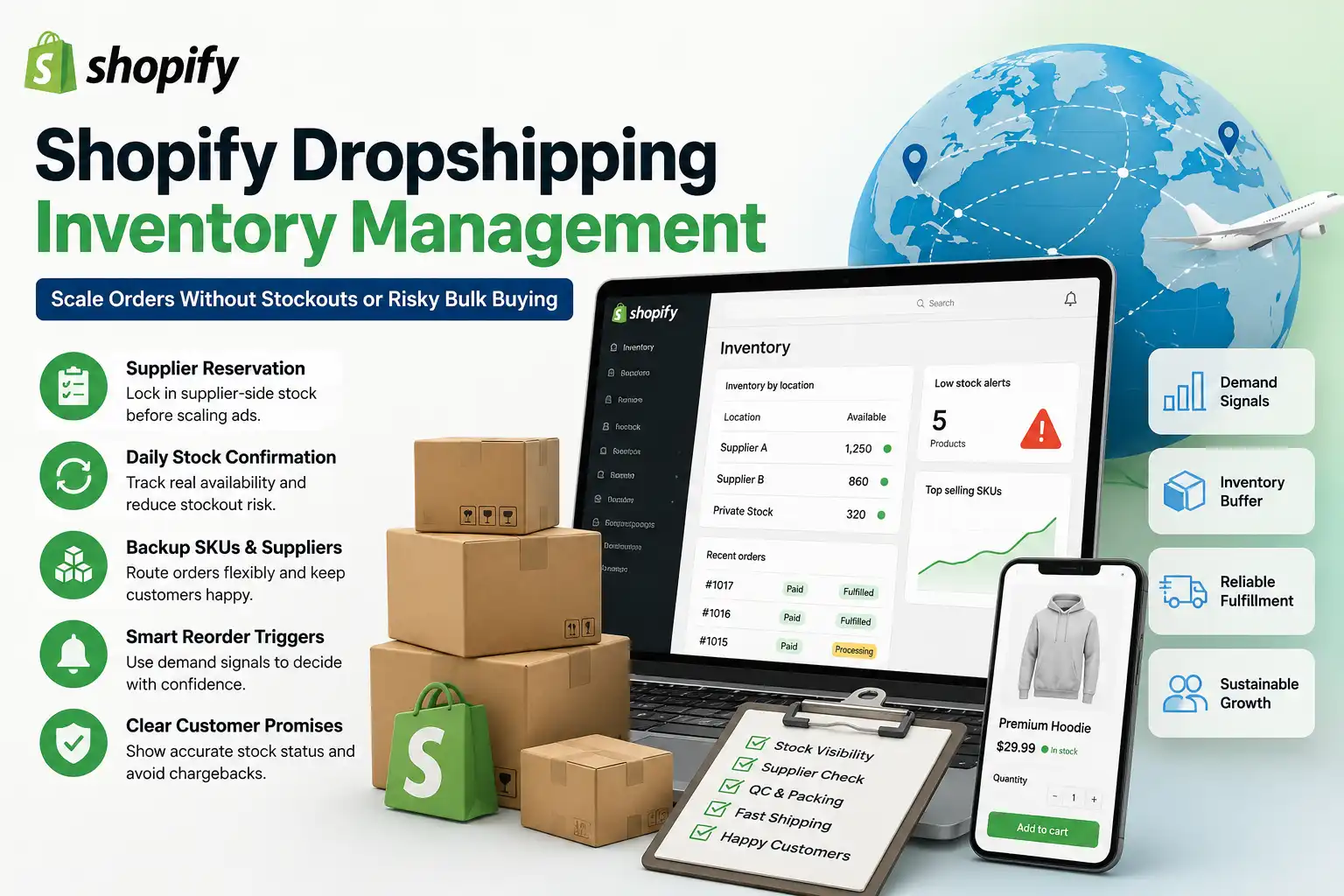
Shopify dropshipping inventory management is not just about counting stock. For a scaling store, it means controlling supplier availability, SKU substitutes, order routing, reorder triggers, and customer promises before demand spikes turn into stockouts.
The safest approach is not to pre-buy bulk inventory first. It is to build a process buffer around supplier confirmation, reserved quantities, backup sourcing, variant-level stock checks, and clear out-of-stock rules so each successful ad can scale without creating an out-of-stock problem.
Core Summary:
- The safest buffer for a dropshipping store is usually a process buffer first: supplier reservation, daily stock confirmation, backup sourcing, order-priority rules, and clear sold-out controls.
- Pre-buying stock can help when a product is proven, but it can also trap cash, hide supplier problems, and create clearance pressure if demand shifts.
- The practical goal is to keep selling velocity aligned with real supply visibility, then move selected winners into small, controlled stock positions only when the data and supplier behavior support it.
Picture a Shopify product that finally starts working. Ads are profitable, and orders arrive faster than your supplier updates inventory. Demand is not the problem; the backend cannot confirm whether tomorrow’s orders can still ship. A useful buffer gives you a calmer scaling decision before you commit cash to inventory you may not need.
Shopify dropshipping inventory management: Quick Verdict

The quick verdict is simple: build a supply-control buffer before you build a stockpile. A growing Shopify store needs slack for demand swings, supplier stock changes, quality holds, and shipping-route issues, but that slack does not always need to sit on your balance sheet.
For most dropshipping sellers, the first buffer should be daily supplier stock checks, reserved supplier-side quantities, backup suppliers, substitute SKU rules, capped ad scaling, and customer-facing stock controls. If your store already has orders and inventory uncertainty is slowing growth, a more accountable Shopify dropshipping fulfillment workflow can connect sourcing, supplier confirmation, product checks, dispatch coordination, and tracking write-back before stockouts reach customers.
Use pre-bought stock only after stable demand, acceptable defect risk, reliable specs, and enough margin to survive slower sell-through. Until then, ask: “How much confirmed supply can I trust before I scale traffic?”
Key Takeaway: Do not use pre-buying as your first answer to growth pressure. Start with visibility, reservation, backup routing, and sell-through controls; then buy small batches only for proven products with clear demand and low variation risk.
Why Scaling Stores Need a Buffer Before They Need Bulk Stock
A scaling store needs a buffer because demand can move faster than supplier communication, quality control, and shipping preparation. Without a buffer, every spike creates a fragile promise: you have accepted the customer’s order before confirming the product can actually be sourced, checked, packed, and shipped as expected.
The common mistake is treating inventory as binary: no stock or bulk inventory. Real models are more layered. You can reserve supplier-side quantity, confirm stock daily, split orders across approved suppliers, hold a small quantity for a proven SKU, or limit ads when confirmed supply becomes thin.
The three buffers that matter
The first buffer is information: knowing what is available. The second is decision time: rules for pausing ads, switching suppliers, offering a substitute, or marking a variant unavailable. The third is physical control: confirmed supply or prepared stock for short bursts.
Inventory Buffering Is Different From Basic Inventory Tracking
Basic inventory tracking tells you how many units are available inside a store or warehouse. Inventory buffering for Shopify dropshipping has to answer a harder question: how much supply can the seller safely promise before supplier stock, variant availability, quality checks, or shipping preparation become uncertain.
Traditional safety-stock formulas are useful when the merchant owns inventory. Dropshipping needs an extra supplier-availability layer because stock may change before the seller receives an update, and variants, packaging, or route limits may not appear in Shopify inventory numbers.
For this reason, the workflow below focuses on supplier-side reservation, stock signals, demand thresholds, backup SKU planning, and controlled escalation into small-batch holding.
Start With SKU Risk, Not Average Daily Orders
Your buffer size should start with SKU risk. Average daily orders show volume, but SKU risk shows how painful a stockout, substitution, or delayed dispatch will become.
A low-risk SKU is simple, stable, easy to source, and forgiving. A phone stand with one color may need stock visibility and a backup supplier. A cosmetics item, electronic accessory, apparel variant, bundle, or branded product needs more caution because substitutions can create quality issues or after-sales work.
Use this table before choosing a buffer:
| SKU factor | Low buffer pressure | High buffer pressure |
|---|---|---|
| Variant complexity | One or two simple variants | Many sizes, colors, plugs, or versions |
| Supplier depth | Several approved suppliers | One supplier with uncertain replenishment |
| Quality risk | Easy visual check | Leakage, battery, fragile, cosmetic, sizing, or accessory risk |
| Demand pattern | Steady orders | Paid-ad spikes, influencer bursts, seasonal surges |
| Customer promise | Flexible delivery expectation | Tight delivery promise or gift/event timing |
This table asks: where can the order fail if demand doubles this week?
Key Takeaway: Buffer risky SKUs with process controls before money. The more variants, fragile attributes, supplier dependency, or customer-promise pressure a product has, the more you need stock visibility, backup routing, and hold rules before scaling ads.
Use Supplier-Side Reservation Before You Pre-Buy
Supplier-side reservation is often the first buffer because it protects access without fully converting inventory into owned stock. The seller asks the supplier or agent to confirm a quantity that can be held, prioritized, or watched for a defined window.
This works best when the product is moving and the supplier relationship is real enough for confirmation. A vague message such as “stock is enough” is not a reservation. A useful record names the SKU, variant, quantity, hold period, dispatch priority, and runout rule.
Supplier-side buffers give you time to validate sell-through while avoiding the hardest risk of bulk buying: paying before demand is stable. They also reveal supplier reliability. If a supplier cannot confirm variant-level stock or keep terms stable, that is a warning sign before you buy.
What to confirm in writing
Ask for the exact variant, available quantity, replenishment condition, package status, inspection needs, and preparation cutoff time. If you work with multiple suppliers, record which supplier owns which variant so one store’s spike does not quietly consume stock promised to another campaign.
For scaling stores, a dropshipping sourcing agent should help verify suppliers, normalize quotes, review samples, and keep repeat-order terms stable before the seller commits to larger volume.
Build a Demand Signal Dashboard That Triggers Actions
A demand signal dashboard turns inventory buffering into a repeatable system. You need a few signals that tell you when to keep scaling, pause, switch routes, or prepare a small batch.
Track daily orders by SKU and variant, confirmed supplier stock, order backlog, cancellation risk, ad spend changes, and stockout warnings. Shopify inventory settings can help merchants manage quantities, but the dropshipping seller still needs a supplier-availability layer because the product may not be inside the seller’s own inventory.
Use thresholds instead of panic. If confirmed stock covers only a short window of orders, pause aggressive ad scaling and confirm replenishment. If one variant drops below the threshold, mark it unavailable. If demand holds and supplier performance stays stable, consider a small controlled stock position.
A practical trigger map
| Signal | Triggered action |
|---|---|
| Supplier confirms healthy stock | Continue normal selling and monitor daily |
| Stock becomes uncertain | Slow ad scaling and request variant-level confirmation |
| One variant becomes thin | Pause or hide that variant before customer orders stack up |
| Backlog grows faster than dispatch | Stop scaling and resolve preparation capacity first |
| Demand stays stable across test cycles | Review small-batch holding or supplier reservation terms |
The guide to Google Trends for dropshipping can help with demand signals, but trend interest still has to connect to supplier reality before you scale.
Key Takeaway: A buffer without triggers is just hope. Define the signals that change your actions before demand spikes: stock confirmation, variant risk, backlog, ad scaling, supplier response, and replenishment confidence.
Design Backup SKUs Without Confusing Customers
Backup SKUs are useful only when they protect the customer promise. A substitute product must match the listing promise, variant, quality expectation, packaging promise, and description closely enough to avoid disappointment.
Many stores treat supplier replacement as a backend detail. The customer treats it as the product they paid for. If the backup item has a different shade, plug type, size fit, accessory set, material feel, or package presentation, it may not be a safe substitute.
Once substitutions start causing wrong variants, missed accessories, or delayed dispatch, the issue shifts from stock buffering into Shopify order fulfillment mistakes that need separate controls.
Create this rule before you need it:
- Approved equivalent: can be used without changing the listing because visible and functional differences are not meaningful.
- Seller-confirmed substitute: needs seller approval before dispatch because some detail may affect the customer experience.
- Not substitutable: must be paused, refunded, or replaced with a new offer because the difference would break the promise.
A stronger dropshipping quality control process supports this decision because substitute products need checks before they enter the live order flow.
Do not let substitutions become silent listing drift
Silent drift happens when supplier versions and listing images slowly stop matching. It may start with a different accessory, texture, cap, or package. At scale, that drift can multiply before anyone notices.
Keep a reference file for approved product details. If a substitute changes the customer-facing promise, update the listing, pause the variant, or refuse the substitute.
Use a Micro-Batch Only After the Product Proves Itself
A micro-batch is a small, controlled stock position for a proven SKU, not an emotional bet on one good day. It makes sense only when demand, quality, supplier behavior, and margin have been tested.
Micro-batches can help high-confidence winners because they reduce supplier uncertainty for a short window. But they create responsibilities: storage, cash commitment, slow-moving stock, product changes, and a replenishment stop rule.
Before buying a small batch, answer five questions:
- Has demand repeated across more than one traffic source, creative, or selling period?
- Are variant-level sales predictable enough to avoid overbuying the wrong option?
- Has the product passed sample or test-order checks?
- Can the margin absorb storage, handling, defects, and slower sell-through?
- Do you have a stop rule if demand fades?
For mentors, agencies, and multi-store operators, keep each store’s demand signal separate unless the product, offer, and buyer profile are genuinely similar.
Key Takeaway: Use micro-batches as a reward for evidence, not a shortcut around uncertainty. If demand, supplier reliability, variant mix, and quality checks are not stable yet, supplier-side reservation is usually safer than owned stock.
Real Case: Overstock Can Become a Growth Problem
The Allbirds inventory reset is a useful public reminder that more stock is not always safer. Public reporting and company disclosures around its restructuring period described excess inventory, promotional pressure, and efforts to simplify products and reduce inventory while the business adjusted strategy.
In its Allbirds 2024 financial results, the company reported year-end inventory of $44.1 million, down 23.6% year over year, and noted that fourth-quarter gross margin was affected partly by inventory adjustments. This does not make Allbirds a dropshipping case, but it is a useful public reminder that owned inventory becomes pressure when demand, assortment, or sell-through changes.
The lesson for Shopify dropshipping is not that a small store faces the same public-company situation. The lesson is basic: when demand changes, owned inventory becomes a fixed problem. You may have to discount it, store it, repackage it, bundle it, or accept trapped cash.
For a scaling dropshipping store, this supports a conservative principle. Use early demand signals to negotiate supplier access, improve stock confirmation, test small batches, and protect customer promises. Do not treat bulk buying as proof that the product is ready to scale.
What to borrow from the case
Borrow the discipline, not the scale. Keep assortment tight. Watch sell-through. Reduce weak variants. Do not let one campaign convince you to buy every color and size. Build an exit plan before you buy.
The point is growth control. A store that can say “not yet” to the wrong stock position is better prepared to say “yes” when the right product proves itself.
Create Customer-Facing Stock Rules Before You Need Them
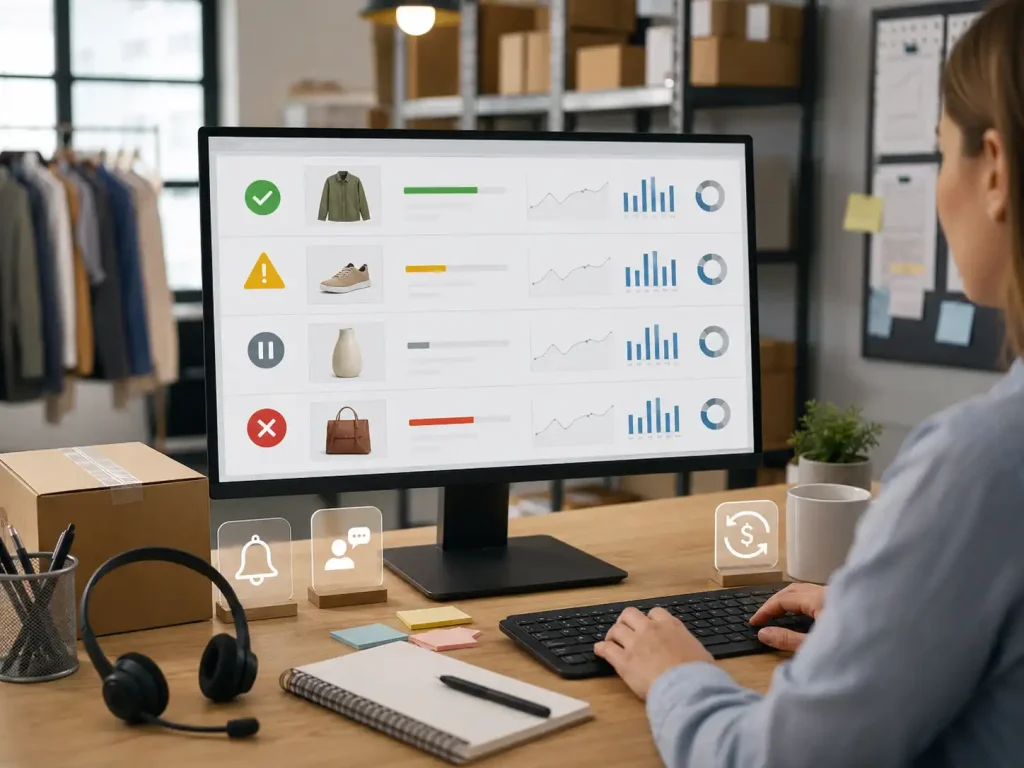
Customer-facing stock rules prevent backend uncertainty from becoming a trust problem. If a product is unavailable or waiting for confirmation, the store should not promise normal dispatch.
Shopify gives merchants ways to manage inventory behavior, but the seller still needs judgment around what customers see. Continuing to sell while stock is uncertain can work for a preorder model only when the promise is clear. Silent order-taking is the risk.
That risk is not only a customer-service problem. When customers place orders for items that were never clearly available, stock uncertainty can turn into refund requests, payment disputes, and Shopify dropshipping chargeback risk before the seller has time to fix the backend issue.
Shopify’s own inventory guidance explains that customers normally cannot purchase an item once tracked inventory reaches zero, unless the merchant intentionally enables Continue selling when out of stock for a product or variant. For dropshipping sellers, that setting should be treated as a customer-promise decision, not just a backend toggle.
Create rules for four states:
| Stock state | Customer-facing action |
|---|---|
| Confirmed available | Sell normally |
| Low but replenishment confirmed | Sell with careful ad scaling and monitoring |
| Uncertain or unconfirmed | Pause variant, slow ads, or collect confirmation before taking more orders |
| Out of stock | Mark unavailable, offer a waitlist, or present a clear alternative |
This connects to customer service for dropshipping because clear stock promises reduce vague support conversations. If there is a delay, your team needs a factual update, not a hopeful script.
Know When Private-Agent Control Becomes Worth It
Private-agent control becomes worth considering when inventory uncertainty keeps repeating after demand is proven. At that point, the question is whether your backend can coordinate sourcing, product checks, reserved quantities, packing, dispatch, tracking, and exceptions in one accountable workflow.
For a small test product, direct supplier messages may be enough. For a growing Shopify store, vague stock answers, supplier substitutions, variant drift, delayed dispatch, and unclear ownership become more expensive. A private dropshipping agent workflow can help coordinate supplier communication, product checks, order preparation, shipping options, and exception escalation.
This does not mean every seller should immediately move into stocked inventory or a private-agent process. If your supplier can provide accurate stock confirmation, stable variants, clear packing, and timely updates, you may only need a light buffer system. If not, uncertainty may cost more than a controlled model.
At that stage, inventory buffering becomes part of broader dropshipping store growth: the store is no longer only testing products, but building repeatable supply-chain control behind winning SKUs.
Key Takeaway: Bring in stronger backend control when stock uncertainty becomes a repeat pattern, not a rare exception. The signal is not one sold-out SKU; it is repeated unclear availability, substitutions, dispatch delays, and scaling decisions made without reliable supply data.
FAQ
How much buffer should a Shopify dropshipping store keep?
Start with confirmed supplier coverage, not a fixed number. A low-risk SKU may only need daily stock confirmation and a backup supplier, while a high-risk or fast-scaling SKU may need reserved quantity, stricter variant rules, or a small tested batch.
Is safety stock the same as inventory buffering?
No. Safety stock usually means extra physical inventory held to protect against demand or supply variation. Inventory buffering can include safety stock, but it also includes supplier reservation, backup sourcing, stock triggers, customer-facing controls, and ad-scaling rules.
Should I let customers buy when a product is out of stock?
Only when the customer promise is clear and the replenishment path is reliable. Silent out-of-stock selling creates trust risk because customers think they bought an available item. Use preorder, waitlist, or variant-pausing rules when supply is uncertain.
When should I move from dropshipping to holding stock?
Move only when the product has stable demand, reliable quality, predictable variants, acceptable margin, and a clear sell-through plan. A micro-batch can be safer than a large purchase when you are still testing demand consistency.
Can a private dropshipping agent hold inventory for me?
It depends on the product, volume, agreement, and operational setup. The safer first step is to discuss current order volume, SKU risk, supplier reliability, and whether supplier-side reservation or a small controlled batch fits the product.
Conclusion
Inventory pressure is a good problem only when you have a system for it. A scaling Shopify store does not need to jump from no-stock dropshipping into risky bulk buying. It needs clearer stock visibility, supplier-side reservation, backup SKU rules, demand triggers, customer-facing stock controls, and a cautious path to micro-batches.
If your store already has orders and inventory uncertainty is limiting growth, Runtodropship can help you build a more accountable private-agent workflow around sourcing coordination, supplier communication, product checks, prepared stock decisions, shipping arrangement, and after-sales support. The future of serious dropshipping is not blind no-stock selling or reckless stockpiling; it is controlled supply-chain execution behind every promise you make. To review your next scaling step, contact Runtodropship and share your product type, daily order pattern, supplier constraints, and stockout risks.