
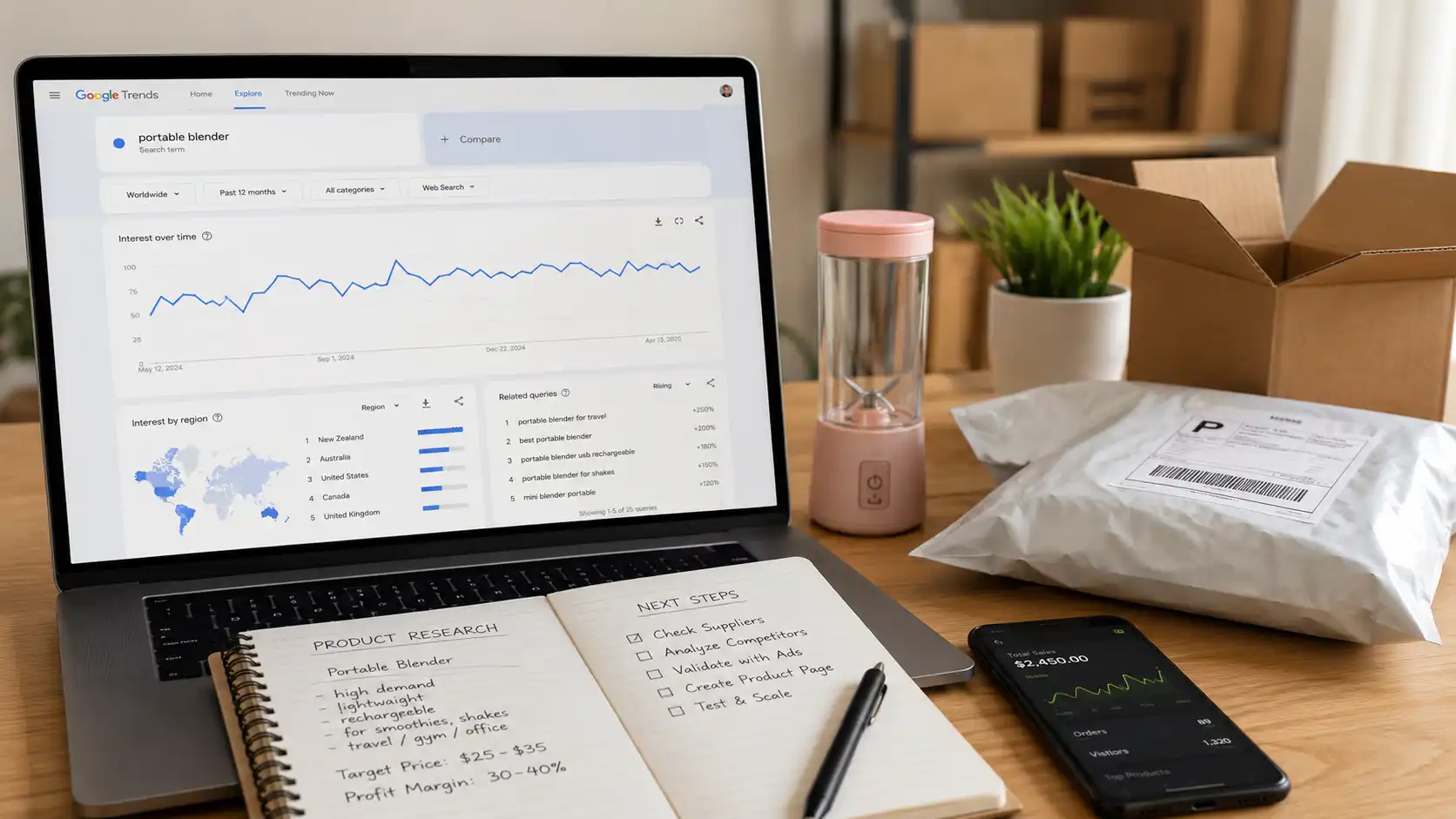
Using Google Trends for dropshipping involves analyzing search interest data over time to validate product demand, identify high-potential niches, and strategically time marketing campaigns to match seasonal consumer behavior.
Imagine you are hunting for a breakthrough item, spending countless hours browsing public marketplaces only to randomly pick a product based on gut feeling. This speculative approach often ends in disaster; you sink hundreds of dollars into targeted ads only to watch your budget evaporate on dead, saturated products that nobody actually wants to buy. Fortunately, you can eliminate this expensive guesswork entirely by integrating Google Trends For Dropshipping into your initial product research strategy to scientifically back up your decisions with real consumer search data.
Is Google Trends For Dropshipping Still Worth It?

Yes, Google Trends remains one of the most powerful, free analytical tools available for digital merchants looking to validate product demand before committing capital to inventory or ad campaigns.
When launching an online store, relying purely on intuition often leads to costly marketing failures and unsellable stock. To stay ahead of the competition, you need access to real-time search behaviors that reflect what consumers are actively thinking about. Using free analytical engines can significantly reduce your startup overhead while offering invaluable strategic direction. Let us guide you through how this data translates into actual sales so you can build a stable foundation.
Is search interest equal to buying intent?
Search interest signals curiosity but does not always guarantee an immediate purchase. While a high volume of search queries proves that a topic is top-of-mind, you must cross-reference this interest with commercial intent before listing the product. For instance, people might search for a luxury item out of sheer curiosity rather than a desire to buy it.
To determine true buying intent, look for transaction-oriented keywords within the related queries section. If users are searching for specific terms like “buy high heels” or looking for discount codes, they are much closer to making a purchase. This distinction prevents you from wasting marketing dollars on purely informational traffic.
Why should dropshippers avoid paid spy tools?
Google Trends is useful because it lets sellers validate demand with free search data before relying on paid tools, supplier lists, or marketplace guesses.
How does search validation protect your ad budget?
Validating search trends before spending money on ads ensures you are only targeting products that people are already actively seeking. This preventative measure directly lowers your customer acquisition costs by aligning your copy with pre-existing market demand. Instead of trying to force a brand new product concept onto an indifferent audience, you simply tap into existing search streams.
By checking search volumes across different seasons and regions, you can also avoid running ads during demand slumps. You can allocate your budget to high-performing times of year and shut down underperforming campaigns before they lose money. This level of control is essential for maintaining healthy cash flows in your business.
How Do You Read Google Trends Demand Data?
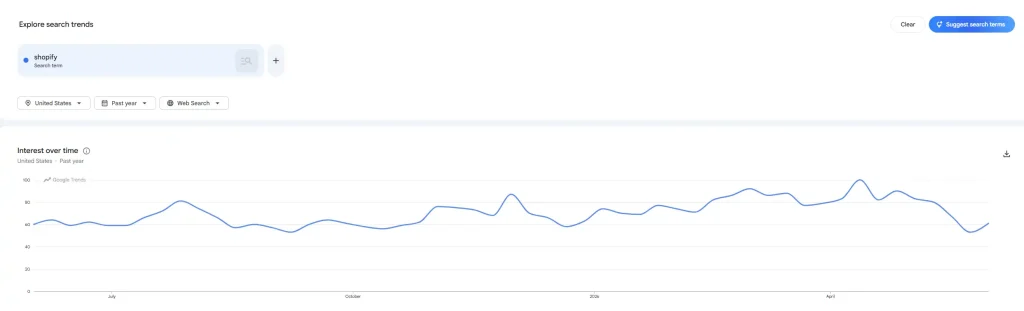
Reading Google Trends data requires understanding that the numbers represent relative search interest on a normalized scale from 0 to 100 rather than absolute search volume. A score of 100 means the selected term reached its highest relative interest for the chosen region and time frame, not that it generated a fixed number of searches. This is why dropshippers should compare product ideas across the same country, date range, and search type before treating a trend as real demand.
A stronger regional signal is still only a demand clue. Before choosing the market, compare that search interest with the operating conditions for dropshipping in the Philippines, dropshipping in India, dropshipping in the UK, or dropshipping in Australia, because payment behavior, taxes, delivery expectations, sales channels, and supplier fit can change the viability of the same product.
What does the 0 to 100 interest score mean?
The 0 to 100 score is a relative popularity metric where 100 represents the peak search volume for the selected term, region, and time frame. A score of 50 indicates that the keyword is half as popular, while a score of 0 means there was insufficient data. This normalization allows you to compare different keywords fairly without raw search numbers skewing the visual graph.
Because the data is relative, a small niche can still hit a score of 100 if it experiences its highest-ever search volume. Always keep this scaling behavior in mind when comparing terms with vast differences in total market size. Understanding this preventing you from misinterpreting a micro-trend as a massive mass-market opportunity.
How do you differentiate rising vs top queries?
Top queries are the most popular search terms overall in your selected category, while rising queries show terms with the strongest recent growth. When Google marks a rising query as Breakout, it means the term grew by more than 5,000%, so it deserves quick investigation but not automatic product launch. You still need to confirm supplier availability, product quality, competition level, and shipping feasibility before scaling ads around that trend.
Can You Spot Evergreen Niches Using Free Tools?

You can absolutely spot evergreen niches using free search tools by analyzing long-term historical data to ensure consistent, non-seasonal consumer interest over several years.
Finding a stable niche is vital because it protects your store from sudden drops in revenue when a short-lived fad inevitably dies out. By looking at a five-year window, you can identify steady demand curves that stay active regardless of the month or season.
How do you filter out temporary market fads?
You filter out temporary fads by adjusting your research window to a macro view of three to five years to spot steep spikes that quickly crash to zero. Fads typically show a single, sharp mountain-like shape on the graph with no recovery, indicating that public interest has completely vanished. True evergreen niches, by contrast, present a steady, wavy horizontal line that never dips near the bottom of the axis.
If you build your entire business around a fad, you will be left with unsellable products and zero traffic once the hype dies down. Evergreen niches allow you to build an actual brand, generate repeat customers, and create predictable cash flows. Focus your core business strategy on these stable foundations to ensure long-term survival.
Which evergreen product patterns should you look for?
Look for products that solve persistent daily problems, cater to long-term hobbies, or require repeat purchases, such as pet supplies or phone accessories. These categories maintain consistent demand lines on the graph because the fundamental human need for them remains unchanged. When your chosen item exhibits this flat, high-interest pattern, you have found a reliable candidate for a sustainable store.
These products typically have consistent search scores above 50 year-round, showing very minor fluctuations during the holidays. They provide the perfect foundation for building a loyal customer base and running stable, predictable advertising campaigns. Once you establish these core items, you can safely scale your brand.
How do you drill down from categories to niches?
Drill down by starting with a massive umbrella category like “shoes” and using related queries to identify highly targeted sub-sectors like “women’s high heels.” This step-by-step narrowing process ensures you enter a market broad enough to have demand, yet specialized enough to avoid overwhelming competition. Focusing on a focused sub-sector makes it much easier to position your brand as an expert.
As you filter down, compare the relative performance of different sub-keywords to see which ones maintain the healthiest demand. You can then tailor your product selection and copy to address that precise customer group. This specialized approach leads to significantly higher conversion rates and brand loyalty.
How Do You Validate Winning Products Step-by-Step?

Validating winning products step-by-step involves brainstorming potential products, comparing their search interest, analyzing their geographical relevance, and checking their real-world competition.
To successfully build a sustainable store, you must systematically screen every product concept before building out a landing page. This structured validation funnel helps you weed out poor-performing items and focus exclusively on high-margin winners. Let us transition into a structured workflow that you can easily replicate for any product idea you discover.
How do you compare multiple product keywords?
You compare multiple product keywords by using the “+ Add Comparison” feature to view their relative search interest on a single chart simultaneously. This visual overlay immediately reveals which product variation commands the highest consumer attention and demand. It is an essential step to ensure you do not launch a product using outdated or low-volume search terminology.
Make sure you test different synonyms and regional variations to get an accurate representation of global demand. For example, comparing “high heels” with “stilettos” will show you which term is more popular in your target market. This keyword optimization directly impacts your search engine optimization and ad targeting.
How do you verify competitor saturation?
You verify competitor saturation by looking for rapid declines in rising queries while the overall search score remains high, indicating a mature, crowded market. When too many competitors run ads for the same keywords, your marketing costs will skyrocket, making it difficult to maintain profitability. Checking these query lifecycles helps you enter the market at the perfect moment.
If you spot “Breakout” queries that are still early in their upward trajectory, you have found an untapped product window. Entering at this early stage allows you to acquire customers cheaply before the market becomes saturated. This timing is critical to achieving high initial profit margins.
Which metrics confirm a product is ready to sell?
A product is ready to sell when it maintains an interest score above 25 over twelve months, shows rising interest in key buying regions, and has active search queries. These healthy metrics prove that a steady stream of prospective buyers is actively looking for what you plan to offer. Once confirmed, you can confidently proceed to find a reliable supplier to handle your fulfillment.
You should also look for a healthy mix of top and rising queries to ensure the product has both present sales potential and future growth. If all metrics align, you have a validated concept that is ready for launch. This structured verification process takes the gamble out of product selection. Reading trend data this way is a learnable skill rather than a talent — it sits in the data domain of the full dropshipping skill map, and it sharpens each time you compare a forecast with what buyers actually did.
| Research Metric | Ideal Trend Value | Strategic Business Action |
|---|---|---|
| Long-Term Interest | Stable baseline score > 25 | Safe for long-term brand building and organic SEO |
| Breakout Queries | Sudden 500%+ growth | Perfect for high-intensity, short-term ad campaigns |
| Regional Focus | Highly concentrated in target countries | Direct ad spending to specific, high-intent subregions |
This structured comparison table demonstrates that aligning your research metrics with clear business actions is the most efficient way to maximize your marketing return on investment.
Key Takeaway: Always validate your product keywords over a 5-year macro timeframe to ensure you are not investing your advertising capital into a dying market fad or a heavily saturated product category.
How Can You Predict High-Profit Seasonal Surges?

You can predict high-profit seasonal surges by analyzing recurring peaks in multi-year historical search data to pinpoint exactly when consumer interest begins to climb each year.
Understanding seasonal spikes is incredibly lucrative because it allows you to launch your marketing campaigns right as demand begins to trend upward. This early positioning helps you secure low ad costs before major competitors flood the ad networks later in the season. Let us walk through the exact steps to identify these cyclical opportunities and adapt your logistics accordingly.
When should you launch seasonal marketing ads?
You should launch your marketing campaigns approximately four to six weeks before the historical search interest peak occurs on the trend graph. This proactive timeline allows your ad pixels to mature, optimize, and build an audience of warm leads. By the time the peak buying season actually arrives, your store will already be positioned at the top of search results.
If you wait until the trend peaks to start advertising, you will face the highest ad costs of the year and intense competitor bidding. Building your funnel early ensures you capture early buyers who are ready to purchase. This early mover strategy is key to dominating seasonal sales.
Why do winter clothing issues trigger trend peaks?
For example, products like lint removers, holiday lights, cooling gadgets, or camping accessories often show recurring seasonal patterns that can be planned before demand peaks.
These functional pain points create highly motivated buyers who want immediate solutions. By connecting these environmental triggers with product solutions, you can run highly persuasive marketing campaigns. This logical alignment is the foundation of high-converting dropshipping stores.
How do you manage supply chains before trends peak?
Managing your supply chain effectively means securing production space and shipping routes months before peak season to avoid costly delivery bottlenecks. If you are exploring marketing strategies for highly dynamic platforms, check out our TikTok dropshipping guide to keep your sales steady. Preparing your logistical channels early protects you from stockouts and keeps your customers happy.
A sudden surge in orders is useless if your supplier runs out of stock or shipping takes weeks. Coordinating with your supply chain partners well in advance ensures seamless fulfillment when sales flood in. This operational readiness is what separates amateur sellers from professional brands.
Key Takeaway: Never wait until a seasonal trend peaks to launch your store; source your suppliers in advance so your marketing is active just as the upward search trend begins.
Why Does Location-Based Interest Data Matter?

Location-based interest data is critical because it tells you exactly which countries, states, or cities have the highest concentration of potential buyers for your specific product.
Standard geographic targeting often leads to wasted ad spend when you assume that a product is universally popular across all English-speaking countries. By drilling down into regional search distribution, you can focus your advertising dollars strictly on areas showing genuine active interest. Let us explore how geographical insights can directly refine your targeting strategies and logistics operations.
How do you target the most profitable countries?
You target profitable countries by analyzing the “Interest by subregion” breakdown to identify countries that display intense, dark blue coloring indicating high search density. This visual map helps you avoid high-competition markets by highlighting alternative countries with strong demand and lower advertising costs. Focusing on these high-density regions allows you to scale your business much more cost-effectively.
For instance, a product might show low overall interest in the United States but experience high demand in Canada or Australia. Shifting your targeting to these highly focused markets can unlock untapped customer pools. This geographic diversification is key to protecting your margins.
Can local trends save your paid ad budget?
Yes, focusing purely on high-interest subregions saves your ad budget by preventing your ads from displaying in locations with zero local demand. Instead of casting a wide, expensive net across an entire continent, you can micro-target states or provinces with proven interest. This surgical precision maximizes your return on ad spend and stretches your marketing budget significantly further.
You can also customize your ad copy to match the specific cultural references and seasons of those high-interest regions. This personalized approach makes your marketing feel highly relevant to the local audience. As a result, you will see a massive spike in click-through rates.
What Are the Limits of Google Search Trend Data?

The primary limitation of search trend data is that it only measures consumer interest and curiosity, completely failing to account for physical supply chain realities, product quality, or shipping logistics.
Relying strictly on online data can create a dangerous blind spot where you scale ad spend for a highly popular item, only to find the product is plagued by manufacturing defects. Furthermore, public search data is visible to everyone, meaning hundreds of other dropshippers are likely trying to source the exact same trending item simultaneously. Let us look closer at why digital interest must always be backed up by a robust, secure supply chain.
Why does search volume fail to guarantee supply?
Search volume only represents web-based curiosity and does not correlate with a factory’s actual manufacturing capacity or raw material availability. You could easily find a product with explosive search volume, only to discover that no factory can produce it fast enough to meet your orders. Without guaranteed supply, scaling your online store will quickly lead to delayed shipments and mass customer complaints.
This supply disconnect can destroy your business overnight if you are forced to issue mass refunds while your ad spend is already spent. You must ensure that your physical backend can scale at the exact same pace as your digital traffic. This is why securing direct manufacturer access is so vital.
Where does search trend research fall short?
Search trend research falls short because it cannot evaluate product safety, functional durability, accessory completeness, import rules, or product-specific shipping restrictions. This matters most in categories such as consumer electronics dropshipping, where a product may show strong search demand but still require power-on testing, version checks, battery-aware route matching, and packaging protection before it is safe to scale.
Failing to verify these physical details can lead to packages being seized at customs or high return rates due to defective items. A trend is only profitable if the physical product actually meets the customer’s expectations upon arrival. You need real, on-the-ground support to verify these details.
How Do Private Sourcing Agents Mitigate Trend Risks?

Private sourcing agents mitigate trend risks by directly verifying factories, conducting strict pre-dispatch quality control, negotiating exclusive wholesale pricing, and offering custom branding to isolate your store from copycat competition.
When a trend-validated product begins to scale, transitioning your fulfillment from chaotic public marketplaces to a controlled supply chain is crucial to protecting your customer experience. This is where partnering with a dedicated partner like Runtodropship makes all the difference, acting as your professional, on-the-ground China team to manage direct factory sourcing. Let us explore how a private agent can turn volatile search trends into a stable, highly profitable brand.
How do you transition from search trend to supplier?
You transition by handing your validated search data, target product specifications, target country, expected order volume, and pricing expectations to a dropshipping sourcing agent in China who can compare supplier options beyond public listings. This step turns keyword-level demand into supplier-level feasibility, including factory availability, sample review, quote clarity, backup supplier options, and whether the product can support repeat orders when your traffic starts converting.
A private dropshipping agent also manages all factory communications, resolving any production issues before they impact your business. This professional representation ensures you get the best terms, even with lower initial order volumes. It is the most secure way to scale your product line.
Why is pre-dispatch quality control mandatory?
Pre-dispatch quality control is mandatory because Google Trends can only show demand signals; it cannot confirm whether the physical product matches your listing, works correctly, includes the right accessories, or arrives in acceptable condition. Before a trend-validated product reaches customers, a private agent warehouse execution team should check visible defects, variant accuracy, packaging readiness, and product-specific risk points so avoidable complaints do not appear after delivery.
By isolating defective batches at the source, you save thousands of dollars in lost shipping costs and refunds. A private dropshipping agent acts as your physical gatekeeper, ensuring only perfect items reach your buyers. This quality assurance is vital to building a lasting e-commerce brand.
Conclusion
Google Trends should be treated as the first validation layer, not the final product decision. After search demand looks promising, sellers still need to confirm supplier availability, product quality, packaging requirements, and shipping feasibility before scaling paid traffic.
FAQ: How To Use Google Trends Data For Dropshipping
Can I rely entirely on Google Trends for product sourcing?
No, because Google Trends only measures online search curiosity and does not verify factory reliability, product quality, or logistics feasibility. You must always combine search data with physical validation through a professional sourcing partner to ensure you can actually fulfill the demand.
What’s the best way to compare different dropshipping niches?
The best way is to input multiple product keywords simultaneously using the platform’s comparative search feature over a five-year period. This allows you to visually identify which niche commands a steady, high-volume baseline versus those that are volatile, highly seasonal, or rapidly declining.
How do I know if a product trend is a short-lived fad or an evergreen niche?
You can identify a fad by a sudden, massive spike on the historical graph that immediately crashes back to zero and never recovers. An evergreen niche, conversely, will display a stable, wavy horizontal trend line that consistently remains active above a score of 25 year after year.
Can I target specific subregions with my social media ads using trend data?
Yes, you should use the “Interest by subregion” breakdown to pinpoint the exact states, provinces, or cities with the highest interest density for your keyword. This geographical focus allows you to concentrate your ad spend where buyers are most active, preventing wasted budget on low-interest territories.
How do I protect my winning product trend from copycats?
You must move away from public supplier catalogs and work with a private dropshipping agent to secure custom branded packaging, unique product bundles, and direct factory pricing. This builds exclusive supply barriers and premium brand equity that competitors cannot easily duplicate on open marketplaces.