
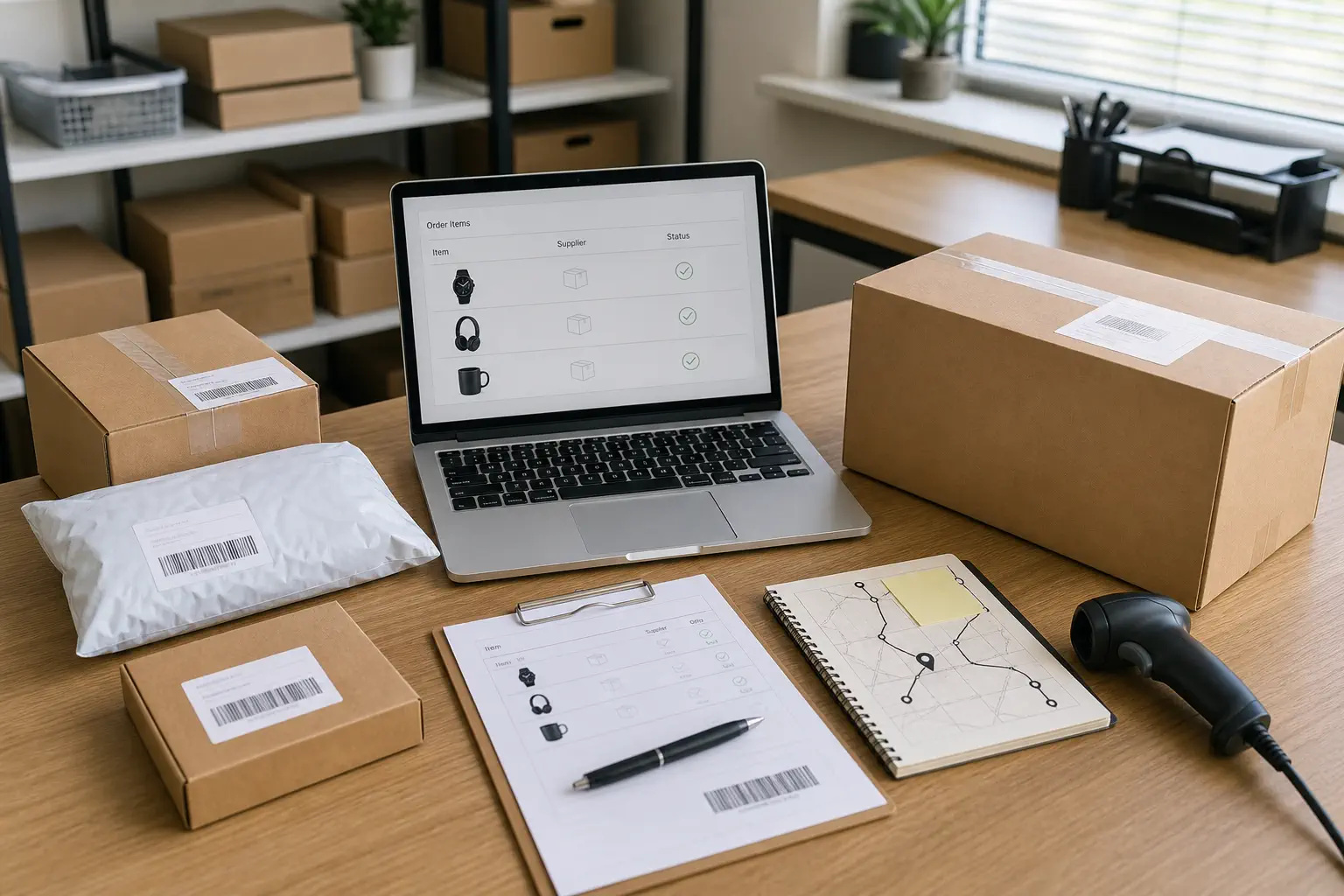
Dropshipping order consolidation is the process of receiving items from different suppliers, checking them against the same customer order, and shipping them together as one complete parcel whenever the products, timing, packaging requirements, and destination make that practical.
Core Summary: If your Shopify store sells bundles, accessories, kits, or multi-item carts from several suppliers, separate parcels can create margin leakage, tracking confusion, missing-item complaints, and weaker brand presentation. The solution is not only a Shopify setting. You need a physical workflow that receives supplier shipments, verifies quantity and variants, holds incomplete orders when needed, combines approved items, and communicates clearly with the customer.
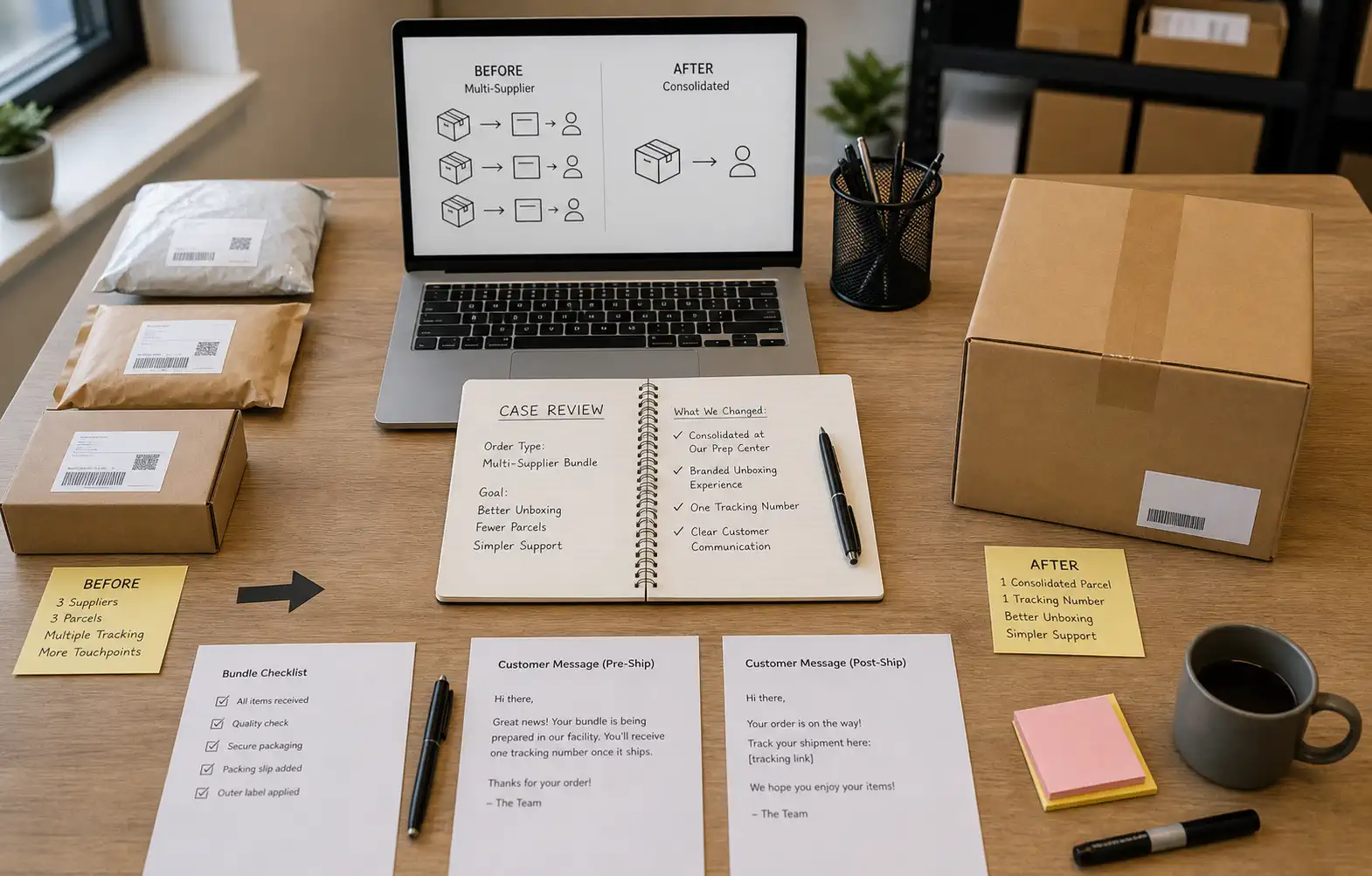
Picture a customer ordering a phone case, charging cable, and small desk light from your store. The store looks like one brand experience, but behind the scenes the three items come from different factories, different dispatch windows, and different packaging habits. If the customer receives three parcels over three different days, your support inbox has to explain what happened. If one item is delayed, you may not notice until the buyer asks. For growing Shopify sellers, mentors, agencies, and operators managing repeatable workflows, consolidation turns a messy supplier chain into a controlled order experience. For Shopify stores using multiple suppliers, consolidation connects supplier coordination, product checks, packaging, tracking, and customer communication.
Why dropshipping order consolidation matters for multi-item Shopify orders
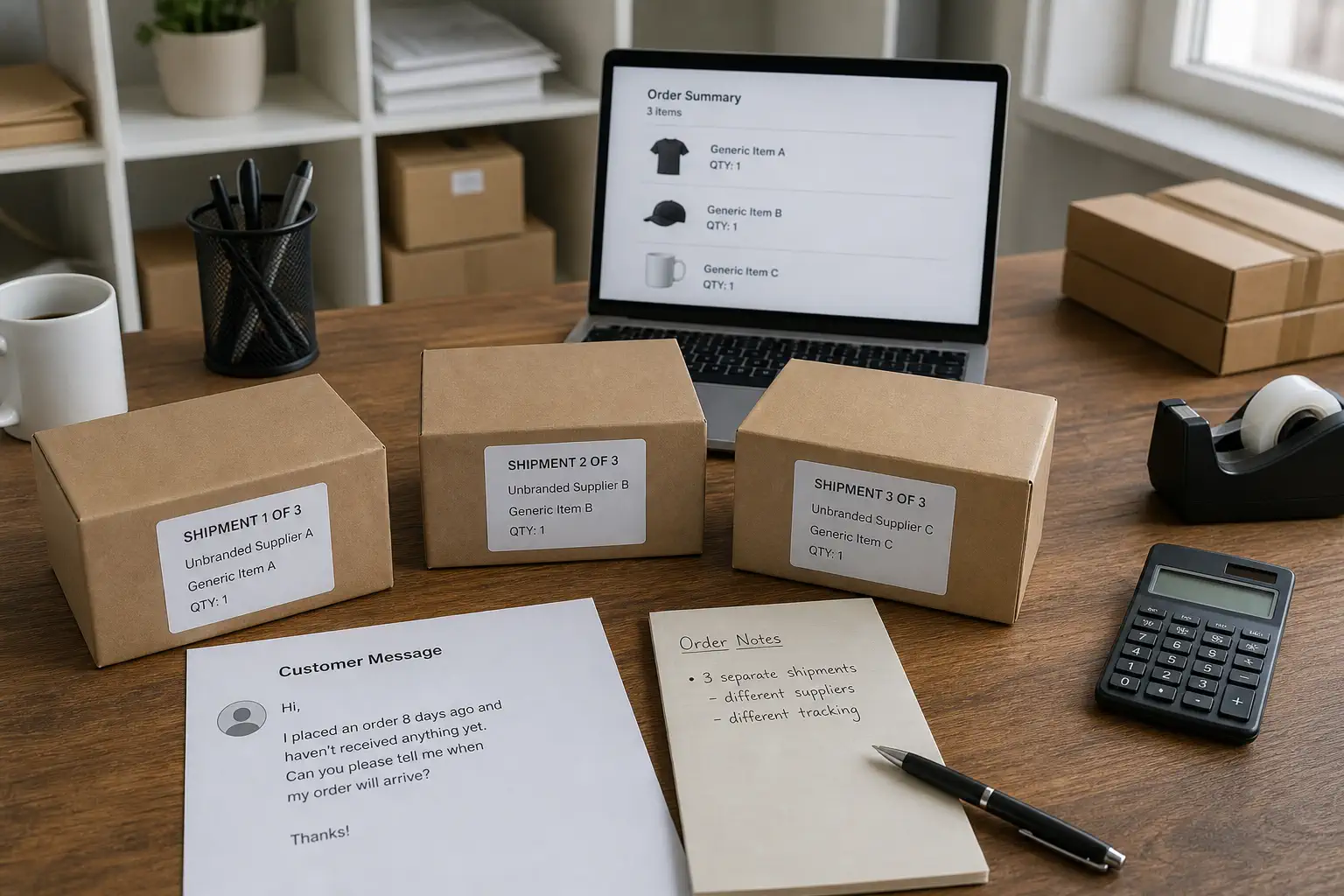
Order consolidation matters because a single Shopify checkout can hide several physical supply paths that the customer never sees.
On the storefront, the buyer sees one cart, one payment, and one order confirmation. In the backend, each SKU may come from a different supplier. One supplier may ship the same day, another may need a variant confirmation, and a third may use packaging that exposes factory information or looks inconsistent with your store’s promise.
This mismatch creates the central problem: Shopify can organize order data, and Shopify split shipping explains how checkout can separate shipments when items cannot be fulfilled together, but Shopify still cannot physically make multiple suppliers pack one customer order into one parcel. Apps can sync products, route orders, and update tracking, yet the parcel still has to be received, checked, combined, and shipped by someone with access to the goods.
For a store selling only one low-risk item at a time, split shipping may be acceptable. For a store increasing average order value through bundles, add-ons, kits, or complementary products, the same model becomes fragile. The more items you encourage customers to buy together, the more visible your backend coordination becomes.
Treat consolidation as an operational decision, not a cosmetic packaging upgrade. If your sales strategy depends on multi-item orders, your supply chain must be able to check and combine those orders before the customer experiences the split.
Why separate packages can damage your margin
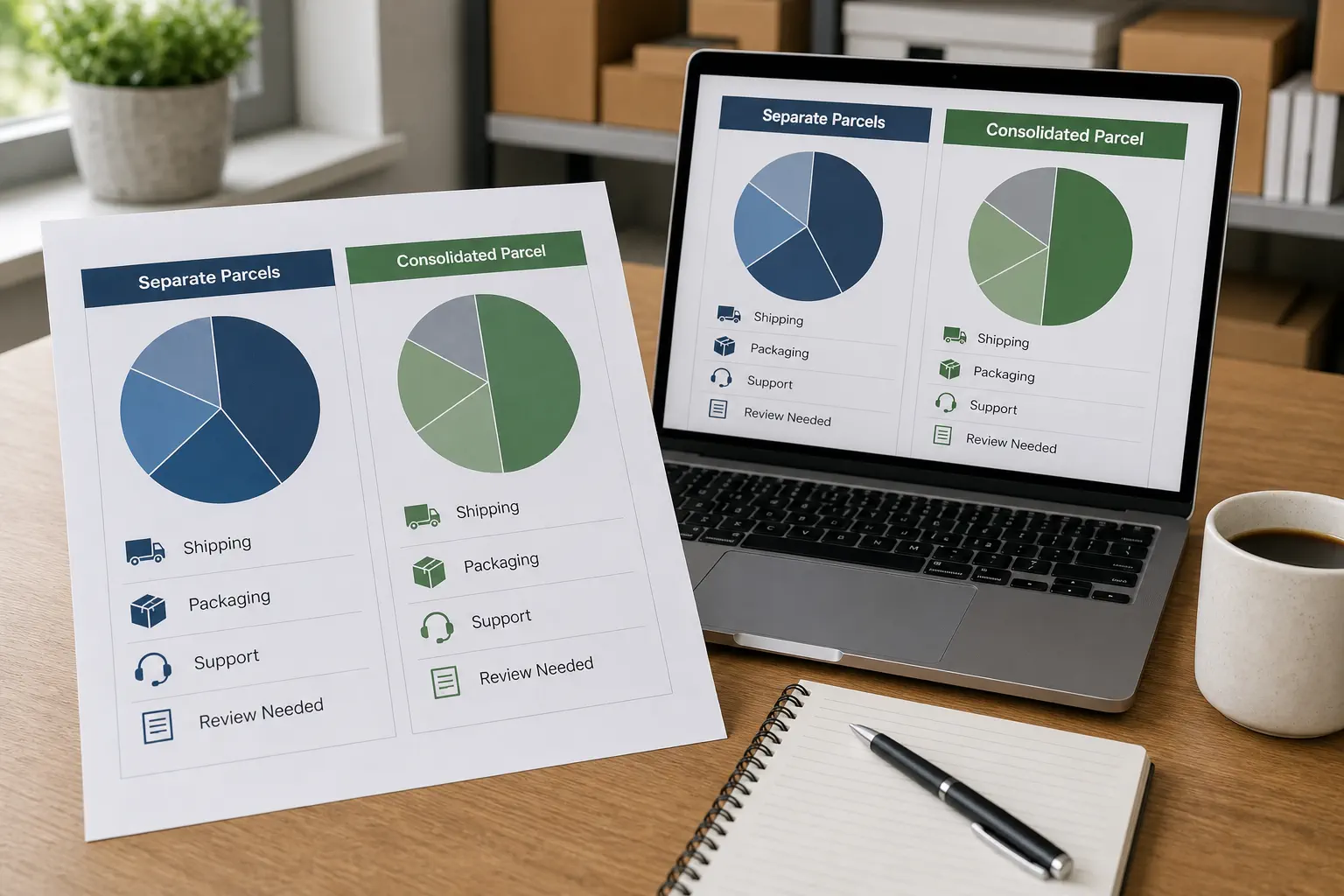
Separate packages can reduce margin because each parcel may carry its own shipping charge, packaging material, handling work, and support burden.
The obvious cost is shipping. Three parcels may mean three first-mile handoffs, three label events, and three tracking histories. Even when each supplier offers a low individual shipping quote, the combined order may become more expensive than one carefully packed parcel.
The less obvious cost is operational noise. A buyer who receives item A today and item B next week may ask whether the rest of the order was forgotten. Your support team then needs to identify which supplier shipped which SKU, whether each tracking number is valid, and whether the last item is actually delayed or simply unscanned.
Separate packaging also weakens bundle economics. If you promote “complete kits” but ship every component separately, the customer may feel that the bundle is only a checkout trick. That makes it harder to justify higher cart values or brand-led product sets.
Use a simple internal comparison before deciding whether to consolidate:
| Decision area | Separate supplier parcels | Consolidated parcel |
|---|---|---|
| Shipping control | Depends on each supplier’s route | One selected route after all items are ready |
| Packaging consistency | Varies by supplier | Can be checked and repacked together |
| Customer tracking | Multiple tracking histories | One main tracking flow when practical |
| Support workload | More missing-item questions | Fewer split-shipment explanations |
| Delay visibility | Supplier-by-supplier | Centralized hold and release decision |
The table does not mean every order should be combined. Large, fragile, restricted, oversized, or destination-specific items may be better shipped separately. The point is to compare the real order economics, not only the product price.
Key Takeaway: A low supplier quote is not always the lowest total cost. For multi-item Shopify orders, calculate shipping, packaging, exception handling, and customer-support pressure together.
How split parcels affect customer experience
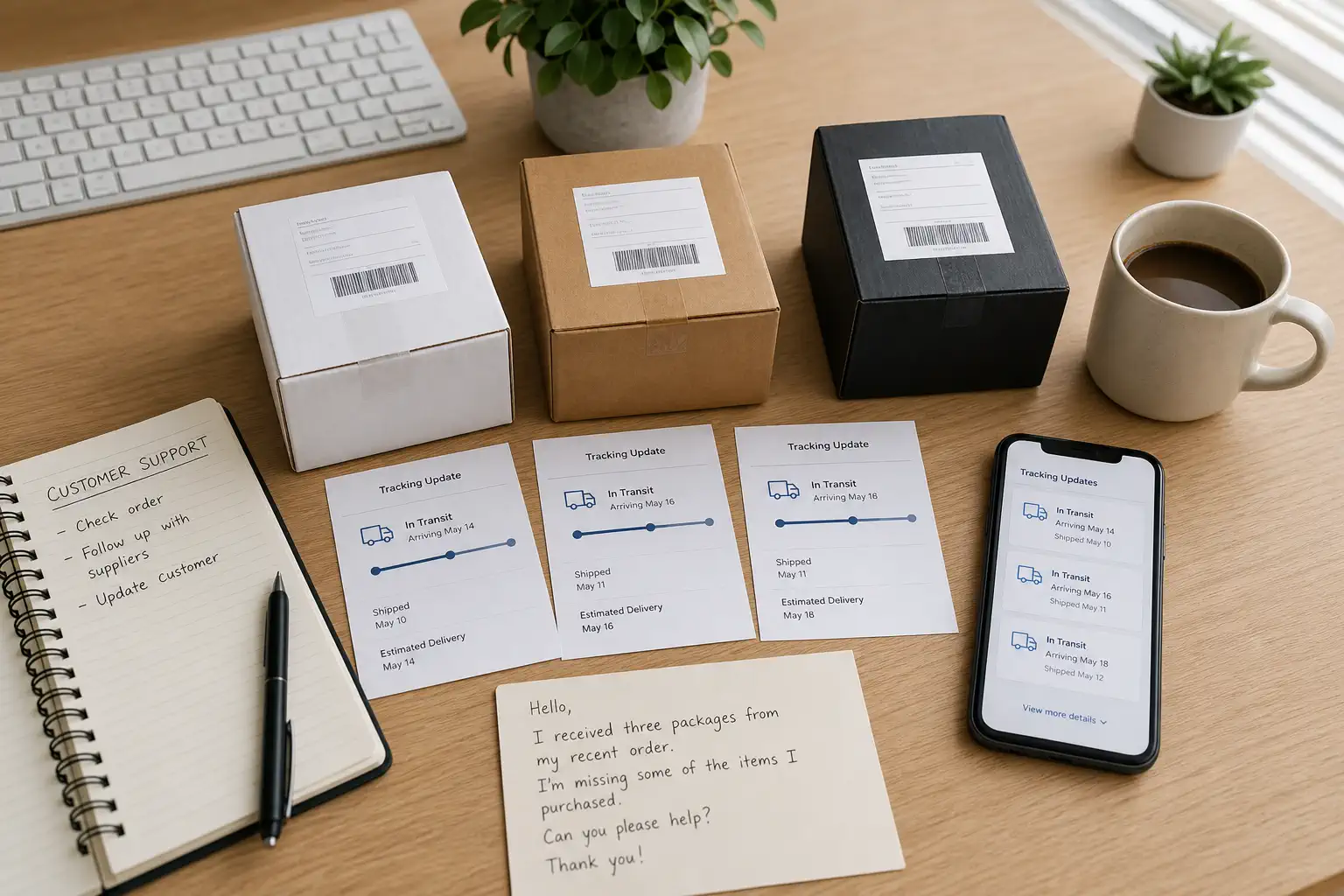
Split parcels affect customer experience because buyers usually interpret one checkout as one complete promise.
Some customers understand split shipping when a large marketplace explains it clearly. A smaller independent store has less room for confusion. If the first parcel arrives alone, the buyer may think the order is incomplete. If tracking updates only cover one item, they may believe the other items were never shipped. If supplier packaging looks unrelated to your store, the order can feel less professional.
This is especially important for:
- Bundles that are marketed as one use case.
- Accessories that must arrive with the main product.
- Giftable products where presentation matters.
- Higher-ticket orders where buyers expect tighter communication.
- Agency, mentor, or community workflows where the same process is repeated across several stores.
Customer experience is not only a delivery-speed issue. It is a clarity issue. A slower but clearly explained complete parcel can feel more controlled than three unexplained shipments moving at different speeds.
This is where order communication and physical execution meet. Your customer-service team should know whether an order is waiting for a second supplier item, held for a packaging check, partially shipped for a specific reason, or ready to combine. If your team cannot see that status, every customer question becomes a small investigation. For wider support planning, the guide to customer service for dropshipping can support the communication side of the workflow.
What order consolidation is and how it works
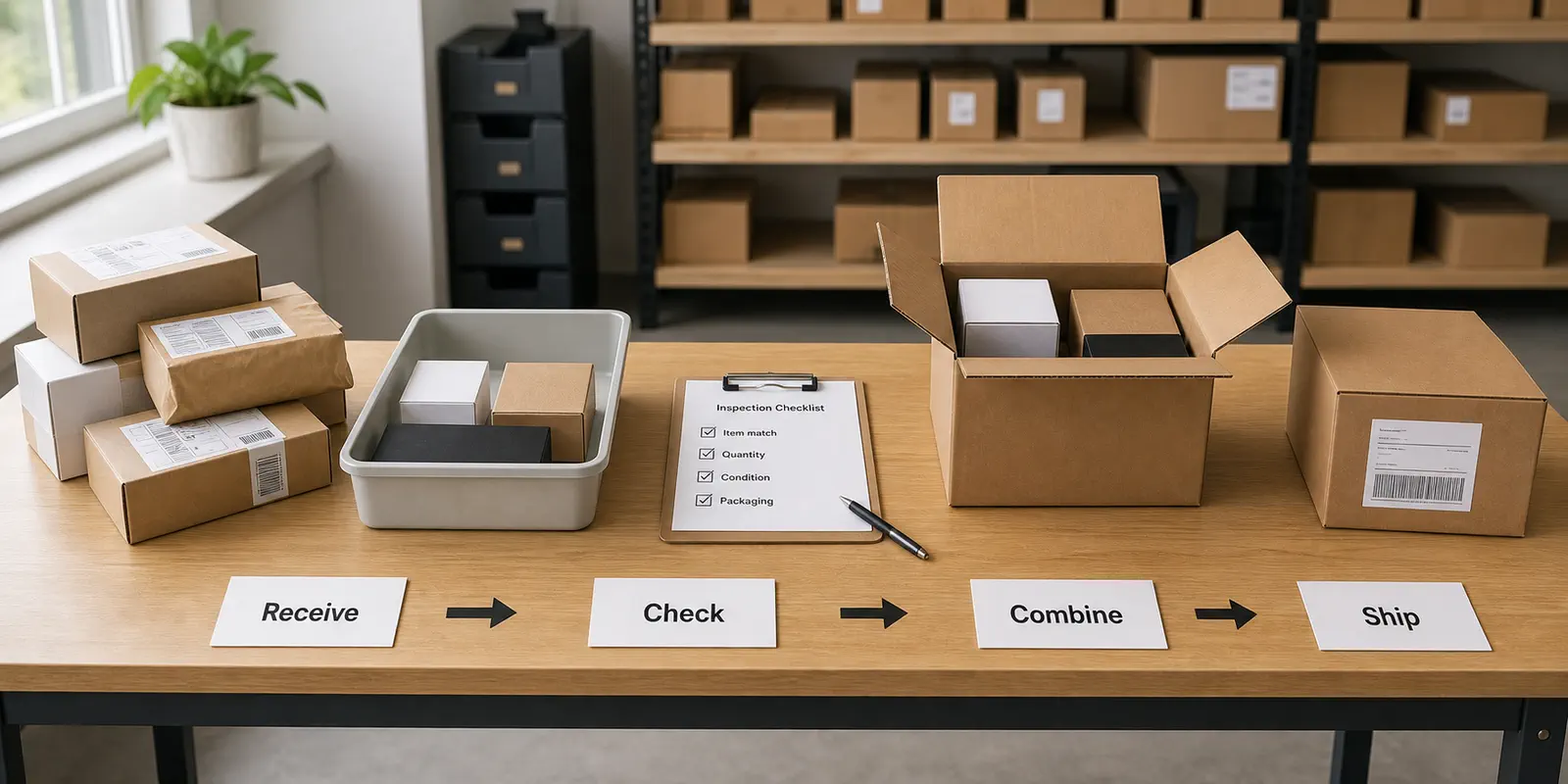
Order consolidation works by routing supplier items into one controlled receiving point before the final customer shipment.
The basic workflow has five stages:
- The Shopify order is reviewed for SKUs, variants, destination, packaging needs, and urgency.
- Supplier purchases or supplier requests are created for each required item.
- Items arrive at the receiving point and are matched against the customer order.
- The team checks quantity, variant, obvious product condition, packing needs, and whether all items are ready.
- Approved items are repacked into one outbound parcel or split intentionally with a clear reason.
The important word is intentionally. A split shipment is not always wrong. It becomes a problem when it happens by accident, without visibility, or without customer-facing explanation.
Consolidation is not the same as bulk warehousing
Bulk warehousing means storing inventory in advance. Consolidation can happen even when you are still buying supplier-by-supplier for active orders. The difference is that the order passes through a controlled receiving and packing step before international dispatch.
This distinction matters for sellers who are not ready to pre-buy large quantities. You can still create a more consistent customer experience by consolidating live orders, especially for proven bundles or repeat multi-item combinations.
Consolidation is not the same as app automation
Automation can identify which products belong to the same order. It cannot inspect the physical item, remove unsuitable supplier packaging, add an insert, or decide whether a delayed component should hold the whole parcel.
That is why Shopify apps and private-agent execution should be viewed as complementary. The app provides digital structure; the physical team provides receiving, checking, packing, and exception handling. If your current problem is frequent wrong items, missed variants, or supplier-side packing errors, those Shopify order fulfillment mistakes should be fixed before consolidation becomes the next workflow upgrade.
Key Takeaway: The goal is not to force every order into one box. The goal is to make every split-or-combine decision visible, deliberate, and aligned with the customer promise.
Start with receiving and packaging checks
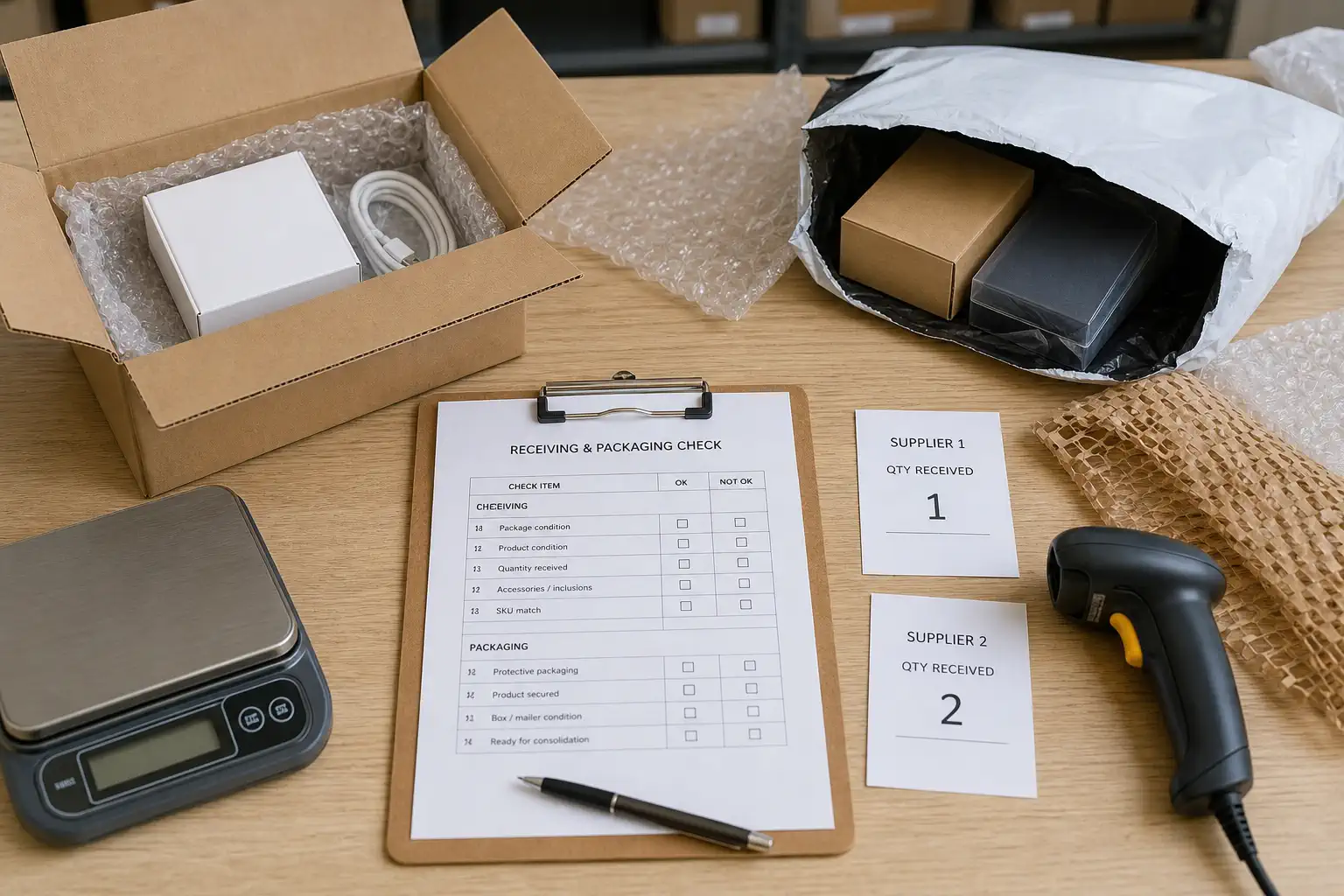
Receiving and packaging checks are the control point that makes consolidation reliable instead of risky.
When items arrive from different suppliers, the receiving team should not simply place them into a larger box. They should check whether the products match the order, whether variants are correct, whether the quantity is complete, and whether the supplier packaging is suitable for customer-facing delivery.
A practical check can include:
- Customer order number and SKU match.
- Variant, size, color, plug type, set contents, or accessory match.
- Visible damage, leakage, crushed packaging, or missing parts.
- Supplier labels, invoices, promotional cards, or factory material that should not face the customer.
- Weight and dimension review for the final shipping route.
- Whether the items can safely travel together without damaging one another.
For higher-risk categories, dropshipping quality control should happen before items are combined, because one wrong variant or damaged item inside a consolidated parcel can make the whole order look incomplete.
Packaging check before final carton
Before the final carton is sealed, confirm three things: all items belong to the same customer order, the packaging protects the weakest item, and the final presentation does not reveal supplier fragmentation.
This is also the point where you decide whether a branded insert, thank-you card, neutral mailer, protective filler, or bundle card should be added. Do not make packaging more complex than the order value justifies. Start with clean, accurate, consistent packaging before adding brand extras.
Synchronize supplier timelines before you promise one parcel
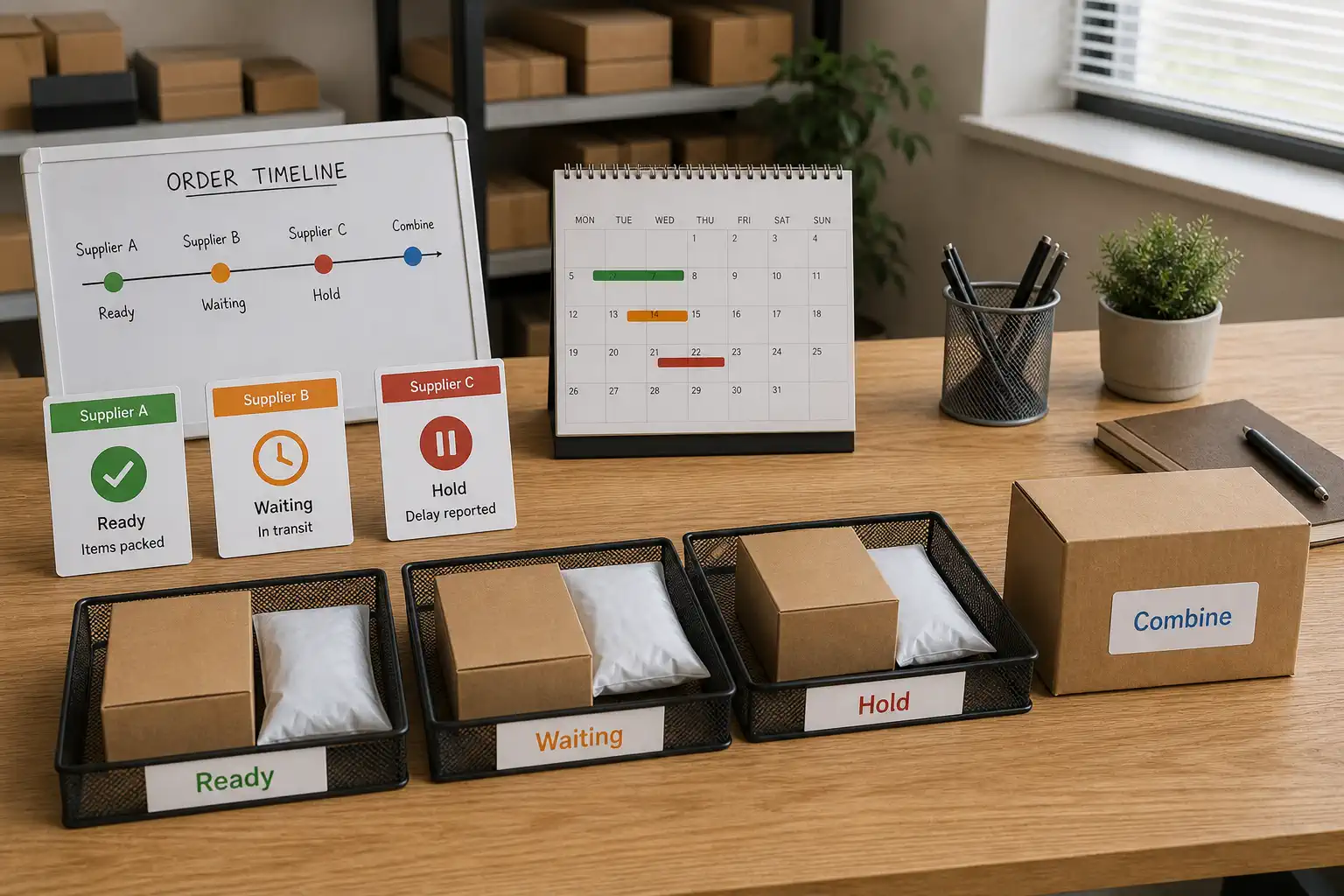
Supplier timeline synchronization decides whether consolidation improves the order or delays it too much.
The most common mistake is promising one parcel before confirming whether all suppliers can deliver to the receiving point within an acceptable window. Before the order is held for consolidation, your Shopify dropshipping inventory management rules should confirm supplier availability, variant-level stock, preparation windows, and backup sourcing options. If one component routinely arrives later, the seller must choose between holding the full order, splitting the shipment, or changing the product offer.
Use status rules before scaling bundles:
- Ready to combine: all items are received, checked, and safe to pack together.
- Short hold: one item is close enough that holding the order protects the customer experience.
- Intentional split: delay is too long, the item is oversized, or the customer should receive part of the order first.
- Supplier review: one supplier repeatedly causes delays, mismatches, or packaging issues.
The decision should be based on product type, customer promise, destination, and order value. A low-cost accessory may not justify delaying a high-value main item. A gift set may need all pieces together or the offer loses meaning.
Do not hide split shipments
If you intentionally split a parcel, say so in customer communication. The message does not need to expose every supplier detail. It can simply explain that items may arrive in separate parcels and that each tracking update will be shared when available.
Clear communication protects trust. Silence forces the customer to guess, and guessing usually creates support tickets.
Key Takeaway: Consolidation works best when supplier timing is measured before the offer scales. If you cannot predict when each component reaches the packing point, you cannot confidently promise one combined parcel.
A real case lesson from ecommerce shipping delays
A public Fashion Nova case shows why delivery promises, delay communication, and refund handling can become serious trust issues for ecommerce brands.
The FTC Fashion Nova settlement described allegations that customers were not properly notified or given cancellation and refund options when merchandise did not ship in a timely manner. This is not a dropshipping consolidation case, and it is not a Runtodropship customer case. It is still a useful operational warning: when the visible customer promise and the physical shipping reality drift apart, the problem can move beyond a single support ticket.
For Shopify sellers using several suppliers, the lesson is practical. If three items in one customer order are moving separately, you need a system that answers:
- Which item is ready?
- Which item is delayed?
- Should the order be held or split?
- Has the customer been told what to expect?
- Can the team show what was packed and when?
Can the team show what was packed and when?
The lesson is not “one combined package solves every dispute.” The lesson is that order promises must be backed by visible physical execution and timely communication.
Upgrade your flow for higher-AOV Shopify orders
Upgrade your flow for higher-AOV Shopify orders
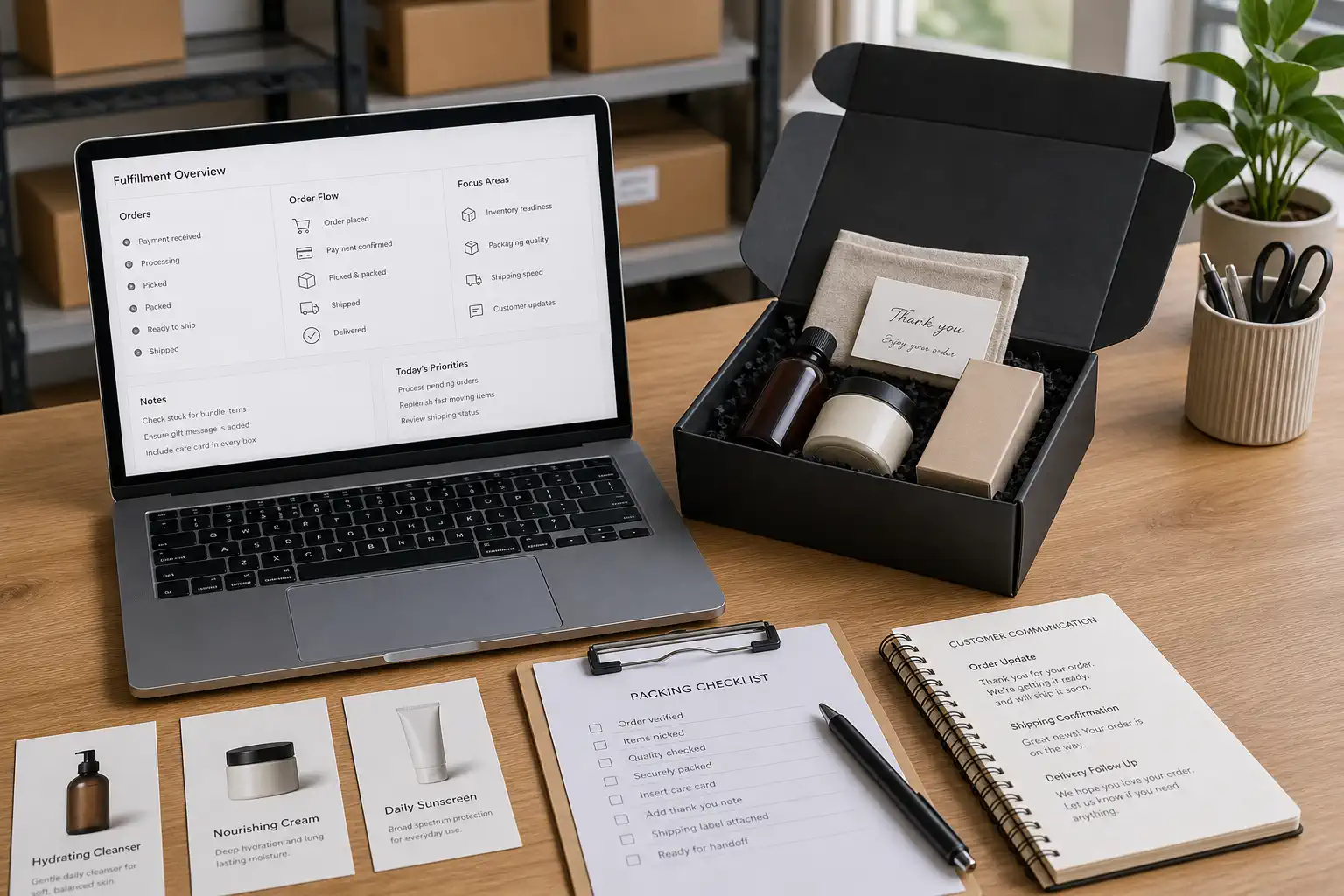
Higher-AOV stores need a consolidation flow because their growth often depends on selling more than one item per order.
Average order value rises when customers buy bundles, accessories, upgrades, replacement parts, or complementary products. But every cross-sell adds a backend responsibility. If your store sells a camera accessory kit, a beauty routine bundle, or a home-office set, the buyer expects the pieces to feel connected.
Build bundle rules by product relationship
Not every product combination deserves the same handling. Create rules:
- Must arrive together: kits, sets, gift boxes, matched accessories, replacement parts.
- Prefer together: low-risk add-ons, small accessories, inserts, lightweight extras.
- Can split: oversized items, supplier-delayed items, products with special shipping needs.
- Should not combine: products that may damage each other, leak, crush, contaminate, or trigger route restrictions.
These rules help your team make decisions without asking the seller every time.
Measure consolidation by fewer exceptions, not just fewer labels
The best success signal is not simply “we used one tracking number.” Better signals include fewer missing-item questions, fewer packing mismatches, clearer support status, and more consistent customer-facing presentation.
If you manage stores for clients, students, or community members, document these rules in a simple SOP. A repeatable process is easier to teach, audit, and improve than a private chat thread with several suppliers.
When to involve a private agent workflow
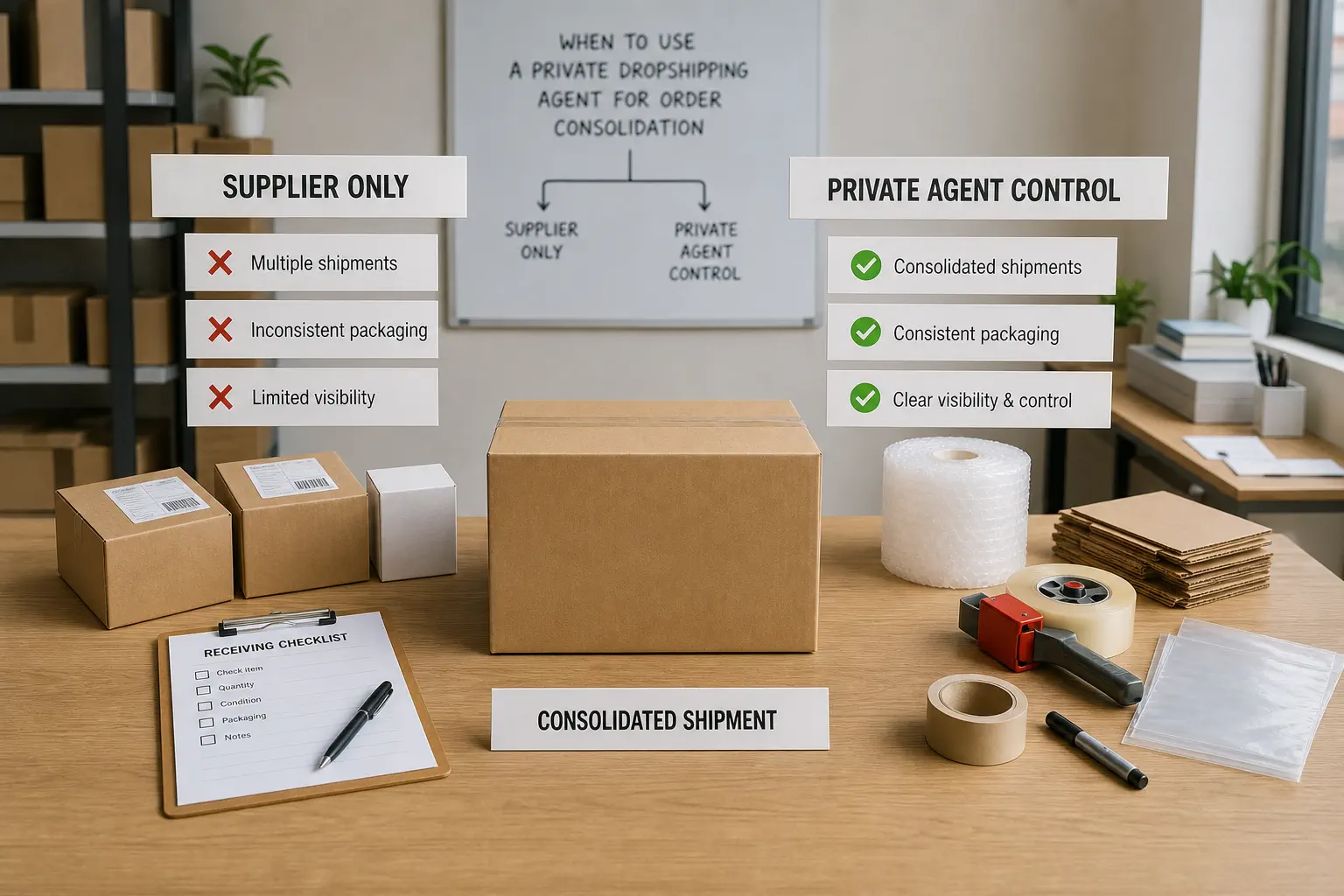
A private agent workflow becomes useful when supplier-only shipping no longer gives you enough control over multi-item orders.
You may be ready for this step when:
- Customers regularly buy two or more items from different suppliers.
- Bundle presentation matters to your positioning.
- Your support team spends too much time explaining partial deliveries.
- Supplier packaging creates brand or trust problems.
- You need a receiving point for product checks, inserts, labels, or repacking.
- You manage multiple Shopify stores, clients, students, or product tests and need a standard process.
This does not mean every small store needs a private agent immediately. If you are testing one product with low order volume, direct supplier shipping may be enough. But when you already have order activity and multi-item carts are part of your sales strategy, one accountable receiving and packing process can protect the customer experience.
Runtodropship is a private dropshipping agent, not a public supplier platform or ordinary logistics company. For qualified Shopify sellers, the relevant support can include supplier coordination, receiving, agreed product checks, packaging confirmation, order execution, shipping arrangement, and after-sales investigation. If your main problem is still supplier selection rather than combining active orders, your next step should be reviewing dedicated sourcing support instead of order consolidation.
Key Takeaway: Bring in private-agent control when the problem is no longer finding products but coordinating physical items across suppliers before the customer sees the order.
FAQ
Can Shopify combine products from different suppliers automatically?
No. Shopify can organize order data and shipping settings, but it cannot physically receive products from different suppliers and place them into one customer parcel. That requires a receiving, checking, and packing workflow outside the storefront.
Should every multi-item order be shipped in one parcel?
No. Some products should be split because of size, fragility, route restrictions, supplier delay, or customer urgency. The best workflow makes the decision intentional and visible rather than accidental.
Does one combined parcel always reduce shipping cost?
Not always. A combined parcel can reduce duplicated shipping and support work in some cases, but it can also become heavier, larger, or slower. Compare total order economics before changing the workflow.
What should I check before combining supplier items?
Check SKU, quantity, variant, visible condition, packaging suitability, supplier materials, weight, dimensions, and whether the items can safely travel together. For higher-risk products, add category-specific checks.
Is this different from using a Shopify dropshipping app?
Yes. An app can move order information, update tracking, or connect suppliers. Consolidation is physical work: receiving goods, checking them, repacking them, and deciding whether to hold or split the parcel.
Conclusion
Multi-supplier Shopify orders can look simple on the storefront and become messy in the packing workflow. The customer expects one coherent order; your backend may be dealing with several suppliers, several timelines, and several packaging standards. The solution is a controlled process: identify which orders need combining, receive supplier items in one place, check quantity and variants, decide whether to hold or split, and communicate clearly when a split is intentional.
For growing sellers, agencies, mentors, and operators managing repeatable Shopify workflows, this is where private-agent execution becomes practical. Runtodropship can help qualified sellers coordinate sourcing, product checks, packaging confirmation, order execution, shipping arrangement, and after-sales investigation through a private-agent workflow. If multi-item orders are becoming part of your growth strategy, send your product links, current order situation, supplier setup, and packaging requirements so the next step can be evaluated against real operating needs.