
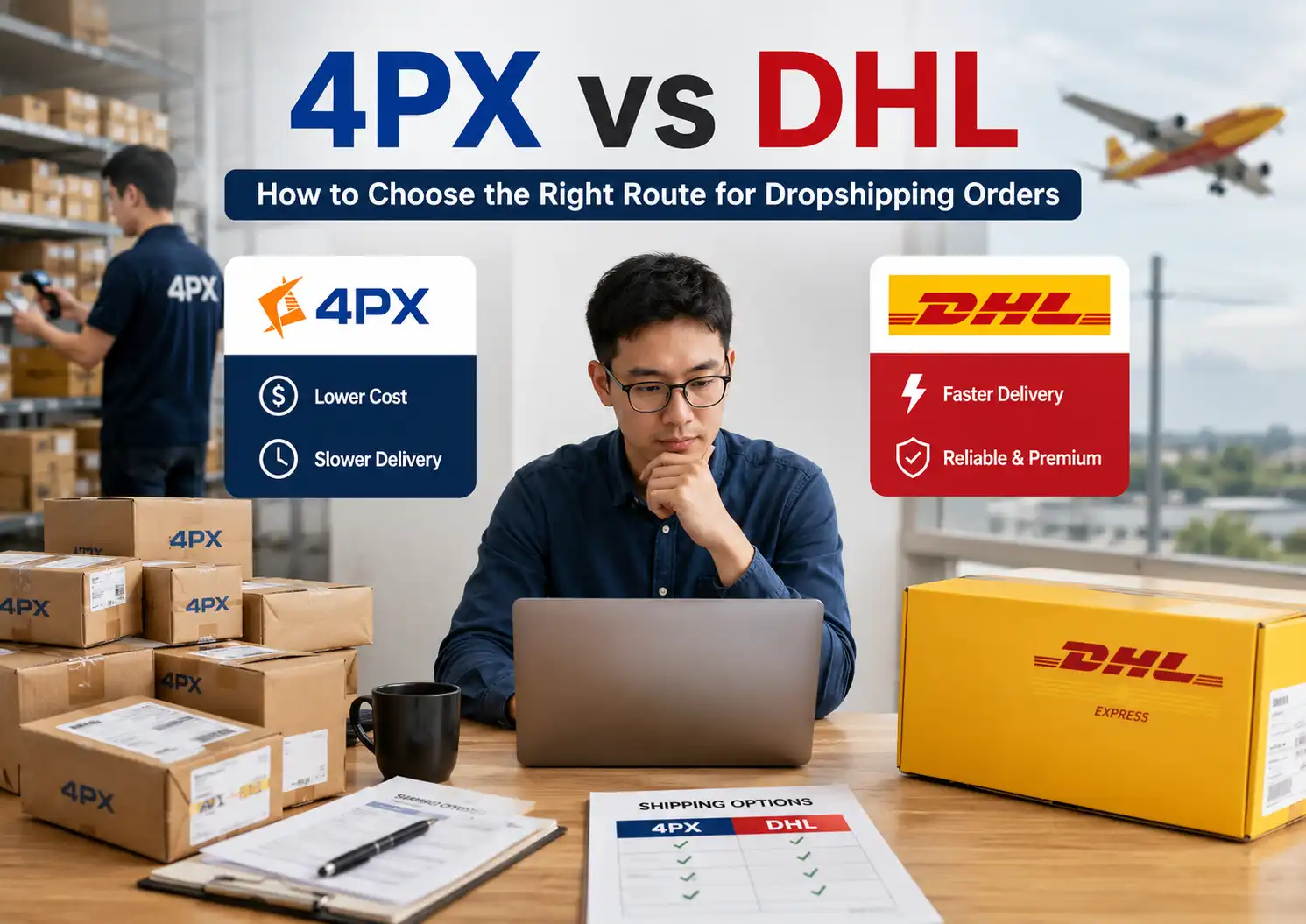
4PX is usually the better choice for lightweight, low-value orders where shipping cost protects the margin. DHL Express or FedEx is usually better for urgent, high-value, or proof-sensitive orders, while Cainiao is often most relevant when fulfillment is tied to the Alibaba or AliExpress ecosystem. For most scaling dropshipping stores, the best answer is not one carrier—it is a route mix based on the SKU, destination, and customer promise.
What Is the Core Difference Between 4PX, DHL, FedEx, and Cainiao?
The core difference is that DHL and FedEx are premium express couriers that control the entire journey, while 4PX and Cainiao are low-cost cross-border networks that hand your parcel to different partners along the way. That single structural difference explains almost every gap in price, speed, and tracking quality.
If you haven’t read the basics yet, our pillar guide on what 4PX shipping is and how it works covers the full picture. In short, 4PX is one of the largest cross-border logistics providers serving ecommerce parcels out of China, moving packages through consolidation, linehaul flights, customs, and local last-mile partners.
Here is how the four players actually differ in kind, not just in price:
- DHL Express — a global integrated courier. One company owns the plane, the customs process, and (in most markets) the delivery van.
- FedEx — same integrated model as DHL, with particularly strong coverage in North America.
- 4PX — a cross-border logistics provider. It builds routes by combining its own network with airlines, customs brokers, and destination-country postal or courier partners.
- Cainiao — the logistics arm of the Alibaba ecosystem. It is deeply tied to AliExpress order flow rather than operating as an independent carrier you contract directly.
Integrated couriers sell certainty. Cross-border networks sell affordability. Everything below flows from that trade-off.
4PX vs DHL: The Comparison Most Sellers Actually Need

The honest answer to “4PX or DHL” is that they are not substitutes — they solve different problems at different price points. Comparing them head-to-head only makes sense once you know what each order is worth to you.
DHL wins on speed, tracking density, and proof. A DHL Express shipment is scanned at nearly every touchpoint, clears customs under DHL’s own brokerage, and typically arrives with signature-capable delivery confirmation. For a seller, that last part matters more than speed: strong delivery proof is what wins payment disputes.
4PX wins on cost — often dramatically. For a lightweight parcel, a 4PX economy route can cost a fraction of a DHL Express label. On a $12 product with a $25 selling price, DHL is simply not an option; the shipping cost alone would erase the margin.
Where 4PX gives that cost back is in visibility gaps and variability. Because the parcel changes hands multiple times — origin warehouse, linehaul, customs, local delivery partner — tracking can go quiet for days in the middle of the journey, and delivery confirmation at the end may be weaker than what express couriers provide.
The practical takeaway: DHL is a per-order decision, 4PX is a portfolio decision. You use DHL when a specific order justifies it. You use 4PX when your overall unit economics demand it — and you accept the customer-service load that comes with it.
Is DHL Faster Than 4PX?
Yes — DHL is almost always faster than 4PX, usually by a wide margin. DHL Express typically delivers cross-border shipments within a few business days, while 4PX economy routes generally take one and a half to three weeks or more, depending on the exact service, destination, customs, and season.
We deliberately avoid quoting a fixed number of days here, because 4PX operates many different route products and the spread between them is large. For realistic country-level expectations, see our dedicated breakdown of how long 4PX shipping actually takes.
What matters for route decisions is the shape of the difference, not just the average:
Ranges above are illustrative industry-typical windows, not guarantees. Peak season, customs holds, and remote destinations can push economy routes well beyond these bands.
Two nuances sellers often miss:
DHL’s speed advantage compounds under pressure. During Q4 peak, economy networks slow down first because they depend on shared linehaul capacity. Integrated couriers protect their own capacity, so the speed gap widens exactly when your ad spend is highest.
“Faster” also means “more predictable.” A DHL shipment that promises three days usually arrives in three days. A 4PX route that averages twelve days might deliver in eight — or twenty-five. For customer experience, variance hurts more than the average, because you can’t write an honest delivery promise around a wide range.
Where Does FedEx Fit In?
FedEx plays the same role as DHL — a premium integrated express option — with a few practical differences for dropshipping sellers. It is not a middle-ground option between express and economy; it sits firmly in the express tier.
FedEx international services are particularly strong for US-bound shipments, where its domestic network gives it dense last-mile coverage, including many rural areas. If your store is US-focused and you need express speed on certain orders, FedEx International Priority is a direct alternative to DHL Express.
Cost-wise, FedEx and DHL land in the same bracket, and the winner on any given lane depends on negotiated rates and dimensional weight rules. Most sellers don’t choose between them philosophically — their freight forwarder or agent picks whichever has better rates on that lane that month.
For route planning purposes, treat DHL and FedEx as one category: the express tier you reserve for orders that justify the cost. The real strategic decision is between that tier, the economy tier (4PX/Cainiao), and the middle tier we’ll cover later.
Cainiao vs 4PX: Two Low-Cost Networks, Two Different Ecosystems

The key difference is that Cainiao is built around the Alibaba ecosystem, while 4PX is an independent logistics provider that anyone in the supply chain can contract with. Both are low-cost cross-border networks, but they answer to different customers.
Cainiao exists primarily to move AliExpress and Alibaba-ecosystem orders. If you dropship from AliExpress, you don’t really “choose” Cainiao — it’s the default pipe your orders flow through, and your supplier controls which Cainiao service tier gets used. That default behavior is one reason many sellers eventually look at moving from AliExpress to a private agent: it converts logistics from something that happens to you into something you decide.
4PX, by contrast, sells routes to suppliers, agents, and platforms across the industry. This makes it more flexible: an agent can pick a specific 4PX service level for a specific destination, rather than accepting whatever tier a marketplace assigns.
In day-to-day performance, the two networks feel similar to customers — comparable price points, comparable delivery windows, and the same characteristic mid-journey tracking quiet zones. The differences that matter to sellers are structural:
- Control: 4PX routes can be selected deliberately; Cainiao routing is largely dictated by the platform and supplier.
- Accountability: with Cainiao, exceptions get resolved through AliExpress’s dispute system; with 4PX via an agent, your agent chases the exception directly.
- Service granularity: 4PX offers multiple tiers per destination; on AliExpress you often only see “AliExpress Standard Shipping” without knowing what sits underneath.
If you’re comparing 4PX against other independent economy lines rather than Cainiao, that’s a different question — see our full 4PX vs YunExpress comparison for that specific matchup.
Side-by-Side: Cost, Speed, Tracking, and Delivery Proof
Here is the full comparison across the dimensions that actually affect a dropshipping business. Note that “tracking visibility” and “delivery proof” deserve as much weight as price — they determine your dispute win rate and customer-service load.
| Dimension | 4PX | Cainiao | DHL Express | FedEx |
|---|---|---|---|---|
| Model | Independent cross-border network | Alibaba-ecosystem logistics platform | Integrated global courier | Integrated global courier |
| Cost tier | Low | Low | High | High |
| Typical speed | Economy: slow-to-moderate; special lines faster | Slow-to-moderate, tier-dependent | Fast, few business days | Fast, few business days |
| Tracking visibility | Good at origin/destination, quiet mid-journey | Similar; platform-dependent detail | Dense, scan at nearly every step | Dense, scan at nearly every step |
| Delivery proof | Depends on last-mile partner | Depends on last-mile partner | Strong; signature options | Strong; signature options |
| Predictability | Moderate; seasonal variance | Moderate; seasonal variance | High | High |
| Dispute defense value | Moderate | Moderate | Strong | Strong |
| Restricted items (batteries, liquids, magnets) | Route-dependent; special lines exist | Route-dependent | Strict but well-defined processes | Strict but well-defined processes |
| Who contracts it | Suppliers, agents, platforms | Mostly the AliExpress ecosystem | Anyone with an account | Anyone with an account |
| Best for | Low-AOV, lightweight, patient customers | AliExpress default flow | High-value, urgent, dispute-prone orders | High-value, especially US-bound |
Two rows in that table are chronically underrated. Delivery proof decides whether you win an “item not received” dispute — a $6 saving on shipping means nothing if you lose a $60 chargeback. And restricted-item handling can eliminate options entirely: many economy routes refuse or return parcels containing batteries or liquids, which forces those SKUs onto specific compliant lines regardless of price.
One clarification, since it comes up constantly: all four companies are real, large, legitimate logistics operators. When tracking looks frozen or “fake,” the cause is usually label timing, seller-side delays, or handoff gaps — we unpack that fully in our guide to whether 4PX is legit.
Which Products Belong on 4PX?
4PX economy routes are the right choice for lightweight, low-value, low-risk products sold to customers who were given an honest delivery window. This is the classic dropshipping profile, and it’s exactly what these networks were built for.
A SKU is a good 4PX candidate when it checks most of these boxes:
- Low product cost — if the item costs $3–15, express shipping would destroy the margin, and a lost parcel is cheap to reship.
- Light and small — economy pricing is weight-driven; under roughly 500g is the sweet spot.
- Durable and simple — no fragile parts, no batteries, no liquids, nothing customs flags.
- Non-urgent demand — evergreen products, not birthday gifts or seasonal must-arrive-by items.
- Honest storefront promise — your product page says a realistic delivery window, not “fast shipping” over an economy route.
That last point is where most sellers hurt themselves. The route isn’t the problem; the mismatch between the route and the promise is. A customer told to expect two to three weeks rarely complains at day twelve. A customer told “ships fast” opens a PayPal case at day nine.
There’s one more condition: your customer-service capacity. Economy routes generate more “where is my order” tickets per hundred shipments than express does. If you’re a one-person operation already drowning in tickets, that hidden cost belongs in your comparison math.
Which Products Belong on DHL or FedEx?
DHL or FedEx is the right route whenever the cost of failure exceeds the cost of the label. That’s the entire decision rule — the rest is just identifying which orders fit it.
In practice, express routes earn their price on:
- High-AOV orders — when a customer pays $150+, a $25–40 express label is cheap insurance for the order, the review, and the dispute risk.
- Dispute-prone situations — orders flagged as risky, customers with chargeback history, or destinations where “item not received” claims are common. Signature-backed delivery proof is your defense.
- Time-critical purchases — gifts, event-driven products, replacements for a botched first delivery. A reshipped order should almost always go express; the customer’s patience is already spent.
- Samples and product validation — when you’re testing a new SKU or a new supplier, waiting three weeks for a sample slows your whole launch cycle.
- Brand-building phases — if you’re moving upmarket and delivery experience is part of your positioning, express delivery is a product feature, not a cost line.
The mistake to avoid is putting your entire catalog on express to “solve” complaints. That fixes customer experience by breaking your P&L. Express is a scalpel, not a blanket policy — which is exactly why route decisions should happen at the SKU and order level, not the store level.
How to Choose a Route by SKU, Country, and Customer Promise

The right way to choose is to stop asking “which carrier is best” and start asking three questions per SKU: what is this product’s risk profile, where is it going, and what did I promise the customer? Route selection is a matching exercise, not a loyalty decision.
Question 1: What is the SKU’s risk profile? Cheap, durable, non-sensitive items tolerate economy routes. High-value, fragile, battery-powered, or dispute-prone items need stronger tracking, delivery proof, or compliant special lines. The product decides the floor of acceptable service.
Question 2: Where is it going? The same carrier performs differently by destination. A route that’s reliable to one market may be slow or surcharge-heavy to another, and remote-area fees can quietly flip the economics of an express label. Route decisions should be made per country lane, not globally.
Question 3: What did you promise? Your delivery promise on the product page is a contract with the customer’s patience. If your store advertises fast delivery, your routes must back it up — our guide to fast shipping strategies for dropshipping covers how to build promises you can actually keep.
Run every SKU through those three questions and your catalog naturally splits into tiers: economy-safe items, express-mandatory items, and a large middle group that needs something better than economy but cheaper than DHL. That middle group is where most sellers lose money by forcing a bad fit in either direction.
A Real Example of Route Splitting
One seller we worked with ran a home-and-lifestyle store with a mixed catalog: lightweight textile accessories alongside battery-powered devices and a few fragile ceramic SKUs. Everything shipped on the same economy route, and the devices and ceramics generated a disproportionate share of complaints, damage claims, and disputes.
We kept the textiles on the low-cost route — it fit them perfectly — and moved the battery-powered and fragile SKUs onto lines with stronger tracking visibility, battery compliance, and pre-shipment QC checks. The store’s overall shipping spend barely moved, because only the problem SKUs changed routes, but the customer-service pressure from those categories dropped noticeably. The lesson wasn’t “economy shipping is bad” — it was that one route cannot serve a whole catalog.
You Don’t Have to Choose Between Cheap-and-Slow and Fast-and-Expensive
The biggest myth in this comparison is that your only options are a slow economy parcel or an expensive express label. Between those extremes sits a full tier of special line services — semi-express routes built for ecommerce that deliver meaningfully faster than economy with far better tracking, at prices closer to economy than to DHL.
The catch is access. These routes aren’t something you pick from a dropdown on AliExpress; they’re contracted through agents and fulfillment partners who match order volume to specific lanes. This is exactly the layer where a sourcing agent changes the equation: instead of you guessing which carrier to trust, the agent matches each SKU and destination to a tested route.
Route matching also only works when the parcel entering the route is right. A fast lane can’t fix a wrong item, a damaged unit, or a mislabeled battery shipment — which is why route selection pairs with dropshipping quality control: pre-shipment inspection, packaging confirmation, and correct declarations before the parcel ever leaves.
At RuntoDropship, this is the core of how we run fulfillment for growing sellers: sourcing, QC, packaging confirmation, route matching per SKU and destination, order execution, tracking follow-up, and exception handling when a parcel stalls. You keep economy pricing on the SKUs that tolerate it, upgrade only the SKUs that need it, and stop paying for problems after they happen instead of preventing them before dispatch.
FAQ
Is DHL faster than 4PX?
Yes, significantly. DHL Express typically delivers within a few business days, while 4PX economy routes usually take one and a half to three weeks or more depending on the service, destination, and season. DHL is also far more predictable, which matters as much as raw speed.
What is the main difference between 4PX and DHL shipping?
DHL is an integrated courier that controls the entire journey with dense tracking and strong delivery proof. 4PX is a cross-border network that combines its own infrastructure with partners, trading some visibility and speed for a much lower price.
Is Cainiao the same as 4PX?
No. Cainiao is the logistics platform of the Alibaba ecosystem and mainly moves AliExpress-related orders, while 4PX is an independent logistics provider that suppliers, agents, and platforms across the industry can contract directly. Their price and speed feel similar, but 4PX offers more route control outside the AliExpress ecosystem.
Should I use 4PX or DHL for dropshipping?
Use both, split by SKU. Lightweight, low-value, durable products belong on 4PX-style economy routes; high-value, urgent, fragile, or dispute-prone orders justify DHL or FedEx. Most scaling sellers also add special line services as a middle tier between the two.
Is FedEx cheaper than DHL for shipping from China?
They sit in the same premium price bracket, and the cheaper option varies by lane, weight, and negotiated rates. FedEx tends to be strongest for US-bound shipments; DHL often leads on broader international coverage. In practice, agents pick whichever offers better rates on a given lane.
Can I ship batteries with 4PX?
Only on specific compliant routes. Many economy lines refuse or return battery-containing parcels, so battery-powered SKUs must be matched to lines certified for them — this is a route-matching question, not a general yes-or-no.
Conclusion
4PX, Cainiao, DHL, and FedEx aren’t competitors fighting for the same job — they’re tools for different jobs. 4PX and Cainiao exist to make low-value cross-border parcels economically viable; DHL and FedEx exist to make important parcels certain. The sellers who struggle are the ones forcing a single carrier to serve an entire catalog.
The better model is route matching: economy lines for the SKUs that tolerate them, express for the orders that demand it, and special lines for the large middle ground the comparison articles never mention. Combine that with pre-shipment QC and active tracking follow-up, and shipping stops being your biggest source of complaints — and starts being a quiet competitive advantage.