
If a tracking page just told you your order is “shipped with 4PX” and you have no idea what that means, you’re in the right place. And if you’re a dropshipping seller trying to decide whether 4PX should carry your orders, this guide is written for you too.
This is the map, not the encyclopedia. We’ll explain what 4PX shipping is, how a parcel actually moves, why problems happen, and when a growing seller should stop treating 4PX as the default route for every order.
What Is 4PX Shipping?
4PX is a real, large-scale cross-border logistics company headquartered in Shenzhen, China, and “4PX shipping” simply means your parcel is being moved through its international delivery network. The full company name is 4PX Express, often branded as 4PX Worldwide Express.
In plain terms: when a product ships from a Chinese supplier to a customer in the US, UK, or Europe, someone has to collect it, fly it across the border, clear customs, and hand it to a local courier. 4PX is one of the well-known cross-border logistics providers used in ecommerce shipping from China to overseas markets. Its official website lists services including global parcel delivery, fulfillment, returns, and B2B logistics.
So when people search “what does 4PX shipping mean” or “what shipping company is 4PX,” the answer is simple. It’s not a scam label and not a mystery courier — it’s one of the highest-volume cross-border carriers serving AliExpress, ecommerce sellers, and dropshipping stores.
Where You May See 4PX Shipping
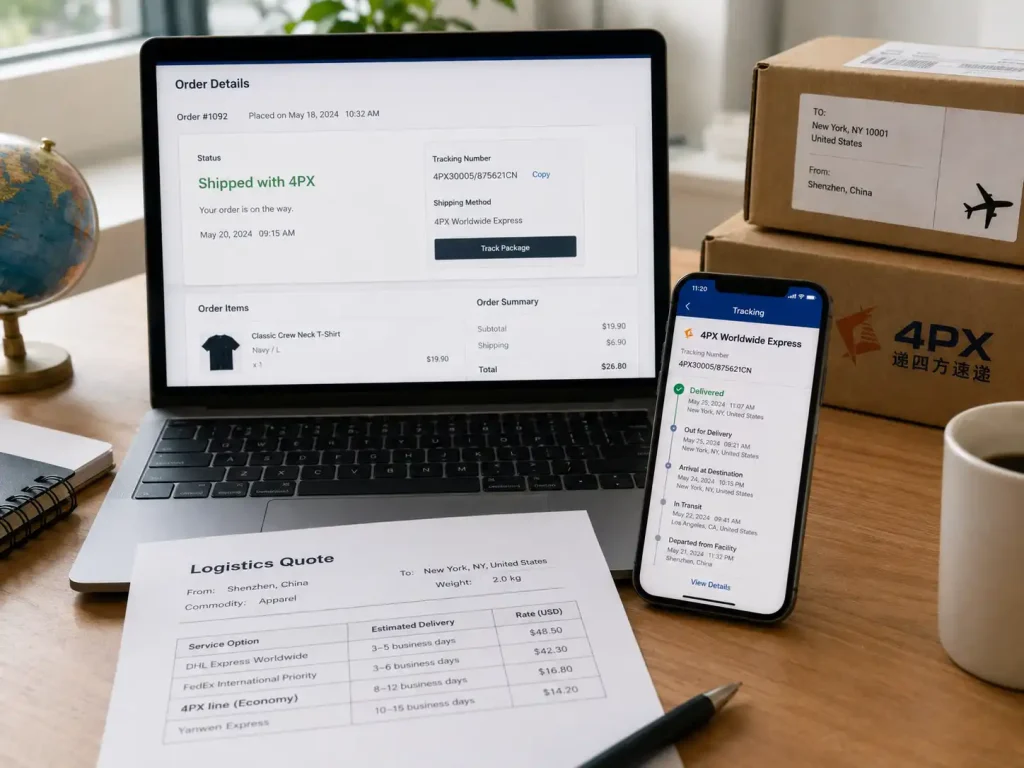
You’ll most often see 4PX on orders placed with AliExpress, independent Shopify or TikTok Shop stores, and some Amazon sellers who ship from China. Many sellers never actively “choose” 4PX — it’s bundled into the cheap or free shipping option their supplier uses.
Typical places the name appears:
- A tracking number that updates on the official 4PX tracking page
- An order status that says “Shipped with 4PX” on a marketplace
- A tracking app showing “4PX Worldwide Express” as the carrier
- A logistics quote from a supplier listing a “4PX line” as the economy option
One important detail: seeing 4PX in tracking doesn’t always mean 4PX handles the whole journey. It often manages the cross-border stage, while a local carrier in your country completes the final delivery — more on that below.
How a 4PX Parcel Moves from Seller to Customer
A 4PX parcel typically passes through four stages: pickup in China, international linehaul, customs clearance, and last-mile handoff to a local carrier. Understanding this chain explains most of the confusion people have with 4PX tracking.
Here’s the simplified journey:
- Label creation and pickup. The seller generates a shipping label, then the physical parcel is collected and scanned at a 4PX facility. These are two separate events — a label can exist days before the parcel actually moves.
- Sorting and export. The parcel is consolidated with thousands of others and prepared for an outbound flight.
- Linehaul and customs. It flies to the destination country and goes through import clearance, which can be fast or slow depending on volume and inspections.
- Last-mile handoff. 4PX hands the parcel to a destination-country carrier, which delivers it to the customer’s door. If you want to know which local companies handle this stage, see our guide on who delivers 4PX parcels locally.
Every handoff between stages is a place where tracking can pause. That’s normal for economy cross-border shipping — but it’s also why buyers panic and why sellers get support tickets.
What 4PX Worldwide Express and Other 4PX Services Mean
4PX Worldwide Express is the company’s core international parcel service, but 4PX is actually a broader logistics group with several product lines. Knowing the difference helps sellers read supplier quotes correctly.
At a high level, 4PX operates:
- Cross-border parcel lines — the economy and standard services most dropshipping orders travel on
- FBA first-leg freight — moving inventory from China into Amazon fulfillment centers
- Overseas warehousing — storage and local fulfillment in destination markets
- Postal and commercial partnerships — cooperations with postal networks and major platforms
For a typical dropshipping order, “4px shipping” almost always refers to one of the parcel lines. The exact line your supplier picks determines speed, tracking quality, and cost — even though the tracking page just says “4PX.” This is why two orders shipped “with 4PX” can have completely different experiences.
Why 4PX Is So Popular in Cross-Border Ecommerce
4PX dominates because it offers very low shipping costs at massive scale, which is exactly what low-ticket ecommerce needs. For a $15 product, a $4 shipping line is workable; a $30 express courier is not.
The main reasons sellers and suppliers default to it:
- Price. Economy lines keep landed costs low enough for thin dropshipping margins.
- Coverage. It ships to most major ecommerce destinations worldwide.
- Platform integration. Marketplaces recognize it, and tracking numbers sync into standard tools.
- Supplier convenience. Most Chinese suppliers already have accounts and daily pickups, so it’s the path of least resistance.
4PX sits in a family of low-cost China-to-worldwide carriers, alongside names like YunExpress. If you’re weighing those two specifically, read our full 4PX vs YunExpress comparison — we won’t repeat it here. Premium carriers like DHL or FedEx play a different role: they suit high-value, urgent, or proof-sensitive orders, and we compare them in detail in our 4PX vs DHL, FedEx & Cainiao guide.
Where 4PX Shipping Often Creates Problems
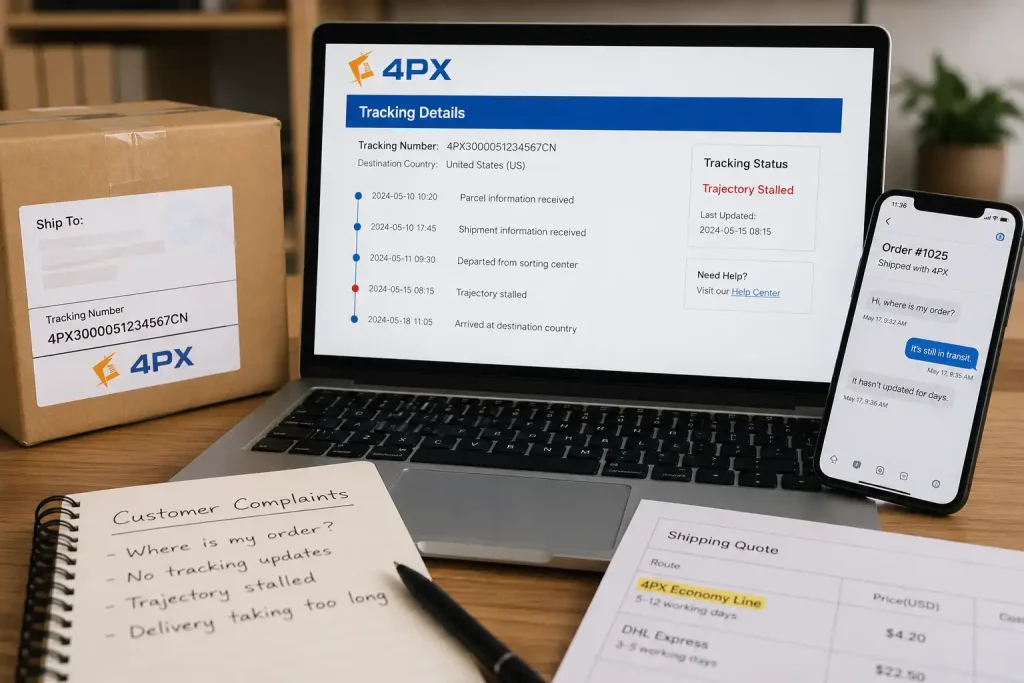
The most common 4PX problems are stalled tracking, unpredictable delivery windows, and customer complaints during handoffs — and almost all of them trace back to the multi-stage structure of economy shipping. The service isn’t broken; it’s built for cost, not for reassurance.
The recurring pain points look like this:
- Confusing tracking language. Statuses like “Trajectory Stalled” or “DN Send” sound alarming but usually describe routine handoff or label events. We decode every status in our 4PX tracking statuses explained guide — that’s the place to diagnose a specific stuck parcel.
- Wide delivery-time variance. How long 4PX takes depends on the exact service line, destination, customs conditions, the last-mile carrier, and seasonality. Peak season can stretch timelines significantly; our realistic 4PX delivery times guide breaks this down by destination.
- Visibility gaps at handoffs. When the parcel moves from 4PX to a local carrier, tracking can go quiet for days, and buyers assume the worst.
- Complaint load on sellers. Every stalled scan becomes a “where is my order” email. Sellers absorb the anxiety even when the parcel is fine — and packaging or product issues discovered on arrival make it worse, which is why upstream dropshipping quality control matters more than most sellers realize.
For buyers, these problems mean waiting. For sellers, they mean support tickets, refund requests, and payment-dispute risk. That difference is what the rest of this guide is about.
Is 4PX Legit?
Yes — 4PX is a legitimate, established logistics company, not a scam. It handles enormous parcel volumes, works with major ecommerce platforms, and is listed in Amazon’s carrier help documentation as a recognized shipping provider.
The “fake tracking” perception usually comes from something else entirely. A tracking number can be created before the parcel is ever handed to 4PX, so if a seller delays actual shipment, tracking sits frozen at an early status — and the carrier takes the blame. Scan delays and route handoffs cause similar false alarms.
If your parcel looks stuck and you’re wondering whether you’ve been scammed, don’t guess. Our dedicated guide on whether 4PX is legit or a scam walks through how to tell a delayed parcel from a real problem, and what to do in each case.
One more practical note: the shipping account holder — usually the supplier, seller, or fulfillment partner — often has more power to trace and escalate a parcel than the end buyer does. For dropshipping sellers, this is why the logistics partner behind the order matters: when something looks stuck, you need someone who can check the shipment record, confirm the handoff, and follow the exception instead of leaving you to contact the carrier alone.
Is 4PX Good for Dropshipping Sellers?
4PX can be a perfectly good choice for dropshipping — for the right products, the right price points, and the right customer expectations. The mistake isn’t using 4PX; it’s using it for everything by default.
Instead of a yes/no answer, judge route fit on five high-level points:
- Product risk. Light, cheap, durable items tolerate economy shipping. Fragile, battery-powered, or high-value SKUs punish you for every rough handoff.
- Tracking visibility. If your customers expect frequent updates, quiet handoff gaps will generate tickets.
- Delivery promise. If your store advertises fast shipping, an economy line can’t back that promise consistently.
- Complaint tolerance. Some niches forgive slow delivery; gift and seasonal niches do not.
- Payment and dispute exposure. Slow, low-visibility shipping is a known driver of chargebacks and payment-processor scrutiny.
If a SKU scores well on all five, keeping it on a 4PX economy line is a rational cost decision. If it fails two or more, the route — not the product — is your problem.
A Real Example: Splitting Routes by Product Risk
One seller we worked with was running their entire catalog on default supplier shipping, most of it through 4PX economy lines. Their light accessories shipped fine, but their fragile and battery-containing SKUs generated a steady stream of damage complaints and “where is my order” tickets.
Instead of abandoning 4PX, we split the catalog: small, low-risk items stayed on the economy route, while fragile and higher-value SKUs moved to lines with stronger tracking visibility, plus pre-shipment QC and packaging checks. Support pressure on the problem SKUs dropped noticeably, and the seller kept the cost advantage where it was safe to keep it. That kind of split is a typical first step when moving from AliExpress-style fulfillment to a private agent.
When 4PX Is Not Enough for Scaling Sellers
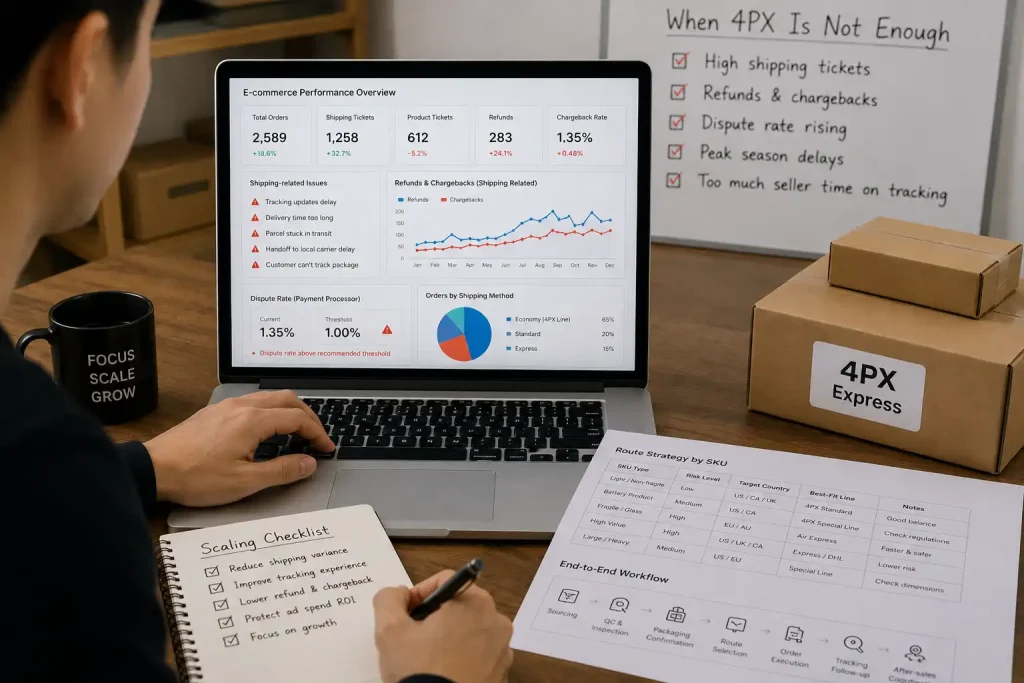
4PX stops being enough when your order volume grows to the point where shipping variance — not shipping cost — becomes your biggest expense. At scale, the hidden costs of an economy-only setup start compounding.
Watch for these signals:
- Support tickets about shipping outpace tickets about products
- Refunds and chargebacks cluster around slow or stalled deliveries
- Your payment processor starts flagging dispute rates
- Peak-season delays wipe out the conversion gains from your ad spend
- You’re spending seller time explaining tracking instead of growing the store
At that point, the fix is not “find one perfect carrier.” The fix is route matching: assigning each SKU to the line that fits its risk, price point, destination, and customer promise. A private dropshipping agent should not simply hand you a tracking number and leave you to chase the carrier. The value is in the full workflow: sourcing, QC, packaging confirmation, route selection, order execution, tracking follow-up, and after-sales coordination when an exception appears. Start with our overview of fast shipping options for dropshipping, and if you want the routing and exception handling done for you, see how working with a sourcing agent works in practice.
You don’t have to quit 4PX. You have to stop treating it as the answer to every order.
4PX Shipping Topic Hub: What to Read Next
This guide gives you the overview. Use the guides below when you need a deeper answer to a specific 4PX shipping question:
| Your question | Read this guide |
|---|---|
| My tracking says “Trajectory Stalled” / “DN Send” — what does it mean? | 4PX Tracking Statuses Explained |
| How long will my parcel actually take? | How Long Does 4PX Shipping Take? Realistic Delivery Times |
| Is my tracking fake? Have I been scammed? | Is 4PX Legit or a Scam? |
| Should I use 4PX or a premium courier? | 4PX vs DHL, FedEx & Cainiao |
| How do I reach a human at 4PX? | How to Contact 4PX Customer Service |
| How do I sync 4PX tracking to my store? | Using 4PX with Shopify and Amazon |
| Who delivers the parcel in my country? | Who Delivers 4PX in the US, UK, and Worldwide? |
FAQ
What does 4PX shipping mean?
It means your parcel is being moved through the international network of 4PX Express, a large cross-border logistics company. It’s a normal carrier designation, commonly seen on orders shipped from China.
What shipping company is 4PX?
4PX is a Shenzhen-headquartered logistics group, best known for its 4PX Worldwide Express parcel service. It handles cross-border shipping for AliExpress orders, dropshipping stores, and marketplace sellers.
Who is the 4PX carrier for final delivery?
4PX usually handles the cross-border stages, then hands the parcel to a local carrier in the destination country for final delivery. The exact local carrier depends on your country and the service line used.
Is 4PX slow?
It depends entirely on the specific service line, destination, customs conditions, and season. Economy lines prioritize cost over speed, so variance is wide — check the dedicated delivery-times guide for realistic expectations.
Can dropshipping sellers rely on 4PX?
For light, low-risk, low-ticket products, yes. For fragile, high-value, or promise-sensitive orders, sellers typically get better results matching those SKUs to routes with stronger tracking and QC.
Conclusion
4PX is one of the workhorses of cross-border ecommerce: legitimate, low-cost, high-volume, and imperfect in exactly the ways economy shipping is always imperfect. For buyers, most 4PX worries are just handoff gaps and patience problems. For sellers, 4PX is a tool — excellent for the right SKUs, expensive in hidden ways for the wrong ones.
The sellers who scale smoothly aren’t the ones who find a flawless carrier. They’re the ones who match each product to the right route, verify quality and packaging before shipment, and have someone following up on tracking exceptions before customers complain. If you’re ready to move from default shipping to deliberate routing, that’s precisely what a private dropshipping agent is for.