
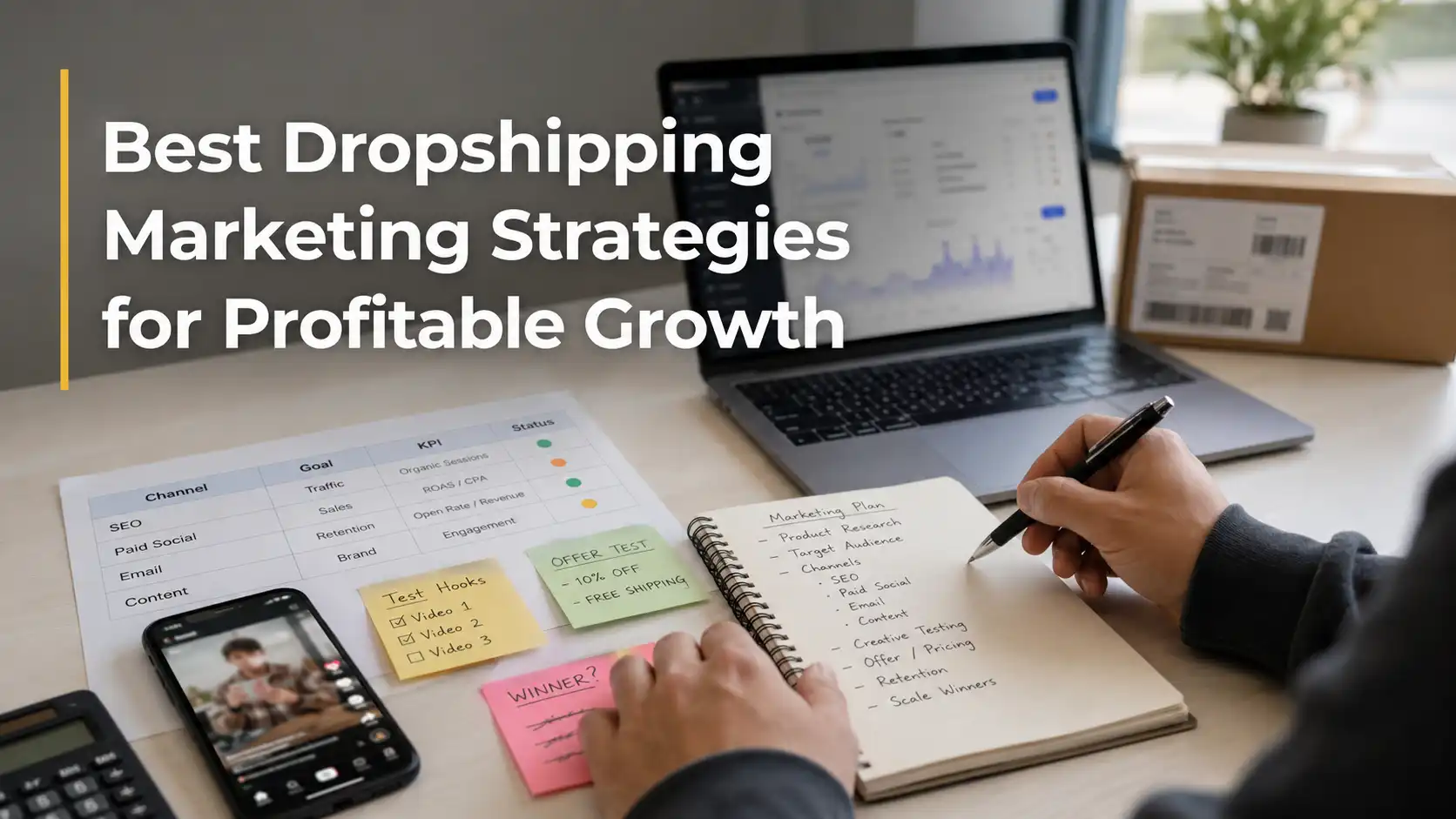
Dropshipping marketing works when your product economics, audience, offer, traffic source, and fulfillment can support one another. The goal is not to use every available channel. It is to choose a customer-acquisition method you can afford, convert that traffic efficiently, retain profitable customers, and scale only after the numbers work.
Current dropshipping marketing results already cover short-form video, paid social, SEO, email, SMS, influencers, UGC, and retention extensively. The more useful question is which strategy fits your product and business stage—and how do you know when it is working?
1. Calculate Your Marketing Economics First
Before choosing TikTok, Meta Ads, Google Ads, SEO, or influencers, calculate how much you can afford to pay for a customer.
Start with your selling price and subtract the variable costs attached to an order:
Allowable CPA = Selling Price − Product Cost − Shipping − Transaction Fees − Fulfillment Costs − Expected Refund/Replacement Cost
For example, assume a product sells for $50:
- Product: $15
- Shipping: $7
- Payment and platform fees: $2
- Expected refund/replacement reserve: $3
That leaves $23 before advertising and profit.

Spending the entire $23 to acquire the customer would produce approximately zero contribution profit on the first order. If you want $8 contribution profit, your target CPA should be around $15 instead.
You can also calculate:
Break-even ROAS = Revenue ÷ Break-even CPA
This is more useful than copying another store’s ROAS target. Two sellers can advertise the same product successfully at very different CPAs because their sourcing cost, shipping cost, refund rate, and average order value are different.
What should you calculate before running ads?
At minimum, know:
- Average order value
- Product cost
- Shipping and fulfillment cost
- Payment and marketplace fees
- Discount cost
- Refund and replacement cost
- Target contribution profit
- Maximum acceptable CPA
If these numbers are unclear, choosing an advertising channel is premature.
2. Define Your Audience, Offer, and Marketing Goal
A marketing strategy needs three decisions before channel selection:
Who are you trying to reach?
Why should they buy this product from you?
What should this campaign accomplish?
Shopify’s current marketing framework likewise treats the audience, measurable goals, budget, product, promotion, and channels as parts of the same strategy rather than treating promotion as the entire strategy.
If you are still deciding what kind of customer and use case to build around, start by finding dropshipping ideas for a focused store before choosing the acquisition channel.
Avoid an audience definition such as:
Women aged 18–45 interested in home products.
Instead, define the buying situation:
Renters with small kitchens who need more usable counter space without permanent installation.
That immediately improves your product page, ad hook, search terms, creator selection, and content ideas.
Your offer also needs to answer:
- What problem does the product solve?
- Why should someone act now?
- What makes this offer easier to trust?
- Is there a bundle, guarantee, demonstration, or delivery promise that reduces hesitation?
Finally, choose one primary objective. A launch campaign may need product validation. An established store may need lower CPA, higher repeat purchase rate, or higher average order value.
Do not optimize every metric at once.
3. Is Your Store Ready for Marketing Traffic?
Buying traffic for an unprepared store turns a marketing problem into a conversion problem.
Before increasing traffic, check the complete buying path.
Product page
A visitor should quickly understand:
- What the product does
- Who it is for
- What is included
- Price and variants
- How it looks in real use
- Expected delivery
- Returns conditions
Use original or properly licensed product media whenever possible. Supplier images alone make it difficult to build a differentiated offer.
Trust
Make contact information, shipping information, returns terms, and business policies easy to find.
Customer reviews can help, but they must be genuine. Do not manufacture social proof to compensate for a weak store.
Mobile experience
Most social traffic will encounter the store on a phone. Test the actual path from landing page to variant selection, cart, checkout, payment, and confirmation.
Tracking
Make sure the events needed to evaluate your chosen channel are working before you spend heavily.
If visitors cannot understand the offer or complete checkout reliably, more traffic simply increases wasted spend.
4. Which Dropshipping Marketing Strategy Should You Use?
There is no universally best channel. Choose based on how customers discover and evaluate the product.
| Business Situation | Strong Starting Strategy | Why |
|---|---|---|
| Low marketing budget | Organic short-form content + SEO | Trades time for lower traffic cost |
| New visual product | Short-form video + creator content | Demonstrates the product quickly |
| Impulse-friendly product | Paid social + email capture | Creates demand and captures visitors |
| Existing search demand | Google Search/Shopping + SEO | Reaches people already looking |
| Repeat-purchase product | Paid acquisition + email/SMS | Makes retention more valuable |
| Trust-sensitive product | Reviews + creators + educational content | Reduces uncertainty before purchase |
| Scaling store | Multi-channel acquisition + retention | Reduces dependence on one source |
A new store generally does not need six channels.
Choose one primary acquisition channel and one owned retention channel. Get enough evidence to understand what is working before expanding.
5. Use Organic Social and Short-Form Video to Test Demand
Short-form video remains a major part of current dropshipping marketing SERPs because it can combine product discovery, demonstration, social proof, and creative testing in one format.
It is especially useful when the product has:
- A visible before-and-after effect
- An unusual mechanism
- A recognizable everyday problem
- A satisfying demonstration
- A strong reaction or use case
The best content usually starts with the use case rather than the product specification.
Instead of:
“This organizer is made from durable material.”
Show:
A crowded drawer, the product solving it, and the finished result.
Test different angles, not just different video edits:
- Problem
- Demonstration
- Comparison
- Objection
- Use case
- Customer reaction
- Unexpected feature
If video becomes your main acquisition format, use a dropshipping video ads testing workflow to turn one angle into controlled creative variations instead of making random edits.
Organic content also gives you inexpensive information about which hooks deserve paid testing.
Do not judge success only by views. Track whether the content produces qualified profile visits, product-page visits, email signups, carts, and purchases.
6. Use Paid Social and Paid Search for Different Jobs
Paid social and paid search should not be treated as interchangeable.
Paid social
Meta and TikTok are useful when you need to create or accelerate demand for a product people may not already be searching for.
Creative is therefore central to testing.
TikTok currently recommends creative variety within ad groups rather than depending on one ad indefinitely.
Test meaningful differences:
- Different opening hooks
- Different product problems
- Demonstration versus testimonial
- Different customer situations
- Different offers
Do not create a universal rule such as “kill every ad after $40” or “never scale before exactly 50 purchases.” Your decision should depend on your CPA target, conversion volume, attribution, and platform.
Meta itself has a learning phase and warns that significant changes can affect delivery while the system is learning. That is a platform consideration, not a universal dropshipping rule.
For sellers using Meta as the primary paid acquisition channel, the deeper Facebook Ads for dropshipping workflow covers testing and scaling without turning this strategy guide into a platform manual.
Paid search and Shopping
Search-based advertising works differently because the shopper often has existing intent.
It is usually stronger when:
- People already search for the product category
- The product solves a known problem
- Search terms indicate purchase intent
- Your price and offer compare well against alternatives
For Google visibility, accurate product data matters. Google can use Product structured data and Merchant Center data to understand and surface ecommerce products across relevant experiences.
The strategic distinction is simple:
Paid social often creates demand. Paid search captures demand.
Choose accordingly.
7. Build SEO Around Ecommerce Buying Intent
SEO should not mean publishing dozens of generic blog posts.
Google explicitly recommends helpful, reliable, people-first content that offers meaningful value beyond what already exists in search results.
For a dropshipping store, SEO can work at several stages.
Product and category pages
Optimize pages around the terms real shoppers use and make the content specific to the actual product.
Avoid simply copying a supplier description that appears across many other stores. Your page needs its own useful information, images, specifications, FAQs, delivery expectations, and use cases.
Problem-solution content
Create content around problems your products genuinely solve.
Examples:
- How to organize a small kitchen without drilling
- How to keep pet hair off car seats
- How to protect furniture during a move
The product can appear naturally within the solution.
Comparison and decision content
Customers close to purchase often search for comparisons, alternatives, sizes, materials, compatibility, and use cases.
These pages can attract lower-volume but higher-intent visitors.
Product data
SEO for ecommerce also includes making product information understandable to search engines. Google’s guidance on Product structured data explains how structured data and Merchant Center feeds can provide Google with richer product information.
SEO is slower than paid acquisition, but it can reduce dependence on continually buying every visit.
8. Use Email and SMS to Get More Value From Existing Traffic
Acquiring a visitor and then losing all contact with that person is expensive.
Email and SMS create an owned audience that you can reach again without paying an advertising platform for every interaction.
Start with three core flows.
Welcome flow
Explain the offer, remove common objections, introduce the brand, and give subscribers a reason to return.
Cart or checkout recovery
Remind shoppers what they left behind and address the hesitation that may have prevented purchase.
Do not rely entirely on discounts. Delivery questions, product uncertainty, trust, and payment friction may be the real problem.
Post-purchase flow
Use this period to:
- Confirm expectations
- Provide shipping information
- Explain product use
- Request honest feedback
- Recommend relevant complementary products
- Encourage repeat purchase where appropriate
Measure revenue per recipient, conversion rate, unsubscribe rate, repeat purchase rate, and customer lifetime value rather than relying on generic industry ROI claims.
9. Use UGC, Influencers, and Reviews to Reduce Purchase Risk
A new ecommerce store has a trust problem before it has a branding problem.
Real customer content can show:
- What the item looks like outside studio photography
- How it performs
- How large it is
- How it is used
- Who it is suitable for
For influencer campaigns, audience fit matters more than follower count alone.
Before sending products, check:
- Audience location
- Typical content
- Comment quality
- Product-category relevance
- Whether previous sponsored content feels natural
- Whether you can obtain appropriate content usage rights
If creators receive payment, free products, or other benefits, follow the FTC influencer disclosure guidance so material connections are clear to the audience. The FTC requires material connections between advertisers and endorsers to be properly disclosed.
The same caution applies to incentivized reviews. Incentives cannot be conditioned on customers leaving a positive or negative review, and relevant incentives may need disclosure.
Trust built through manipulated reviews is not a sustainable marketing strategy.
10. How Do You Know Whether Your Marketing Is Working?
Do not diagnose marketing from ROAS alone.
Follow the funnel.
| Signal | Likely Area to Investigate |
|---|---|
| Ads are barely clicked | Creative, audience-message fit |
| Good clicks but little product engagement | Landing page or message mismatch |
| Product engagement but few carts | Offer, price, trust, product fit |
| Carts but weak checkout completion | Shipping, checkout, payment, unexpected costs |
| Purchases but weak contribution profit | CPA, product cost, shipping, discounts |
| Initial profit but rising refunds | Product quality, expectations, fulfillment |
| Healthy first orders but weak repeat sales | Product experience, retention strategy |
The important number is not simply revenue.
Track:
Contribution Profit = Revenue − Product Cost − Fulfillment − Shipping − Fees − Refund/Replacement Cost − Advertising
A campaign can show an attractive platform ROAS while producing poor real profit after operational costs.
That is why your ad dashboard and your order economics need to be reviewed together.
11. How Does Fulfillment Affect Marketing Profitability?

Dropshipping separates marketing from fulfillment, but customers experience them as one purchase.
If a campaign promises convenience and the order arrives late, marketing created an expectation the operation failed to deliver.
Fulfillment affects marketing through several mechanisms:
Shipping cost
Higher shipping cost reduces the CPA you can afford.
Delivery consistency
Unpredictable delivery creates more support contacts and makes it harder to communicate an accurate customer promise.
Product quality
Poor quality increases refunds, replacements, negative reviews, and the cost of acquiring future customers.
Inventory reliability
Running campaigns for unavailable variants wastes demand and can damage customer trust.
Packaging and presentation
For stores trying to build a recognizable brand, the customer experience continues after checkout.
This is where a private dropshipping agent can support marketing without pretending to be a marketing agency. Better sourcing, QC, packaging coordination, inventory visibility, and shipping execution improve the economics and customer experience behind the campaign.
The marketing team still needs to create demand. Operations need to make that demand profitable to fulfill.
12. How to Build Your Dropshipping Marketing Plan Step by Step
A practical strategy can be built in eight steps.
Step 1: Calculate your allowable CPA
Know what you can spend before choosing a paid channel.
Step 2: Define one audience and one core offer
Do not launch with five audiences and ten unrelated product claims.
Step 3: Prepare the store for traffic
Check product pages, trust elements, mobile checkout, delivery information, analytics, and conversion tracking.
Step 4: Choose one primary acquisition channel
Use product behavior to decide:
- Visual discovery → short-form social
- Existing search demand → search/Shopping
- Low cash budget → organic content/SEO
- Trust-heavy purchase → creator and educational content
Step 5: Build an owned audience
Capture email or SMS where appropriate so paid traffic can create value beyond the first visit.
Step 6: Measure the complete economics
Evaluate CPA, conversion rate, average order value, refunds, fulfillment cost, and contribution profit together.
Step 7: Decide whether to scale, fix, or stop
- Scale: acquisition and order economics are healthy.
- Fix: traffic is promising, but a specific funnel or operational problem is visible.
- Stop: the offer cannot produce acceptable economics despite meaningful testing.
Step 8: Add another channel only after learning from the first
A second channel should diversify a working system, not hide problems in the first one.
Final Thoughts
The best dropshipping marketing strategy is not the one with the most channels. It is the one that connects audience, offer, acquisition cost, conversion, retention, and fulfillment into a profitable system.
Start with your economics. Choose the channel that matches how customers discover the product. Make the store ready for traffic. Track real contribution profit instead of relying only on ad-platform metrics. Then scale what works. Marketing is only one of the six domains in the full dropshipping skill map, and it improves fastest when the domains behind it — product choice, fulfillment, and unit economics — are not quietly working against it.
For growing sellers, marketing and fulfillment should also be reviewed together. A private dropshipping agent can help control sourcing, QC, packaging, inventory coordination, and shipping so that successful customer acquisition does not create an operational problem behind the scenes.
FAQ
What is the best marketing strategy for dropshipping?
There is no single best strategy. Visual and impulse-driven products often fit short-form social and paid social, while products with established search demand can fit Google Search, Shopping, and SEO. Your margins, audience, buying behavior, and business stage should determine the channel.
How can I market a dropshipping store with a small budget?
Start with organic short-form content, useful SEO content, creator outreach, and email capture. Use the response to different products and messages to decide where paid advertising deserves investment.
Should a new dropshipping store use SEO or paid ads first?
Use paid acquisition when you need faster feedback and can afford testing. Use SEO when buyers actively research the category and you can invest in longer-term demand capture. Many stores eventually use both, but they do not need to start both at full scale.
How do I calculate a break-even CPA for dropshipping?
Subtract product cost, shipping, payment fees, variable fulfillment expenses, and expected refund or replacement costs from the revenue generated by an order. The amount remaining before advertising is the maximum theoretical CPA at break-even. Set a lower target if you require profit on the first purchase.
Can fulfillment affect dropshipping marketing performance?
Yes. Product cost, shipping cost, product quality, stock availability, delivery expectations, refunds, and replacements all affect the real profit produced by acquired customers. Marketing performance should therefore be evaluated together with order-level economics.