
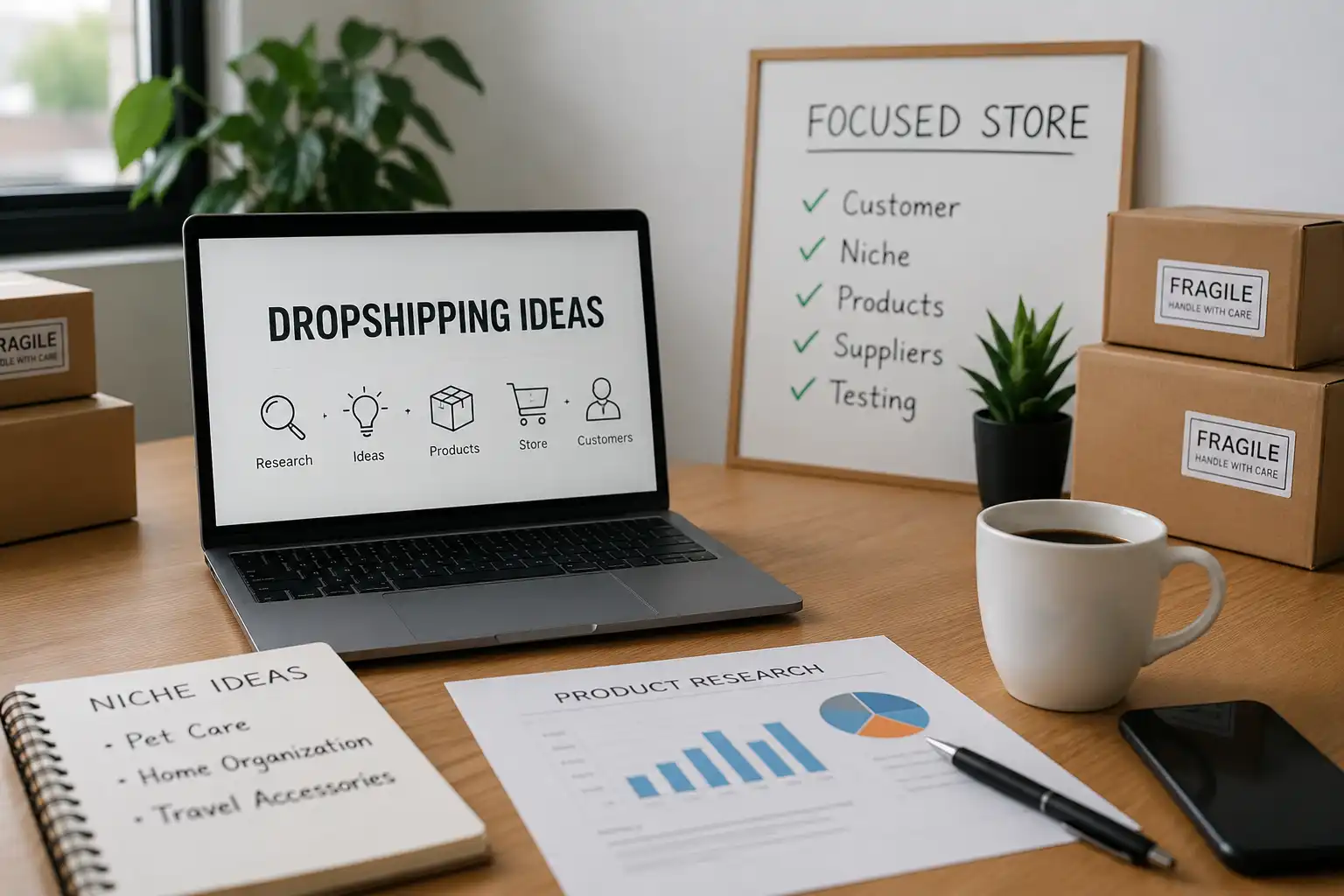
The best dropshipping ideas are not random products that happen to look popular. A stronger starting point is a clear customer, a repeatable use case, and a small product range that can support one believable store promise. Choose a concept first, reject weak operational fits, and test evidence before you build a full catalog.
Start by defining the person and situation your store will serve. Then use the same evidence questions for every candidate instead of letting one viral product or attractive supplier listing control the decision.
Dropshipping Ideas: Start With a Customer and a Use Case
A store concept should answer three questions in one sentence: who is the customer, what situation are you helping with, and what kind of products belong together?
“Useful accessories for small-apartment dog owners” is a concept. “Pet supplies” is only a category. “A light-up collar I saw in a video” is only a product.
This distinction matters because products come and go. A coherent concept gives you a reason to select one item and reject another. It also makes product pages, ads, bundles, emails, and customer support feel like parts of the same business.
Before you shortlist anything, write this sentence:
We help [specific customer] handle [specific situation] with [coherent product range].
If you cannot complete it without words such as “everyone,” “trending,” or “general,” the idea is still too broad.
Nine Store Concepts Worth Shortlisting
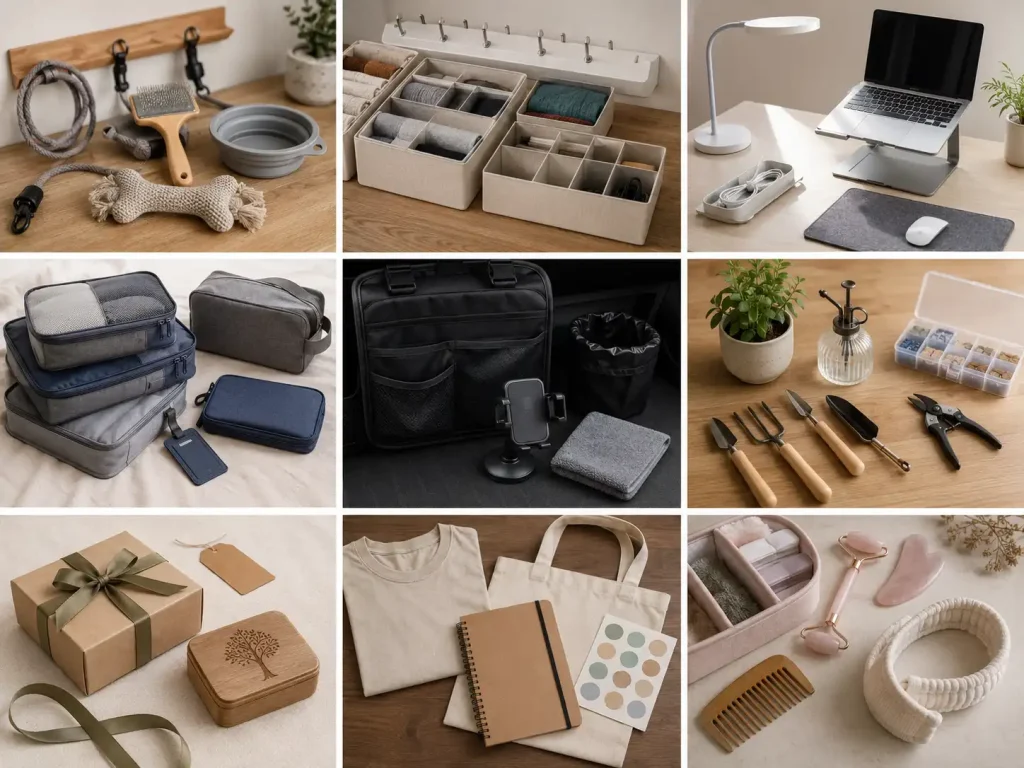
These are starting directions, not promises of profit. Each one can work only if real products, supplier performance, complete order costs, and customer demand support it.
1. Pet routines for a defined owner
Best fit: Owners with one recognizable routine, such as apartment living, road travel, grooming, or indoor enrichment.
Reason to buy: The products help the customer complete a repeated task instead of buying unrelated pet accessories.
Main risk: Fit, material safety, durability, and size expectations can create returns or complaints.
First verification: Choose one routine, read customer complaints about existing products, and request samples of the two items most likely to touch or restrain an animal.
2. Organization for one difficult space
Best fit: Renters, students, families, or remote workers dealing with one specific space such as a small kitchen, bathroom, wardrobe, or desk.
Reason to buy: A clear before-and-after use case can connect several practical products.
Main risk: Bulky dimensions, weak materials, and misleading capacity photos can destroy the value of an apparently simple item.
First verification: Measure the target space yourself, check packed dimensions, and test whether the sample holds the weight or volume shown in your content.
3. Desk comfort and focus accessories
Best fit: Remote workers, students, creators, or gamers with a defined desk setup problem.
Reason to buy: Customers can combine cable control, positioning, lighting, and storage around one working environment.
Main risk: Generic products are easy to compare, while electronics add compatibility and support questions.
If you later add powered products, use the consumer electronics dropshipping controls to check plug type, voltage, regional version, accessories, battery-route readiness, and support requirements before launch.
First verification: Start with non-electronic accessories, compare competing offers, and document one visible improvement your sample genuinely provides.
4. Travel organization for one trip type
Best fit: Customers preparing for carry-on travel, road trips, family travel, outdoor weekends, or frequent business trips.
Reason to buy: A trip creates a deadline and a connected packing task.
Main risk: Seasonal demand, size claims, and late delivery can make the product useless for the planned journey.
First verification: Build a sample packing list for one trip type, order the core products, and confirm that dimensions and delivery expectations match the promise.
5. Car care for a specific driver
Best fit: Commuters, rideshare drivers, new-car owners, families, or people who travel with pets.
Reason to buy: Cleaning, storage, and protection products can support one repeated ownership routine.
Main risk: Vehicle compatibility, liquid restrictions, fragile parts, and exaggerated restoration claims can create avoidable problems.
First verification: Limit the first range to simple, non-liquid accessories and test each sample in the vehicle type named in the offer.
6. Accessories for one hobby community
Best fit: People already invested in a hobby whose language, routines, and frustrations you understand.
Reason to buy: Knowledge of the activity can produce more useful product selection and content than a generic trend list.
Main risk: Enthusiasts notice poor specifications quickly, and some branded, licensed, or safety-critical items are unsuitable for casual sourcing.
First verification: Interview or observe real participants, identify one repeated inconvenience, and avoid products whose performance you cannot personally check.
7. Personalized gifts for one occasion
Best fit: Buyers shopping for a defined event or relationship, such as weddings, new homes, graduations, or pet memorials.
Reason to buy: Personalization can make the offer less interchangeable than a generic gift catalog.
Main risk: Misspellings, unclear previews, production delays, and limited return options raise the cost of mistakes.
First verification: Submit a real sample order with difficult text, check the preview and final product, and write an approval process before accepting customer orders.
8. Creator or community merchandise
Best fit: Creators, clubs, newsletters, events, or small communities that already share an identity.
Reason to buy: Print-on-demand can connect products to original designs without requiring a broad ready-made catalog.
Main risk: A design alone does not create demand, and print quality, garment fit, production location, and intellectual-property rights still need verification.
First verification: Use only designs you have the right to sell, order the most important variants, and ask a small existing audience to choose between two finished concepts.
9. Non-ingestible self-care tools
Best fit: Customers following a simple grooming or relaxation routine that does not depend on medical or therapeutic claims.
Reason to buy: A routine can connect tools, organizers, and accessories around a clear moment of use.
Main risk: Skin contact, cleaning, materials, electrical safety, and unsupported health claims can turn a promising category into a high-risk launch.
First verification: Remove products that require a claim you cannot support, request material and care information, and personally inspect every sample that touches skin.
Before copying another store’s catalog, study these dropshipping store examples for observable lessons in audience focus, product range, traffic strategy, and customer promise—without assuming their current profit or fulfillment model.
Compare Your Shortlist With the Same Six Questions
Do not compare one concept by search volume, another by a viral video, and a third by your personal interest. Put every finalist through the same questions.
If you use marketplace research tools to build the shortlist, the AliExpress Dropshipping Center data guide explains how to read listing and supplier signals without treating them as proof of demand, margin, or delivery reliability.
Use market research and competitive analysis to examine demand, market size, saturation, pricing, and possible differentiation. Then assess buyer access and operational fit with product-specific evidence rather than impressive-looking numbers.
| Question | Evidence to collect | Warning sign |
|---|---|---|
| Is there a clear customer situation? | Search language, reviews, forums, customer conversations, and competing offers | You can describe only a broad demographic or product category |
| Is the reason to buy specific? | A repeated task, frustration, deadline, identity, or visible outcome | The only reason is “it is trending” |
| Can the offer be meaningfully different? | Better selection, clearer education, a useful bundle, original design, or stronger service | Your plan depends on copying the same listing and ad |
| Can one completed order support the business? | Product cost, shipping, payment cost, returns, replacements, and customer-acquisition assumptions | Margin exists only when you ignore a major cost |
| Can the product arrive as promised? | Sample quality, packed size, tracking, destination eligibility, and return path | The supplier cannot confirm the exact variant and route |
| Can you reach the buyer credibly? | Content topics, communities, search behavior, creator fit, or existing audience access | Your only channel plan is “run ads” |
Score the evidence, not your excitement. A concept with moderate visible demand and a credible customer route is usually a better first test than a fashionable category you cannot explain, deliver, or promote.
Key Takeaway: Keep only concepts that answer all six questions with observable evidence. A missing answer is a research task, not permission to assume the best.
Turn One Concept Into a Testable Offer
Once a concept survives the comparison, narrow it into a one-sentence offer:
For [customer] who needs [job or outcome], this store offers [small coherent range] selected for [verifiable difference].
For example:
For apartment dog owners who need calmer indoor routines, this store offers compact enrichment and storage accessories selected for small spaces and easy cleaning.
That sentence gives you a practical filter. A product belongs only if it serves the named customer, supports the named situation, and passes the stated difference. This prevents a store from becoming a collection of whatever a supplier happens to list.
Next, shortlist a few products that can demonstrate the promise together. Do not add dozens of variants before you know whether the core offer makes sense. For deeper SKU-level checks, use the product-selection process after the concept is clear.
Reject a Weak Concept Before It Consumes Your Budget
Some ideas deserve to stop before a store, logo, or advertising campaign exists.
Reject or redesign a concept when:
- it depends on medical, environmental, performance, or safety claims you cannot verify;
- its products are fragile, bulky, restricted, size-sensitive, or hard to return without enough margin and operational control;
- customers can buy an identical item more conveniently and you have no stronger selection, explanation, design, bundle, or service;
- the supplier will not provide enough information or a representative sample;
- the buying reason exists only inside a short-lived social trend;
- you cannot name a credible way to reach the customer;
- the complete order economics work only after excluding returns, replacements, payment costs, or acquisition costs.
A risk does not always mean “never sell this.” It means the idea needs stronger evidence and controls before it earns a test. New sellers should usually favor products they can inspect, explain, ship, and support without complex claims.
Key Takeaway: The cheapest failure is the concept you reject on paper. Treat unclear claims, weak differentiation, and untestable delivery as stop signs until evidence resolves them.
Run a Small Evidence Test Before Building the Full Store
Your first test should answer a decision, not merely produce traffic. The UK government’s guide to testing and validating a business idea recommends examining customer needs, competitor pricing, route to market, willingness to pay, and feedback from a limited first version before expanding.
- Write the customer-and-use-case statement.
- Choose one narrow offer and a small product set.
- Review current search interest, competing offers, customer complaints, and community language. Google Trends can help you compare direction and seasonality, but it does not prove that buyers will choose your offer.
- Order representative samples and test quality, instructions, packaging, tracking, and the return route.
- Build one honest offer page with your own explanation and verified product details.
- Put the offer in front of a relevant audience with a limited time and budget.
- Record what people did: ignored it, asked questions, added to cart, bought, complained, or returned.
- Continue only when the evidence identifies a buyer, a workable offer, and an operational path you can support.
Do not interpret a few clicks as proof of a business. Look for a chain of evidence: the right people recognize the problem, the offer earns meaningful action, the order can be delivered as described, and the remaining economics justify another test.
Key Takeaway: Set the test limit and success criteria before spending. The goal is to learn whether the concept deserves the next controlled step, not to defend your first guess.
FAQ
Is a one-product store or a niche store better for a first test?
A one-product store can make the message and test easier to control, but it depends heavily on one item. A niche store gives you more room for related products and repeat offers, but it can become unfocused. Choose the smallest structure that expresses one customer promise clearly; expand only when a new product serves the same audience and use case.
Can print-on-demand help test a store concept?
Yes, when original design or community identity is central to the offer. It can reduce the need to commit to finished inventory before demand is clear. You still need to verify samples, production routes, sizing, print quality, intellectual-property rights, and what happens when a personalized order is wrong.
Do I need Shopify to test a product direction?
No. You need a credible way to show the offer, capture real customer behavior, and fulfill any order you accept. A simple landing page, approved marketplace listing, social storefront, or ecommerce platform can serve different tests. Choose the channel your target customer already uses and confirm its current product and seller rules before listing.
Can I change my niche after launch?
Yes, but change it from evidence rather than panic. Keep the parts that attracted the right customers, then adjust the audience, use case, product range, or message that failed. If the new direction serves a different customer and buying reason, treat it as a new concept with a new validation test.
Is high-ticket dropshipping a separate business model?
It uses the same basic supplier-direct order structure, but the operating demands can be different. Higher-priced or larger products may need stronger pre-sale education, more cash-flow room, better damage and return controls, and more responsive support. Treat it as a distinct risk and sales path inside your concept evaluation, not as automatic proof of better profit.
Conclusion
A useful store direction begins with a customer and a situation, not a long list of fashionable products. Shortlist coherent concepts, compare them with the same evidence, eliminate operationally weak choices, and run one limited test before building a large catalog.
If your test produces repeatable demand and supplier coordination, sample checks, packaging, or order execution become the next constraint, RuntoDropship can help you assess a private dropshipping agent workflow for that validated stage.