

Reverse dropshipping is a cross-border retail model in which you source a higher-value or hard-to-find product from a mature supply market and sell it to customers in a destination where that exact product is difficult to obtain. The supplier holds the stock and sends each paid order to the customer, while you remain responsible for the offer, price, compliance, delivery promise, and customer resolution.
The opportunity is a destination-specific access gap—not the fact that a product is foreign or expensive. This model is worth testing only when that gap survives five checks: local availability, import legality, delivered price, supplier execution, and after-sales support.
For example, a specialist pen that is difficult to find in one destination may justify a route test, while a fashionable fragrance aimed at another market may fail immediately because resale permission, product registration, or liquid transport is unresolved. The decision belongs to the complete route, not the prestige of the source country.
What Is Reverse Dropshipping?
The model reverses the direction associated with conventional low-cost dropshipping. Instead of moving inexpensive goods from a large manufacturing base to wealthier consumer markets, it usually moves premium, specialist, or origin-sensitive goods from markets such as the United States, Europe, Japan, or South Korea into an emerging or high-growth destination.
China-origin sourcing can still support a viable cross-border store, but ordinary Alibaba dropshipping does not become reverse dropshipping unless the route genuinely moves against the commonly associated market direction and solves a verified destination access gap.
“Reverse” describes the commercial direction. It does not mean customer returns, reverse logistics, retail arbitrage, or adding a large markup to an imported product.
Three conditions define a credible route:
- customers in the destination market have a specific access, authenticity, specification, or trust problem;
- a supplier in the source market can legally sell and ship genuine goods to individual customers there; and
- the completed order remains viable after international delivery, import charges, payment fees, marketing, support, and problem orders.
If those conditions do not exist together, the offer is ordinary cross-border selling or an expensive delivery experiment; it is not a defensible reversed-market model.
How Does the Reversed Market Flow Work?
The checkout sequence still looks like dropshipping, but the market direction changes what you must prove before launch.
- You identify a destination where an exact product, specification, or trusted origin is difficult to access.
- You confirm whether the item can be advertised, sold, imported, paid for, delivered, and returned on that route.
- You contract a source-market supplier that permits international resale and direct-to-customer shipping.
- You publish a localized offer with an honest delivered price, duty treatment, arrival range, and return process.
- After the customer pays, you submit the order and pay the supplier.
- The supplier ships the parcel, but you monitor delivery and resolve customer problems.
The supplier handles the parcel. You still own the commercial promise. That distinction matters because a carrier or supplier cannot repair an unlawful listing, a misleading authenticity claim, an unexpected duty charge, or a return policy that cannot be executed.
How Is It Different From Standard Dropshipping?
Standard dropshipping and the reverse model differ mainly in where the advantage comes from. A conventional store may compete through price, novelty, or rapid product testing. The reversed model must solve a destination-specific access or trust gap that is strong enough to justify a more difficult international order.
| Decision | Standard model | Reversed model |
|---|---|---|
| Typical direction | Lower-cost production market to a wealthier consumer market | Mature supply market to an underserved or high-growth destination |
| Product advantage | Price, convenience, novelty, or offer execution | Scarcity, verified origin, specialist specification, or trusted quality |
| First research question | Can this offer attract buyers? | Why can the destination customer not buy an acceptable equivalent locally? |
| Main cost pressure | Advertising and price competition | Product cost, international shipping, import charges, and localization |
| Main trust problem | Why buy from this store? | Is the product genuine, suitable, importable, and worth the final price? |
Both models avoid stocking inventory, and both leave the seller responsible for product claims, customer communication, refunds, and applicable selling rules. A broader dropshipping advantages and disadvantages guide covers those shared characteristics.
Key Takeaway: Use the reversed model only when the destination access gap explains why a customer would accept the extra cost and complexity. A fashionable label proves nothing.
Which Products and Markets Fit This Model?

The strongest candidates are usually small enough to ship economically, valuable enough to absorb cross-border costs, difficult to substitute locally, and simple enough to support from another country. Premium is not a product category; it is a customer judgment that must be supported by origin, materials, performance, design, authenticity, or a specialist specification.
Useful product directions include:
- Origin-sensitive craft and design goods: premium Japanese stationery, specialist European kitchen tools, or small-batch design accessories where provenance matters and can be documented.
- Professional or hobby products with exact specifications: precision hand tools, fountain pens, optical accessories, musical accessories, or specialist cycling components that customers search for by model or standard.
- Durable, high-value-to-weight upgrades: compact components or accessories that are expensive relative to parcel size and do not require local installation.
- Authorized personal-care or beauty products: potentially attractive where trust and authenticity matter, but often harder because ingredients, claims, registration, labeling, liquids, and parallel-import rules can apply.
Avoid starting with food, supplements, medical products, dangerous goods, fragile items, temperature-sensitive goods, large parcels, unclear branded inventory, or products whose battery, radio, warranty, or repair requirements have not been checked.
Four concrete route hypotheses
The examples below are research starting points, not claims that demand currently exists or recommendations to enter these markets.
| Route hypothesis | Why it could fit | What must be verified first | Likely rejection reason |
|---|---|---|---|
| Premium Japanese fountain pens and archival notebooks → India | Specific origin, nib, paper, or collector preferences may be hard to substitute | Exact local SKU availability, authorized resale, landed price, and damage rate | Strong local distributors or duties remove the access advantage |
| German specialist hand tools → Indonesia | Professional buyers may value a precise standard or trusted origin | Local alternatives, certification, parcel weight, warranty, and replacement parts | Heavy shipping and unusable cross-border warranty erase the value |
| US specialist cycling components → Brazil | A compact, model-specific component may solve an availability gap | Compatibility, local inventory, tariff treatment, delivery reliability, and returns | Import cost, long delivery, or fit-related returns overwhelm the margin |
| French niche fragrance → China | Origin and authenticity may create interest | Brand permission, cosmetics rules, labeling, liquid transport, duties, and returns | Regulatory and shipping friction makes direct parcel fulfillment unsuitable |
The fourth example is intentionally a possible rejection. A visible demand signal does not make a route operationally feasible.
For broader methods of comparing product candidates, use the site’s dropshipping product research framework. On this page, the narrower question is whether one named product solves one destination access gap and can legally complete that exact route.
Key Takeaway: Approve a market and product together. Reject the pair if a local substitute, import rule, shipping constraint, or unusable after-sales path removes the reason to buy.
What Are the Main Advantages and Disadvantages?
The model can support a differentiated offer, but most of its benefits are conditional and most of its weaknesses appear after checkout.
| Potential advantage | Required condition | Matching disadvantage |
|---|---|---|
| Less direct price competition | The exact item or trusted equivalent is genuinely scarce locally | The seller must prove the gap instead of assuming foreign equals desirable |
| Higher revenue per order | Customers accept the complete delivered price | Higher supplier, shipping, duty, refund, and payment exposure per order |
| Stronger origin or authenticity story | Provenance and selling rights are documented | Counterfeit concerns and parallel-import rules can increase legal and trust risk |
| Focused niche positioning | A specific buyer group values the specification | Demand may be narrow and expensive to reach |
| No inventory held by the seller | The supplier can dispatch single international orders reliably | You have less control over stock, packing, documents, and dispatch |
The biggest advantage is not a high price. It is a defensible reason the destination customer cannot obtain the same outcome easily. The biggest disadvantage is that every order crosses more commercial and regulatory boundaries while the seller controls less of the physical execution.
Key Takeaway: The model is attractive when scarcity or trusted specification is real and measurable. It is unattractive when the supposed advantage depends on status, markup, or a customer ignoring local alternatives.
Is the Reversed Model Legal?
The business model is not inherently illegal, but a specific product, claim, sale, payment, or import route can be unlawful. Legality must be checked for the seller’s jurisdiction, the supplier’s export location, the destination country, the product category, and the selling channel.
Before accepting orders, identify and verify:
- required business, tax, importer, or marketplace registrations;
- whether the product is prohibited, restricted, licensed, tested, or subject to destination labels;
- the correct product description, origin, customs value, tariff classification, and supporting documents;
- trademark authorization, genuine-goods records, territorial distribution limits, and parallel-import rules;
- advertising, safety, warranty, cancellation, refund, privacy, and consumer-information duties; and
- who acts as importer of record and who pays duties and taxes.
Import licensing is a separate administrative requirement in some markets and for some goods; it is not replaced by paying a carrier. The WTO’s Import Licensing Procedures text explains the role of licensing regimes, while the International Trade Administration’s country guides point exporters to destination-specific import, labeling, standards, and restricted-goods information. For branded goods, the applicable exhaustion and parallel-import rule must be checked in the destination; it is not safe to assume that genuine goods may always be resold across every border.
This is a compliance framework, not country-specific legal advice. For a real route, confirm the current rules with the destination customs authority, product regulator, tax authority, consumer regulator, marketplace, payment provider, and qualified local adviser where the exposure is material.
What Does a Realistic Profit Example Look Like?
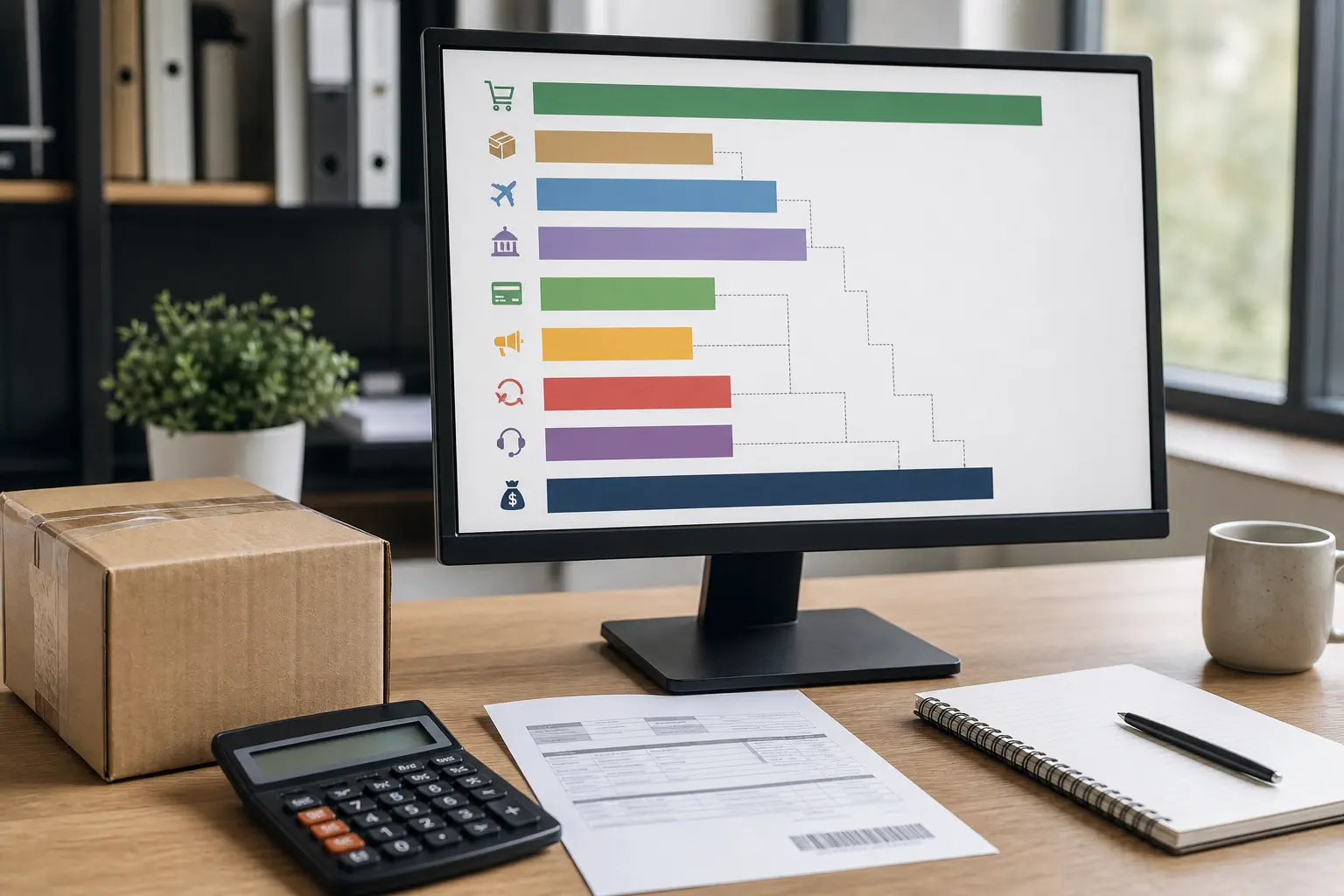
Consider a hypothetical compact specialist product sold for $160. These figures illustrate the calculation; they are not a forecast or a claim about any product or market.
| Order item | Amount |
|---|---|
| Customer payment | $160 |
| Supplier product cost | −$70 |
| International shipping | −$18 |
| Duties or taxes absorbed by the seller | −$12 |
| Payment and currency fees | −$7 |
| Customer acquisition cost | −$28 |
| Return or replacement allowance | −$10 |
| Platform and support allocation | −$5 |
| Expected order contribution | $10 |
The store shows a $90 difference between selling price and product cost, but only $10 remains after the full order, or 6.25% of revenue in this example. The visible product spread is not the order profit. If one lost or damaged parcel requires another $70 product and $18 shipment, that order moves from a $10 contribution to a $78 loss before any extra support cost. One replacement can turn a positive order into a substantial loss.
Run at least three cases before launch: the expected order, a cost shock, and a problem order. Use a range when duty, acquisition cost, returns, or exchange rates are not yet known. Replace assumptions with completed-order data as soon as the test produces it.
Key Takeaway: High ticket value does not guarantee high profit. Continue only when the complete order can absorb realistic delivery, acquisition, and exception costs without depending on an optimistic markup.
How Should You Validate One Route?

Use four route-specific gates instead of repeating a general product-testing workflow.
- Demand-gap gate: Name the exact destination customer, unavailable or distrusted local alternative, required specification, and final price hypothesis. Stop if acceptable local supply already solves the problem.
- Import-feasibility gate: Confirm selling rights, product restrictions, labels, documents, importer responsibility, taxes, payment support, and the return path. Stop before listing if a required approval is missing.
- Parcel gate: Send the exact SKU through the planned source-to-destination route. Inspect packing, declarations, tracking, customs handling, delivery, and any unwanted supplier invoice or promotion.
- Completed-order gate: Test a narrow offer and measure paid orders, delivered orders, acquisition cost, import surprises, support time, cancellations, refusals, returns, and contribution. Expand only when the whole route works.
Keep the test to one supplier, one destination, and a small product set. The purpose is not to prove that the category is popular; it is to prove that this reversed route produces a lawful, supportable, financially acceptable completed order.
Key Takeaway: Validate the destination gap and import path before spending heavily on demand. Advertising cannot repair a route that should never have accepted the order.
Is It Worth Doing?
It may be worth a controlled test when all of these statements are true:
- customers lack an acceptable local equivalent, not merely a cheaper one;
- the product’s origin or specification creates a reason to wait and pay more;
- branded resale and import requirements are confirmed;
- the supplier has passed an actual destination test order;
- the customer sees a credible delivered price, delivery range, and return policy; and
- expected contribution remains positive after a cost shock and a reasonable problem-order allowance.
It is usually not worth doing when the same item is locally available, premium positioning is the only differentiator, the product needs approvals you cannot obtain, duties make the offer uncompetitive, returns must cross the world, or one replacement erases the contribution from many normal orders.
Key Takeaway: Make a route-level decision, not a category-level decision. A workable pen route says nothing about a fragrance route, and success in one destination does not validate another.
FAQ
Is this the same as reverse logistics?
No. Reverse logistics moves goods from a customer back toward a seller, repair center, recycler, or disposal point after delivery. The model here is a forward retail sale in an uncommon market direction.
Must the supplier be in the United States or Europe?
No. Japan, South Korea, or another source may fit when it provides a documented product advantage and the destination has a verified access gap. Source-country prestige alone is not enough.
Can a China-based private agent support the classic route?
Usually not when the goods are sourced from unrelated suppliers in the United States, Europe, Japan, or South Korea. The operating partner should be able to contract, inspect, prepare, and ship from the actual source market. If the goods are sourced in China, assess the route separately; it may be ordinary China-origin cross-border dropshipping unless the same reversed demand-gap logic is genuinely present.
Conclusion
The model is not a shortcut to high margins. It is a narrow response to a verified destination access gap. Before you build a store, write down one product, one source market, one destination, the legal import path, the final customer price, and the loss from a failed order. If any part cannot be verified or supported, reject the route early.
Runtodropship is a China-based private dropshipping agent team, so it is generally not the operating match for the classic US-, European-, Japanese-, or South Korean-source path described in this guide. If your actual route uses China-origin sourcing, Runtodropship can discuss that separate private-agent workflow—but it should be evaluated honestly as its own cross-border model, not relabeled to force a fit with this one.