
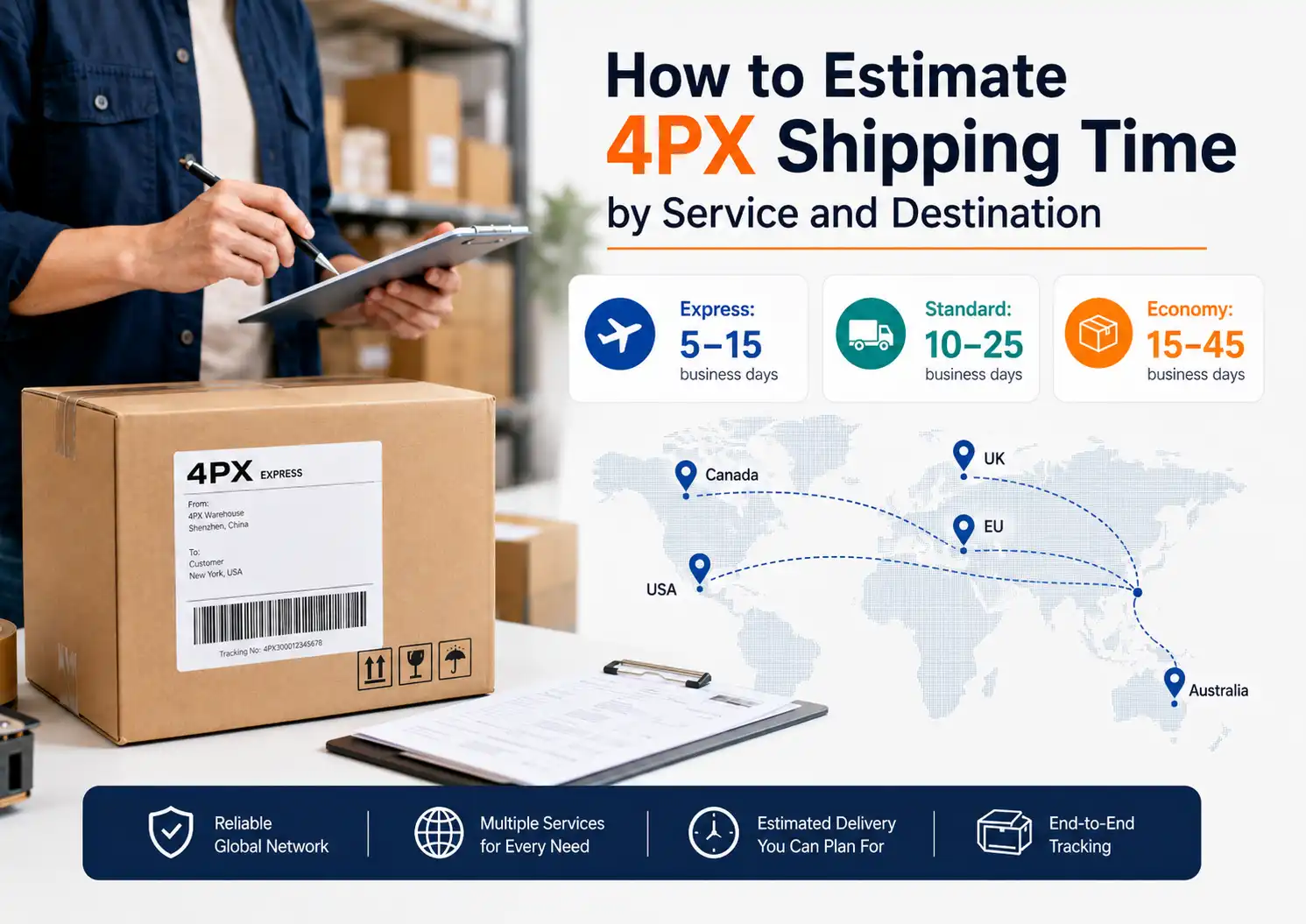
4PX shipping time usually ranges from about 5 to 10 business days for faster direct or special-line services, while standard and economy routes may take 10 to 15 business days or longer. The actual delivery window depends on the specific service, destination country, seller handover speed, customs processing, seasonal capacity, and local last-mile carrier.
4PX is not one fixed shipping method. Its official Global Direct Shipping documentation describes a service that integrates global postal and express networks, so the 4PX name alone does not identify one universal delivery window. Our guide to how 4PX shipping works explains the broader carrier network, service model, and package journey.
For dropshipping sellers, it is also important to separate supplier processing from carrier transit time. A tracking number may be created before the parcel is physically handed to 4PX, making the customer’s total waiting time longer than the carrier transit time shown in route estimates.
This guide compares realistic 4PX delivery times to the USA, UK, Europe, Canada, Australia, and other destinations. It also explains where delays occur, how standard and economy routes differ, and how sellers can build customer-facing delivery estimates from actual route performance.
The Five Stages Behind Every 4PX Delivery Time
A 4PX parcel passes through five distinct stages, and each one adds its own days to the total delivery time. When you understand where the days come from, you stop guessing and start diagnosing.
Stage 1: First-Mile Pickup and Warehouse Processing (1–4 days)
This is the gap between “label created” and the parcel physically entering a 4PX sorting facility. In plain terms: your supplier prints a shipping label, but the actual box may still be sitting in their warehouse.
A supplier should confirm whether the parcel is only label-created, packed, awaiting pickup, or physically accepted; structured dropshipping supplier communication prevents those states from being treated as the same event.
If your supplier is slow to pack or waits to batch orders, this stage alone can eat 3–5 days before the parcel moves an inch. Slow first-mile handoff is usually a supplier discipline problem, not a 4PX problem, which is why serious sellers invest in dropshipping quality control and packaging confirmation before dispatch.
Stage 2: Export Processing and Consolidation (1–3 days)
Once 4PX receives the parcel, it gets sorted, weighed, consolidated with other parcels, and prepared for export clearance. This stage is usually fast during normal months.
During peak season, sorting centers back up, and this stage can quietly stretch to 4–6 days. Nothing shows on tracking except silence.
Stage 3: International Linehaul (3–8 days)
This is the actual flight (or, for some economy products, sea or rail leg) from China to the destination country. Air-based standard lines typically cross in 3–5 days.
Economy products may wait for available cargo space, which is where much of the variance between “standard” and “economy” pricing actually lives. You are not just paying for speed — you are paying for priority boarding.
Stage 4: Import Customs Clearance (1–7+ days)
Customs is the least predictable stage in the entire chain. Most parcels clear within 24–72 hours, but agencies like U.S. Customs and Border Protection can hold any shipment for inspection without a stated reason or timeline.
Products with batteries, liquids, or unclear declarations get flagged more often. A clean, accurate declaration prepared before dispatch is one of the cheapest ways to protect your delivery time.
Stage 5: Last-Mile Handoff and Local Delivery (2–6 days)
After clearance, 4PX typically hands the parcel to a local carrier in the destination country for final delivery. This handoff involves a data transfer between two systems, which often creates a visible tracking gap of 1–3 days.
Which local carrier delivers your parcel, and how that handoff works country by country, is a topic of its own — we cover it separately in our guide to 4PX last-mile delivery partners.
Realistic 4PX Delivery Times by Destination
For standard-line services in normal months, expect roughly 8–15 business days to the USA, 7–12 business days to the UK, 8–15 business days across the EU, 10–15 business days to Canada, and 8–15 business days to Australia. Economy services add roughly 3–5 business days on top of these ranges.
Here is how the typical ranges compare across major destinations:
Note: These are typical off-season delivery ranges for standard 4PX-style routes. Actual delivery time can vary by service line, destination, customs processing, last-mile carrier, and peak-season volume.
A few honest caveats about these numbers. They assume the parcel actually entered the 4PX network promptly — remember Stage 1. They assume no customs inspection. And they assume off-season conditions.
Canada deserves a special mention: the extra last-mile distance and less frequent linehaul frequency make it consistently slower than the USA, even though the two markets look similar on a map. EU times vary heavily by country — Germany and the Netherlands tend to run faster than Southern or Eastern Europe.
If you also run YunExpress routes, the same staged logic applies, and you can compare realistic ranges in our guide to YunExpress shipping times.
4PX Shipping Time From China to USA: What to Actually Expect
4PX shipping time from China to the USA is typically 8–15 business days on standard lines and 10–18 business days on economy lines during normal months. The USA is 4PX’s highest-volume destination, which cuts both ways.
High volume means frequent linehaul departures and mature clearance processes, so standard-line parcels move efficiently most of the year. But high volume also means US-bound routes are the first to congest when capacity tightens.
The most common US delivery pattern that confuses sellers looks like this: fast movement for the first 5–7 days, then 2–4 days of tracking silence around the customs and last-mile handoff, then sudden delivery. The parcel was never lost — it was between systems.
For sellers, the practical takeaway is simple. Do not quote your customers the fastest number you have personally seen. Quote a range that covers the handoff gap and normal customs variance, or you will manufacture your own support tickets.
Off-Season vs Q4 Peak Season: Why the Same Route Behaves Differently
The same 4PX route that delivers in 10 days in April can take 12–18 business days in November and December. Peak season is not a small adjustment — it is a different operating environment.
Three things happen simultaneously in Q4. Order volume from Black Friday through Christmas floods every sorting center in the chain. Air cargo space gets bought up by every ecommerce player at once, so economy parcels wait longer for boarding. And destination customs agencies process record volume with the same headcount.
The compounding effect is what catches sellers off guard. One extra day at each of the five stages does not add five days — bottlenecks cascade, and missed linehaul slots push parcels to the next available departure.
Practical planning guidance for sellers:
- Treat mid-October through early January as peak conditions, not just Black Friday week
- Add at least 5–10 days to your normal delivery estimates for economy services in Q4
- Move time-sensitive or gift-oriented SKUs to faster routes before November, not after complaints start
- Update your store’s shipping policy page seasonally instead of running one static promise all year
Route timing is only one part of Q4 dropshipping logistics; stock readiness, supplier cutoffs, warehouse capacity, dispatch timing, and customer communication should also be reviewed before seasonal order volume rises.
Sellers who scale ad spend in Q4 while keeping off-season delivery promises are effectively pre-selling refunds. The fix is not to stop scaling — it is to match the route and the promise to the season.
Why Tracking Time Is Not the Same as Delivery Time
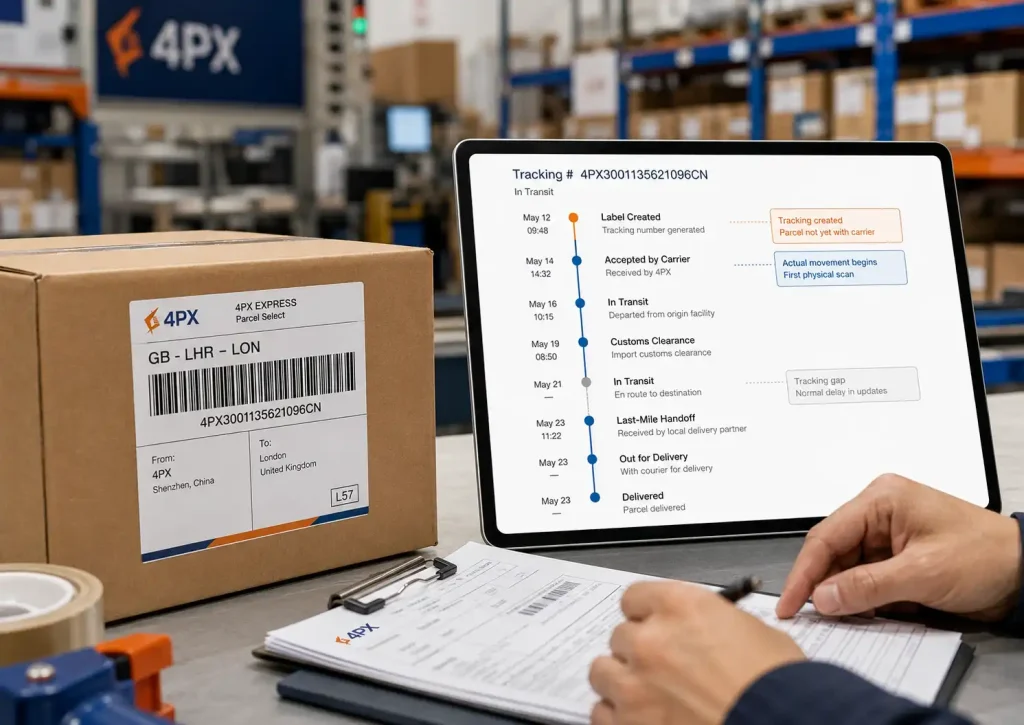
The date your tracking number was created is often several days earlier than the date your parcel actually started moving, which makes 4PX look slower than it really is. This single misunderstanding causes more panic than any actual delay.
Here is the plain-language version. When a supplier buys a shipping label, the official 4PX tracking page immediately shows an initial status. But that status only means data was submitted — not that a physical box was scanned into the network.
If the supplier takes four days to hand over the parcel, your “shipping time” clock appears to start four days early. A parcel that physically traveled for 11 days looks like a 15-day delivery to the customer staring at the tracking page.
There are also legitimate scan gaps mid-journey: during linehaul flights, during customs processing, and during the last-mile handoff, parcels routinely go 2–4 days without a new event. To be clear, a quiet tracking page is not evidence of fake tracking — 4PX is a real, large-scale logistics company, and we unpack the “is it a scam” question fully in our separate guide on whether 4PX is legit.
What each specific status message actually means — and which ones genuinely signal a problem — is its own deep topic. We break every status down in our dedicated guide to 4PX tracking statuses, so this article stays focused on time.
For sellers, the operational lesson is this: measure your real fulfillment speed from physical handover scan to delivery, not from label creation. That is the number that tells you whether your route is healthy.
Is 4PX Fast? A High-Level Answer
4PX is moderately fast for its price class — clearly faster than untracked postal mail, clearly slower than premium express carriers. It occupies the middle of the cross-border logistics market on purpose.
Premium carriers like DHL or FedEx can deliver from China to the USA in 3–7 days, but at a cost that destroys margins on low-ticket dropshipping products. Economy postal routes are cheaper than 4PX but can drift past 30 days with weak tracking. 4PX standard lines sit between those extremes, which is exactly why AliExpress-ecosystem sellers use them by default.
The full cost-versus-speed comparison across carriers is a decision framework we cover separately, and if you are weighing 4PX against its most direct alternative, start with our 4PX vs YunExpress comparison.
The better question than “is 4PX fast?” is “is 4PX fast enough for the promise my store is making?” That is a per-SKU decision, not a yes-or-no answer.
How to Set a Delivery Promise Your Store Can Actually Keep
Your customer-facing delivery promise should be built on your slowest realistic scenario, not your fastest one. A promise you beat builds trust; a promise you miss creates disputes.
Here is a workable method for setting delivery promises on 4PX routes:
- Track your real numbers. Pull the last 30–50 delivered orders per route and note the actual handover-to-delivery days.
- Promise the 80%, not the average. If most orders arrive in 10–14 business days but a meaningful share takes 18, your promise should say “10–18 business days.”
- Add a buffer between your internal expectation and the public number. If you expect 12 days, promising 10–15 gives you room; promising 7–10 gives you tickets.
- Adjust seasonally. Your October promise and your December promise should not be identical.
- Say it before checkout, not after. Delivery expectations disclosed on the product page prevent disputes far better than apology emails.
There is also a compliance angle US-focused sellers often miss. Under the FTC’s Mail, Internet, or Telephone Order Merchandise Rule, if you make a shipping-time claim, you need a reasonable basis for it — and if you cannot meet it, you have notification and refund obligations. A realistic promise is not just good customer service; it is regulatory hygiene.
A Real Example: Splitting SKUs by Route Risk
One seller we worked with was running their entire catalog through a single 4PX economy route because it was the cheapest option their supplier offered. Their light, low-cost accessories performed fine on that route, but their battery-powered and fragile SKUs kept hitting customs delays and arriving damaged, generating a steady stream of “where is my order” tickets and refund requests.
Instead of abandoning 4PX entirely, we kept the light small items on the economy route and moved the battery, fragile, and higher-value SKUs to a faster route with stronger tracking visibility and pre-dispatch QC. The support inbox calmed down within weeks, and the seller could finally set two different delivery promises that both held up.
That kind of route matching — pairing each SKU with the route its risk profile deserves — is exactly what working with a sourcing agent is supposed to solve. No single route is right for a whole catalog.
When Slow Shipping Starts Costing You Real Money
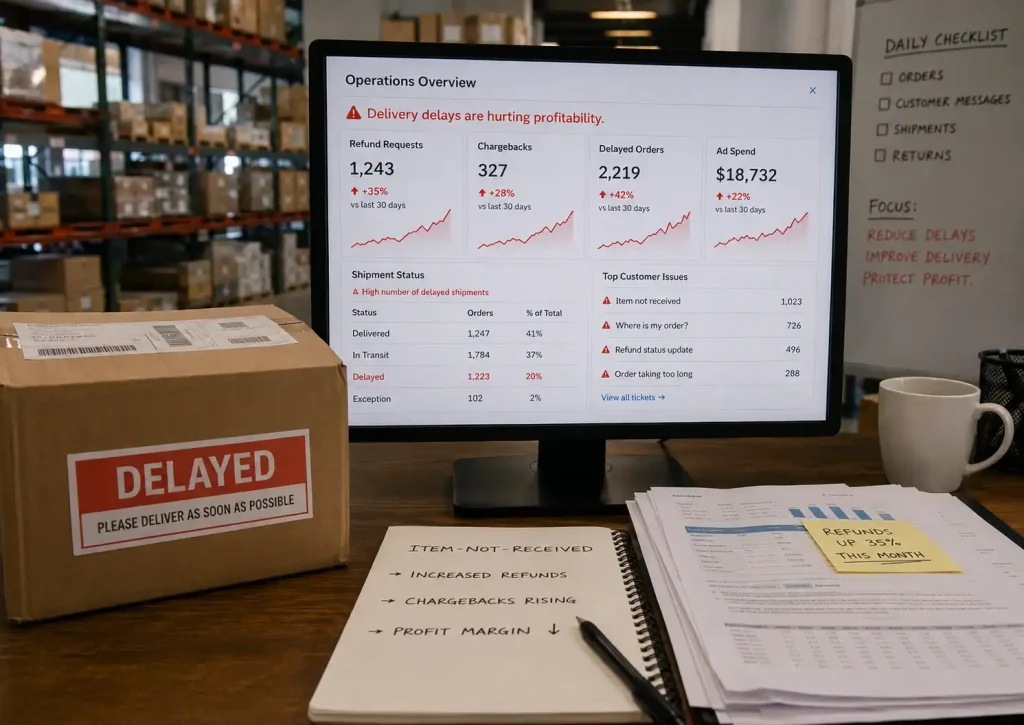
Slow and unpredictable delivery times stop being a customer service issue and become a financial issue the moment you scale paid traffic. At low order volume, a late parcel is an annoying email. At high volume, it is a pattern that payment processors can see.
Here is the chain reaction that plays out for scaling stores:
- Long delivery windows trigger “item not received” refund requests before the parcel even arrives
- Refunds that go unanswered escalate into chargebacks
- Rising chargeback ratios put PayPal and Stripe accounts under review, sometimes with rolling reserves or frozen funds
- Meanwhile, your ad account keeps spending against a conversion funnel that leaks at the delivery stage
The cruel part is timing. This chain reaction peaks in Q4 — precisely when you scaled spend and precisely when 4PX routes are at their slowest.
The solution is rarely “never use 4PX.” It is knowing which orders deserve a better route, and having someone accountable for tracking follow-up when parcels stall. That is the operating model behind fast shipping for dropshipping: stable 5–12 day lines for the SKUs and destinations where speed protects your margin, with proactive exception handling instead of reactive apologies.
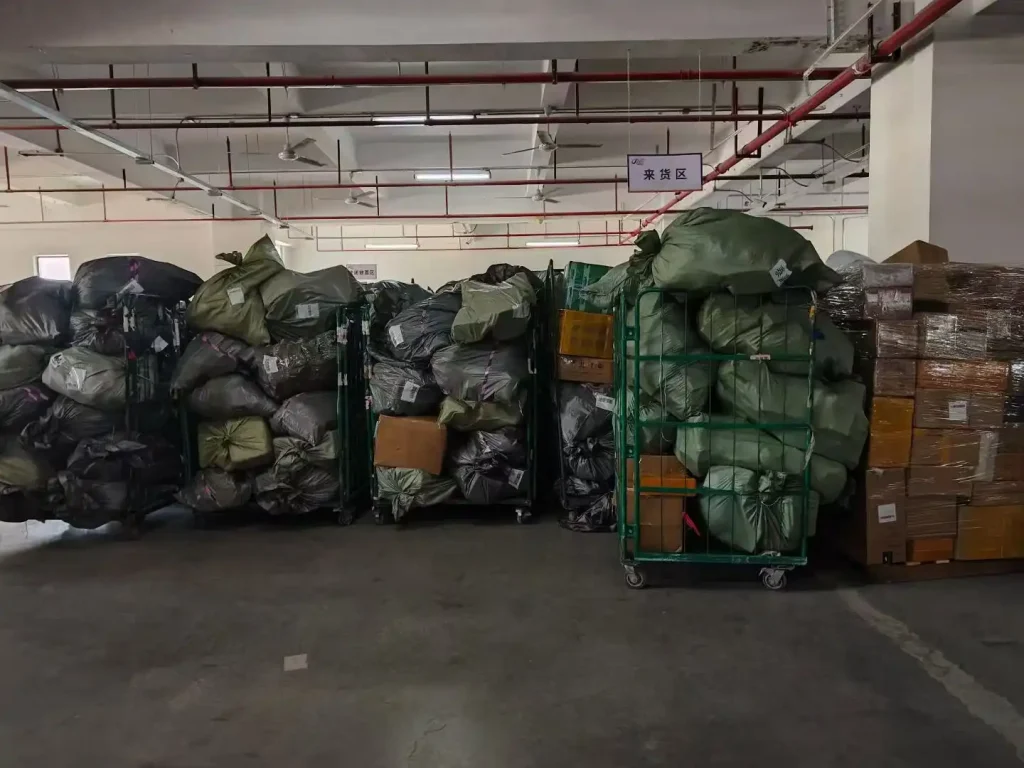
And if your current setup gives you no control over first-mile handover speed, packaging quality, or route selection at all, it may be time to consider moving from AliExpress to a private agent — because many “4PX delays” are actually supplier delays wearing a 4PX tracking number.
FAQ
How long does 4PX shipping take from China to the USA?
Typically 8–15 days on standard lines and 10–18 days on economy lines during normal months. In Q4 peak season, add 3–6 days or more to those ranges.
How long does 4PX take to deliver to the UK?
Usually 7–12 days on standard services in the off-season. The UK’s frequent linehaul and efficient clearance make it one of 4PX’s faster major destinations.
Is 4PX fast compared to other carriers?
4PX sits in the middle of the market: slower than premium express carriers like DHL, but faster and better-tracked than economy postal mail. It is built for cost efficiency, not speed records.
Why has my 4PX package not moved in a week?
The most common causes are a supplier who created the label but has not handed over the parcel, a customs processing window, or the handoff between 4PX and the local last-mile carrier. None of these automatically mean the parcel is lost.
Does 4PX deliver faster during certain months?
Yes. February through September generally sees the fastest, most consistent times. Mid-October through early January is peak season, when the same routes run significantly slower.
Can I speed up a 4PX shipment that has already been sent?
No — once a parcel is in the network, its route is fixed. Speed decisions happen before dispatch, which is why route selection per SKU matters more than after-the-fact chasing.
Conclusion
4PX shipping typically takes 8–15 days, but the number that matters for your business is not the average — it is the variance. A route that delivers in 10 days most of the time and 30 days some of the time will quietly damage a scaling store, even if the “average” looks acceptable.
The sellers who win with 4PX are the ones who treat it as one tool in a route portfolio: economy lines for light, low-risk SKUs, faster tracked lines for anything fragile, powered, high-value, or promised quickly. They measure real handover-to-delivery times, set promises they can beat, and adjust everything for Q4.
If you are tired of guessing whether each order will take 10 days or 30, RuntoDropship handles route matching, pre-dispatch QC, packaging confirmation, and tracking follow-up as part of order execution — so your delivery promise becomes something you control, not something you hope for.