
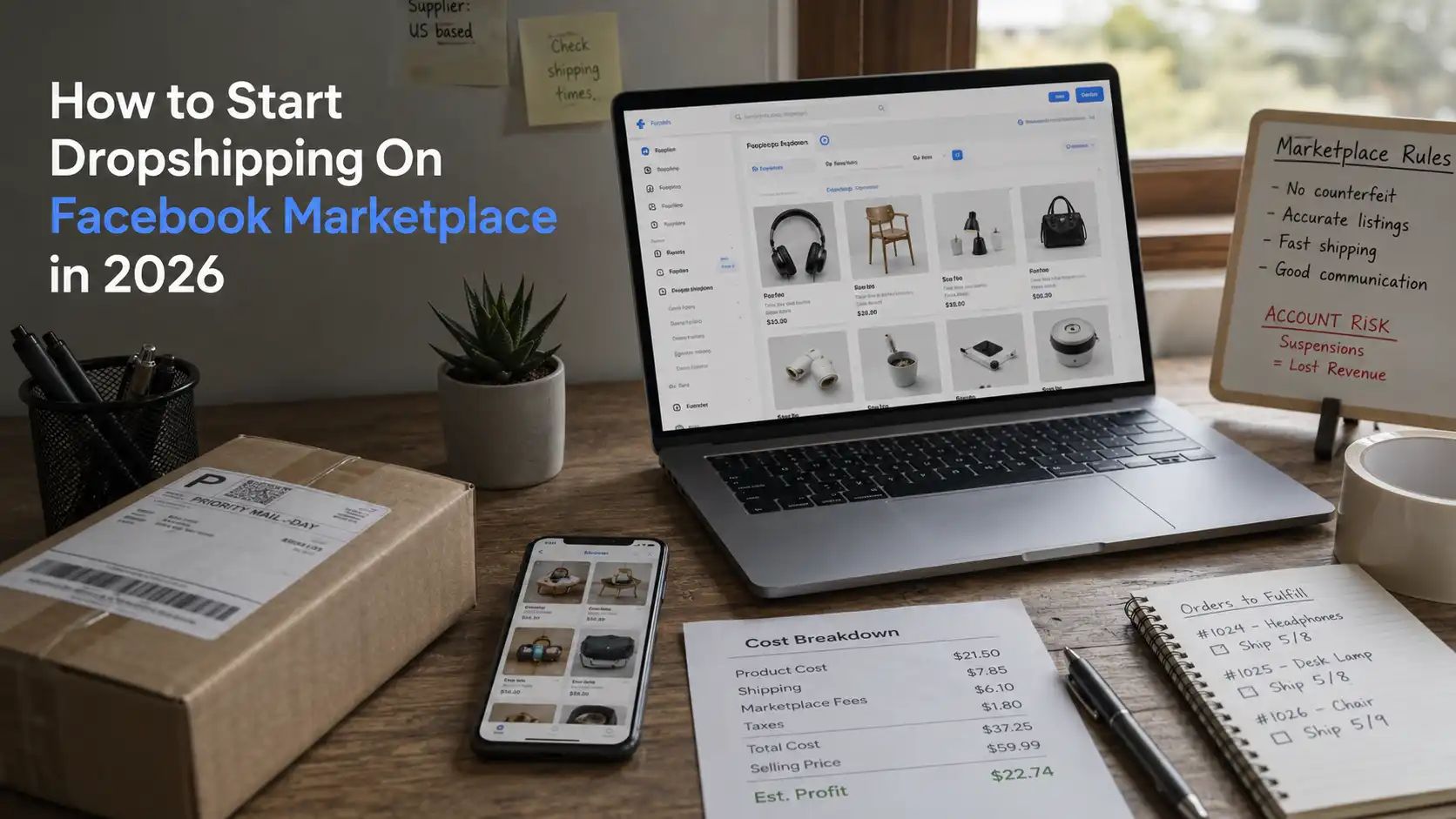
Dropshipping On Facebook Marketplace means listing products you never hold in stock, then having a supplier ship each order straight to your buyer after checkout. You keep the difference between your listing price and your total sourcing cost.
Here’s a scene you might recognize: you list twenty products, get your first sale within days, then watch your account get restricted because tracking uploaded late or a supplier canceled on you. That sting of losing a selling account over something preventable pushes many sellers away for good. The fix isn’t luck — it’s understanding Marketplace policy, real margin math, and a sourcing setup built for speed, which this guide walks through step by step.
1. What Is Dropshipping On Facebook Marketplace?
Dropshipping On Facebook Marketplace is a retail model where you sell through Marketplace’s shipped-checkout system while a third party fulfills every order on your behalf. You act as the storefront; your supplier acts as the warehouse.
Here’s why sellers care: Marketplace gives you access to buyers already inside Facebook, with zero monthly store fees and built-in local demand signals. That combination makes it one of the cheapest places online for testing product ideas before committing real money.
How does the model actually work?
The flow has four moves: you list a product with shipping enabled, a buyer pays through Facebook checkout, you forward that order and address details, and your supplier ships with valid tracking. Facebook releases your payout after delivery confirmation and any hold period. Your profit lives in the gap between sale price and combined product, shipping, and fee costs.
Why pick Marketplace over other channels?
Marketplace rewards fresh listings with organic reach, so you can sell without paid ads — a rarity in e-commerce today. Compared with running a standalone store, you skip domain costs, theme setup, and traffic building. The trade-off comes later in this guide: stricter policy enforcement and tighter shipping windows than most channels demand.
2. Is Dropshipping Allowed Under Marketplace Rules?
Yes — with real limits, and misunderstanding those limits gets more sellers banned than any other single cause. Meta’s Commerce Policies permit shipped orders fulfilled by third parties, but you remain fully responsible for delivery speed, tracking accuracy, and item condition. You can review the current rules directly in Meta’s Commerce Policies.
Here’s the catch: ordering from another retailer’s website (classic retail arbitrage) frequently violates that retailer’s terms and produces branded packaging that confuses your buyer. Facebook also flags accounts whose tracking numbers originate from mismatched carriers or arrive late, so your supplier choice directly controls your account survival.
What do the shipping requirements say?
Marketplace requires you to mark orders shipped within your stated handling window — usually two to three business days — and upload tracking from a recognized carrier. Miss those windows repeatedly and your selling access shrinks before it disappears. Buyers can also report non-arrival, which triggers refunds from your pocket and strikes against your account health.
Key Takeaway: Treat policy compliance as your product. A supplier who ships in 2 days with clean tracking protects your account better than any listing trick, so vet fulfillment speed before you list a single item.
3. How Do You Set Up A Marketplace Seller Account?
You set up by activating shipped checkout on an established personal Facebook profile, confirming your identity, and connecting a payout method. Marketplace selling with shipping currently sits behind eligibility requirements — a genuine, aged profile in a supported region (primarily the US) matters more than most beginners expect.
Before listing, work through this checklist:
- Use a real, active profile with history — fresh accounts get flagged fast
- Confirm identity and tax information when prompted
- Connect a bank account for payouts and note the initial holding period
- Set handling time honestly based on your supplier’s true speed
- Write listings with original photos and titles, never copied text
One thing worth flagging before you move on: never run multiple seller profiles from one device or network. Facebook links accounts aggressively, and one restricted profile can pull down every account it touches.
In July 2026, Meta launched Seller, a dedicated app for frequent Facebook Marketplace sellers in the US. It brings listing creation, buyer messages, inventory management, shipping tasks, and performance insights into one place. Seller also uses Meta AI to help create titles, descriptions, categories, and price suggestions from product photos.
For dropshippers, the biggest benefit is operational visibility: you can see listings that need attention, buyer conversations, items waiting to ship, and performance data such as views, clicks, messages, and sold listings from one dashboard. However, the app does not change your responsibility for accurate listings, inventory availability, shipping, tracking, or buyer service.
4. What Products Sell Best For Marketplace Dropshipping?
Practical, problem-solving items in the $15–$60 range perform best — think pet supplies, home organization, car accessories, garden tools, and small fitness gear. Marketplace buyers browse casually rather than searching with high intent, so visual, instantly understandable products outperform niche technical items.
So what separates a winner from a dud? Strong Marketplace products share these traits:
- Solve a visible everyday problem within three seconds of seeing the photo
- Weigh little, keeping shipping under roughly $8
- Avoid trademarks, batteries with shipping restrictions, and fragile parts
- Support at least a 30% margin after fees and shipping
How do you validate demand before listing?
Search your product idea inside Marketplace and check how many active listings show recent activity, then compare pricing across the top results. If ten sellers offer the same item under your possible price floor, skip it. Sellers who want vetted, non-saturated options often lean on professional winning product sourcing support instead of guessing from saturated supplier catalogs, because pre-negotiated factory pricing changes what “profitable” even means.
5. How Do You Price For Profit After Marketplace Fees?
Price by working backward from your total landed cost, then adding your target margin — never by copying competitors blindly. Facebook charges a selling fee on shipped orders (a percentage of the order total with a minimum per-item charge), and that fee comes off the top before product cost, shipping, or refunds touch your numbers.
Let’s make that concrete with a typical $40 sale:
| Cost Item | Amount | Share of Sale |
|---|---|---|
| Product cost (agent-sourced) | $12.00 | 30% |
| Shipping to buyer | $6.50 | 16.25% |
| Marketplace selling fee | $4.00 | 10% |
| Refund/loss reserve | $2.00 | 5% |
| Net profit | $15.50 | 38.75% |
That reserve line matters — sellers who skip it discover their “profit” evaporates after two refunds a month.
Key Takeaway: If a product can’t clear 30% net margin after fees, shipping, and a refund reserve, drop it. Thin-margin items punish you twice — once on profit and again when a single refund wipes out five sales.
6. How Do You Handle Orders, Shipping, And Returns?
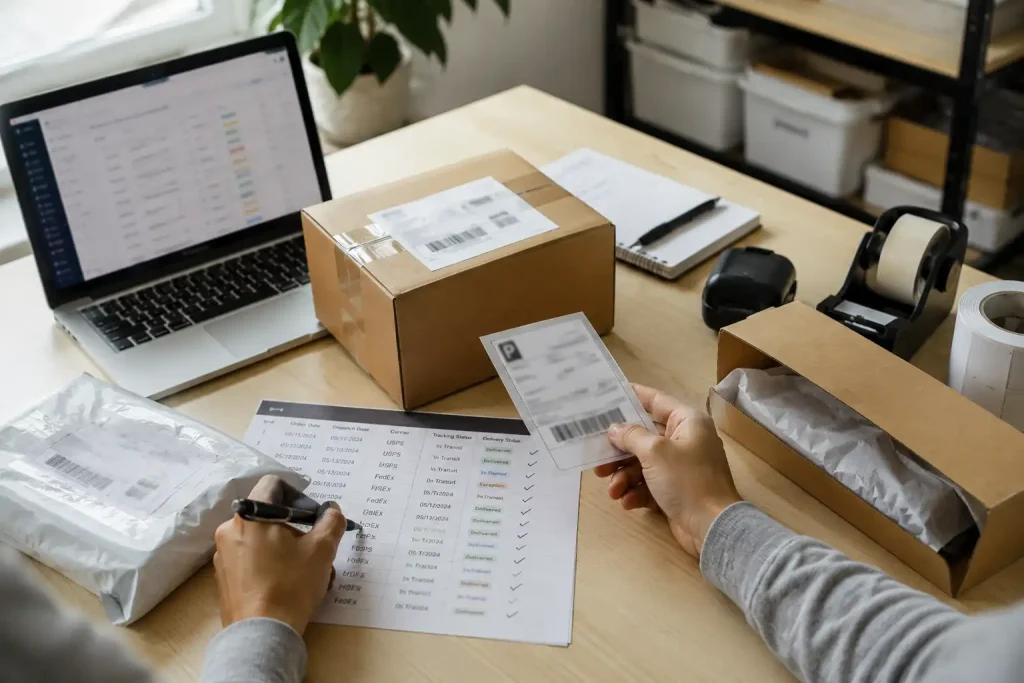
You handle orders by forwarding buyer details to your supplier the same day, uploading tracking within your handling window, and answering messages within 24 hours. Speed here isn’t a nice-to-have — Marketplace measures your handling time, tracking validity, and response rate as account health signals.
But here’s where beginners stumble: returns. Facebook’s purchase protection sides with buyers on non-delivery and not-as-described claims, so a supplier who ships slowly or substitutes items quietly drains your payouts. Sellers running higher volume often add pre-shipment quality inspection for dropshipping orders so defective units never reach a buyer in the first place.
What does a clean fulfillment routine look like?
Build a daily rhythm: pull new orders each morning, batch them to your supplier before their cutoff time, and upload tracking the moment it generates. Keep a simple sheet logging order date, ship date, carrier, and delivery date so you spot slowdowns before Facebook does. When a delay appears, message the buyer proactively — a heads-up prevents most disputes from ever opening.
7. What Mistakes Get Marketplace Sellers Suspended?
Late or fake tracking, retail-arbitrage packaging, duplicate listings, and multi-account behavior cause the vast majority of Marketplace suspensions. Facebook’s enforcement runs on automated signals, so patterns matter more than intent — you can get restricted without a single angry buyer.
Before you write this off as fear-mongering, look at how each mistake maps to a fix:
| Mistake | Why It Triggers Action | Prevention |
|---|---|---|
| Tracking uploaded late | Breaks handling-time promise | Use suppliers with same/next-day dispatch |
| Amazon/Walmart packaging | Signals prohibited arbitrage | Source blind-shipped, unbranded parcels |
| Copy-paste duplicate listings | Reads as spam behavior | Write original titles and photos per listing |
| Multiple accounts, one device | Linked-account detection | Run one clean, established profile |
| High cancellation rate | Supplier stockouts | Confirm live stock before listing |
Each row above traces back to one root cause: sourcing from channels never built for dropshipping.
Key Takeaway: Your supplier’s behavior becomes your account record. Audit dispatch speed, packaging, and stock reliability before scaling — recovering a banned account costs far more than preventing one.
8. Should You Source From Retailers Or A Private Agent?
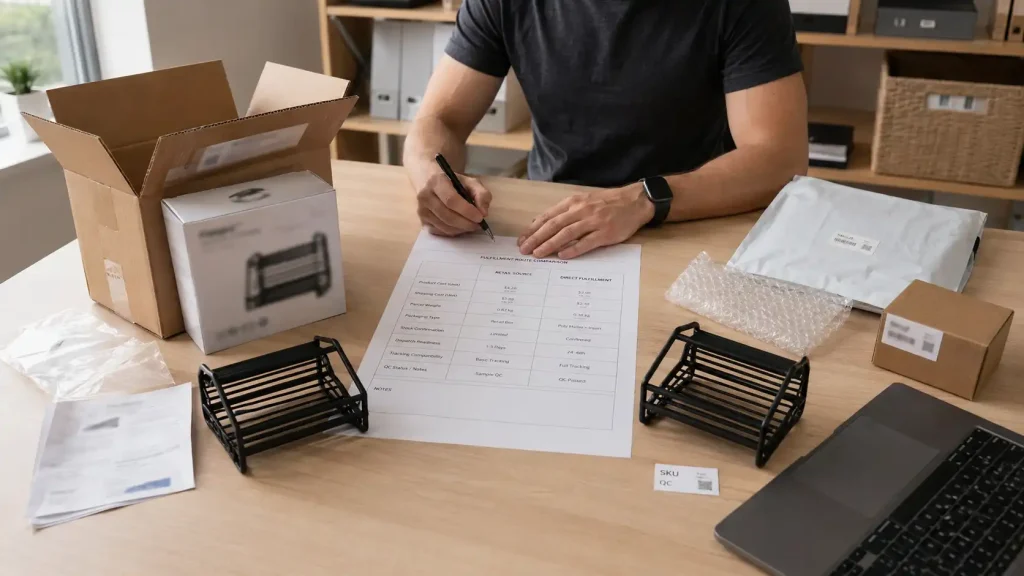
For anyone planning to sell beyond a handful of test orders, a private dropshipping agent beats retailer sourcing on cost, packaging control, and account safety — while retailers only win on day-one convenience. This choice shapes your margins and your risk profile more than any listing tactic.
Here’s how the two paths compare on the factors that actually decide outcomes:
| Factor | Retail Arbitrage | Private Agent Sourcing |
|---|---|---|
| Product cost | Retail price, thin margin | Factory-level pricing |
| Packaging | Branded retailer boxes | Blind, unbranded shipping |
| Stock reliability | No visibility | Confirmed before listing |
| Quality control | None | Inspection before dispatch |
| Policy risk | High | Low |
The pattern speaks clearly: retailers solve speed for your first test, and agents solve everything that comes after.
When does switching to an agent make sense?
Switch once a product proves demand — usually after 5–10 consistent weekly sales — because agent pricing turns a marginal item into a real earner. One seller we worked with moved a pet grooming brush from retailer sourcing at 12% margin to agent-sourced fulfillment and reached 31% margin within three weeks, mostly through lower unit cost and fewer refunds from damage. The volume was identical; only the sourcing changed.
Key Takeaway: Test with whatever gets you moving, but don’t scale on retail sourcing. Once a product shows repeat sales, agent sourcing is the difference between a side experiment and a durable business.
Final Thoughts
Marketplace rewards sellers who respect three things: policy compliance, honest margin math, and fast, clean fulfillment. This guide covered what the model involves, what the rules actually permit, how to price after fees, and why your sourcing choice quietly decides whether your account survives its first hundred orders.
If you’re ready to move from testing into stable volume, RuntoDropship works as your private dropshipping agent — sourcing at factory pricing, inspecting before dispatch, and shipping blind with reliable tracking so your account health stays protected. We believe dropshipping wins long-term only when sellers build on real supply chains instead of shortcuts — and that’s exactly the foundation we help you build. What product will you test this week?
FAQ
Q1: Can I dropship on Facebook Marketplace without a US account?
Mostly no. Shipped checkout with nationwide reach currently favors established US profiles, and workarounds like borrowed accounts or VPN setups carry heavy ban risk. If you’re outside supported regions, build on a legitimate profile or pick a different channel.
Q2: What’s the best price range for Marketplace products?
$25–$60 works best. Below $20, fees and shipping crush your margin; above $80, casual Marketplace browsers hesitate without brand trust. That middle band gives you room for 30%+ net margins with impulse-friendly pricing.
Q3: How do I know if my listings are getting suppressed?
Watch views per listing over the first 48 hours. Healthy new listings pull steady impressions immediately; near-zero views across multiple fresh listings signals reduced distribution, usually from duplicate content, policy flags, or a weakened account.
Q4: Can I use Amazon as my supplier for Marketplace orders?
You can, but you shouldn’t beyond initial tests. Amazon-branded boxes confuse buyers, violate Amazon’s own terms for reselling via Prime, and generate the packaging complaints that trigger Marketplace restrictions. Move winning products to blind-shipped sourcing quickly.
Q5: How fast do I really need to ship?
Within your stated handling window, ideally 1–2 business days. Facebook tracks handling time as an account health signal, and late tracking uploads compound into restrictions. Set your handling time based on your supplier’s proven speed, never on optimism.