
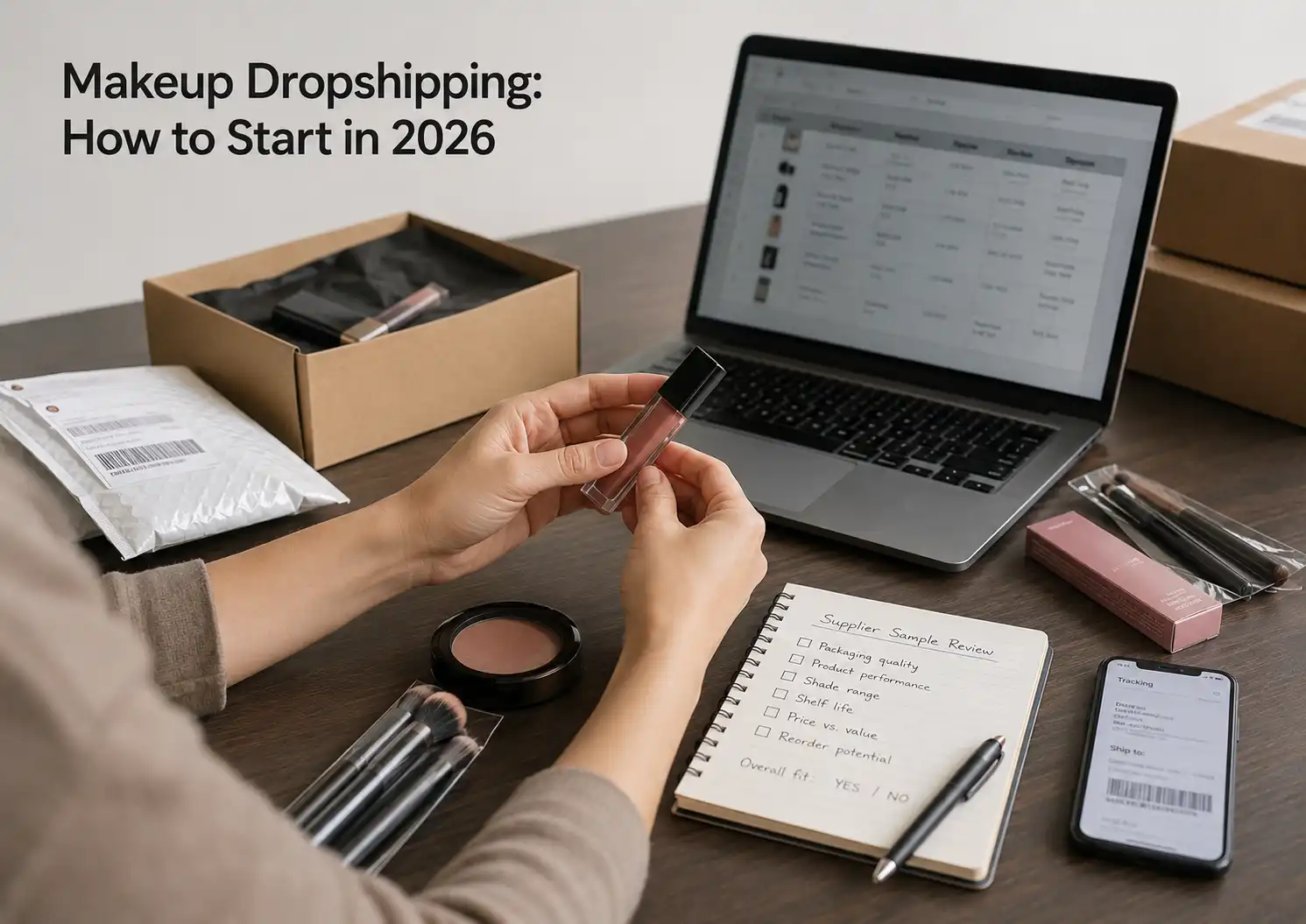
Makeup dropshipping can work in 2026, but only if you treat it as a controlled cosmetics business rather than a catalog shortcut. The opportunity is real: NIQ reported that the global beauty market grew 10% year over year and ecommerce expanded six times faster than in-store sales, based on retail data spanning nine categories in 52 markets (NIQ, “Global Beauty Market Grows 10% as AI and E-commerce Reshape Consumer Buying,” 2026). That market growth does not guarantee that a store, product, or advertisement will be profitable.
This guide explains how to choose a narrow assortment, reject weak suppliers, check US or EU requirements, calculate contribution margin, and scale only after the operation works. If you want to see how sourcing, inspection, branding, and fulfillment fit together, start with the cosmetics dropshipping workflow.
Key Takeaways
- Start with one target market, a narrow customer problem, and a small set of easy-to-identify SKUs.
- Do not accept a certificate badge as proof that a specific formula, label, claim, and destination market are compliant.
- Reject suppliers that cannot identify the legal manufacturer or provide formula-specific documents, batch traceability, stable shade mapping, and representative samples.
- Calculate contribution margin per delivered order after shipping, payment fees, advertising, refunds, replacements, and variable compliance costs.
- Move into private label only after the generic or white-label version has repeat demand and a controlled quality and fulfillment process.
Is Makeup Dropshipping Worth It in 2026?
Makeup dropshipping is worth testing when you have a specific audience, compliant products, reliable fulfillment, and positive unit economics. It is a poor fit if the plan depends on copying a large public catalog, making unverified product claims, or buying ads before checking the delivered unit.
The model lets you test demand without buying a broad range of shades and packaging upfront. However, regulatory and customer-service responsibilities do not disappear because a supplier ships the parcel. A defensible offer depends on clear shade information, credible product details, consistent packaging, and a controlled response when an order or batch goes wrong.
How Does Makeup Dropshipping Work?
In makeup dropshipping, a supplier or fulfillment partner sends your store’s order directly to the customer. You still control the storefront, claims, customer communication, refund policy, and commercial relationship. You may also hold regulatory duties even when you never touch the product.
Four operating models sit on a spectrum from fast testing to high control:
| Model | What the customer receives | Inventory exposure | Product control | Main limitation |
|---|---|---|---|---|
| Generic resale | The supplier’s existing unbranded product | Low | Low | Easy to test, but difficult to differentiate |
| White label | A standard formula sold with your branding | Low to medium | Medium | Branding changes, but the formula may be shared by many sellers |
| Private label | A product and package configured for your brand | Medium | Medium to high | More documentation, packaging inventory, and responsibility |
| Custom formulation | A formula developed or materially customized for the brand | High | High | Higher minimum orders, longer validation, and more compliance work |
The right starting point is normally the least complex model that can test your actual value proposition. A dropshipping business plan can document the target customer, market, sales channel, decision thresholds, and cash exposure before supplier negotiations begin.
Step 1: Choose One Market and One Operating Model
By the end of this step, you should have one target market, customer problem, and initial model. This decision controls the label, formula review, shipping route, returns process, and documents you need.
- Define the buyer, such as beginners who want a small everyday lip set.
- Choose the first sales market. Do not assume a product prepared for one country is ready for another.
- Select generic resale or white label unless you already have documented demand and private-label resources.
- Write a one-sentence product promise that avoids medical or therapeutic language.
- Set launch gates for the sample, documents, delivered cost, shipping, defects, and contribution margin.
Verification: Someone outside the project should be able to read the plan and identify exactly who the product serves, where it will be sold, and which conditions must be met before advertising starts.
Step 2: Select Products by Risk, Not Hype
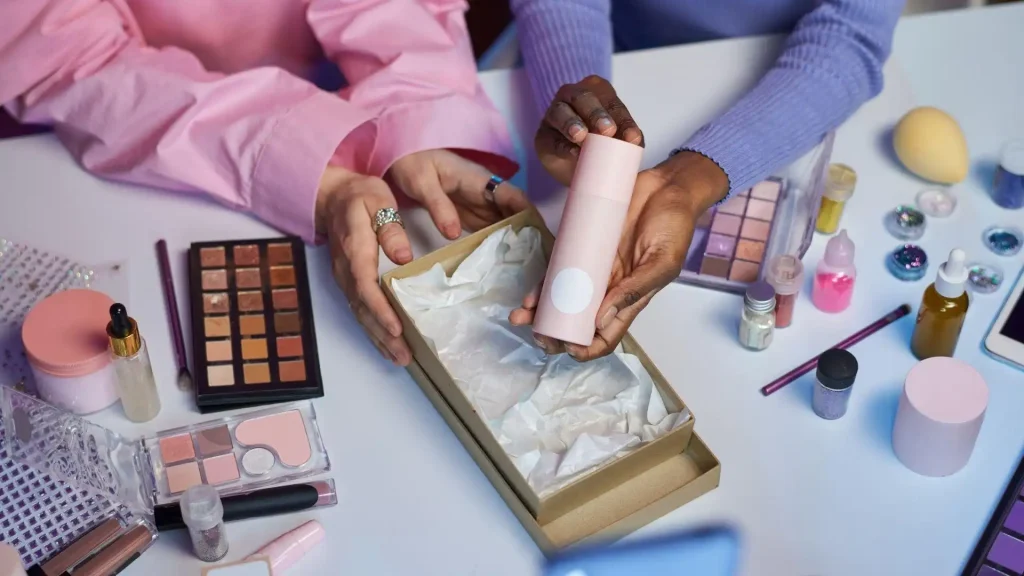
Your first products should minimize claim, application-area, shipping, and SKU errors. Accessories such as brushes, applicators, and organizers can reduce formula-related complexity, although they still require material, construction, packaging, and claims checks. Formula products can be tested when the supplier supports the exact product and target market with adequate records.
| Product or characteristic | Initial risk | Why it needs attention | Safer first action |
|---|---|---|---|
| Brushes, applicators, and organizers | Lower | Material quality, shedding, breakage, and misleading claims can still cause returns | Inspect construction and test the shipped unit |
| Lip, brow, or complexion products with few variants | Medium | Formula, pigment, shade accuracy, labeling, and batch control matter | Approve each formula and lock the SKU map |
| Large shade ranges | Medium to high | Similar codes increase wrong-item dispatch and shade-related returns | Start with fewer distinct variants and clear swatches |
| Mascara, eyeliner, lash dye, and eye-area products | High | Intended use and eye-area color restrictions require closer review | Launch only with formula-specific evidence and expert review |
| SPF, acne, skin-lightening, lash-growth, or therapeutic products | High | Claims or ingredients may place the item under additional regulatory rules | Exclude from a beginner launch unless qualified counsel clears it |
| Aerosols, pressurized items, or heat-sensitive formulas | High | Carrier acceptance, leakage, storage, and route conditions add complexity | Confirm route eligibility and perform package testing first |
| Third-party branded stock | High | Authenticity and resale authorization may be uncertain | Require traceable authorization or reject it |
These labels are editorial screening priorities, not regulatory classifications. They reflect formula and claim complexity, application-area restrictions, transport sensitivity, SKU-error exposure, and authenticity risk.
Public marketplaces can aid discovery, but they do not replace manufacturer verification. Review these AliExpress alternatives before treating a listing as evidence.
Verification: Each launch SKU should have a unique code, defined application area, complete ingredient information where applicable, approved sample, target-market label plan, and documented shipping method.
Step 3: Vet the Supplier and Run a Test Order
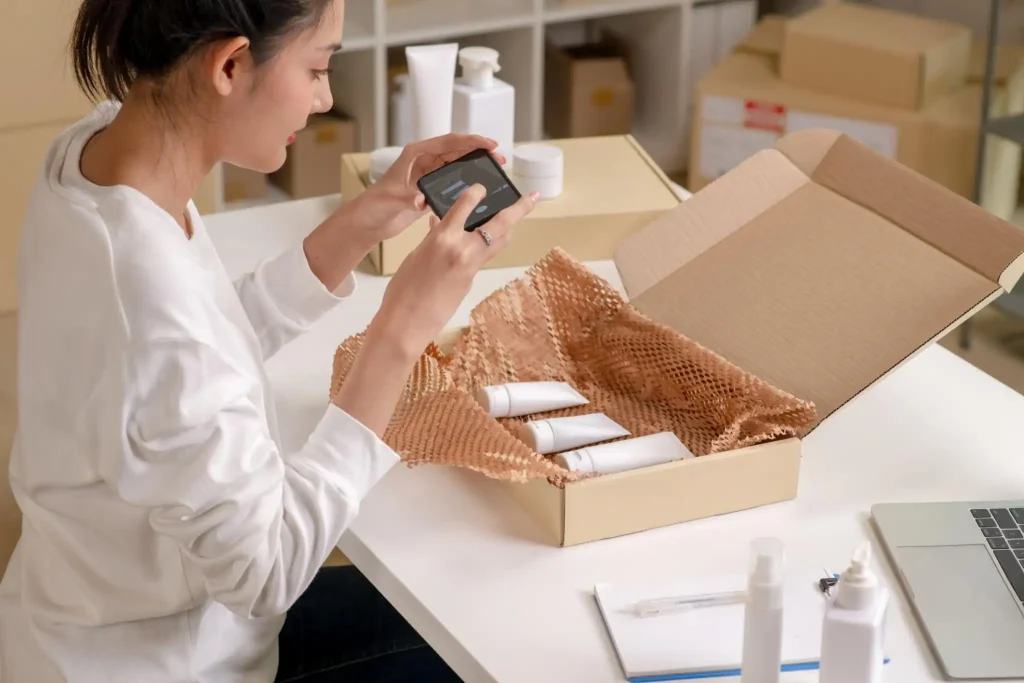
A usable supplier must support the exact formula, package, label, and destination market. A generic factory certificate or the phrase “FDA approved” is not enough.
Request the following before you treat a product as launch-ready:
- Legal manufacturer name and manufacturing location.
- Complete ingredient list in the nomenclature required by the target market.
- Formula-specific safety, stability, and appropriate microbiological or contaminant test support.
- GMP evidence, including the issuer, scope, facility, and validity period.
- Pigment and color-additive details for the intended lip, eye, or external use.
- Batch or lot coding, manufacture-date records, durability or expiry logic, and recall traceability.
- Evidence supporting any US registration or listing and any EU compliance claim that applies to the arrangement.
- Samples from the same formula, packaging, and production source intended for customer orders.
- Written shade-to-SKU mapping and standards for seals, closures, pumps, leakage, and breakage.
- Blind-shipping rules, tracking handoff, replacement policy, and an escalation contact.
- Written notice before any formula, ingredient, factory, packaging, or sub-supplier change.
Hard-Rejection Checklist
Reject the supplier or SKU if any of these conditions remain unresolved:
- [ ] The legal manufacturer cannot be identified.
- [ ] The ingredient list is missing, incomplete, or inconsistent across documents.
- [ ] Reports belong to another formula, factory, or product.
- [ ] Lot codes cannot connect a shipped unit to production records.
- [ ] The supplier will not send a representative sample.
- [ ] Eye or lip pigments cannot be verified for the intended use.
- [ ] Shade codes on the product, carton, pick list, and store cannot be reconciled.
- [ ] The supplier can change the formula or packaging without notice.
- [ ] Branded goods lack credible authenticity and distribution evidence.
- [ ] “EU compliant” or “FDA approved” is offered as a slogan without the supporting records.
A China sourcing agent can coordinate factory identification and documents. A dropshipping quality control process converts the approved sample into repeatable inspection criteria. Neither replaces legal review.
Verification: Place test orders through the same route customers will use. Confirm the lot code, SKU, shade, seal, package condition, tracking events, delivery time, label, and all inserts against the approved standard.
Step 4: Check US FDA and MoCRA Requirements
US cosmetics generally do not receive FDA premarket approval, except that color additives must be approved for their intended use. FDA facility registration or product listing is also not product approval. A seller must determine which obligations apply to its role, product, claims, and business size.
Under the Modernization of Cosmetics Regulation Act of 2022, the manufacturer, packer, or distributor whose name appears on the label can be the responsible person. FDA explains that the responsible person must maintain adequate safety-substantiation records, list marketed cosmetic products and update those listings annually, and report serious adverse events within 15 business days. Facilities generally register and renew every two years, subject to conditional exemptions (FDA, “Modernization of Cosmetics Regulation Act of 2022”). Small-business exemptions do not cover every product type, so do not assume turnover alone removes the duty.
Labels generally need product identity, net quantity, an ingredient declaration, and other required information displayed conspicuously. Ingredients normally appear in descending order of predominance, with specific rules for color additives and ingredients present at 1% or less (FDA, “Summary of Cosmetics Labeling Requirements”). State rules may add requirements.
Color makeup needs application-specific screening. A color permitted in an externally applied cosmetic is not automatically permitted for use on the lips or around the eyes, and FDA identifies color-additive violations as a common reason imported cosmetics are detained (FDA, “Color Additives and Cosmetics: Fact Sheet”).
Claims can also change the product category. Language about treating acne, changing melanin production, growing lashes, or affecting body structure may make an item a drug or a cosmetic-drug combination. SPF makeup is a familiar dual-category example (FDA, “Is It a Cosmetic, a Drug, or Both? (Or Is It Soap?)”).
Verification: Before launch, match the final formula, intended use, claims, label name, responsible-person arrangement, listing status, safety file, complaint process, and adverse-event escalation procedure.
Step 5: Set Up EU Responsible Person, CPSR, PIF, and CPNP Duties
Every cosmetic placed on the EU market needs an EU-established Responsible Person and a compliance file for the exact product. Importers are normally the Responsible Person for imported cosmetics unless another EU-established person accepts a written mandate. A distributor can become the Responsible Person by selling under its own name or trademark or making a compliance-relevant modification.
Before sale, the Responsible Person must arrange a qualified safety assessment and Cosmetic Product Safety Report, maintain a Product Information File for ten years after the last batch is placed on the market, document good manufacturing practice, and notify the product through CPNP. These duties appear in Articles 4, 8, 10, 11, and 13 of Regulation (EC) No 1223/2009, consolidated through September 1, 2025.
CPNP is the EU’s online notification system, and one notification avoids further national notification within the EU. Notification is not regulatory approval (European Commission, “Cosmetic product notification portal”).
Claims must be truthful, honest, fair, and supported by adequate, verifiable evidence. Evidence for an ingredient does not automatically prove the finished product has the same effect (European Commission, “Commission Regulation 655/2013”).
Verification: The Responsible Person should confirm that the final formula, CPSR, PIF, CPNP record, label, claims, GMP evidence, and shipped unit all correspond. A supplier PDF labeled “EU certificate” is not a substitute for this chain.
Step 6: Calculate Contribution Margin and Test the Offer
Calculate profit per delivered order before setting an advertising budget. Do not use a generic makeup dropshipping margin as a benchmark because product, shipping, refund, compliance, and acquisition costs vary too widely.
Use this formula:
Contribution margin = selling price - product cost - supplier fee - packaging - payment fee - outbound shipping - customs or tax absorbed - expected refund and replacement cost - variable app cost - advertising cost
Also calculate break-even customer acquisition cost by excluding advertising cost from the deductions. This shows the maximum acquisition spend available before the order’s contribution reaches zero.
Hypothetical Worked Example
The following numbers are illustrative assumptions, not industry averages or a forecast:
| Item | Hypothetical amount |
|---|---|
| Selling price | $42.00 |
| Product cost | $8.50 |
| Supplier handling fee | $1.50 |
| Packaging | $1.20 |
| Payment fee | $1.56 |
| Outbound shipping | $6.50 |
| Customs or tax absorbed | $0.00 |
| Expected refund and replacement reserve | $2.10 |
| Variable app cost | $0.50 |
| Advertising cost | $11.00 |
| Contribution margin | $9.14 |
In this example, contribution margin is 21.8% of revenue, and break-even customer acquisition cost is $20.14. Neither figure is net profit because fixed software, samples, legal review, compliance files, salaries, and income taxes are outside the order-level calculation.
Run the model by shade and route, then stress-test higher ad costs, shipping, defect rates, and refund reserves. This reveals whether a visually promising product can survive ordinary variation.
Verification: Launch only after at least one representative test order passes and the downside scenario still fits your cash and margin limits.
Step 7: Move From Testing to Private Label Makeup
Move into private label after repeat demand and operational control appear, not merely because a supplier offers logo printing. A new logo does not create formula exclusivity, and private label can increase your documentation and regulatory responsibilities.
Use a staged path:
- Validate: Test a narrow generic or white-label assortment from a manufacturer capable of supporting later branding.
- Control: Lock the formula, shade codes, label copy, packaging, batch records, inspection standard, and fulfillment flow.
- Brand the package: Add inserts or outer packaging once demand repeats and dimensional weight remains economical.
- Private label the product: Put the brand on the item only after responsibility, documentation ownership, claims evidence, and change control are clear.
- Consider custom formulation: Accept higher minimum orders and validation work only when demand and compliance resources justify them.
The private label dropshipping process explains the operational transition. The dropshipping-to-private-label case study also shows how that progression differs from launching a large branded assortment on day one.
Verification: Your branded production sample, customer unit, formula records, label, packaging, SKU map, compliance file, and product page should all describe the same product.
Prevent Returns and Compliance Failures
Preventable failures often begin when the store, compliance file, and shipped item do not match. Connect every customer unit to the approved standard.
Build a Variant and Packaging Control Sheet
Record the store and supplier SKUs, shade name and code, barcode, reference photos, and pick location. Test seals, pumps, compacts, caps, and liquids under expected route conditions.
Track Batches and Changes
Keep lot numbers, dispatch dates, complaints, and formula and packaging versions. Require approval before any ingredient, applicator, container, label, factory, or sub-supplier change.
Create a Complaint and Recall Path
Give support staff a script for leakage, contamination concerns, reactions, and wrong shades. Preserve order evidence, lot numbers, reported symptoms, and escalation dates. Route serious cases promptly to the compliance owner.
Test the Actual Customer Route
Order anonymously through the customer route and repeat after a batch or packaging change. For migration from a public platform, use a controlled AliExpress-to-private-agent transition to protect SKU mapping and customer promises.
What Success Looks Like Before You Scale
A makeup offer is ready for cautious scaling when its documents, sample, store page, and delivered unit agree. You should be able to trace each lot, assign compliance duties, reconcile shade codes, calculate contribution after failures, and execute a complaint or recall escalation.
Frequently Asked Questions
Is makeup good for dropshipping?
Makeup can be suitable for dropshipping when the store serves a clear audience and controls formula documentation, shade accuracy, packaging, delivery, and returns. It is less suitable for a beginner who wants to import a large, undocumented catalog or advertise therapeutic products without specialist review.
Is makeup dropshipping legal?
The fulfillment method itself is generally not the deciding issue. Legality depends on the formula, ingredients, intended use, claims, label, seller role, destination market, and required records. Get qualified legal or regulatory advice for the exact arrangement before launch.
Does FDA approve makeup before it is sold?
FDA generally does not pre-approve cosmetic products or establishments, except that color additives require approval for their intended use. Facility registration and product listing under MoCRA do not mean FDA has approved the product.
Do I need an EU Responsible Person?
Yes, every cosmetic placed on the EU market must have an EU-established Responsible Person. The importer is normally responsible for an imported product unless another EU-established person accepts a written mandate, and selling under your own name or trademark can affect who holds that role.
Can I private-label makeup without holding inventory?
Some suppliers can manufacture branded products and fulfill orders, but private label often creates minimum orders for products or packaging. It can also increase your responsibility for the label, compliance documents, product claims, and change control even if another company stores the units.
What documents should a makeup supplier provide?
The exact list depends on the product and market, but it normally starts with manufacturer identity, full ingredients, formula-specific safety and stability support, suitable test reports, GMP evidence, pigment details, batch traceability, label records, and market-specific support. For EU sales, confirm the Responsible Person, CPSR, PIF, CPNP, and claims evidence. For US sales, confirm the applicable MoCRA, labeling, color-additive, and safety-substantiation records.
Start With a Controlled Makeup Dropshipping Test
The safest launch sequence is simple: choose one market, narrow the SKU set, reject undocumented products, approve the customer-route sample, verify compliance, and run the complete contribution-margin calculation before buying traffic. Scale only after the operation works as documented.
For help assessing supplier sourcing, quality checks, branding, and fulfillment as one connected process, request a review through RuntoDropship’s cosmetics dropshipping workflow.