

Dropshipping order execution support is the controlled work that turns a paid Shopify order into a correctly sourced, checked, packed, dispatched, and traceable parcel. For a scaling store, it should include clear release rules, named owners, exception handling, and evidence at every important handoff—not merely order syncing or a tracking number.
Quick Answer:
- The service should connect Shopify data to supplier confirmation, physical product and packing checks, carrier acceptance, and tracking write-back.
- The biggest risk is a clean dashboard hiding unconfirmed stock, an incorrect variant, an unhandled exception, or a label that exists before the parcel moves.
- Before assigning meaningful volume, test the workflow with representative orders and agree on the evidence, escalation rules, responsibilities, and review cadence.
A typical scaling problem starts quietly. Your Shopify orders sync correctly, but a supplier changes a variant, an accessory is unavailable, or a packed parcel waits for collection. The store still looks orderly while your team chases messages across apps and spreadsheets. As volume rises, those small gaps repeat faster than people can improvise. The answer is not more status updates; it is an operating system that defines what must be true before each order advances.
Dropshipping Order Execution Support: Scope and Quick Verdict

Real support covers the complete controlled path between a paid order and a verified shipping handoff. It should coordinate the digital order, supplier-side availability, the physical item, the package specification, the carrier event, and any exception that interrupts the normal flow.
That scope is broader than marking an order fulfilled. Shopify describes fulfillment as preparing, packing, and shipping items after a customer places an order, and its tools support holds, bulk actions, batches, and external services. Those features organize work, but the operator still needs a process for deciding whether an order is ready to move.
For sellers who need sourcing, product checks, dispatch coordination, and tracking write-back under one accountable model, a private Shopify dropshipping agent workflow gives a clearer way to connect store orders with supplier-side execution.
A credible scope should answer four questions: What enters the workflow? What must be verified? Who can stop or release the order? What record proves the handoff occurred?
Key Takeaway: Do not evaluate support by the length of its service list. Evaluate whether every customer-facing promise has an owner, a release condition, and a verifiable record.
Map the Execution Chain Before You Scale

An execution chain should show how one order moves from store data to physical dispatch without losing context. Start with the paid order, then map every handoff: import, SKU match, supplier confirmation, purchasing or stock allocation, receiving, inspection, packing, label creation, carrier acceptance, and tracking return.
The map should distinguish a normal order from a held order. A normal order follows agreed rules without manual debate. A held order stops because a condition is unresolved: suspicious payment, incomplete address, stock uncertainty, price change, wrong variant, visible damage, missing accessory, packaging mismatch, or unsuitable shipping route.
Shopify’s own guidance on putting fulfillment on hold supports the same operating principle: when inventory is unavailable, an order needs review, or a fulfillment condition is unresolved, the order should not move forward as if it were ready. The practical extension is to specify what releases that hold. “Supplier replied” is weak. “Exact SKU and available quantity confirmed for this order” is actionable.
This process map should also define when the storefront status changes. An imported order is not yet supplier-confirmed; a printed label is not yet carrier-accepted. Clear states prevent the digital record from running ahead of physical reality.
Build SOPs Around Release Gates, Not Activity Lists
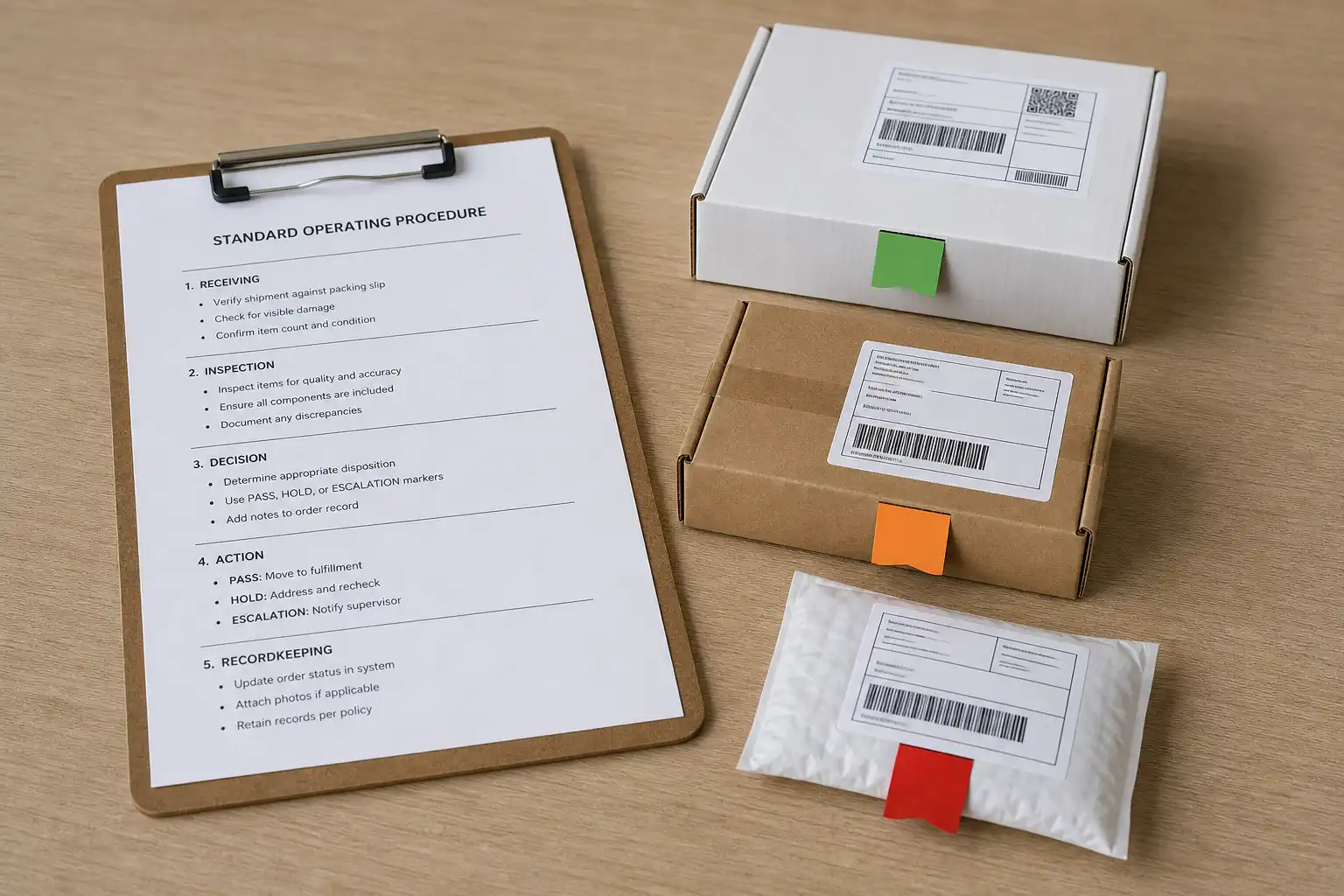
A useful fulfillment SOP defines decisions and release gates, not just a sequence of tasks. “Check the item” leaves too much room for interpretation. “Match SKU, variant, quantity, visible condition, and required accessories before packout” tells the operator what passing means.
Each procedure should contain five elements:
| SOP element | What it must define |
|---|---|
| Input | The order, SKU specification, packaging instruction, and required deadline |
| Action | The work performed and the approved tools or evidence |
| Release gate | The conditions that must pass before the order advances |
| Exception path | Who decides when a condition fails or remains unclear |
| Record | The status, photo, scan, note, or timestamp retained for review |
The same logic should cover cancellations, address edits, substitutions, split orders, fragile items, branded inserts, and delayed supplier confirmation. Not every order needs maximum inspection; the SOP can assign stricter gates to high-value, complex, new, or complaint-prone SKUs.
Review procedures after a recurring exception or material product change. A document that never learns from actual failures quickly becomes ceremonial paperwork.
Key Takeaway: If two trained operators could interpret a checkpoint differently, the SOP is not finished. Define the pass condition and the person authorized to resolve failure.
Separate Store Data From Physical Proof

Shopify, an app, or an ERP can record what should happen; physical proof shows what did happen. A robust workflow connects the two without pretending they are interchangeable.
The store record should carry the order ID, customer-approved variant, quantity, destination, shipping method, and special instructions. The execution record should add supplier confirmation, the physical SKU, inspection result, packaging completion, label match, carrier handoff, and the reason for any hold.
This boundary is especially important when automation works perfectly. An app may transmit the correct variant while the supplier picks the wrong one. It may upload a valid number before the parcel receives its first carrier event. This is where physical supply-chain execution matters more than automation alone: the service must prove that the correct item was confirmed, checked, packed, handed to the carrier, and connected back to the Shopify order record.
Use one order identifier across systems where possible. If supplier references, internal tickets, and tracking records use different IDs, maintain an explicit mapping. Otherwise, support teams spend valuable time reconstructing which physical parcel belongs to which customer promise.
Confirm Supplier Stock and Purchasing Decisions

Supplier confirmation should verify exact availability and the next executable action before an order is released. A generic “in stock” message is not enough for products with colors, sizes, versions, bundles, or changing packaging.
The confirmation should cover exact SKU or variant, available quantity, current product specification, purchase status, expected readiness, and any proposed substitution. If the product is bought only after the sale, the record should link the customer order to the supplier order. If a small buffer is used, the workflow should show what quantity is physically available rather than relying only on a feed.
Human judgment matters when the normal path breaks. A substitute may look similar but fail the listing promise. A second supplier may offer the same model with different accessories. A delayed batch may be acceptable for one customer but not for an expedited order. The operator needs an approval rule, not permission to improvise silently.
For fast-moving SKUs, set a cadence for reconciling supplier statements with physical or reserved quantity. Avoid unsupported promises about predictive purchasing: forecasting can inform a decision, but someone must still confirm supply and decide whether to hold demand, reserve stock, or change the offer.
Design SKU, Packing, and QC Release Rules

The physical release rule should match the product’s actual failure modes. A simple visual accessory may need a lighter check than a powered device, liquid item, apparel variant, bundle, or branded package.
At minimum, the order record should support checks for SKU, variant, quantity, visible condition, required accessories, packaging specification, and label-to-order match. Add product-specific checks only when they are meaningful and operationally possible. A vague promise of “strict QC” is less useful than a written checklist that states what is inspected and what is outside scope.
When wrong variants, missing pieces, or visible defects are recurring risks, the dropshipping quality control process should become part of the order release decision, not a separate marketing promise. Inspection is not a separate marketing feature; it is a gate that can hold an order before the problem reaches the buyer.
Packing rules deserve the same precision. Specify inserts, neutral or branded materials, protective requirements, bundle composition, and whether multiple supplier items should wait for consolidation. A completed pack check should confirm the parcel matches both the order and the agreed presentation.
Create an Exception Queue With Named Owners

Exceptions should enter one visible queue with a reason, owner, next action, and review deadline. Without that structure, difficult orders disappear into chat threads while normal orders continue moving.
Use a small set of reason codes that operators can apply consistently: payment or address hold, supplier stock issue, specification mismatch, product check failure, packing issue, route restriction, tracking delay, cancellation request, or customer decision needed. Every code should route to a person who has authority to act.
What the Fashion Nova shipping case shows
A real ecommerce case illustrates why exception ownership matters. In 2020, the US Federal Trade Commission announced a $9.3 million settlement with Fashion Nova over allegations involving late shipment notices, cancellation options, and refunds for unshipped merchandise. The case was not about dropshipping, and it does not prescribe a private-agent workflow. Its relevant lesson is narrower: when orders cannot ship as promised, the business needs an operating path that identifies the delay and enables a compliant customer decision instead of letting the exception drift.
When physical delays, unclear tracking, or failed release checks are not routed quickly, the same operational issue can later become a refund request; stores that want to reduce Shopify dropshipping refund requests should connect exception handling with evidence and customer-service timing.
Your internal rule should therefore connect the physical delay to the store’s customer-service owner. Legal obligations vary by market, so obtain appropriate advice for your policies; operationally, the crucial point is that the team must know an order has missed its release condition.
Key Takeaway: An exception without a named owner is not being managed. Route every hold to someone who can decide, document, and communicate the next step.
Make Tracking a Verified Handoff, Not a Number
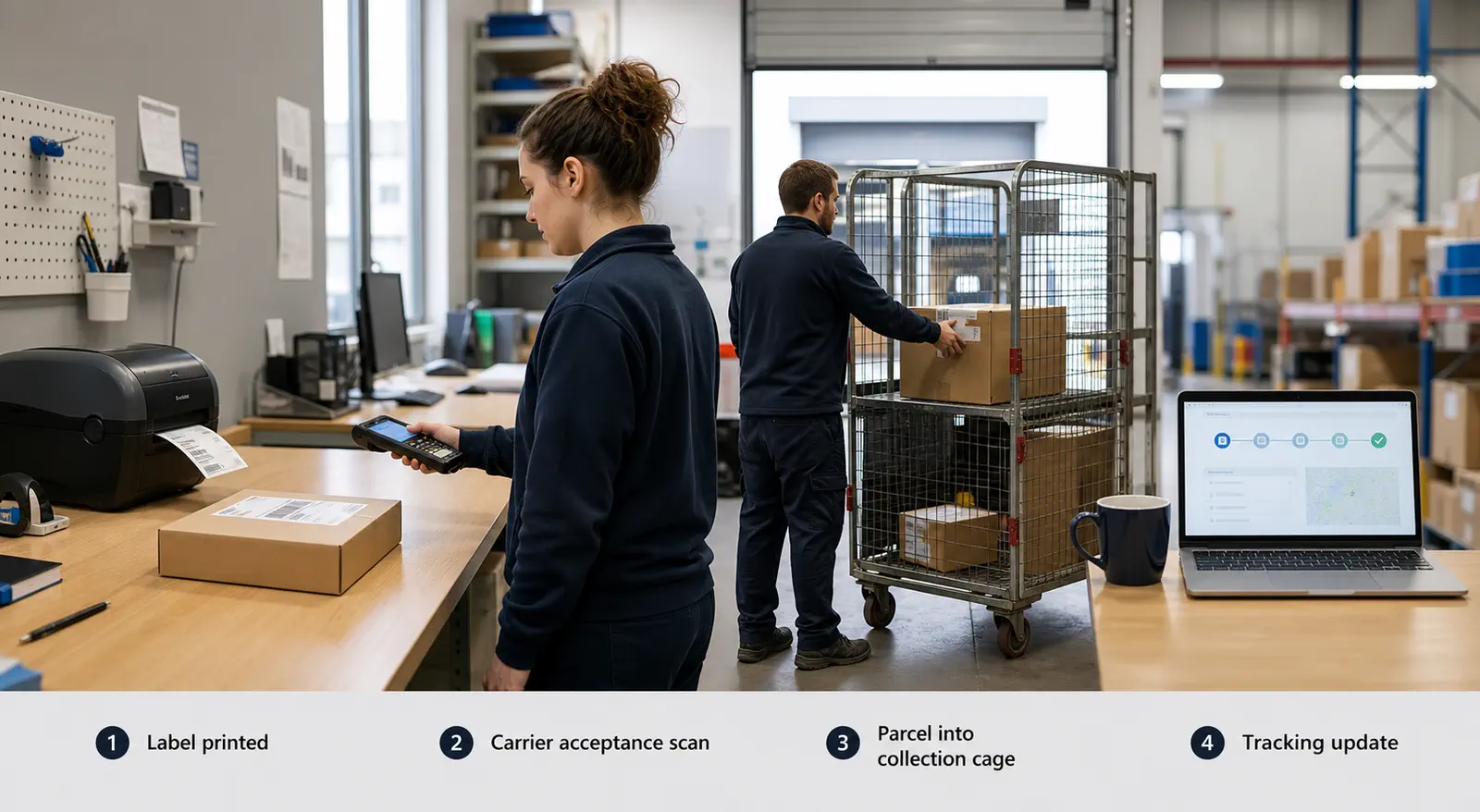
Tracking should reflect a verified shipping event, not merely label creation. Your workflow should distinguish the label, carrier acceptance, first movement, cross-border transfer where relevant, local handoff, delivery, and abnormal inactivity.
The service should define which event triggers Shopify’s fulfilled status and customer notification. Shopify warns that custom fulfillment services may not sync progress back to the admin, so stores using a custom connection need an explicit return path for status and tracking data. The safest rule is the one your team can explain and audit consistently.
When movement stalls, the exception queue should capture the parcel, last event, action owner, and next review point. If your biggest issue is delayed, unclear, or inconsistent parcel visibility, real-time tracking update support can help your team identify stalled shipments earlier instead of waiting for customers to complain.
Do not promise that visibility prevents every complaint or delivery problem. It gives your team earlier, more specific information and helps customer support avoid guessing.
Define the Account Manager’s Operating Role

A dedicated account manager should own coordination and decisions, not function as a message-forwarding layer. The role needs defined authority, coverage hours, escalation contacts, and responsibilities across supplier communication, order holds, packaging questions, route issues, and seller approvals.
Ask how the account manager works when unavailable. A personal contact is valuable, but a process that depends on one person’s memory is fragile. Order history, approvals, and unresolved issues should remain visible to an authorized backup.
Clarify the boundary between the merchant and the execution team. The merchant normally owns listing promises, customer policy, product approval, and decisions that change the offer. The execution team owns the agreed supplier-side and pre-shipment tasks. Ambiguous boundaries create delays because each side assumes the other has acted.
For agencies, mentors, or multi-store operators, also ask whether the service can keep store-specific instructions separate. A repeatable template should not flatten meaningful differences in products, packaging, routes, or approval rules.
Use an Evidence Pack to Make Work Auditable

An evidence pack makes each material handoff reviewable without demanding a photo of every routine action. It should capture enough information to reconstruct what happened when an order is questioned.
A practical pack can include:
- supplier order or allocation reference;
- exact SKU and variant confirmation;
- inspection or release result for the agreed scope;
- packing completion and special-instruction confirmation;
- label-to-order match;
- carrier handoff event and returned tracking record;
- exception reason, decision, approver, and timestamp when applicable.
Decide what is retained for every order and what is collected only for higher-risk cases. Photos or videos can help with expensive, new, complex, or disputed items, but collecting media without an indexing and retention rule produces a folder rather than useful evidence.
This is a major information advantage over a simple feature checklist. You can test whether the provider’s claims are operationally real by asking for a redacted example of the record structure, then confirming that the pilot produces the agreed fields.
Set a retention rule before the first live order. The rule should state which records are kept, where they are indexed, who may access them, and when they are removed. It should also protect customer and supplier information by limiting collection to what the workflow genuinely needs. During a review, sample ordinary completed orders as well as exceptions; otherwise, the evidence system may look strong only when someone already knows a problem exists.
Record the sampling method too, so later reviews compare the same order types and do not quietly exclude inconvenient failures.
Choose Metrics Without Chasing Vanity Targets

Execution metrics should reveal where the process breaks and whether corrective action works. Avoid accepting impressive rates without definitions, time windows, sample size, exclusions, or access to the underlying event logic.
Useful measures include order acknowledgment time, supplier-confirmation backlog, held-order age, release failures by reason, packing or variant exceptions, time from label creation to carrier acceptance, tracking-write-back completeness, and repeat issues by SKU or supplier. The right set depends on your products and promises.
Review both totals and aging. Ten open exceptions may be manageable if they are new and assigned; two old unowned exceptions may be more dangerous. Segment the data so a problem SKU or supplier does not disappear inside an overall average.
Agree on the source of truth for each measure. Shopify can report store events, while the supplier-side or physical workflow supplies different timestamps. A dashboard becomes useful only when both parties understand what each status actually proves.
Run a 30-Day Pilot Before Entrusting Volume

A controlled pilot is the safest way to test execution support before assigning meaningful order volume. Use representative products and scenarios rather than only the easiest single-SKU order.
Before peak season or a larger campaign, Q4 dropshipping logistics should be tested through representative orders because supplier replies, packing capacity, carrier handoff, and tracking visibility can fail faster under volume pressure.
Include a normal item, a multi-variant product, a package with a special instruction, and one deliberately simulated exception that does not affect a real customer. Before the test, agree on the expected order states, evidence fields, escalation path, communication channel, and acceptance criteria.
During the pilot, review whether:
- Orders import with correct SKUs, variants, quantities, and addresses.
- Supplier references and availability confirmations link back to store orders.
- Failed checks stop release and reach the correct decision-maker.
- Packing instructions remain visible at the work point.
- Tracking returns only under the agreed event rule.
- Both teams can reconstruct an order without searching private chat history.
The purpose is not to manufacture a perfect month. It is to observe how the process handles ordinary work and recoverable failure. End with a written gap list, owner, fix, and retest date.
Key Takeaway: Trust a tested workflow, not a polished demo. Pilot the edge cases that matter to your store before moving the order volume that matters to your business.
Decide When Private-Agent Control Is the Right Fit

Private-agent control becomes relevant when your main constraint is accountable supplier-side and physical execution rather than storefront setup. The signal is not a particular revenue label; it is repeated complexity that your current team cannot see or resolve reliably.
Strong fit signals include multiple suppliers, variant-heavy or high-risk products, packaging requirements, recurring stock uncertainty, unclear carrier handoffs, frequent manual exceptions, or several stores needing consistent but separable instructions. A private dropshipping agent can coordinate those stages inside one workflow when the capability and operating rules are verified.
It may be too early if you have no validated product, only occasional test orders, or constantly changing specifications. In that situation, keep the process light and learn what failure modes deserve formal control. It may also be the wrong model if your real need is domestic bulk storage and regional distribution; evaluate the service category that matches the physical flow.
The decision should follow the evidence: mapped responsibilities, sample SOPs, a workable data connection, clear release gates, a named exception owner, and a passed pilot. Revenue claims and impressive dashboards cannot substitute for those controls.
FAQ
Is order syncing the same as execution support?
No. Order syncing transfers data, while execution support coordinates the supplier, product, package, dispatch, tracking return, and exceptions that follow. A strong service connects both layers and records each important handoff.
Do I need an ERP before working with a private agent?
Not necessarily. You need a reliable way to share orders, map SKUs, return statuses, and preserve decisions. The right technology depends on order complexity; a larger system should solve a defined control problem rather than become a badge of scale.
Should every order have inspection photos or video?
No. Evidence should match risk and the agreed inspection scope. Routine orders may need structured status and scan records, while new, high-value, complex, or disputed items may justify additional visual evidence.
How do I compare two providers fairly?
Give both providers the same representative scenarios and acceptance criteria. Compare release rules, evidence, exception ownership, communication continuity, data return, and pilot results—not only quoted price or a feature list.
Can this workflow eliminate fulfillment mistakes?
No. A controlled workflow can expose risks earlier and make responses more consistent, but no credible provider should promise that every supplier, product, carrier, or customer issue will disappear.
Conclusion
Scaling Shopify operations requires more than moving orders faster. You need a controlled chain that connects store data to exact supplier confirmation, physical release, packaging, carrier acceptance, tracking visibility, and owned exceptions. The practical test is simple: can your team explain what must pass, who decides when it fails, and what evidence remains afterward?
If your store already has orders and the backend is breaking at those handoffs, Runtodropship can help you review products, order flow, supplier coordination, inspection expectations, packaging rules, shipping arrangement, and after-sales responsibilities through a private-agent workflow. Serious dropshipping becomes more defensible when every customer promise has an accountable physical process behind it. Send your product links, current order flow, tools, target markets, and recurring exceptions to start with a focused execution review and representative test order.