

Dropshipping supply chain execution is the physical work that happens after an order is created: supplier confirmation, stock handling, product checks, packing, shipping handoff, tracking updates, and exception control. Automation can move order data quickly, but it cannot negotiate with a supplier, inspect a product, reject a damaged item, confirm packaging, or decide what to do when a parcel should be held.
Key Points:
- Automation is useful for order syncing, product importing, inventory alerts, pricing updates, and tracking upload, but it cannot replace physical checks before dispatch.
- The real risk appears when sellers treat a fulfilled status as proof that the correct item was sourced, checked, packed, and handed to the right route.
- A stronger operating model combines software speed with human verification, supplier communication, parcel control, and clear exception rules before customers feel the problem.
Picture a Shopify store that looks organized from the dashboard. Orders flow in, an app pushes them to a supplier, tracking numbers appear, and the backend feels controlled. Then the first cracks show: one variant is out of stock, packaging changes without approval, an accessory is missing, or tracking exists before the parcel has truly moved. The problem is not whether automation is useful. The problem is whether your physical process can keep the customer promise the software already recorded.
Dropshipping Supply Chain Execution: Quick Verdict
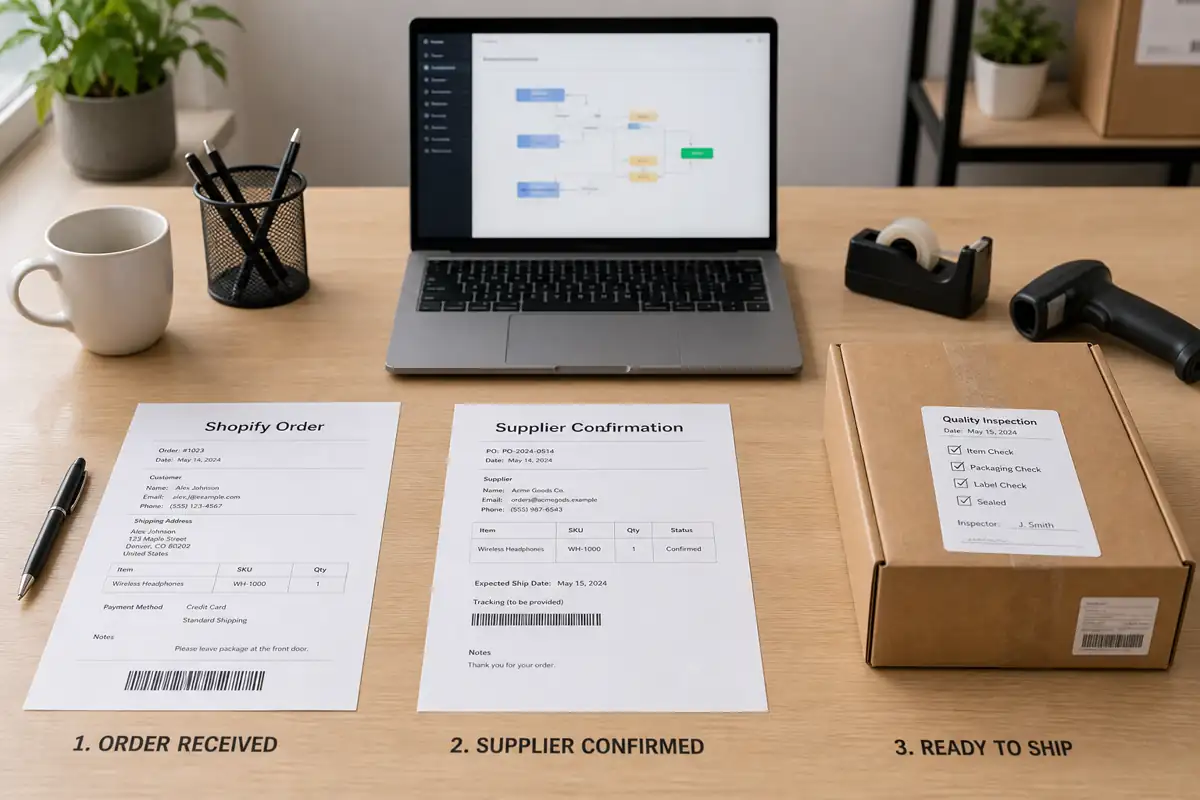
The quick verdict is simple: use automation to move information, but use people and process to control physical reality. A Shopify app can transfer orders, update inventory, and upload tracking, but it cannot see whether a product is scratched, whether the supplier packed the correct accessory, or whether a substitute item breaks the listing promise.
For growing Shopify sellers, this distinction matters because an automated workflow can make a weak backend look calm until customers complain. If you already have Shopify orders and need one accountable workflow for sourcing, product checks, dispatch coordination, and tracking write-back, a private-agent workflow for Shopify dropshipping becomes the next layer above app-only order handling.
That does not mean every seller needs a private agent on day one. If your products are simple, suppliers respond quickly, and error rates are manageable, software may be enough for now. But when variants, fragile goods, custom packaging, multi-supplier orders, or paid-ad scaling enter the picture, the physical layer becomes the part that decides whether your clean dashboard turns into a clean customer experience.
Key Takeaway: Do not ask automation to do a job it was never built to do. Let software reduce repetitive admin work, then add physical checkpoints wherever real products, supplier behavior, packaging, and customer promises can fail.
What Dropshipping Supply Chain Execution Actually Includes
Dropshipping supply chain execution covers the operational work between a customer order and a delivered parcel. It is not only “fulfillment” in the narrow sense. It includes supplier confirmation, stock handling, product checks, packing decisions, shipping handoff, tracking visibility, and exception control.
For a Shopify seller, this means the order is not truly under control just because the app has received it. The seller still needs to know whether the supplier has the exact variant, whether the item matches the listing, whether the package includes the correct accessory, whether the parcel has been handed to the carrier, and whether someone can act when tracking stalls.
A practical dropshipping supply chain execution workflow usually includes six checkpoints:
| Execution checkpoint | What must be confirmed |
|---|---|
| Supplier confirmation | Exact SKU, variant, available quantity, replenishment timing, and substitute risk |
| Product check | Condition, version, color, size, accessory completeness, and listing match |
| Packing control | Packaging strength, inserts, labels, bundle accuracy, and fragile protection |
| Shipping handoff | Label accuracy, carrier acceptance, first scan, and route suitability |
| Tracking visibility | Movement status, stalled tracking, handoff delay, and customer-facing updates |
| Exception handling | Stockout, damaged item, wrong variant, substitute offer, address issue, or delayed route |
Automation can support these checkpoints by moving data and recording status. But the checkpoints still require a real process, because the risk is physical, not only digital.
What Sellers Should Understand Before Automating Dropshipping

Most sellers do not run into problems because automation is useless. They run into problems because automation makes the workflow look finished before the physical work has actually been verified.
An app can send order details, sync tracking, and reduce manual admin work. But the risk starts when the seller assumes that a synced order means the supplier has the exact variant, the product matches the listing, the package includes the right accessories, and the parcel has been accepted by the carrier.
This difference matters most when the store begins to scale. A simple product with stable stock may run smoothly through app-based workflows. A product with variants, fragile packaging, bundles, custom inserts, or multiple suppliers needs more than automatic order transfer. It needs supplier confirmation, product checks, packing control, shipping handoff, and exception rules.
For mentors, agencies, and multi-store operators, this distinction is even more important. If the process only teaches app setup, students or clients may believe the business is fully automated while the highest-risk work still happens at the supplier, packing station, or carrier handoff.
Where Automation Stops and Physical Reality Begins
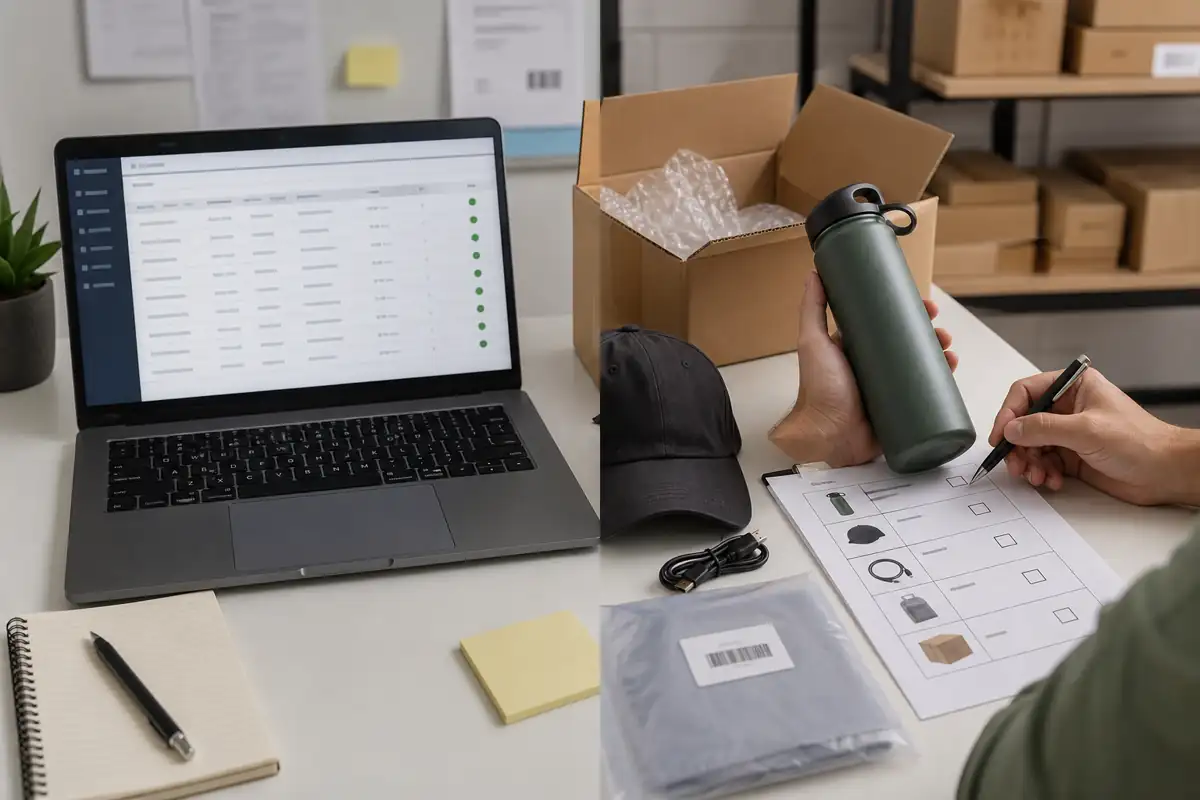
Automation stops when the order leaves the world of data and enters the world of products. That point may arrive earlier than many sellers expect.
Order-sync tools can push customer details, SKUs, variants, quantities, and shipping addresses. They can also trigger fulfillment statuses and send tracking numbers back to Shopify. Those functions save time and reduce manual copying errors. But they do not prove that the supplier picked the correct item, that the current batch matches the listing, or that the package is ready for the promised customer experience.
Think of the workflow as two layers:
| Workflow layer | What it can control | What it cannot prove alone |
|---|---|---|
| Software automation | Order transfer, inventory alerts, pricing rules, tracking upload, basic status updates | Product condition, actual stock availability, correct accessories, packing quality, supplier substitution |
| Physical execution | Product checks, variant confirmation, packing review, parcel handoff, exception handling | App settings, customer checkout logic, payment rules, storefront UX |
The safest store connects both layers. A status update should trigger a physical task, and a physical task should update the digital record. If a product fails a check, the order should not move forward as if everything is normal.
This is also where many Shopify order fulfillment mistakes begin. The dashboard says the order exists; the real question is whether the correct item can be acquired, checked, packed, and dispatched without creating a customer problem.
Key Takeaway: Shopify fulfillment status can help sellers track where an order sits in the order workflow, but a fulfilled status is not the same as a verified order. Treat automation as the information layer, then require physical confirmation before the order becomes a customer promise in motion.
Why Supplier Stock Problems Need Human Judgment

Supplier stock problems rarely follow a perfect rule. They need human judgment because the right decision depends on timing, product risk, customer expectation, and available substitutes.
Automation can flag a low-stock item, but it cannot always know whether the supplier can replenish tomorrow, whether one variant can be substituted, whether the current batch has a quality issue, or whether a different supplier’s version matches the listing. A tool may show available stock because the supplier feed is outdated. It may also show zero stock when the supplier can still reserve a small quantity through direct communication.
When demand increases, the seller needs more than an inventory alert. They need answers:
- Is the product available by exact variant?
- Can the supplier hold quantity for a defined period?
- Is replenishment confirmed or only promised?
- Is a backup supplier’s version visually and functionally equivalent?
- Should ads slow down before customer orders exceed confirmed supply?
For scaling stores, Shopify dropshipping inventory management rules should turn supplier stock signals into actions: continue selling, slow ads, pause a variant, confirm replenishment, or prepare a backup source.
These questions involve negotiation and risk judgment. A simple product with one color may be easy to route to a backup source. A skincare item, electronics accessory, apparel size range, or branded package may be much harder because small differences can create complaints.
This is where dropshipping supplier communication becomes part of execution rather than a separate soft skill. The seller needs supplier answers that are specific enough to act on: SKU, variant, available quantity, hold period, packaging status, preparation cutoff, and fallback route.
Product Checks Before Dispatch Are Not Optional at Scale
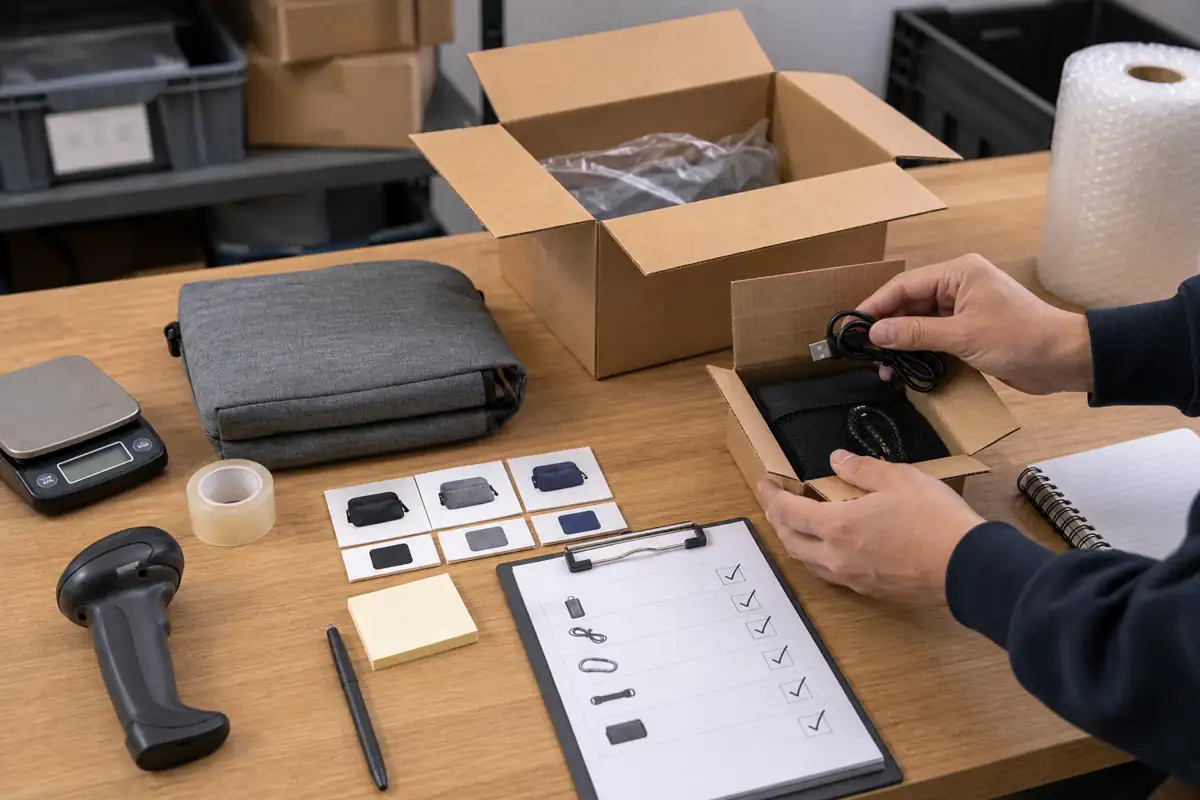
Product checks before dispatch become more important as order volume, product complexity, and customer expectations rise. The more you scale, the less room you have for silent mistakes.
For simple low-risk products, a lightweight visual check may be enough. For high-ticket, fragile, branded, liquid, cosmetic, apparel, electronics, or bundle-based products, the check should be more specific. The goal is not to create a slow inspection ceremony for every parcel. The goal is to catch the failure modes that would damage the customer promise.
A practical check can include:
- correct SKU and variant;
- color, size, plug type, version, or bundle contents;
- visible condition and surface damage;
- accessory completeness;
- packaging seal, leakage risk, or fragile protection;
- listing promise versus actual shipped item.
At this stage, the check needs a clear ship-or-hold rule. If the item is the wrong version, missing an accessory, visibly damaged, poorly sealed, or different from the listing promise, the order should not move forward just because the app workflow is ready. This is where dropshipping quality control matters: automation can create the task and record the result, but the decision still depends on someone comparing the actual product with the customer order before dispatch.
For agencies and mentors, this is a useful teaching distinction. A beginner may think “my supplier handles fulfillment” means the product is checked. An experienced operator asks what is checked, who can stop a bad order, and how proof is stored.
Key Takeaway: The higher the product risk, the less you should rely on supplier status messages alone. Define the exact physical check that protects the listing promise before a customer ever sees the parcel.
Packaging and Parcel Handoff Protect the Customer Promise

Packaging is where the operational promise becomes visible to the customer. If the product is correct but the parcel is weak, incomplete, poorly presented, or split in a confusing way, the customer still experiences the order as a failure.
Automation usually treats packing as a status: unfulfilled, fulfilled, shipped. Real execution treats packing as a controlled step. Does the parcel include the right item? Does it include the right insert or accessory? Is fragile protection enough? Is branded packaging being used only when approved? Is the shipping label matched to the correct order?
This matters for multi-item orders too. If one customer buys three items from different suppliers, the simplest automated path may create three separate parcels, three tracking numbers, three delivery moments, and three chances for confusion. Dropshipping order consolidation can reduce that confusion, but only when someone controls what should be packed together, what should ship separately, and how each tracking update should be explained to the customer.
Parcel handoff is another control point. A tracking number created too early can make the seller feel safe while the customer still sees no movement. A good process distinguishes label creation, carrier acceptance, movement, local handoff, and delivery update.
Exception Handling Is the Missing Middle Layer
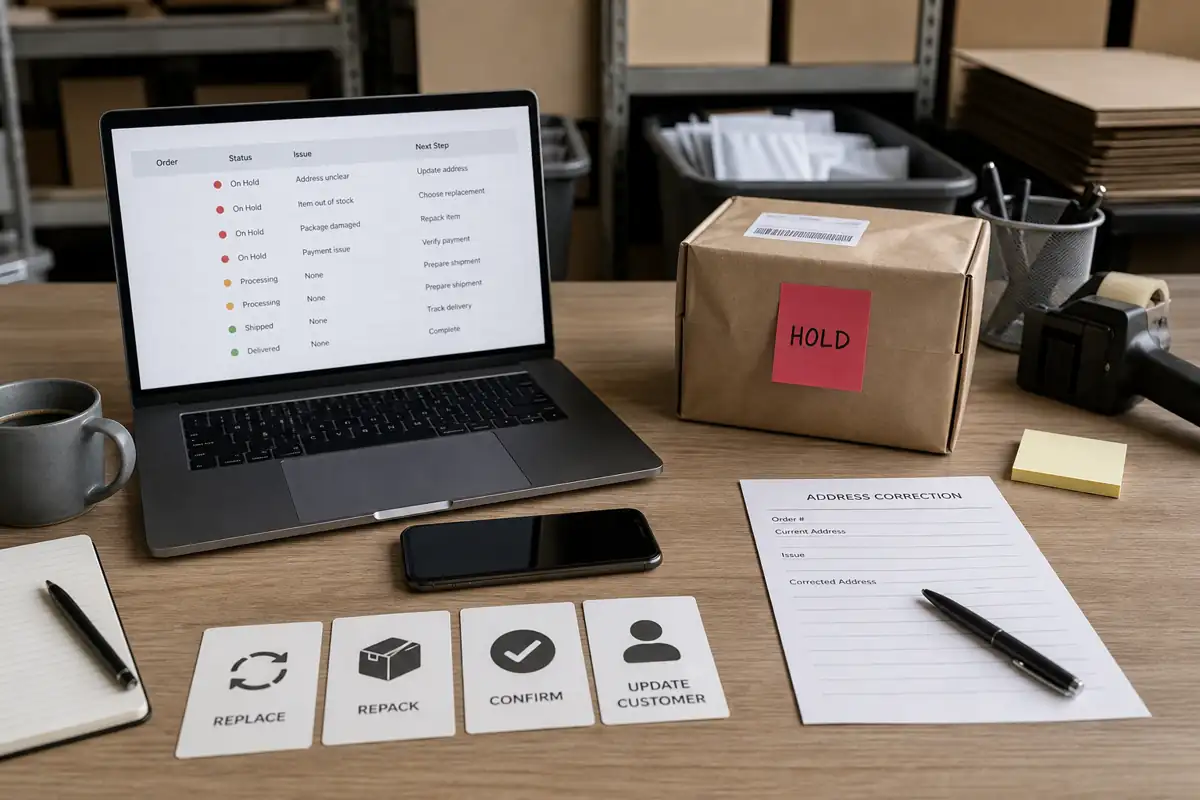
Exception handling is the missing middle layer between automation and customer service. It decides what happens when an order cannot safely follow the normal path.
Most stores have a happy-path workflow. Order arrives, supplier receives it, product is packed, tracking is uploaded, customer waits. The real stress begins when the workflow breaks: supplier stock changes, address details look wrong, a product arrives damaged, a substitute is offered, the route is unsuitable, or tracking stalls.
If nobody owns exceptions, small backend issues become public customer problems. The right process should define who can pause an order, who confirms with the seller, who updates the customer, and when a replacement or cancellation is safer than shipping uncertainty downstream.
Use a simple decision map:
| Exception | Wrong response | Better response |
|---|---|---|
| Supplier offers a substitute | Ship it silently | Compare it against the listing promise and ask for seller approval if needed |
| Product arrives damaged | Send it to avoid delay | Hold, replace, document, and update the order record |
| Tracking has no movement | Tell the customer to wait vaguely | Check acceptance status and send a specific, conservative update |
| Variant is unclear | Guess based on supplier message | Confirm SKU, photo, or packing record before dispatch |
This is also why real-time tracking updates need an exception process behind them. A tracking number alone is not enough if nobody checks carrier acceptance, stalled movement, delayed handoff, or the customer message that should follow. The earlier you identify the exception, the less pressure lands on customer service.
Key Takeaway: Build rules for abnormal orders before abnormal orders arrive. A clear hold, confirm, replace, repack, or update rule prevents the backend from shipping uncertainty to the customer.
Real Case: Target Canada Shows Why Systems Need Execution Discipline

Target Canada is a useful public cautionary case because it shows how a large company can have systems, plans, and processes on paper while execution still breaks in the real world.
Harvard Business Review discussed the case in Why Target’s Canadian Expansion Failed. The details are not a dropshipping example, so the lesson should not be overstated. The relevant point for Shopify sellers is narrower: technology can organize information, but it cannot protect the customer experience if stock data, warehouse flow, packing, and handoff control are unreliable.
For a Shopify seller, the scale is smaller but the pattern is familiar. A dashboard can say orders are flowing. A supplier feed can say stock exists. A tracking field can say shipped. But if the product is unavailable, the package is wrong, the parcel has not been accepted, or nobody owns the exception, the customer experience will reveal the failure.
How to Integrate Tech With Human Supply-Chain Control
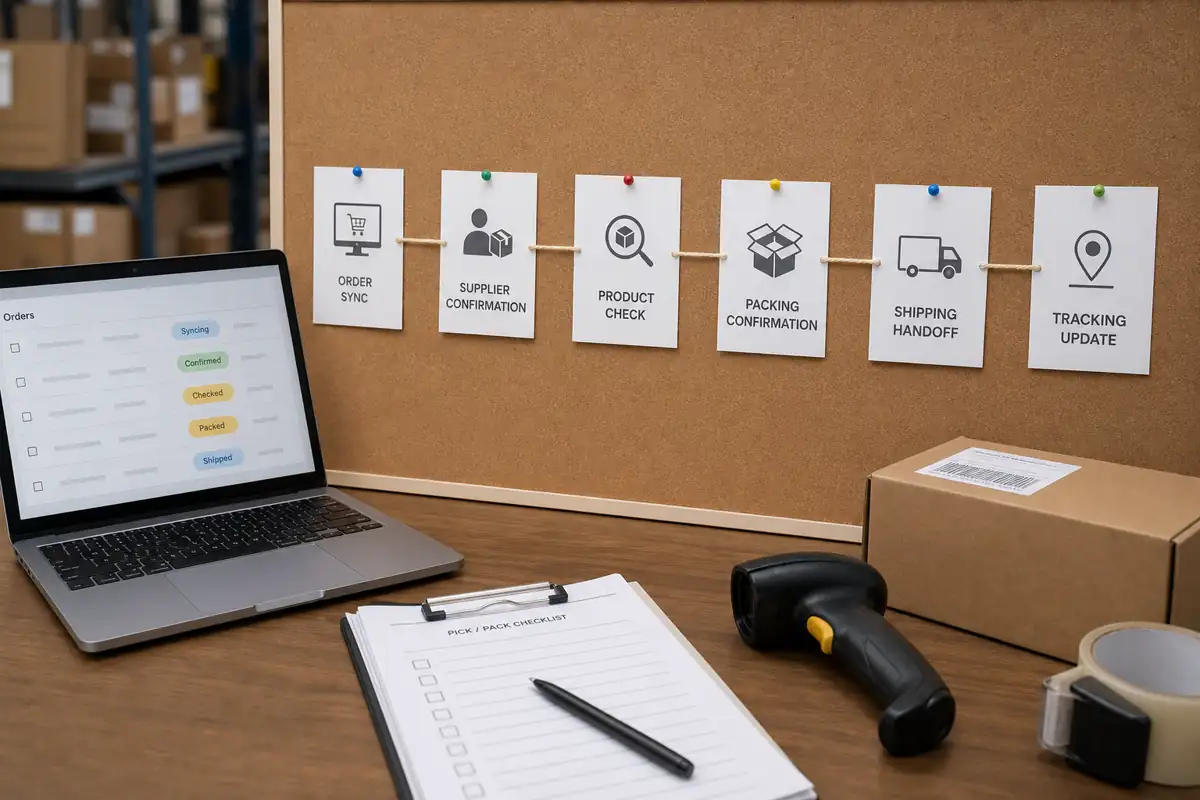
The best model is not automation versus people; it is automation plus human control at the right checkpoints. Software should make the routine faster, while people handle the judgment calls that affect product truth and customer trust.
Start by mapping your current order path. Where does the order enter? Who confirms supplier stock? Who checks the product? Who approves substitutes? Who confirms packaging? Who owns the first scan gap? Who updates customer support when something goes wrong?
Separate tasks into three groups:
- Automate: order import, SKU mapping, inventory alerts, basic tracking upload, repetitive status notifications.
- Standardize: supplier confirmation format, product-check checklist, packing record, parcel handoff status, exception tags.
- Escalate: stockout, damaged item, unclear variant, substitute product, address issue, route problem, delayed acceptance, customer complaint pattern.
The power is in the connection between the groups. If a product fails a check, the software record should show the hold. If a supplier confirms a substitute, the seller should receive enough information to approve or reject it. If a tracking number has no movement, customer service should not have to guess.
A repeatable workflow gives operators the same language for problems: normal order, held order, supplier exception, packing issue, route issue, and customer update needed.
When Private-Agent Control Becomes Worth It
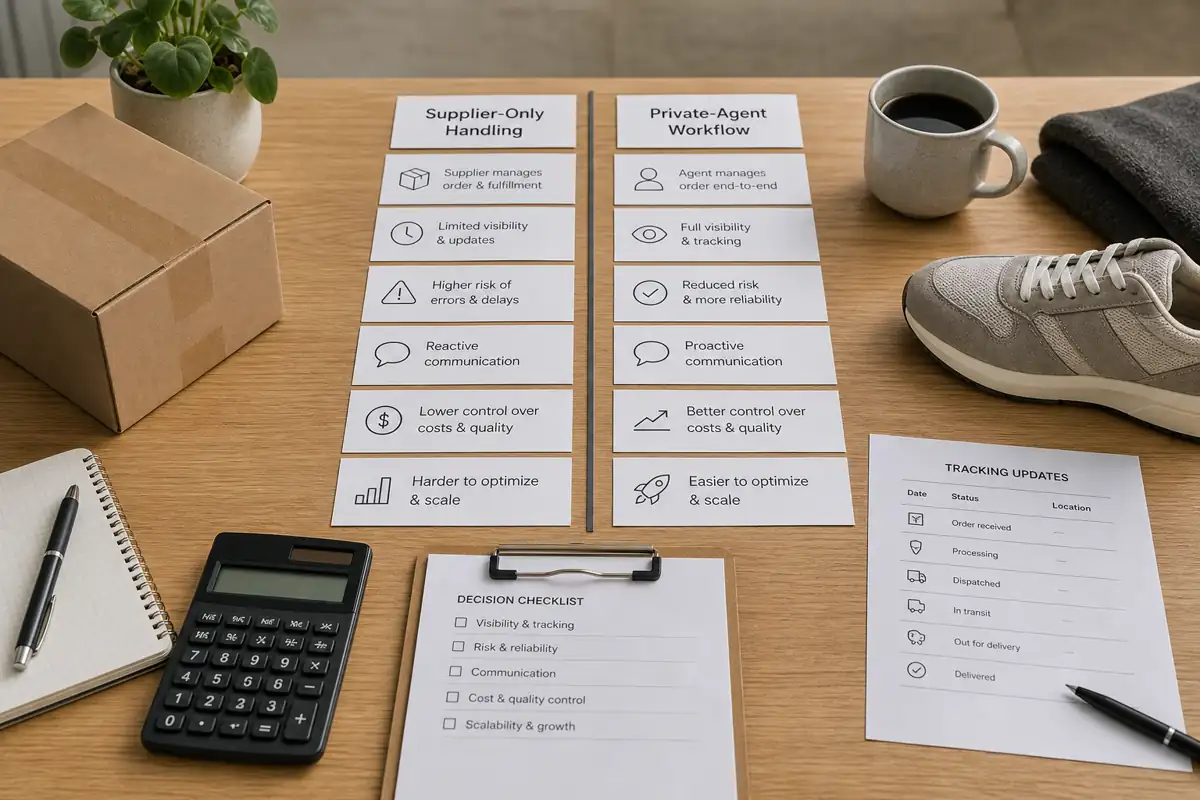
Private-agent control becomes worth considering when the main bottleneck is no longer order data but physical coordination. If the app is working but customers still receive wrong items, delayed parcels, missing accessories, poor packaging, or vague updates, your issue is execution depth.
Use these signals:
- You rely on supplier messages but cannot verify product or package condition.
- Stock changes faster than your app or supplier feed updates.
- Paid ads create spikes that suppliers cannot confirm in time.
- Customer support problems repeat around the same SKU, variant, route, or package type.
- You need product checks, packing confirmation, inserts, labels, kitting, or parcel consolidation.
- You manage multiple stores or clients and need one repeatable backend process.
RuntoDropship is a private dropshipping agent team for ecommerce sellers and operators who already have orders and need stable sourcing, product checks, order execution, shipping arrangement, and after-sales support. In this context, the value is not replacing software. It is connecting software to the physical work that keeps the customer promise credible.
If your current setup is simple and stable, keep improving the app workflow. If growth is exposing supplier uncertainty, packing mistakes, tracking blackouts, or unowned exceptions, the next improvement is usually not another automation rule. It is a more accountable backend process that connects supplier communication, product checks, packing control, shipping handoff, and after-sales follow-up.
Key Takeaway: Bring in private-agent support when the failure pattern is physical: unclear stock, unverified products, packing risk, weak supplier responses, tracking uncertainty, or repeated exceptions that software can record but cannot fix.
FAQ
Can dropshipping automation replace a private agent?
No. Automation can replace some manual admin tasks, but it cannot fully replace supplier negotiation, product inspection, packing confirmation, physical order handling, or exception judgment. The right choice depends on product risk, order volume, supplier reliability, and how much control your customer promise requires.
What should I automate first in a Shopify dropshipping workflow?
Start with repetitive data tasks: order import, SKU mapping, inventory alerts, tracking upload, and simple customer notifications. Then build manual or agent-led checks for product condition, variant accuracy, packing, route selection, and abnormal orders.
Is this only important for high-volume sellers?
No, but the risk becomes more visible at volume. A small store can manually check more exceptions. A growing store needs a repeatable system because one supplier mistake can repeat across many orders before anyone notices.
How do I know whether my problem is software or execution?
If orders are not syncing, tracking is not uploading, or inventory rules are misconfigured, start with software. If the synced orders still create wrong items, stockouts, damaged parcels, missing accessories, or vague supplier answers, the problem is physical execution.
Should mentors and agencies teach automation first or process first?
Teach the process first, then show which parts can be automated. Students and clients need to understand supplier confirmation, product checks, packing, route handoff, and customer updates before they assume an app can run the whole backend.
Conclusion
Automation gives Shopify sellers speed, but speed alone does not protect the customer promise. Real backend control comes from connecting order data to supplier confirmation, product checks, packaging, parcel handoff, tracking visibility, and exception handling. Once you see that distinction, you can make better decisions about which tasks should be automated, which should be standardized, and which need human judgment.
For sellers already receiving consistent orders, the next step is to identify where the workflow is breaking: supplier confirmation, product checks, packing, shipping handoff, tracking updates, or exception handling. If those problems are happening outside the app, a private dropshipping agent workflow can help connect automation with real supply-chain execution.