

Dropshipping UK is legal and worth testing in 2026 only when you can offer a compliant product to a defined British customer, acquire that customer at a workable cost, and keep responsibility for the complete order experience.
Quick Answer: Use a go-or-stop screen before building the store: prove reachable demand, safe order economics, and a delivery promise you can verify. If any one remains unknown, spend your next small test on that uncertainty instead of adding products or advertising budget.
Many new sellers begin with a theme, a supplier catalogue, and social ads because those steps feel productive. The painful discovery comes later: the product has no defensible reason to buy, the parcel does not match the promise, or one return removes the margin from several orders. Starting with a decision screen turns those hidden weaknesses into questions you can test while they are still inexpensive.
What Is Dropshipping UK and How Does It Work?
UK-focused dropshipping is a retail model in which you sell to British customers without buying a batch of stock first, while a supplier dispatches each paid order directly to the buyer.
The customer buys from your store or marketplace listing. You receive the order and payment, send the correct details to the supplier, and the supplier picks, packs, and dispatches the item. You remain the retailer responsible for descriptions, delivery promises, cancellations, refunds, faults, and support.
The model reduces cash tied up in unsold inventory and makes small product tests possible. It does not remove spending on samples, selling-channel fees, creative work, marketing, refunds, software, tax support, or supplier payments made before a platform releases your funds.
Is UK Dropshipping Worth It in 2026?
It is worth testing when your advantage comes from customer understanding, presentation, service, or coordinated execution—not merely finding the same product at a low supplier price.
Its advantages are lower inventory commitment, flexible product testing, and the ability to focus resources on customer acquisition. Its disadvantages are lower physical control, dependence on supplier stock and dispatch, intense competition, split parcels that require order consolidation, and margin pressure from advertising, tax, returns, and one-by-one purchasing.
The model is a poor fit if you expect passive income, cannot fund samples and exceptions, need guaranteed delivery without route evidence, or want to sell regulated products without understanding the required documents. It is a better fit when you are willing to test one connected offer and improve control as repeat demand appears.
Key Takeaway: Continue only if you are prepared to operate as the retailer, fund real tests, and take responsibility when a supplier-side failure reaches the customer.
Research Demand and Competition Before Choosing a Product

Good product research proves that a reachable UK customer has a reason to buy your offer at a price that can support the complete order cost.
Start with a narrow customer problem rather than a viral-products list. Use Google Trends for dropshipping to compare UK search patterns across several time ranges, then cross-check relevant marketplace listings, customer reviews, social content, and seasonal demand. Search interest and views are signals; purchases at a workable cost are stronger evidence.
Compare the offers customers already see
For five to ten relevant sellers, record the product or bundle, delivered price, stated delivery window, main promise, proof shown, repeated review complaints, and returns clarity. Look for a serviceable difference such as clearer fit information, a useful bundle, stronger demonstration, better packaging, or more dependable support.
Avoid a gap that depends on an unsafe claim or a price you cannot sustain. Order a sample before listing the product, then verify the physical item, instructions, labels, packaging, packed dimensions, and likely customer questions.
For products sourced from China, a product quality-control process can check visible product and packing details before dispatch. It does not replace UK compliance evidence, laboratory testing, or legal advice.
Key Takeaway: Select a product only when demand, a credible difference, parcel fit, and physical verification point to the same decision.
Calculate a Startup Budget and the Real Cost Per Order
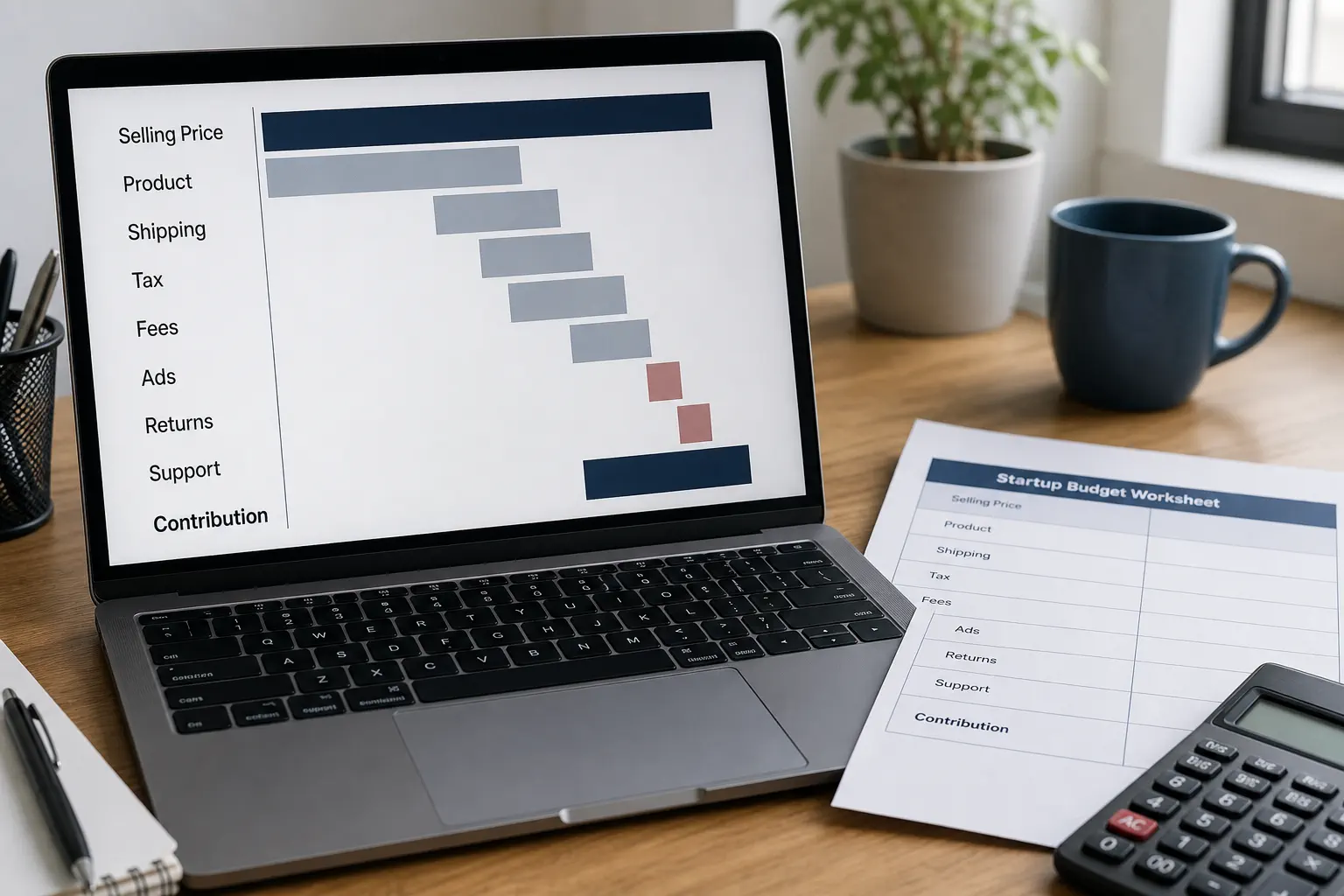
Your startup budget must fund enough learning to decide whether the offer works, not merely enough software to open a store.
Build four budget envelopes: setup, product and delivery tests, customer-acquisition tests, and an exception reserve for refunds, replacements, chargebacks, or payout delays. A universal minimum would be misleading because the product, channel, creative method, and risk level change the amount required.
Calculate contribution after the customer is served
Use this planning formula:
Order contribution = selling price − product cost − packaging − shipping − VAT and duty borne by the business − platform and payment fees − customer acquisition cost − expected returns, replacements, and support cost
Use the packed parcel and real destination for shipping quotes. Keep enough working capital to pay suppliers while customer payments are pending or held. The dropshipping business plan framework can connect these numbers to cash flow, test limits, and stop conditions.
Key Takeaway: Do not approve the offer because its product markup looks attractive. Approve it only when a delivered and supported order can leave usable contribution.
Is Dropshipping Legal in the UK?
Yes, the model is legal, but you remain an online retailer whose offer must satisfy the consumer, product, data, and tax rules that apply to the actual transaction.
The GOV.UK distance-selling guidance requires online sellers to provide specified business, pricing, payment, delivery, cancellation, and contract information. Your product page and policies should make the total price, delivery expectations, cancellation route, and contact method clear.
The UK returns and refunds guidance says online customers normally have 14 days after receipt to tell the seller they want to cancel, followed by another 14 days to return the item, subject to exceptions. Faulty or misdescribed goods create separate duties, so the supplier’s policy cannot replace your responsibility to the buyer.
Check the exact product category
Use the government’s product safety guidance for businesses as an entry point. Required labels, warnings, traceability, conformity evidence, and responsible-business details vary by product.
Avoid regulated, ingestible, electrical, children’s, cosmetic, medical-claim, branded, or battery products unless you can confirm the documents and responsibilities that apply.
Choose a Business Structure and Map the VAT Transaction
Your business structure and VAT treatment depend on where the business is genuinely established, how you sell, where the goods are located at sale, and how the order enters the UK.
UK residents commonly compare operating as a sole trader with forming a limited company. GOV.UK’s business setup guidance explains the registration paths; an accountant can help apply them to your circumstances.
Do not apply one VAT threshold to every seller
The domestic VAT registration threshold matters to many UK-established businesses, but it is not a universal answer for cross-border stores. HMRC says an overseas seller making taxable direct sales to UK customers may need UK VAT registration under different conditions.
HMRC’s direct-sales VAT guidance states that many consignments valued at £135 or less require the seller to charge and account for VAT at the point of sale; normal import VAT and customs rules generally apply above that amount. Marketplaces can have different collection responsibilities, and Northern Ireland can involve separate rules.
Map one transaction before launch: seller location, channel, customer type, goods location at sale, consignment value, importer, VAT collector, and return route. Obtain qualified tax advice when the result is unclear.
Key Takeaway: Confirm tax against the transaction you will actually run. A UK business, an overseas direct seller, and a marketplace seller cannot safely rely on the same one-line VAT answer.
Compare Supplier Models by Control and Customer Promise
The right supplier model is the one that can repeatedly meet the product, delivery, communication, and after-sales conditions your validated offer requires.
UK-based suppliers may simplify domestic delivery and returns. Overseas marketplace suppliers can support low-commitment testing, but each seller must be checked separately. A private dropshipping agent becomes relevant when a store with meaningful order activity needs one contact to coordinate sourcing, samples, product checks, packaging, order processing, shipping arrangements, and issue follow-up.
Before relying on any model, use a documented supplier communication process to confirm exact product and variant mapping, live stock updates, packed dimensions and weight, shipping eligibility, dispatch evidence, approved packaging, and responsibility for faults, loss, replacements, and returns.
Place a sample order and at least one customer-path test order. A structured dropshipping supplier evaluation process can help compare responsibilities without treating a directory listing as proof of suitability.
Build a Store and Choose One Customer-Acquisition Route
Your store should make the validated offer easy to understand and connect it to one credible source of first customers.
Shopify gives you control over the storefront, checkout, and customer relationship, but you must generate traffic. TikTok Shop can connect content discovery with marketplace checkout, subject to current rules. WooCommerce offers greater technical control, while marketplaces provide existing demand but impose their own seller and dropshipping policies.
Use original descriptions and evidence. Explain who the item is for, what it does, dimensions or compatibility, what is included, delivery expectations, returns, and how to get help.
Choose one primary acquisition route that matches the product and your skills: short-form demonstrations, search ads, creator partnerships, useful search content, or marketplace listings. Define the signal you need before spending—qualified visits, product engagement, checkout starts, or completed orders—and do not increase spend merely because content received views.
Launch With a Controlled Test and Decide Whether to Scale

A controlled launch tests the complete customer journey with limited products, limited spend, and written pass or stop conditions.
Begin with one customer group, one core offer, and one traffic route. Process early orders closely enough to see where data, variants, stock, packing, tracking, or customer messages fail.
After the test, review demand, conversion, product accuracy, delivery evidence, and complete order contribution. Proceed when the evidence supports another controlled increase; revise a specific problem when it can be corrected; stop when safety, legality, customer expectations, or economics cannot be made workable.
Key Takeaway: Scale only after the same offer can attract a customer, arrive as promised, and leave usable contribution. Revenue alone is not validation.
FAQ
Does a marketplace reporting my sales to HMRC mean I automatically owe tax?
No. Platform reporting does not by itself determine whether tax is due. GOV.UK explains that you still need to assess whether your activity amounts to trading and apply the relevant income, profit, and VAT rules to your circumstances.
Can a customer cancel a personalised or hygiene-sensitive product just because they changed their mind?
Not always. The normal online cancellation right has exceptions, including certain personalised, perishable, unsealed hygiene-sensitive, and digital or media products. Faulty or misdescribed goods remain a separate issue, so confirm the exact exception before writing the returns policy.
Can I use the Great Britain 135-pound VAT rule for orders sent to Northern Ireland?
Do not assume so. HMRC identifies separate rules for some goods moving between Northern Ireland and the EU, so map the destination and route separately rather than copying the Great Britain treatment.
Conclusion
A viable UK store follows a decision chain: confirm that the model fits your responsibilities, validate demand and differentiation, prove complete order economics, map compliance and tax, test the supplier and customer journey, and scale only when the evidence stays connected.
When repeat demand makes scattered supplier accounts and inconsistent execution difficult to manage, Runtodropship can coordinate sourcing, samples, product checks, packaging, order processing, shipping arrangements, and after-sales follow-up through one private-agent workflow. Sustainable ecommerce depends on accountable execution behind every promise; send your product link, target UK customer, current order volume, and main operational problem to discuss the next test.