
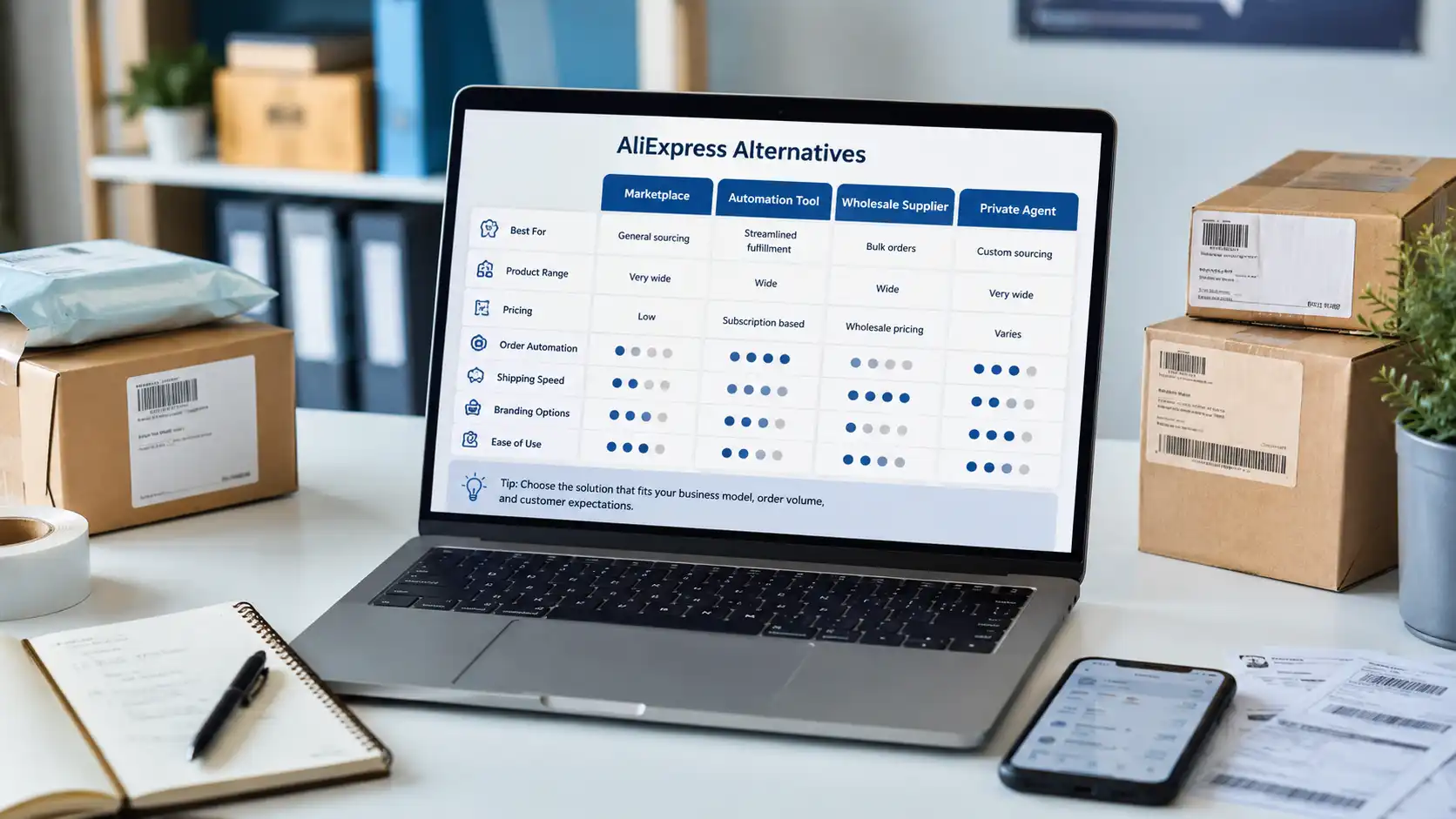
Finding the right AliExpress alternatives can help dropshipping sellers improve shipping control, product quality, supplier reliability, and customer experience. AliExpress can still be useful for testing products because it gives sellers access to a wide product range with a low entry barrier. However, once a Shopify, TikTok Shop, or DTC store starts getting stable orders, the weaknesses of public marketplace sourcing can become more visible.
Many sellers begin looking for sites like AliExpress when they experience slow shipping, inconsistent product quality, weak tracking updates, poor packaging, or limited branding control. At the testing stage, these issues may feel manageable. At the scaling stage, they can increase refund requests, customer complaints, and operational stress.
This guide compares 15 AliExpress alternatives for dropshipping sellers in 2026. Some are automation tools. Some are supplier directories. Some are wholesale marketplaces. Others are private sourcing and order execution options for sellers who need more control over product checks, packaging, and shipping coordination.
The goal is not to say that one option fits every seller. The best AliExpress alternative depends on your order volume, product type, delivery expectations, branding needs, and how much control you want over your supply chain.
What Is AliExpress and Why Do Dropshippers Use It?
AliExpress is a global online marketplace where sellers can find low-cost products across many categories, including home goods, electronics, beauty items, accessories, apparel, gadgets, and lifestyle products. Many beginner dropshippers use AliExpress because it is easy to access, has a broad product selection, and allows sellers to test products without buying large amounts of inventory upfront. This fits the basic dropshipping business model, where products are sold online while supplier-side partners handle inventory or shipping steps.
For early product testing, AliExpress can still make sense. A seller can validate product demand, test ad creatives, study customer reactions, and identify winning products before investing in a more controlled sourcing workflow.
During that testing stage, the AliExpress Dropshipping Center can be useful for building a product shortlist and reviewing platform-side demand signals before you spend money on samples or advertising.
The problem usually appears after a product starts selling consistently. AliExpress was not built as a dedicated order execution system for scaling Shopify, TikTok Shop, or DTC sellers. Different suppliers may use different shipping lines, packaging standards, stock handling methods, and communication practices. That makes it harder to control the customer experience as order volume grows.
This is why many sellers start searching for AliExpress alternatives once they move from testing products to scaling a real ecommerce brand.
Why Look for AliExpress Alternatives in 2026?
Dropshipping sellers usually look for alternatives to AliExpress when they need better control over delivery time, product quality, supplier communication, and branding. These problems are not always serious at the beginning, but they can become expensive when a store starts processing more daily orders.
Common reasons include:
- Slow shipping and long delivery times
- Inconsistent product quality from different suppliers
- Limited quality control before dispatch
- No clear pre-dispatch product check process
- Missing accessories or incorrect product variants
- Weak packaging standards
- No branded packaging or custom inserts
- Tracking delays that increase customer support pressure
- Limited supplier communication during peak sales periods
- Difficulty scaling winning products safely
- Higher refund requests and customer complaints
The right AliExpress alternative should solve the specific problem your store is facing. A beginner may need automation. A Shopify seller may need better store integration. A TikTok Shop seller may need faster dispatch control and tracking updates. A scaling brand may need product sourcing, sample confirmation, packaging checks, and private agent order execution support.
Quick Comparison: Best AliExpress Alternatives by Seller Type
| Seller Type | Best Alternative | Why It Fits |
|---|---|---|
| New product testing | AliExpress / DSers | Useful for testing many products before choosing a stable SKU |
| Beginner dropshippers | Zendrop / CJdropshipping | Easier product importing, supplier access, and store workflow support |
| Faster US/EU delivery | Spocket / Doba | Focuses more on suppliers or inventory closer to Western markets |
| Bulk sourcing | Alibaba / DHgate / Global Sources | Better for wholesale comparison, MOQ discussions, and supplier research |
| Electronics products | Banggood / niche electronics suppliers | More focused on gadgets, electronics, and tech-related products |
| Shopify automation | AutoDS / DSers | Helps import products, manage listings, and automate parts of the store workflow |
| Supplier research | SaleHoo / Wholesale2B | Useful for comparing suppliers, directories, and product catalogs |
| Branded dropshipping | Private dropshipping agent | Better for packaging control, product checks, and brand presentation |
| Scaling sellers | China private dropshipping agent | More suitable when the seller needs sourcing, QC, shipping coordination, and stable order execution |
| TikTok viral orders | Private agent with stock readiness | Better when demand spikes require preparation, tracking coordination, and dispatch control |
15 Best AliExpress Alternatives for Dropshipping Sellers
1. RuntoDropship — Best for Scaling Sellers Who Need a China Private Dropshipping Agent
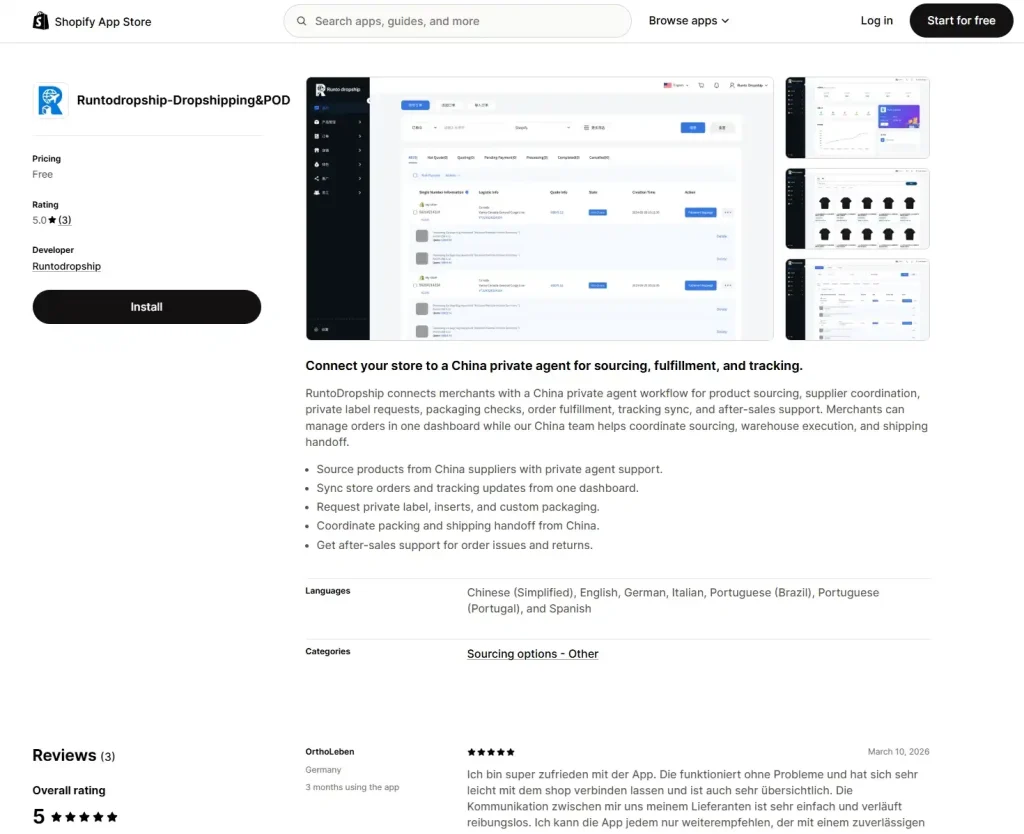
Best for: Shopify, TikTok Shop, and DTC sellers with stable product demand who need more control over sourcing, product checks, shipping coordination, and branded packaging.
Main advantage: RuntoDropship works as a China private dropshipping agent, not as a public marketplace, generic 3PL, or ordinary fulfillment center. It is designed for sellers who want support from a China sourcing team and a private agent warehouse execution team. This can help sellers move beyond random public marketplace suppliers and create a more controlled order execution workflow.
RuntoDropship can support product sourcing, sample confirmation, product checks before dispatch, packaging checks, accessory checks, shipping coordination, tracking workflows, branded packaging, and private label support based on the seller’s product type and requirements.
For sellers replacing AliExpress suppliers, this model is useful because it focuses on the practical problems that appear after scaling: supplier inconsistency, unclear product standards, weak packaging, slow shipping, tracking issues, and customer complaints.
Main limitation: RuntoDropship may not be the best fit for sellers who are still testing dozens of random products with very low daily order volume, have no stable SKU, or only want the cheapest possible item without sample confirmation or quality standards.
When to use it: Use RuntoDropship when AliExpress shipping, product quality issues, packaging limits, or supplier instability start affecting your customer experience. It is especially relevant when your store needs a more structured China dropshipping sourcing agent instead of relying on public marketplace vendors.
2. Zendrop — Best for Beginner-to-Intermediate Dropshipping Automation
Best for: Dropshipping sellers who want an all-in-one platform for product discovery, importing, order workflow support, and easier store operations.
Main advantage: Zendrop is widely known as a dropshipping platform that helps sellers find products, automate parts of the order process, and manage supplier-related workflows. It is especially attractive for sellers who want to move away from manual AliExpress product importing but still prefer a platform-style experience.
Zendrop can be useful for beginners because the platform is built around dropshipping workflows, rather than requiring sellers to manually contact every supplier. It may also offer branding or private labeling options depending on seller eligibility, product type, and program requirements.
Main limitation: Platform-based dropshipping tools may still limit how much physical control you have over product checks, packaging details, factory-side pricing comparison, and private order execution. Sellers with higher volume may eventually need more customized sourcing and inspection standards.
When to use it: Use Zendrop when you want a more guided dropshipping platform than AliExpress and need easier product importing, supplier access, and basic automation.
3. CJdropshipping — Best for Product Sourcing and Platform-Based Dropshipping Support
Best for: Beginner and mid-scale dropshipping sellers who want a platform that combines product sourcing, product catalog access, store connections, and order workflow support.
Main advantage: CJdropshipping is a well-known option for sellers who want more dropshipping-specific support than standard AliExpress suppliers. It offers product sourcing, marketplace-style product access, warehouse-related options, and print-on-demand features for certain products.
For sellers who want to test products while using a platform that understands dropshipping operations, CJdropshipping can be a practical alternative. It may also help sellers who want broader sourcing options without negotiating directly with multiple suppliers.
Main limitation: Because CJdropshipping serves many sellers and product categories, the level of control may vary depending on the product, supplier, warehouse location, and chosen shipping method. It may not provide the same private execution control as a dedicated China private agent.
When to use it: Use CJdropshipping when you want a more dropshipping-focused platform than AliExpress and need product sourcing, catalog access, and store workflow support in one place.
4. DSers — Best for AliExpress Automation and Order Processing
Best for: Sellers who still want to use AliExpress but need better automation, product importing, supplier mapping, and order processing.
Main advantage: DSers is closely connected to the AliExpress dropshipping workflow. It helps sellers import products, manage suppliers, process orders, and automate parts of the AliExpress-based dropshipping system.
This makes DSers useful for beginners who are not ready to leave AliExpress completely. Instead of replacing AliExpress, DSers can make AliExpress more manageable by improving how products and orders are handled inside the store workflow.
Main limitation: DSers does not fully solve the core weaknesses of AliExpress itself. If the underlying supplier has poor product quality, weak packaging, slow shipping, or limited communication, automation alone cannot fix those operational issues.
When to use it: Use DSers when you are still testing products through AliExpress and want better store workflow automation before moving to a more controlled sourcing option.
5. AutoDS — Best for Dropshipping Automation Across Multiple Suppliers
Best for: Sellers who want automation tools for product importing, product management, pricing updates, order handling, and supplier workflows.
Main advantage: AutoDS is an automation-focused dropshipping platform that can help sellers manage product uploads, listings, supplier connections, and parts of the order workflow. It can be useful for sellers who want to save time and reduce manual work across multiple supplier sources.
For sellers running many products or testing many niches, automation can be valuable because it reduces repetitive store management tasks. It also helps sellers organize product data and supplier workflows more efficiently than manual sourcing alone.
Main limitation: Automation tools mainly improve workflow efficiency. They do not automatically guarantee product quality, packaging control, faster delivery, or supplier reliability. The quality of the final customer experience still depends on the supplier, product type, shipping route, and operational standards behind the order.
When to use it: Use AutoDS when your main problem is operational workload, product importing, or supplier workflow management, rather than deep product inspection or private packaging control.

6. Spocket — Best for US and EU Supplier Access
Best for: Sellers targeting customers in the United States, Europe, Canada, Australia, or other Western markets who want supplier options closer to the customer.
Main advantage: Spocket focuses heavily on US and EU supplier access, which can help sellers reduce delivery time for certain products and markets. It is especially useful for sellers who want to avoid long overseas shipping routes for specific product categories.
Spocket can be a strong AliExpress alternative for stores that sell products with local availability and want a more Western-market-friendly supplier base. It can also help sellers who value branded invoicing and a more localized buyer experience.
Main limitation: Local supplier access may come with a smaller product range, higher product costs, or less flexibility compared with China-based sourcing. It may not be ideal for sellers who need factory-side customization, broad product sourcing, or private label support across many product categories.
When to use it: Use Spocket when faster regional delivery matters more than having the widest possible product range or the lowest sourcing cost.
7. Alibaba — Best for Wholesale Sourcing and Supplier Research
Best for: Sellers who want to compare manufacturers, negotiate bulk pricing, source custom products, or prepare for larger product runs.
Main advantage: Alibaba is one of the most widely used platforms for wholesale sourcing and manufacturer research. It can help sellers find factories, compare product options, discuss MOQ, request samples, and negotiate pricing for larger orders.
Alibaba is useful when you already know your winning product and want to explore direct supplier options beyond AliExpress. It can also help sellers who want more product customization, packaging discussions, or private label possibilities.
Main limitation: Alibaba is not always ideal for daily dropshipping order execution. Many suppliers are designed for bulk orders, MOQ-based production, or wholesale purchasing rather than individual end-customer orders. Communication, sample checking, and supplier verification still require careful management.
When to use it: Use Alibaba when your product is already validated and you want to compare supplier options, request samples, or explore wholesale sourcing before scaling.
8. Global Sources — Best for B2B Supplier Discovery and Manufacturer Comparison
Best for: Sellers, importers, and brand owners who want to research manufacturers and compare B2B suppliers.
Main advantage: Global Sources is more B2B-focused than a typical consumer marketplace. It can be useful for supplier discovery, product research, manufacturer comparison, and sourcing discussions for specific product categories.
It is especially relevant for sellers who are moving from simple product testing toward more serious sourcing, sample confirmation, and supplier evaluation. Global Sources may also be useful for sellers who want to compare supplier credibility and product categories before starting direct communication.
Main limitation: Like Alibaba, Global Sources is not mainly designed as a daily dropshipping order execution system. Sellers may still need a separate workflow for product checks, packaging checks, shipping coordination, tracking updates, and order-level execution.
When to use it: Use Global Sources when you want to research B2B suppliers and compare manufacturing options before building a more controlled sourcing process.
9. DHgate — Best for Low-Cost Marketplace and Small Wholesale Orders
Best for: Sellers who want to test low-cost products, compare small wholesale options, or research marketplace-style supplier listings.
Main advantage: DHgate offers a wide range of products across many categories and can be useful for sellers looking for low-cost sourcing options. It may work for small wholesale orders, product comparison, or testing certain consumer product categories.
For sellers moving away from AliExpress, DHgate can feel familiar because it is also marketplace-based. It can provide a broad product range without requiring sellers to immediately manage factory-level sourcing.
Main limitation: Like other marketplaces, DHgate does not automatically provide full control over product checks, supplier reliability, packaging consistency, or shipping performance. Seller experience can vary based on the specific supplier and product.
If DHgate is not solving the real problem, switching platforms may only give you another catalog with the same supplier-control issues. Before moving to a new sourcing route, compare DHgate alternatives for supplier research and order control so you know whether you need another marketplace, a wholesale source, a directory, or a more controlled operating model.
When to use it: Use DHgate when you want another marketplace-style option for product research, low-cost sourcing, or small wholesale testing.
10. Banggood — Best for Gadgets, Electronics, and Product Marketplace Testing
Best for: Sellers focused on gadgets, electronics, small tech accessories, tools, and lifestyle products.
Main advantage: Banggood is known for consumer products, gadgets, electronics, and marketplace-style product access. It may be useful for sellers who want to test product categories that perform well in demonstration-based marketing, such as TikTok videos, Facebook ads, or short-form product creatives.
For some sellers, Banggood can be a better fit than AliExpress when the product category aligns with its marketplace strengths.
Main limitation: Electronics and gadget products often need careful product checks, accessory verification, packaging protection, and shipping route review. A marketplace listing alone does not guarantee that the product will arrive in perfect condition or match your store’s customer expectations.
When to use it: Use Banggood when you are testing gadget-style products, but use additional product checks before scaling high-volume electronics orders.
11. SaleHoo — Best for Supplier Directory Research
Best for: Sellers who want to research suppliers, compare wholesale partners, and reduce the risk of dealing with unknown vendors.
Main advantage: SaleHoo is a supplier directory that helps ecommerce sellers find pre-vetted suppliers and wholesale partners. It is useful for sellers who want research support and do not want to start supplier discovery from a completely open marketplace.
A supplier directory can save time because it gives sellers a more organized way to compare potential partners. This can be valuable when you are still deciding which product category or supplier type fits your store.
Main limitation: A directory helps you find suppliers, but it does not automatically manage your full product check, packaging check, shipping coordination, or order execution workflow. You still need to evaluate each supplier carefully.
When to use it: Use SaleHoo when supplier research is your main challenge and you want a more organized supplier discovery process.

12. Doba — Best for Product Curation and Inventory Sync Workflows
Best for: Sellers who want product catalog access, inventory data, product curation, and store workflow support.
Main advantage: Doba positions itself as a supplier and product discovery platform with inventory management and product synchronization features. This can help sellers reduce manual product research and keep product data more organized.
It may be useful for sellers who want a managed product catalog experience instead of searching through a public marketplace manually.
Main limitation: As with other supplier platforms, Doba may not provide the same level of private control over factory-side sourcing, product checks, custom packaging, or China-based order execution as a private dropshipping agent.
When to use it: Use Doba when you want a supplier platform that supports product discovery and inventory workflow management for your store.
13. Wholesale2B — Best for Dropshipping Supplier Access and Store Automation
Best for: Sellers who want access to a large product catalog, inventory synchronization, order routing, and connections to ecommerce platforms.
Main advantage: Wholesale2B offers supplier access and automation features that can help sellers list products, sync inventory, route orders, and push tracking information back to the store. This can reduce manual workload for sellers who want a catalog-based dropshipping workflow.
It may work well for sellers who sell across Shopify, WooCommerce, Amazon, eBay, or similar channels and want supplier workflow automation.
Main limitation: Catalog and automation platforms can help with store operations, but they do not always provide deep product-level control. Sellers still need to consider product quality, shipping route, packaging, and supplier reliability before scaling aggressively.
When to use it: Use Wholesale2B when you want product catalog access and store automation rather than manual supplier management.
14. 1688 or Taobao with a Buying Agent — Best for Low-Cost China Sourcing Research
Best for: Sellers who understand China sourcing or work with a buying agent to access domestic Chinese products.
Main advantage: 1688 and Taobao can offer access to a large number of China-based product listings, often at domestic market pricing. For experienced sellers, these platforms can be useful for product research, price comparison, supplier discovery, and early sourcing investigation.
When used with a buying agent or China private agent team, these platforms can sometimes help sellers identify factory-side options or product versions not easily found on AliExpress.
Main limitation: These platforms are not built for international dropshipping sellers. Language, payment, logistics, product verification, and export handling can be difficult without local support. Sellers should not treat them as simple plug-and-play AliExpress replacements.
When to use it: Use 1688 or Taobao with a buying agent when you want deeper China sourcing research and have support for product checks, communication, packaging, and export coordination.
15. Local Warehouse Suppliers or Niche Suppliers — Best for Faster Delivery or Specialized Products
Best for: Sellers who need faster local delivery, category-specific products, or specialized supplier knowledge.
Main advantage: Local warehouse suppliers can shorten delivery time when inventory is already stored closer to the customer. Niche suppliers can also provide stronger product knowledge, better documentation, and more category-specific support than broad public marketplaces.
This is useful for sellers in categories like beauty, apparel, pet products, home goods, electronics accessories, or products requiring clear specifications and consistent packaging.
Main limitation: Local warehouse suppliers may have higher product costs, smaller catalogs, and less customization flexibility. Niche suppliers may also require stronger supplier relationships, clearer order standards, or minimum order expectations.
When to use it: Use local warehouse or niche suppliers when fast delivery or specialized product knowledge matters more than having the widest possible product selection.
AliExpress vs Marketplace vs Automation Tool vs Private Agent
Not every AliExpress alternative works the same way. Some options help you find products. Some help automate listings. Some help with wholesale sourcing. Some support faster regional delivery. A private dropshipping agent is different because it focuses more on sourcing, product checks, packaging, shipping coordination, and order execution workflow.
| Option Type | Examples | Best For | Main Limitation |
|---|---|---|---|
| Marketplace | AliExpress, DHgate, Banggood | Testing products and comparing low-cost listings | Limited control over product checks, packaging, and shipping consistency |
| Automation tool | DSers, AutoDS | Importing products, managing listings, and reducing manual store work | Still depends on supplier quality and shipping performance |
| Supplier directory | SaleHoo, Doba, Wholesale2B | Supplier research and catalog comparison | Limited hands-on execution after the supplier is selected |
| Wholesale marketplace | Alibaba, Global Sources, 1688 | Bulk sourcing, sample requests, and supplier comparison | Not always built for daily dropshipping order execution |
| Local warehouse supplier | Spocket, Doba, niche local suppliers | Faster delivery in specific markets | Smaller product range, higher product costs, and less sourcing flexibility |
| Private dropshipping agent | RuntoDropship | Scaling sellers that need sourcing, product checks, packaging control, and shipping coordination | Requires clearer product direction, stable demand, and agreed product standards |
This is why the best AliExpress alternative depends on your store stage. A beginner may need automation more than sourcing control. A seller with a validated product may need supplier comparison and sample confirmation. A scaling Shopify or TikTok Shop seller may need a China private dropshipping agent that can support product sourcing, product checks before dispatch, packaging checks, tracking workflows, and more stable ecommerce dropshipping order execution.
How to Choose the Best AliExpress Alternative for Your Store

Choosing the best AliExpress alternative is not only about finding cheaper products. A lower product cost can become expensive if shipping delays, damaged items, missing accessories, or unclear tracking create refund requests and customer complaints.
Before choosing an alternative, evaluate these factors carefully.
1. Product Quality Control
If your main problem is poor product quality, look beyond product listings. You need to know whether the supplier or partner can support sample confirmation, product checks before dispatch, packaging checks, and accessory checks.
Marketplace platforms may show product photos, but photos alone do not prove that every batch will meet your store’s expectations. For higher-volume products, a more structured product checks before dispatch workflow can reduce product quality risk when inspection standards are clearly defined.
2. Shipping Time and Tracking Reliability
Shipping speed matters, but tracking reliability matters too. Customers may tolerate a reasonable delivery window if tracking updates are clear. They become frustrated when tracking is delayed, unclear, or inconsistent.
If your current AliExpress suppliers create repeated tracking issues, compare alternatives based on:
- Dispatch timing
- First tracking update speed
- Estimated delivery window
- Carrier reliability
- Tracking upload process
- Shipping route consistency
For sellers that need more stable delivery control, faster dropshipping shipping support may be more important than simply choosing another marketplace.
3. Supplier Communication
A good supplier should respond quickly, explain product availability clearly, and help solve order issues before they become customer complaints. Poor supplier communication becomes more damaging when your daily order volume grows.
If you are selling only a few orders per week, delayed supplier replies may feel manageable. If you are processing stable daily orders, slow communication can delay dispatch, increase support tickets, and make problem-solving harder.
4. Store Integration
Automation matters when your order volume increases. Tools like DSers, AutoDS, CJdropshipping, Wholesale2B, and Doba can help sellers manage product importing, inventory updates, order routing, and tracking workflows.
However, integration alone is not enough. A store connection does not guarantee better product quality, better packaging, or better shipping. You need to separate software convenience from physical order execution quality.
5. MOQ and Pricing Transparency
Some AliExpress alternatives are better for no-MOQ testing. Others are better for wholesale sourcing or private label preparation. Before choosing an alternative, check:
- Whether MOQ applies
- Whether sample orders are available
- Whether shipping costs are clear
- Whether pricing changes by order volume
- Whether packaging has separate costs
- Whether custom branding requires upfront preparation
A cheaper product listing is not always the lowest real cost if shipping fees, packaging issues, returns, and refund requests increase your total loss.
6. Branding and Packaging Control
If your store is moving from product testing to brand building, packaging becomes important. Generic packaging may be acceptable during early testing, but it can hurt customer trust once you want repeat buyers.
Look for alternatives that support:
- Custom mailers
- Branded boxes
- Thank-you cards
- Product inserts
- Logo stickers
- Packaging checks
- Private label support
A private agent model may be more suitable when you need branded packaging for dropshipping without holding large amounts of bulk inventory.
7. Scaling Support for Stable Daily Orders
The needs of a testing store and a scaling store are different. Testing stores need product variety and low entry cost. Scaling stores need consistency.
If your product already sells every day, your AliExpress alternative should help you stabilize:
- Product sourcing
- Supplier communication
- Product standards
- Packaging requirements
- Shipping route selection
- Tracking updates
- Customer complaint reduction
- Order execution workflow
This is where a China private dropshipping agent can become more relevant than another public supplier platform.
When a Private Dropshipping Agent Becomes the Better AliExpress Alternative

A private dropshipping agent becomes a better AliExpress alternative when your store needs more control than a marketplace or automation tool can provide. This usually happens after you find a winning product and start receiving stable daily orders.
A private agent is usually more suitable when:
- The same SKU keeps selling consistently
- You are receiving stable daily orders
- Shipping delays are hurting customer experience
- Tracking updates are creating customer support pressure
- Product quality problems are increasing refund requests
- Customers complain about missing accessories or wrong variants
- You want branded packaging, custom inserts, or private label support
- You need sample confirmation before scaling
- TikTok Shop or Shopify order volume is increasing
- You want a clearer order execution workflow from China
This does not mean every seller should leave AliExpress immediately. AliExpress can still be useful for early product validation. But once your store has repeatable demand, the goal changes from “find any product” to “build a stable sourcing and shipping workflow.”
RuntoDropship fits this stage because it works as a China private dropshipping agent with a sourcing team and private agent warehouse execution team. It is not a generic 3PL, not a public marketplace seller, and not a standard fulfillment center. The focus is on helping scaling sellers manage sourcing, product checks before dispatch, packaging checks, shipping coordination, tracking workflows, and branded order execution.
For sellers moving away from public marketplace suppliers, this type of workflow can be more useful than simply switching from one marketplace to another.
How to Switch from AliExpress Without Disrupting Orders
Switching away from AliExpress should be done carefully. A sudden supplier change can create product differences, shipping delays, packaging mismatches, or customer complaints if the transition is not planned.
Use this process to reduce disruption.
1. Identify Winning SKUs
Do not move every product at once. Start with the products that already have stable demand. These are the SKUs worth improving because better sourcing, shipping, and packaging can have a direct impact on customer experience and profit.
Look at:
- Daily order volume
- Refund rate
- Customer complaints
- Product reviews
- Shipping delay frequency
- Product defect feedback
- Repeat purchase potential
2. Collect AliExpress Product Links and Specifications
Before asking any supplier or private agent to replace an AliExpress product, collect the exact product information.
Prepare:
- AliExpress product link
- Variant details
- Product dimensions
- Material information
- Photos and videos
- Packaging expectations
- Accessory list
- Current supplier price
- Current shipping method
- Customer complaint history
This helps the new sourcing channel compare the correct product version instead of guessing from a product image.
3. Compare Alternative Sourcing Channels
Next, compare the best sourcing options for the product. Some products may work better through Alibaba or Global Sources. Some may be suitable for niche suppliers. Some may require a private agent to compare factory-side options, confirm samples, and manage order execution.
The goal is not just to find a cheaper product. The goal is to find a more stable product source with better quality control, packaging, shipping coordination, and communication.
4. Confirm Samples Before Switching
Sample confirmation is critical when replacing an AliExpress supplier. Product photos can be misleading, and similar-looking products may differ in material, color, weight, function, packaging, or accessories.
A sample helps confirm:
- Product appearance
- Material quality
- Functionality
- Variant accuracy
- Packaging condition
- Accessory completeness
- Branding potential
- Customer expectation fit
Skipping this step can create unexpected quality problems after you start moving orders.
5. Check Packaging, Accessories, and Product Details
Many customer complaints come from small but important details: missing cables, wrong plugs, weak boxes, unclear instructions, damaged packaging, or incorrect variants.
Before fully switching suppliers, confirm:
- What is included in the package
- Whether accessories are complete
- Whether the product needs protective packaging
- Whether the box can survive international shipping
- Whether branding or inserts can be added
- Whether product labels or instructions are required
This is especially important for electronics, cosmetics, apparel, pet products, and fragile home goods.
6. Test Shipping Route and Tracking Updates
Do not judge a new supplier only by product price. Test the shipping route before scaling.
Check:
- Dispatch time
- First tracking update
- Tracking accuracy
- Delivery window
- Customer-facing tracking clarity
- Shipping damage risk
- Regional delivery performance
A product that is cheaper but creates late deliveries may reduce your profit after refunds and support costs.
7. Move Orders Gradually
Do not move all orders away from AliExpress at the same time. Start with one stable SKU, confirm the product version, test the shipping route, and compare customer feedback before increasing order volume through the new workflow. This gives you time to check product consistency, packaging details, tracking updates, and support pressure without disrupting active campaigns. This is also the same phased logic used by sellers who have moved from AliExpress to a private agent after public marketplace sourcing became too unstable for daily order execution.
A safer transition may look like this:
- Test sample
- Run test order
- Move a small percentage of orders
- Compare delivery performance
- Monitor customer feedback
- Increase order volume only after performance is stable
This approach reduces the risk of disrupting active campaigns.
8. Monitor Refunds, Complaints, and Delivery Performance
After switching from AliExpress, keep tracking the numbers that matter.
Monitor:
- Refund requests
- Damaged item complaints
- Missing accessory complaints
- Delivery delay complaints
- Tracking support tickets
- Product review changes
- Repeat purchase behavior
- Ad performance after delivery improves
If these signals improve, the new AliExpress alternative is probably a better fit for your store.
Who Should Stay with AliExpress for Now?
Not every seller needs to switch immediately. AliExpress can still be useful if you are in the early testing stage.
You may stay with AliExpress for now if:
- You are still testing many products
- You do not have a winning SKU yet
- Your daily order volume is very low
- You are not ready to confirm samples
- You are still comparing niches
- You only need a low-cost testing channel
- You do not need branded packaging yet
- You are not ready to define product standards
- You are still learning basic store operations
This is important because moving to a private sourcing or agent model too early can create unnecessary complexity. If your product has not proven demand yet, your first priority is testing. Once the product starts selling consistently, your priority should shift toward stable sourcing, shipping coordination, quality checks, and customer experience control.
Final Recommendation: Which AliExpress Alternative Should You Choose?
There is no single best AliExpress alternative for every seller. The best choice depends on your store stage, product type, target market, and operational needs.
| Situation | Recommended Option |
|---|---|
| Testing many products | AliExpress / DSers |
| Beginner dropshipping store | Zendrop / CJdropshipping |
| Need easier product importing | AutoDS / DSers |
| Need faster US/EU delivery | Spocket / Doba |
| Need wholesale sourcing | Alibaba / Global Sources |
| Need small wholesale marketplace options | DHgate |
| Need supplier directory research | SaleHoo / Wholesale2B |
| Need electronics or gadget testing | Banggood / niche electronics suppliers |
| Need deeper China sourcing research | 1688 / Taobao with buying agent |
| Need category-specific suppliers | Niche suppliers |
| Need branded packaging | Private dropshipping agent |
| Need stable sourcing, QC, and shipping coordination | China private dropshipping agent |
| Need TikTok viral order support | Private agent with stock readiness and shipping coordination |
If your store already has stable product demand and you need more control over sourcing, product checks, packaging, shipping coordination, and tracking updates, a China private dropshipping agent may be the stronger long-term AliExpress alternative.
FAQs
What are the best AliExpress alternatives for dropshipping?
The best AliExpress alternatives for dropshipping include Zendrop, CJdropshipping, DSers, AutoDS, Spocket, Alibaba, DHgate, Global Sources, Banggood, SaleHoo, Doba, Wholesale2B, 1688 or Taobao with a buying agent, niche suppliers, local warehouse suppliers, and private dropshipping agents. The best choice depends on your store stage, product type, shipping needs, and branding goals.
What are the best sites like AliExpress?
The best sites like AliExpress include DHgate, Banggood, Alibaba, Global Sources, 1688, Taobao, CJdropshipping, and other marketplace or sourcing platforms. If you are a dropshipping seller, you should also compare automation tools, supplier directories, local warehouse suppliers, and private agent options because not every alternative works like a public marketplace.
Is AliExpress still good for dropshipping in 2026?
AliExpress can still be useful for early product testing in 2026 because it offers many products with a low entry barrier. However, sellers may need alternatives when slow shipping, product quality issues, weak packaging, or limited supplier communication begin to affect customer experience.
Which AliExpress alternative has faster shipping?
Spocket, Doba, local warehouse suppliers, and some private agent shipping routes may offer faster delivery depending on the product, market, and warehouse location. The fastest option depends on where your customers are located and whether the product is already stored near the destination market or can be shipped through a reliable route.
Is Alibaba a good alternative to AliExpress?
Alibaba can be a good alternative to AliExpress if you are sourcing in bulk, requesting samples, comparing manufacturers, or preparing for private label products. However, Alibaba is not always ideal for daily dropshipping order execution because many suppliers focus on MOQ-based wholesale or production orders.
What is the best AliExpress alternative for Shopify dropshipping?
For Shopify dropshipping, DSers and AutoDS can help with automation, Zendrop and CJdropshipping can support platform-based dropshipping workflows, and a private dropshipping agent can support scaling sellers who need sourcing, product checks, packaging control, and shipping coordination.
When should I switch from AliExpress to a private dropshipping agent?
You should consider switching from AliExpress to a private dropshipping agent when you have stable daily orders, a winning SKU, rising customer complaints, shipping delays, product quality problems, or a need for branded packaging. A private agent is usually more useful after the product has proven demand.
Do AliExpress alternatives require MOQ?
Some AliExpress alternatives do not require MOQ, especially automation tools, marketplace platforms, and certain dropshipping platforms. Wholesale marketplaces, private label suppliers, and some private agent workflows may require MOQ for custom packaging, stocked inventory, or product customization. Always confirm MOQ before switching suppliers.