

Sourcing sensitive products dropshipping is possible only when the exact SKU, product configuration, destination market, transport classification, documents, packaging, and carrier acceptance are verified before you take orders. A supplier saying “we can ship it” is not enough; the practical decision is whether one documented product can move through one approved route to one destination without misdeclaration.
Quick Answer: Treat “sensitive” as a prompt to investigate, not as a universal shipping category. First identify what creates the restriction, then validate product legality, technical documents, carrier rules, packaging, and a return or hold plan. If any link in that chain is unclear, pause the SKU rather than testing compliance with a customer’s parcel.
A familiar scenario starts with an attractive electronic device, cosmetic liquid, perfume, powder, or magnetic product. The sample looks good and the factory offers a competitive quote, but the shipping answer changes when you ask about the battery configuration, alcohol content, destination country, or paperwork. If you launch anyway, the first sign of a mismatch may be a rejected parcel, a customs question, or tracking that never progresses. A safer workflow resolves those questions before the product enters your Shopify catalog and assigns one person to keep the supplier, documents, packing method, and approved route aligned.
This is operational guidance, not legal advice. Requirements vary by product and jurisdiction, so confirm them with qualified compliance professionals, customs brokers, and the carrier accepting the shipment.
What Sourcing Sensitive Products Dropshipping Really Requires
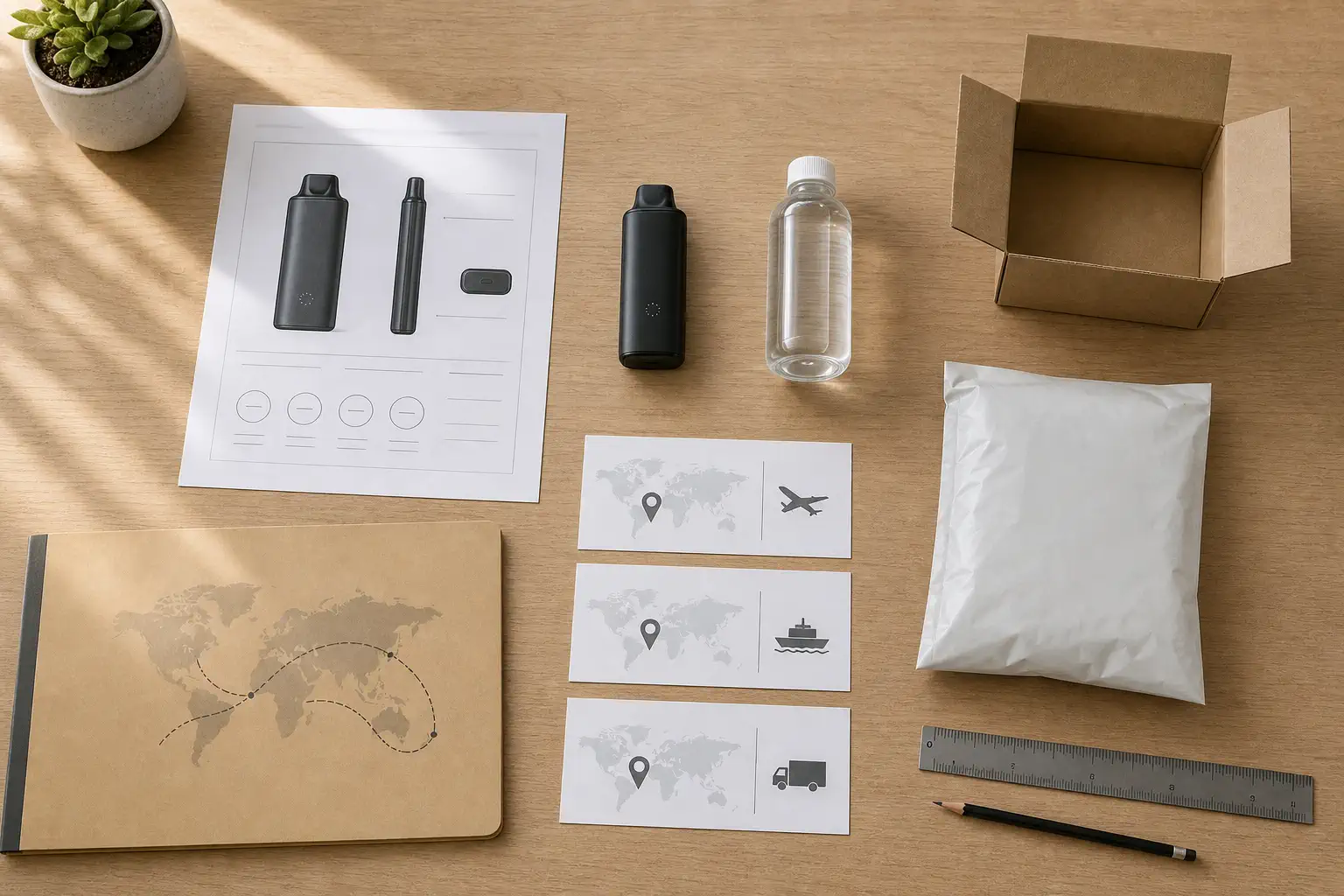
It requires a product-and-route decision, not a broad promise that an agent or carrier “handles sensitive goods.” The phrase is common in cross-border trade, but it can cover several different problems: transport danger, leakage risk, destination-market controls, intellectual-property restrictions, or a carrier’s own acceptance policy.
That distinction matters because a product can be legal to sell but unavailable on your preferred line. Another product may be accepted by a carrier yet still lack the labeling, safety file, or responsible economic operator required in the destination market. Shipping eligibility does not prove product compliance, and product compliance does not guarantee carrier acceptance.
Before requesting a quote, create a short product identity record:
- Exact product name, model, variant, and intended use.
- Components that affect transport, such as batteries, liquids, aerosols, magnets, or chemicals.
- Battery chemistry, configuration, capacity, and whether it is installed, packed with equipment, or shipped alone.
- Liquid composition, volume, flash-point or safety information when relevant.
- Manufacturer and supplier identity, product photos, packaging dimensions, and destination countries.
- Documents already available and the party that issued each one.
For a Shopify operator, this record connects the product listing to the physical item that will be packed. A private Shopify dropshipping agent can coordinate sourcing, product checks, dispatch, and tracking write-back, but the seller still needs a defensible go/no-go decision for every restricted SKU and market. The operational value comes from maintaining that connection, not from replacing regulatory professionals or carrier approval.
Key Takeaway: Never approve a sensitive SKU at category level. Approve a specific configuration for a specific destination and route, then document the conditions that would force a new review.
Classify the Product Before You Choose a Supplier

Classification should come before supplier selection because the risk-causing component determines which documents, packing controls, and routes you need. “Electronics” and “cosmetics” are commercial categories; they are not precise transport classifications.
Batteries are not one shipping category
A rechargeable battery installed in a device, a battery packed beside equipment, and a standalone power bank may face different requirements. Chemistry, energy rating, condition, quantity, and mode of transport also matter. IATA explains that lithium batteries are dangerous goods and that air carriage depends on configuration and ratings, while PHMSA notes that designs offered for transport must pass the applicable UN 38.3 tests.
That means you should not accept a generic “battery certificate.” Match the test summary to the cell or battery model inside the sellable product. If the supplier changes the battery without telling you, the document set and route decision may no longer match the shipped SKU.
If battery-powered items are central to your range, consumer electronics dropshipping also requires model-level checks for plug type, accessories, labeling, and functional condition. Those commercial checks sit alongside, not in place of, transport review.
Liquids, aerosols, powders, and magnets need different questions
Some liquids are mainly a leakage concern; others may be flammable or chemically regulated. Perfume, nail products, pressurized sprays, adhesives, and cleaning solutions cannot be treated like a water-based lotion. Powders may trigger identification or screening questions even when they are not dangerous goods. Strong magnets can affect air-transport acceptance. The correct starting point is composition and physical properties, not the supplier’s category label.
Cosmetics add a separate market-access layer. For example, the European Commission states that products covered by the EU cosmetics rules require notification through the Cosmetic Products Notification Portal by responsible persons and, in certain cases, distributors. If you are evaluating cosmetics dropshipping, confirm formula, labeling, safety assessment, responsible-person, and notification duties for the target market before assuming that a shippable liquid is sellable.
For U.S. sales, cosmetics are not automatically “approved” simply because a supplier can ship them. FDA explains that most cosmetics do not require premarket approval, except for color additives, but they still must be safe, properly labeled, and not adulterated or misbranded. Some facility registration and product listing duties may also apply under MoCRA, so sellers should check the target market before treating a shippable cosmetic as sellable.
Restricted does not mean prohibited
A restricted product may be accepted only under defined conditions. A prohibited product or destination cannot be made acceptable by relabeling it, choosing an informal line, or changing the customs description. Counterfeit goods, undeclared dangerous goods, and products barred by destination law should be rejected, not “worked around.”
Platform and payment rules are a separate checkpoint. A product may be technically shippable but still create problems under Shopify policies, payment-provider rules, ad-platform rules, marketplace restrictions, or product-recall obligations. Before listing a sensitive SKU, check not only the carrier route but also whether the product category, claims, age restrictions, and safety status are acceptable for the sales channel.
Verify Documents Against the Exact Sellable SKU

Documents are useful only when they are current, authentic, applicable, and matched to the item you will sell. A PDF with the right acronym is not proof by itself.
For lithium batteries, ask the manufacturer or distributor for the UN 38.3 test summary and confirm that the manufacturer, model, chemistry, and identifying information correspond to the installed battery. PHMSA’s Lithium Battery Guide for Shippers explains that the test summary supports traceability and that modifications capable of affecting test results may create a new battery type requiring testing.
For chemical products, an SDS can help identify composition, hazards, handling, and transport information, but it is not a magic export certificate. Check who issued it, the product name and revision date, whether the formula matches the sellable item, and whether the transport section is consistent with the proposed declaration. Ask a qualified party to resolve contradictions rather than selecting whichever page supports the desired route.
Create a document-control table for each SKU:
| Record | What to match | Why it matters |
|---|---|---|
| Supplier quotation | Model, variant, components | Prevents a cheaper substitute from changing the approved configuration |
| Product specification | Materials, battery, formula, dimensions | Defines the physical item under review |
| Test summary or report | Manufacturer and exact model | Connects technical evidence to the shipped product |
| SDS, when applicable | Product/formula and revision | Supports hazard and handling review |
| Market-access records | Destination and responsible party | Separates sale legality from transport acceptance |
| Carrier approval or written confirmation | Product, route, quantity, packaging | Records what the accepting channel actually reviewed |
A supplier’s past shipment, a screenshot, or a tracking number does not prove that your product is approved today. Routes, airline policies, and destination restrictions can change.
Key Takeaway: Document names are not the control; traceability is. If you cannot connect each record to the exact product model, responsible issuer, destination, and proposed shipment, the file is incomplete.
Validate One Route from Origin to Destination

A valid route is an end-to-end chain in which every participant accepts the declared product under the proposed conditions. Checking only the first-mile courier or freight quote leaves major gaps.
Build a route sheet that names:
- Pickup location and shipper of record.
- Export declaration party and product description.
- Transport mode and line-haul operator.
- Required marks, labels, documents, and packaging.
- Transit countries or transfer points when relevant.
- Importer, responsible economic operator, broker, or consignee duties.
- Customs and destination restrictions.
- Final-mile carrier acceptance.
- Procedure for holds, rejection, damage, or non-delivery.
Carrier policy can be narrower than the broad legal framework. DHL eCommerce, for example, states that hazardous shipments must be correctly classified, described, packaged, marked, and labeled, and that certain limited-quantity services require prior approval. That is why “the regulations allow it” and “this service will accept it” are separate questions.
Use a SKU-route matrix instead of one storewide promise
The most practical control for a growing store is a matrix with products on one axis and destinations on the other. Each cell should show approved, conditional, pending, or blocked. Conditional cells should state the approved battery configuration, maximum quantity, packaging, line, and document version. Do not copy an approval from the United States to Canada, the EU, or Australia without checking the destination-specific layer.
Revalidate a cell when the supplier, model, formula, battery, packaging, route, carrier, destination rule, or order quantity changes. A route that worked last month is evidence of a past shipment, not permanent authorization.
This is where a private dropshipping agent workflow becomes useful. The agent should not promise that every sensitive product can move. For scaling stores, dropshipping order execution support should prove that the approved SKU was checked, packed, handed to the accepted route, and updated before the order is treated as safely dispatched. The practical value is coordinating the supplier, document collection, pre-shipment checks, packing instructions, approved route, tracking update, and exception handling under one SKU-level record.
Inspect and Pack the Approved Configuration Before Dispatch

Pre-dispatch verification must confirm that the physical product and parcel still match the approved record. This is where sourcing control becomes observable rather than administrative.
Your checking instructions should focus on attributes that can invalidate the route or create customer-facing risk:
- Correct model, variant, plug, battery, accessories, and quantity.
- No swelling, leakage, corrosion, damage, or signs of battery abuse.
- Battery installed or packed in the approved configuration.
- Liquid container closed, sealed, protected from movement, and placed in suitable secondary containment when required.
- Product, retail box, outer packaging, marks, and labels consistent with the approved method.
- No unapproved substitution, extra battery, sample bottle, promotional aerosol, or branded insert added at the last minute.
- Photos or records captured at the agreed checkpoints without exposing customer data.
A strong dropshipping quality control process can verify visible condition, variants, accessories, and packing requirements before dispatch. It cannot certify hidden chemistry or replace laboratory evidence, so your checklist should distinguish what staff can physically inspect from what depends on valid technical documentation.
Control supplier substitutions
Substitution is a serious but under-discussed risk. A factory may consider two batteries, pumps, liquids, or magnets commercially equivalent even though the transport evidence applies to only one. Put “no component substitution without written review” into the purchase specification. Compare incoming goods against reference photos, model markings, and the approved bill of materials where practical.
Pre-shipment photos can reveal mismatches and help trace what was packed, but they do not prove regulatory compliance.
Key Takeaway: The last safe moment to stop a mismatched parcel is before carrier handoff. Give the checking team explicit hold authority when the product, documents, packaging, or approved route no longer agree.
Calculate Margin with Restriction Costs and Failure Paths

The viable product is not the one with the cheapest factory quote; it is the one that remains commercially sensible after compliant preparation, route constraints, and exception handling are included.
Build a landed-cost scenario without inventing a universal rate:
Product + domestic movement + verification + compliant packaging + documentation + approved transport + duties/taxes + exception reserve + support burden
Request quotes by SKU, destination, chargeable weight, battery or liquid configuration, declared value, and expected order pattern. Ask what is included, what can change after acceptance, and which event triggers a surcharge or return cost. A quote for general cargo should never be used as the planning rate for a restricted configuration.
Then test failure scenarios:
- What happens if the carrier refuses the parcel before export?
- Can the item be returned domestically to the supplier, and who pays?
- What happens if customs requests information from the importer?
- Is a damaged or recalled battery eligible for return transport?
- Can the product be safely held, replaced, or disposed of under an approved procedure?
- What customer remedy can you fund if the route becomes unavailable?
Reverse logistics deserves special attention. A route that accepts a new battery-powered product outbound may not accept a damaged, defective, or recalled battery on return. PHMSA warns that those batteries have greater potential to short-circuit, release heat, or catch fire. Your customer policy must not promise an unsafe or unavailable return method.
The correct comparison is therefore not “standard shipping versus sensitive-line shipping.” It is launch, hold, substitute, local-stock, or reject. Sometimes the best margin decision is not to list the SKU until a stable process exists.
Build a Stop-Ship and Exception Workflow

A stop-ship workflow protects the business when the approved assumptions fail. It should be simple enough that a sourcing coordinator, packing checker, or customer-service lead can trigger it without improvising.
Use four states:
- Approved: Product, documents, packaging, destination, and route match.
- Hold for review: A document expired, a component changed, or the route needs reconfirmation.
- Blocked: The product is prohibited, damaged, misdeclared, unsupported, or rejected by the required participant.
- Released with recorded conditions: A qualified reviewer resolves the issue and records the new basis for dispatch.
The escalation record should include the order or batch, SKU, issue, photos, document versions, people consulted, decision, and customer action. This gives mentors, agencies, and multi-store operators a repeatable standard across projects rather than relying on informal chat history.
A real lithium-battery enforcement example
In 2020, the U.S. Federal Aviation Administration proposed a $120,000 civil penalty against UPS over an air shipment containing loose, damaged lithium batteries. The FAA alleged that the batteries lacked short-circuit protection and that the shipment was not properly packaged, declared, described, marked, or labeled. The notice described allegations and a proposed penalty, not a final finding, but it shows why physical condition, packaging, documentation, and declaration must agree before air carriage.
For a dropshipping store, the lesson is narrow and practical: never ask operations to “try the route” with a damaged, altered, or poorly documented battery. Put the order on hold and escalate it.
Prepare customer communication before an exception
Write templates for document review, route unavailability, product substitution rejection, customs-information requests, and order cancellation. State what is known, what is being checked, and the next decision time. Do not promise clearance or delivery while the product is on hold.
Decide When a Private-Agent Workflow Fits

A private-agent workflow fits when you have validated demand and need one accountable process to coordinate suppliers, physical checks, packaging instructions, approved shipping arrangements, order-system updates, and exceptions. For multi-store operators, this is part of broader dropshipping supply chain execution, not just a sensitive-goods shipping workaround. It does not make an illegal, prohibited, or undocumented product acceptable.
Use this go/no-go checklist before launch:
- The exact product and restriction-causing components are identified.
- The target market permits the product and required responsible parties are assigned.
- Technical and market-access records match the sellable model.
- The accepting carrier or shipping channel reviewed the real configuration.
- Packaging and inspection instructions are executable at order level.
- Substitutions require written approval.
- The SKU-route matrix shows where orders may and may not go.
- Quotes include the relevant handling and exception costs.
- Stop-ship authority and escalation contacts are clear.
- Customer cancellation, replacement, hold, and return options are realistic.
Ask potential agents specific questions rather than “Can you ship sensitive products?” Request the inputs they need for evaluation, who checks document applicability, how the route is confirmed, what physical checkpoints are recorded, and what happens when a line rejects a parcel. A credible answer should contain conditions and boundaries. Instant worldwide approval without reviewing the SKU is a warning sign.
Runtodropship is a private dropshipping agent team, not a regulator, laboratory, customs authority, or carrier. Its relevant role is operational coordination: keeping the approved supplier item, pre-shipment checks, packing instructions, shipping arrangement, and exception communication connected for sellers who already have orders and need a more controlled backend.
Key Takeaway: Choose support for accountability and execution, not for a promise to bypass restrictions. The right partner is willing to reject a route, hold an order, or request better evidence when the product cannot yet be handled responsibly.
FAQ
Can I dropship products with lithium batteries internationally?
Sometimes, but not through every route or to every destination. Eligibility depends on battery chemistry, configuration, rating, condition, quantity, packaging, documents, carrier approval, and destination rules. Obtain a model-matched UN 38.3 test summary and written route confirmation before accepting orders.
Is an SDS enough to ship liquids or cosmetics?
No. An SDS may support hazard identification and handling, but carrier acceptance and destination-market compliance can require additional records, labeling, responsible parties, notifications, or approvals. It must also match the actual formula and product.
Does “sensitive goods line” mean the shipment is compliant?
No. It is a commercial description, not proof of legal or carrier acceptance. Ask who carries the parcel, what product configuration was reviewed, which documents and packaging are required, and which destinations are approved.
What should I do if a supplier changes the battery or formula?
Stop dispatch and revalidate the SKU. A component change can invalidate technical documents, product-safety conclusions, packaging instructions, and carrier approval even when the retail product looks unchanged.
Should I offer returns for damaged battery products?
Offer a safe remedy, but do not automatically instruct the customer to mail a damaged battery. Obtain product- and destination-specific guidance because damaged, defective, or recalled batteries can face stricter transport restrictions. Your procedure may require local handling, replacement, or another approved solution.
What products are considered sensitive products in dropshipping?
Sensitive products commonly include battery-powered electronics, liquids, cosmetics, perfumes, aerosols, powders, magnets, branded goods, supplements, and products with destination-market restrictions. The exact risk depends on the SKU, formula, battery configuration, destination, and carrier route.
Can a private dropshipping agent ship all sensitive products?
No. A private dropshipping agent can help check suppliers, documents, packaging, route options, tracking, and exceptions, but it cannot make prohibited, counterfeit, unsafe, undocumented, or carrier-rejected products acceptable.
Conclusion
Sensitive products can be viable for a mature Shopify store, but only when product identity, technical evidence, destination duties, physical checks, compliant packaging, and a carrier-approved route stay connected. The disciplined sequence is simple: classify, document, validate, inspect, price the failure path, and stop shipment when any assumption changes.
For sellers, mentors, and agencies managing real order flow, Runtodropship can coordinate supplier communication, product checks before dispatch, packing requirements, shipping arrangements, system updates, and exception handling through one private-agent workflow. Responsible execution is not about making every product shippable; it is about knowing which orders can move, under what conditions, and when to say no. Send the exact product link, specification, battery or formula details, target countries, and expected order pattern to start a SKU-level feasibility review.