
Dropshipping knives can work, but the product is less forgiving than an ordinary home or fashion item. You need a supply path that fits your stage, a knife that your market and sales channels allow, a paid sample that proves the exact specification, and a delivery process that protects both the blade and the customer.
Do not begin with a huge catalog. Begin with one buyer use case, one knife type, one destination market, and one order route you can test from checkout to delivery.
Dropshipping Knives: 7 Supply Paths to Compare
The seven paths below cover the main ways an online seller can source and send knife orders without starting with a large finished-goods inventory. Each path solves a different problem, so compare its control, commitment, and weakest point before asking which one is best.
1. Domestic specialist blind dropshipper
Audience and scope: This path suits a seller who wants ready-stock kitchen, outdoor, collectible, or utility knives shipped from the same country as the customer. The supplier prepares each customer order and removes its invoice or promotional material when its blind-shipping program permits it.
Distinctive fit: Domestic stock can simplify delivery testing and returns within one market. Material limitation: The catalog, stock level, knife types, and reseller approval rules belong to that supplier, and a local address does not prove that every product or listing is allowed. First validation: Open the dealer account, confirm the exact SKU is eligible for blind dropshipping, and place a paid order to an address you control.
2. Overseas specialist knife manufacturer
Audience and scope: A specialist manufacturer fits a seller who wants direct access to kitchen knives or another defined blade category, with a possible route toward engraving, packaging, or a custom specification. Some manufacturers will send single orders directly, while others reserve customization for batches.
The same distinction appears in Alibaba dropshipping fulfillment models, where direct single-unit shipping, small-batch purchasing, and agent-held stock require different commitments.
Distinctive fit: Product questions can go closer to the maker, which helps when steel, hardness, grind, handle, sheath, and packaging details matter. Material limitation: International delivery, import rules, age checks, carrier acceptance, and returns can differ by product and destination. First validation: Request one complete written specification and a delivered quote for the exact destination, then order the same SKU through the proposed customer route.
3. General dropshipping catalog or app
Audience and scope: A catalog platform fits a seller who values store connection, order syncing, and access to many products in one account. It can be useful for early discovery when you have not yet chosen a specialist source.
Distinctive fit: The workflow may be easier to test than a manual supplier arrangement. Material limitation: A product appearing in a catalog does not prove stable stock, verified knife specifications, permitted advertising, or acceptance by the destination carrier. First validation: Ask the platform to confirm the source, live stock, exact item data, shipping service, return address, and restricted-product handling in writing.
Before choosing a platform, compare the catalog, automation, fulfillment, and private-agent models rather than treating every app as the same type of supplier.
4. Wholesale distributor with a dropship account
Audience and scope: This model suits an established retailer that wants access to several knife brands or categories through one approved dealer relationship. The distributor may provide product feeds, dealer pricing, and individual-order shipping.
Distinctive fit: One account can reduce the number of direct supplier relationships. Material limitation: Dealer approval, opening orders, later order minimums, brand authorization, product-feed accuracy, and dropship fees vary. First validation: Separate the distributor’s wholesale terms from its single-order dropship terms and confirm which exact brands and SKUs you may advertise.
5. Private dropshipping agent
Audience and scope: A private agent fits a growing seller who has evidence of demand and needs one workflow for supplier communication, samples, product checks, packaging instructions, individual orders, and shipping options. It is more useful when disconnected supplier messages have become an operating risk.
Distinctive fit: The seller can define one approved specification and one exception process across sourcing and order execution. Material limitation: An agent cannot make a prohibited knife legal, override a marketplace, or guarantee carrier acceptance. First validation: Send the exact product, target market, daily or weekly order pattern, required checks, packaging, and delivery needs for a route review before moving live orders.
6. Private-label or small-batch production
Audience and scope: This route suits a proven kitchen or utility knife offer that needs a logo, handle choice, packaging, insert, bundle, or more consistent stock. You normally buy or commit to a batch before customer orders use that inventory.
Distinctive fit: A controlled batch can support a repeatable product and unboxing standard. Material limitation: Tooling, samples, packaging quantities, production approval, stock cash, and unsold inventory replace the low-commitment benefit of pure dropshipping. First validation: Approve a physical sample and written specification, then compare the full batch commitment with the demand already observed. If the offer is ready for this step, define the exact scope of private-label work before paying for production.
7. Local stock with outsourced order execution
Audience and scope: This is a transition path for a seller whose winning SKU needs local availability, tighter packing control, or a dependable returns address. It is no longer inventory-free, but the seller can still outsource individual-order preparation.
Distinctive fit: Known stock and a tested local shipping service can reduce uncertainty for one target market. Material limitation: You carry inventory, storage, reconciliation, and obsolete-stock risk, and local storage still does not remove product or channel restrictions. First validation: Move only a small proven quantity, reconcile every unit, and compare the real delivered cost and exception rate with the supplier-direct route.
For a first test, shortlist the Domestic specialist blind dropshipper when local stock and a simple dealer program matter, the Overseas specialist knife manufacturer when product specification matters most, or the General dropshipping catalog or app when workflow speed matters more than customization. Move toward a private-agent, controlled-batch, or local-stock model only when repeat orders create a clear need for more control.
Key Takeaway: Choose the lowest-commitment path that can prove the exact product and customer order. A bigger catalog is not an advantage if you cannot verify the knife, listing permission, route, package, and problem-handling process.
Decide What Kind of Knife You Can Actually Sell

Your first product decision is the knife’s intended use and design, because the same word can describe a chef’s knife, a folding utility knife, or an item a platform treats as a weapon. Do not let a supplier category decide how your selling market, marketplace, advertising channel, payment provider, or carrier classifies it.
Start with the ordinary use case
Write the product’s normal use in plain language: food preparation, outdoor work, craft, collecting, everyday utility, or another legitimate task. Then record the blade style, opening mechanism, blade length, locking method, point, sheath, materials, branding, and every claim you plan to use.
Marketing language can change the risk. A general-use product described for combat, confrontation, or self-defense may be treated differently from an ordinary kitchen or work tool, even when the physical item looks similar.
Check law, sales channel, promotion, and transport separately
These are four different approvals. Identify the rules that apply where your business operates and where the customer receives the product, then obtain qualified advice for the actual market when the answer is unclear.
Platform permission is narrower than store software permission. TikTok Shop US currently lists several knife types among prohibited weapons, including automatic, butterfly, gravity, concealed, push, spring-loaded, and stiletto knives. Google’s Merchant Center policy separately rejects knives designed or promoted to provide a confrontational advantage. Those examples do not form a universal legal list; they show why every exact product and marketing angle needs its own current channel check.
Shipping also needs a product-level decision. For example, USPS Publication 52 places strict limits on who may receive switchblade knives through US mail. A supplier saying it ships worldwide or uses a major carrier is not route approval for your item.
Use a simple release rule: do not publish the SKU until you can name the selling market, buyer destination, sales channel, promotion channel, payment route, carrier service, age or identity controls when applicable, and the person responsible for each check. If the product is hard to classify, pause it and run a sensitive-product sourcing and shipping check before accepting orders.
Key Takeaway: Treat product law, marketplace permission, advertising permission, and carrier acceptance as four separate gates. Passing one does not pass the others, and a supplier cannot approve them on your behalf.
Compare Suppliers with One Specification and Paid Samples
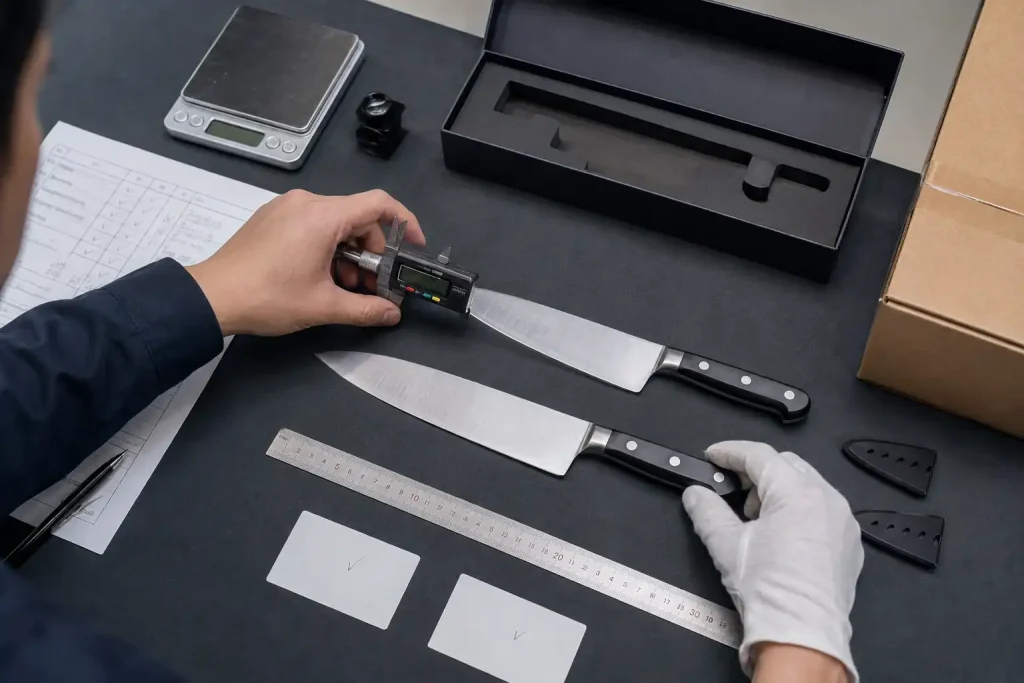
A useful supplier comparison holds the product and test conditions steady. If each candidate sends a different steel, blade geometry, handle, package, or shipping service, the lowest quote tells you almost nothing about repeatable customer value.
Build one knife specification
Record only details you can inspect or document:
- intended use and knife type;
- blade material, dimensions, thickness, grind, edge, and finish;
- handle material, construction, balance, and visible tolerances;
- opening and locking mechanism when the knife folds;
- sheath, guard, tip protection, care instructions, and warning information;
- logo, packaging, included accessories, unit weight, and packed dimensions;
- acceptable cosmetic variation and defects that require a hold.
Avoid unsupported labels such as premium, handmade, Japanese, Damascus, professional, or food-safe unless the supplier provides evidence that supports the exact wording for the exact SKU.
Test the product and the parcel
Buy the exact variant through the same order method you plan to use for customers. Inspect identity, measurements, finish, edge condition, handle fit, moving parts, included items, labels, tip protection, inner movement, outer carton, and any supplier invoice or branding.
Use the knife only for its intended ordinary task and record the method. A visual check cannot prove edge retention, corrosion resistance, locking reliability, or material composition, and a casual home test is not a certification. If important claims require laboratory or manufacturer evidence, request it or remove the claim.
When repeat orders need the approved sample translated into pre-dispatch checks, define a dropshipping quality control process with photographs, measurable tolerances, hold rules, and an escalation contact. Telling a supplier to send high quality is not an inspection standard.
Test supplier behavior when something goes wrong
Send a controlled problem such as an address change before dispatch, a request for a missing document, or a photo of a packaging defect. Record who answers, what evidence they need, when the order can still be stopped, and what remedy is available under the written terms.
Key Takeaway: Approve the specification, physical sample, package, and exception response together. A sharp sample in a good presentation box does not prove that the next customer will receive the same item through the same route.
Calculate the Order Before You Promise a Margin
Knife profitability must be calculated from the complete customer order, not from the gap between retail price and supplier price. A heavy set, protective package, age-check service, return, or replacement can change the result.
Use your own written quotes:
Contribution per order = customer payment - product cost - supplier handling - inspection - branding and packaging - payment and platform fees - shipping - duties or seller-paid tax - customer acquisition cost - refund and replacement allowance
Run the calculation for a normal single-knife order, the bundle or set you expect to sell, and a damaged or replaced order. Use the actual target destination and packed weight. If the contribution disappears when one ordinary exception occurs, change the price, product, package, route, or terms before increasing promotion.
Startup cash is a separate decision. It can include samples, inspection, store setup, product photography, business or legal advice, packaging tests, account fees, launch promotion, deposits, small-batch stock, and a reserve for customer issues. Avoiding a large inventory does not make the launch free.
Set stop conditions before launch. Pause when the paid sample fails, the supplier cannot document the promised specification, a required channel or carrier rejects the SKU, or the complete delivered cost leaves no workable allowance for customer acquisition and customer issues.
Key Takeaway: Approve a knife offer only when a normal order leaves a defensible contribution and the launch budget can absorb samples, failed tests, and ordinary customer problems without using money reserved for promotion.
Run a Store-to-Door Test Before You Scale
A controlled launch should prove demand and order execution at the same time. Interest in an advertisement is not a pass if the supplier rejects the order, the parcel is unsafe, tracking is unclear, or the item arrives different from the listing.
- Publish one narrow collection for one buyer use case and market.
- Use original product copy based on the approved SKU and evidence.
- Place paid orders through the real checkout to representative addresses.
- Record order transfer, supplier acceptance, checks, dispatch, tracking, delivery condition, and support response.
- Separate demand problems from product, supplier, and route problems before changing the offer.
- Retest after any change to the SKU, supplier, packaging, stock location, carrier service, or destination.
Choose measures that change a decision: qualified visits or conversations, paid orders, complete contribution, supplier acceptance, wrong-item or damage events, dispatch exceptions, delivery condition, customer questions, refunds, and repeat interest. Do not change the buyer, price, product, creative, and supplier at the same time, because the result will not show which part worked.
RuntoDropship is a private dropshipping agent for growing sellers and operators with real order needs. Its relevant role can include supplier coordination, samples, product and packing checks, private-label work, warehouse-side order execution, suitable shipping options, and after-sales coordination within an agreed scope; it does not replace the seller’s target-market duties, a manufacturer, a marketplace decision, or carrier approval.
Key Takeaway: Scale only after both sides pass: customers buy the offer and the backend repeats the approved product, package, route, and exception process. More traffic amplifies whatever the test did not fix.
FAQ
Can a knife supplier ship without its invoice or branding?
Yes, if the supplier has a confirmed blind-shipping process for your account and route. Check the packing slip, commercial documents, return address, box markings, tape, inserts, QR codes, and customs disclosure separately, then verify the customer-facing package with a paid order; blind shipping does not permit false customs or legal information.
Will knives from different suppliers arrive in one parcel?
Usually not. They will arrive together only when both products reach the same approved dispatch point and a written consolidation process covers sharp-item handling, packaging, documents, tracking, and destination acceptance; otherwise show separate parcels, charges, and delivery timing before checkout.
Can a customer return a knife after using or sharpening it?
Often only under limited terms, and some suppliers treat used, sharpened, damaged, engraved, or personalized knives as nonreturnable. Agree on inspection evidence, authorization, return destination, carrier method, legal possession, and who pays before publishing your policy; your customer-facing obligations may be broader than the supplier’s policy.
Do I need product liability insurance to sell knives online?
The need and available cover depend on your business, knife type, market, channels, and insurer. Ask a qualified broker or insurer to review the exact products and destinations, disclose the dropshipping arrangement, and confirm exclusions in writing; do not assume the supplier’s policy, a marketplace, or a store platform covers your retail liability.
Can I sell sharpeners, blocks, or sheaths in the same store?
Yes, when each accessory serves the same buyer and passes its own product, listing, package, and route checks. Confirm compatibility with the exact knife, avoid claims the supplier cannot support, and do not assume an accessory is unrestricted merely because it has no exposed blade.
Conclusion
A responsible knife offer starts with one supply path, one exact product, one target market, four separate permission checks, a paid sample, complete order economics, and a store-to-door test. That sequence is slower than importing a catalog, but it gives you the evidence needed to reject a bad offer before promotion makes the problem larger.
When repeat orders make supplier communication, samples, product checks, packaging, order execution, shipping choices, and exceptions too important to coordinate through disconnected messages, RuntoDropship can assess whether a private-agent workflow fits. Send the product link, target market, expected order pattern, approved specification, packaging needs, and unresolved route questions to discuss a practical test or transition plan.