
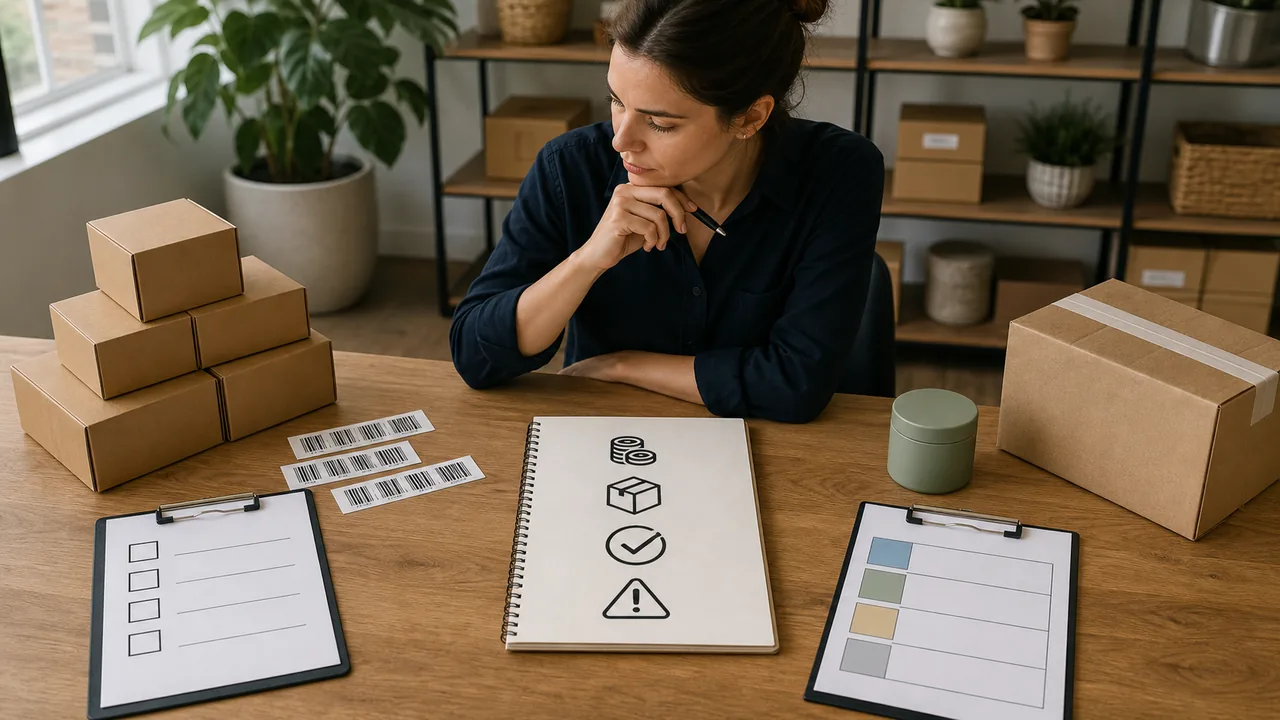
Amazon FBA vs dropshipping comes down to when you buy inventory, who controls fulfillment, and where the customer places the order. FBA is usually the stronger fit for products with proven Amazon demand when you can fund inventory, inbound shipping, and replenishment. Dropshipping is usually the stronger fit when demand is still uncertain and avoiding a bulk inventory purchase matters more than Prime delivery or direct control over stocked units.
One distinction must be made before comparing costs or profit. “Dropshipping” may mean a supplier ships an order placed in Amazon’s store, or it may mean a customer orders through an independent Shopify or WooCommerce store. The inventory model is similar, but traffic, fees, customer data, returns, and platform rules are not.
This guide compares both situations without mixing them. It also explains when a hybrid strategy—testing through supplier-direct fulfillment and moving qualified products into FBA—can make more sense than choosing one model for every SKU.
Amazon FBA vs Dropshipping: Key Differences at a Glance
The fastest way to make a useful comparison is to identify the order channel first. FBA and Amazon dropshipping can both serve orders placed in Amazon’s store. Independent-store dropshipping changes the sales channel as well as the fulfillment route.
| Decision factor | FBA in Amazon’s store | Dropshipping in Amazon’s store | Independent-store dropshipping |
|---|---|---|---|
| Inventory | You buy and replenish stock before sales | The supplier holds stock until each order | The supplier holds stock until each order |
| Demand source | Amazon marketplace plus your listing and promotion work | Amazon marketplace plus your listing and promotion work | You earn or buy traffic for your store |
| Physical fulfillment | Amazon stores, picks, packs, and ships | The supplier ships under your responsibility | The supplier ships under your responsibility |
| Customer service and returns | Amazon handles service and returns for FBA orders | You remain accountable under Amazon rules | You design and operate the service process |
| Storefront and customer relationship | Amazon environment | Amazon environment | Your store, subject to payment, privacy, and acquisition-platform rules |
| Main scaling constraint | Replenishment cash, stockouts, excess stock, and Amazon fees | Supplier capacity, stock sync, delivery metrics, and policy compliance | Profitable acquisition, supplier execution, support capacity, and payment risk |
The first two columns compare fulfillment methods inside one marketplace. The third describes a broader business-model choice. A hybrid is not another comparison context; it is a strategy that assigns different jobs to different routes.
What Amazon FBA Actually Handles
With Fulfillment by Amazon, you purchase inventory, prepare it to current requirements, and send it into Amazon’s fulfillment network. After a customer orders, Amazon stores, picks, packs, and ships the unit. Amazon also handles customer service and returns for that FBA order.
Starting January 1, 2026, Amazon no longer offers prep and item-labeling services for FBA shipments in the US store. Any preparation and labeling required for those shipments must therefore be completed before the inventory reaches Amazon.
You still own the decisions before and around fulfillment: product selection, supplier management, listing accuracy, pricing, advertising, compliance, inventory planning, and replenishment. FBA does not validate demand or guarantee profit. It changes who performs the downstream order work after compliant inventory is accepted into the network.
This route is strongest when a product has repeatable Amazon demand, its size and selling price can absorb current fees, and faster delivery or Prime eligibility improves the offer. The main tradeoff is that you commit cash before the sale and carry stockout, excess-inventory, storage, and replenishment risk.
How Amazon Dropshipping Works—and What Amazon Requires
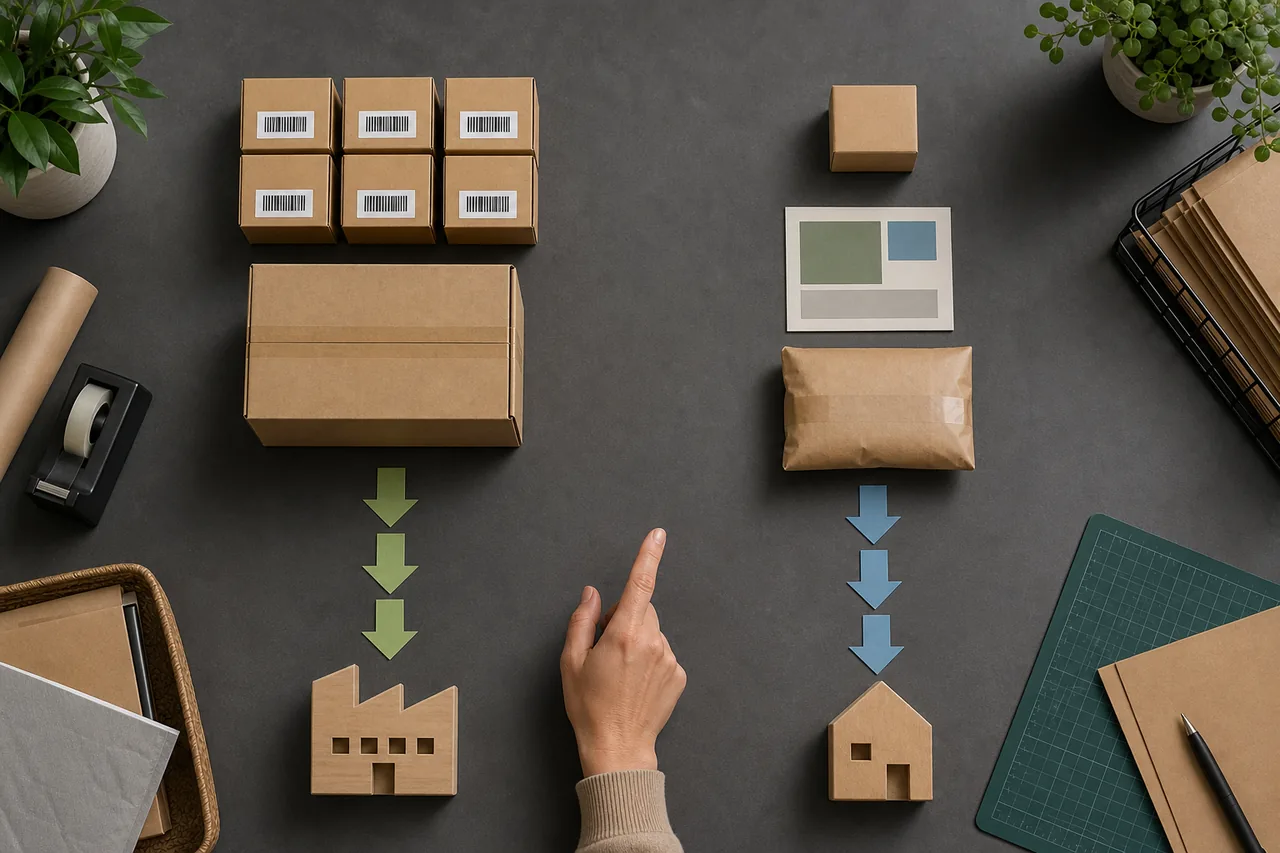
For an Amazon dropshipping order, you list the product without sending that inventory into FBA. After a customer buys through Amazon, you pass the order to a supplier, which ships directly to the customer. You remain responsible for the listing, delivery performance, tracking, customer communication, refunds, returns, and account health.
Amazon dropshipping is viable only when the complete supplier workflow complies with Amazon’s current Drop Shipping Policy. You must have an arrangement that identifies you as the seller of record. Packaging, packing slips, invoices, and other customer-facing materials must not identify another retailer or third-party seller. You also remain responsible for accepting and processing returns and providing customer service that meets Amazon’s requirements. Review the current Amazon dropshipping policy guidance before approving the workflow.
A supplier that can ship a product is not automatically an Amazon-compatible dropshipping supplier. Before listing, confirm packaging identity, dispatch timing, stock updates, valid tracking, delivery performance, cancellation handling, return routing, and who pays for supplier errors.
Amazon dropshipping is also not a synonym for Fulfilled by Merchant. FBM is the broader Amazon framework in which the seller manages fulfillment instead of using FBA. A seller may ship owned inventory from its own facility or use an eligible third party; dropshipping is only one possible supplier-direct arrangement within that responsibility.
A separate comparison of retail arbitrage vs dropshipping helps clarify why retailer sourcing, inventory ownership, and supplier-direct fulfillment should not be treated as the same operating model.
How Independent-Store Dropshipping Changes the Comparison
In an independent Shopify or WooCommerce store, you control the storefront, offer, and on-site customer journey. When a customer orders, the supplier ships the product directly, but you must create or purchase traffic, manage conversion, collect payment, provide support, and absorb supplier failures.
Built-in marketplace demand, customer-data access, and storefront control should be compared only after the sales channel is identified; they are not inherent differences between FBA and every form of dropshipping. An independent store reduces dependence on one marketplace, but introduces its own payment, advertising, website, privacy, and traffic-concentration risks.
Store ownership does not automatically create a brand advantage. Generic products, inconsistent packaging, slow dispatch, or an offer copied by many stores can still weaken the customer experience. Order an approved sample and complete a destination test before making product, packaging, or delivery promises.
When growing order volume makes supplier coordination, product checks, dispatch, and tracking write-back difficult to manage separately, a Shopify dropshipping agent can connect those backend tasks without taking over the seller’s storefront or customer responsibility.
Compare Costs and Profit by Fulfillment Route
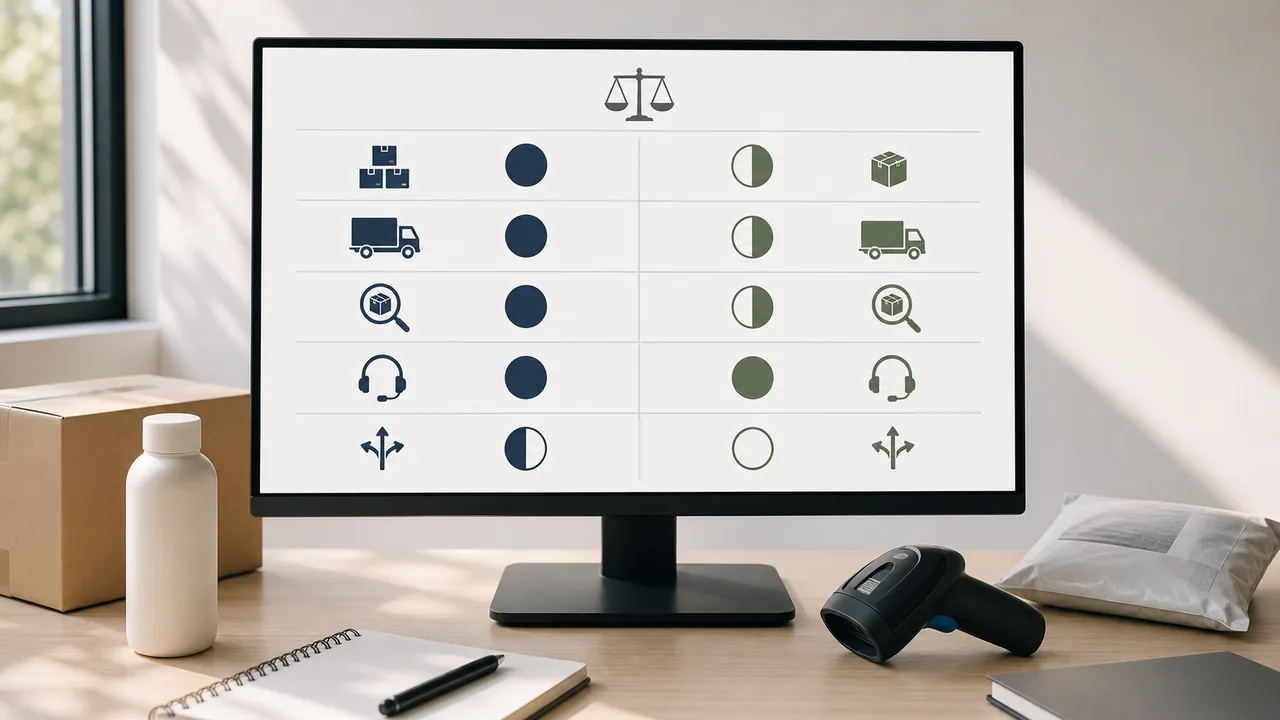
There is no defensible universal startup budget or profit margin for these routes. Product size, selling price, destination, advertising, returns, supplier terms, and cash timing can reverse the result. Compare the same product and selling price with one complete delivered-order formula.
For FBA, include samples, the first inventory order, preparation and labeling, inbound freight, selling fees, fulfillment, storage, advertising, returns, and replenishment reserves. For Amazon dropshipping, include samples, selling fees, supplier payment, direct shipping, advertising, cancellations, refunds, reships, and the timing gap before marketplace funds become available. For an independent store, add the domain, store, apps, payment processing, creative work, customer acquisition, chargebacks, and customer support.
Contribution per delivered order = customer revenue − product cost − shipping and fulfillment − channel and payment fees − advertising allocated to the order − expected returns, refunds, reships, chargebacks, and loss allowance
Illustrative Example: Compare the Maximum Affordable Acquisition Cost
The following figures demonstrate the calculation method only. They are not industry averages or a prediction of what either model will earn.
Assume a product sells for $39.99 and the seller requires at least $8.00 in contribution per delivered order.
| Illustrative cost | Amazon FBA | Amazon dropshipping | Independent-store dropshipping |
|---|---|---|---|
| Product cost | $8.50 | $11.50 | $11.50 |
| Prep and inbound shipping | $1.80 | — | — |
| Direct customer shipping | — | $6.00 | $6.00 |
| Amazon referral fee | $6.00 | $6.00 | — |
| FBA fulfillment and storage allocation | $5.30 | — | — |
| Store and payment allocation | — | — | $1.60 |
| Expected returns and loss allowance | $1.20 | $1.50 | $1.50 |
| Maximum acquisition cost while retaining an $8 contribution | $9.19 | $6.99 | $11.39 |
The example does not prove that independent-store dropshipping is automatically more profitable. It shows that each route can support a different maximum acquisition cost before the target contribution disappears. Actual customer-acquisition costs, supplier quotes, product dimensions, return rates, and shipping destinations can reverse the result.
Replace every illustrative figure with a current supplier quote and a product-specific estimate. Amazon’s Revenue Calculator lets you enter dimensions, weight, category, price, and other costs to compare Amazon fulfillment with your own fulfillment. Run expected, downside, and break-even cases, then test cash timing separately.
Key Takeaway: Never compare an FBA contribution figure with a gross-margin claim for an independent store. Use the same delivered-order formula and disclose the channel, destination, acquisition cost, return allowance, and cash-timing assumptions on every route.
Pros and Cons of FBA and Supplier-Direct Fulfillment
FBA offers outsourced downstream order handling, Prime eligibility for qualified offers, and a fulfillment network that can process more orders without requiring you to pick and pack each parcel. Its disadvantages are the inventory purchase, inbound execution, storage and fulfillment charges, replenishment cash, stockout exposure, and the cost of slow or unsuitable stock.
Amazon dropshipping avoids the same initial batch purchase and can test demand inside Amazon’s store. Its disadvantages are thinner control over stock and dispatch, supplier dependence, direct-shipping costs, customer-service work, and strict policy and account-performance exposure.
Independent-store dropshipping also delays the bulk inventory commitment and gives you more control over the storefront and acquisition mix. However, it adds the work and cost of generating traffic, maintaining the website and payment system, supporting customers, managing chargebacks, and keeping the supplier experience consistent with the store promise.
Scaling changes the bottleneck rather than removing it. FBA growth increases the cash tied up in replenishment. Supplier-direct growth tests stock accuracy, cutoff times, packing, tracking, and issue response. Before increasing inventory or traffic, assign owners for stock updates, order exceptions, returns, replacements, customer messages, and backup supply. The pros and cons of dropshipping matter most when supplier dependence becomes the limiting factor.
Which Is Better for Beginners and Scaling Sellers?
There is no universal winner, but your current selling stage makes the decision clearer.
Choose Amazon FBA when:
- Amazon is a primary sales channel.
- The product has repeatable demand rather than short-lived interest.
- The selling price can support current selling, fulfillment, storage, advertising, return, and inbound costs.
- You can fund the first inventory order and replenishment without depending on immediate sell-through.
- Faster delivery and Prime eligibility materially improve the offer.
Choose Amazon dropshipping when:
- You want to test demand inside Amazon’s store without sending an initial batch into FBA.
- The supplier can meet Amazon’s seller-of-record, packaging, tracking, delivery, return, and customer-service requirements.
- The product remains profitable after referral fees, advertising, direct shipping, refunds, and reships.
- You can monitor stock and order performance closely enough to protect account health.
Choose independent-store dropshipping when:
- You want to control the storefront, offer, customer journey, and acquisition channels.
- You are prepared to create or purchase traffic rather than rely on marketplace demand.
- The supplier can deliver the product, packaging, tracking, and service experience promised by the store.
- The price leaves enough room for acquisition, payment fees, shipping, refunds, chargebacks, and after-sales work.
Choose a hybrid model when:
- Some products are still being tested while others have stable Amazon demand.
- Fast-moving products can justify FBA inventory, while slower or uncertain SKUs should remain supplier-direct.
- You can keep inventory, costs, service promises, returns, and order ownership separated by SKU and channel.
Neither route is ready when there is no approved sample, no complete destination test, no product-specific contribution calculation, no demand evidence, or no clear owner for product and delivery failures. If the underlying decision is supplier-direct orders versus a bulk purchase, compare dropshipping with wholesale inventory before committing cash.
Before committing inventory or increasing ad spend, use a dropshipping product validation process to shortlist products, calculate delivered-order contribution, approve a sample, and test real demand.
Key Takeaway: Choose the route that protects the customer promise and remains viable in a conservative cash and contribution case. Low inventory commitment is not enough if supplier execution fails; fast fulfillment is not enough if the stock never sells.
Can You Use Amazon FBA and Dropshipping Together?

Yes. A hybrid model gives each route a declared job: supplier-direct fulfillment handles uncertainty, while FBA handles selected products whose Amazon demand and economics justify stocked inventory. Amazon describes sellers testing products through dropshipping, then using FBA for faster-moving items while keeping slower products supplier-direct.
A simple sequence is to order and approve a sample, complete a supplier-direct test to the real destination, measure contribution and delivery performance, confirm repeat demand, recalculate the product with current FBA costs, and move only the qualified SKU and channel into FBA.
Prepare the Operational Handoff Before Moving a Product to FBA
Moving a product into FBA is not only a larger purchase. It changes an order-by-order process into a batch-controlled inventory process. Before creating the first shipment, confirm:
- the approved sample, final specifications, variants, accessories, and packaging;
- the batch price, minimum order quantity, production lead time, and payment terms;
- the inspection standard and process for holding or replacing failed units;
- the applicable barcode, unit-prep, packaging, poly-bagging, warning-label, expiration-date, and FNSKU requirements for each SKU;
- who completes the preparation, who verifies the SKU and labels against the shipment plan, and who holds or reworks the shipment when the inspection fails;
- carton quantities, dimensions, weights, and shipment-plan data;
- confirmation that the physical units, carton contents, box IDs, quantities, dimensions, and weights match the final Send to Amazon shipment plan before carrier pickup;
- exporter, importer, duty, freight, insurance, and delivery responsibilities;
- the reorder point and lead time required to avoid an FBA stockout;
- the backup fulfillment route if Amazon inventory becomes unavailable; and
- separate return and exception rules for FBA and supplier-direct orders.
The checklist above identifies who should control each part of the FBA handoff. This official Amazon Seller University video provides a visual overview of the barcode, packaging, preparation, and labeling requirements that may apply before inventory is sent to a fulfillment center.
Requirements vary by SKU and marketplace, so use the video to understand the workflow and verify the current rules for the actual shipment before dispatch.
For inventory sent across borders to Amazon fulfillment centers, you or your logistics provider must act as exporter of record and importer of record. Amazon states that it is not responsible for customs duties and import taxes on FBA inventory, and shipments that arrive with duty charges due may be returned. Confirm these responsibilities in the current Amazon international selling guidance before dispatch.
The product should move only after demand and the physical handoff process are both proven. Otherwise, you replace supplier uncertainty with batch, inventory, and inbound-shipment uncertainty. When supplier screening, samples, product checks, packaging, and repeat-order preparation are the immediate constraint, a dropshipping sourcing agent can coordinate the evidence required before the larger commitment.
Key Takeaway: A hybrid works only when every SKU has a declared channel, stock owner, fulfillment route, cost record, return route, and exception owner. Test the handoff before buying the batch.
FAQ
Do I need a Professional selling plan to use FBA?
No. Amazon states that FBA can be used with either an Individual or Professional selling plan. Compare the current plan pricing and features with your expected sales volume and tool requirements before registering.
Can FBA inventory fulfill orders from an independent store?
Yes. Amazon Multi-Channel Fulfillment can use eligible inventory in Amazon’s network for orders from off-Amazon channels, including a seller’s own website. It is a separate fulfillment service with its own fees, eligibility, integrations, packaging options, and restrictions.
Can my supplier ship inventory directly to Amazon FBA?
Yes. A supplier or distributor can ship inventory directly to an Amazon fulfillment center, provided the shipment follows the assigned Send to Amazon plan and the applicable product-prep, labeling, carton, and routing requirements.
For shipments to the US FBA service, Amazon stopped providing prep and item-labeling services on January 1, 2026. Any required work must therefore be completed and verified before the inventory leaves the supplier or prep location. The seller remains responsible for the accuracy of the shipment and its compliance with Amazon’s requirements.
Do I need an LLC to dropship on Amazon?
No. Amazon’s current guidance says an LLC is not required to start dropshipping in its store, although a formal business structure may become useful as the operation grows. Registration, tax, licensing, and liability requirements still depend on where the seller and business operate, so obtain local professional advice when needed.
Conclusion
FBA is usually the stronger choice when a product has proven Amazon demand, the economics support current fees, and you can fund inventory and replenishment. Supplier-direct dropshipping is usually the stronger choice when demand remains uncertain and protecting cash from an unproven inventory purchase is the priority.
The sales channel still matters. Amazon dropshipping must satisfy Amazon’s seller-of-record and fulfillment requirements, while an independent store must create its own traffic and customer-service system. Neither route removes product research, supplier verification, financial responsibility, or customer risk.
A hybrid model becomes useful when each method has a defined job: supplier-direct fulfillment tests uncertain products, while FBA supports selected SKUs whose demand and economics justify stocked inventory.
When the next step requires supplier sourcing, sample approval, product checks, packaging confirmation, labeling preparation, order execution, or shipping coordination, RuntoDropship can support the upstream work as your private dropshipping agent. Amazon remains responsible for downstream FBA fulfillment after compliant inventory is accepted into its network.