

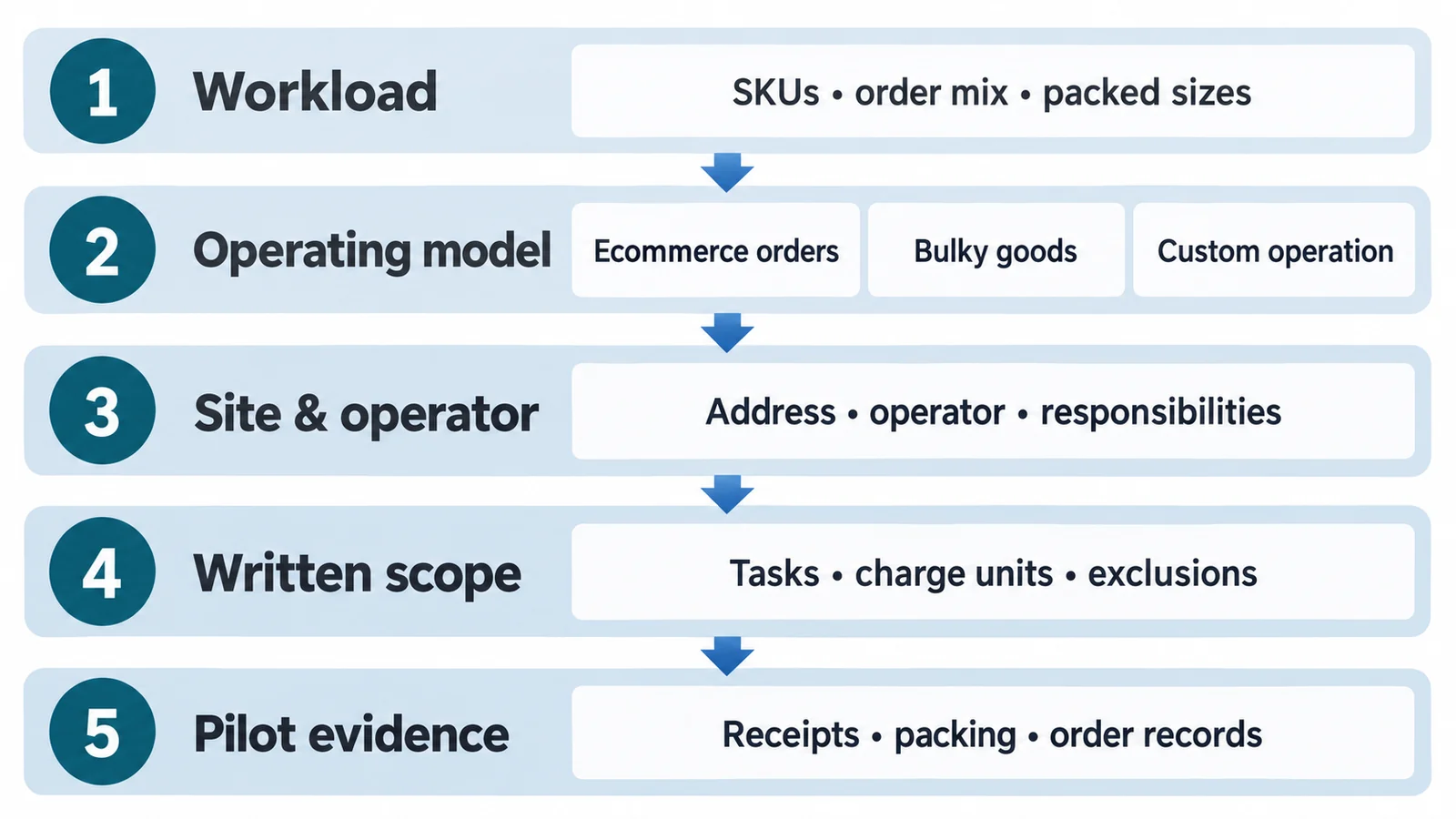
You receive three fulfillment proposals: one emphasizes its network, another a low pick fee, and another a custom warehouse operation. The company names are familiar, but the offers cover different work. Choosing before those differences are clear can leave stock in the wrong operation and orders waiting during the changeover. Compare third party logistics companies by their operating scope, product and channel conditions, proposed site, total quoted workload and handover evidence.
Which third party logistics companies should you compare?
Compare ShipBob, ShipMonk, Amazon Multichannel Fulfillment (MCF), Red Stag Fulfillment, DHL Supply Chain, and GXO against the work your business needs done.
How do their operating jobs differ?
These six candidates cover different operating requests; their inclusion is based on public documentation and disclosures, rather than a performance test or ranking. If you need the underlying model explained first, our guide to how a 3PL works covers the general relationship. Start your shortlist with three questions:
- Which physical tasks will the company perform?
- Which products and sales channels must the operation support?
- What evidence will confirm that the proposed service fits?
| Your operating request | Candidate to investigate | Evidence to obtain before shortlisting |
|---|---|---|
| Ecommerce orders and stocked inventory | ShipBob | Receiving records and the required order connection |
| Consumer orders alongside retail distribution | ShipMonk | Enabled retail processing and retailer/shipping mappings |
| Off-Amazon orders served from Amazon inventory | Amazon Multichannel Fulfillment | Product eligibility and channel/packaging settings |
| Large, heavy or bulky products | Red Stag Fulfillment | Packed-product handling and integration responsibilities |
| Combined warehouse, transport and additional work | DHL Supply Chain | The division, operating facility and contracted tasks |
| A customized outsourced distribution operation | GXO Logistics | Project scope, systems handover and operating ownership |
Use the table to remove mismatched service models before requesting detailed proposals. Key Takeaway: A useful shortlist connects each company to a specific job and a condition you can verify.
Which companies fit consumer and retail orders?
ShipBob, ShipMonk, and Amazon MCF are candidates for consumer-order fulfillment, but their receiving, retail and channel rules need separate checks.
How does ShipBob confirm inventory is ready?
ShipBob’s receiving documentation distinguishes physical arrival, counting, placement in storage (stowing) and completion. It tells integrators to retrieve current receipt and box records after receiving events. An individual stowed notification does not establish that the whole receipt is finished. Ask how your team will see:
- The expected products and quantities on the receiving order.
- The current state of each inbound box, including discrepancies.
- Completion and the inventory reconciliation that follows it.
For a launch shipment, identify which record your team will use before opening sales. If the proposed route includes a receiving hub and a later transfer, confirm which facility must finish the work before those units are available.
What must ShipMonk enable for retail orders?
ShipMonk’s order integration documentation distinguishes consumer orders from retail orders. Retail distribution requires the appropriate order classification, trading-partner rules and account setup; business-to-business (B2B) processing must be enabled before its attributes are sent. A shipping service that lacks the required configured mapping can leave an order awaiting action.
Bring a representative retailer order to the discussion. Ask the company to show the order type, required labels, shipping mapping and active warehouse identifier it would use. This gives you something more specific to approve than a general statement that both consumer and business orders are supported.
What changes when you use Amazon MCF?
Amazon MCF fulfills off-Amazon-channel orders using inventory placed in Amazon’s fulfillment system. Its official support FAQ says you do not need to sell on Amazon to use the service. Existing Fulfillment by Amazon (FBA) inventory can serve both Amazon and MCF-channel orders, subject to the applicable setup.
Confirm product and regional eligibility, then check the selected integration’s packaging and carrier settings against your channel requirements. Unbranded packaging is described as the default with exceptions; strict blank-box or carrier-block choices can require configuration. Key Takeaway: Choose between these candidates using a demonstrated account workflow, including receiving, retail rules or channel settings relevant to your store.
Which providers suit bulky goods or custom operations?
Red Stag is a candidate for large or heavy products, while DHL Supply Chain and GXO warrant a separate conversation about customized contract operations.
What must a bulky-product provider confirm?
Red Stag describes large, heavy and bulky goods as its operating focus, including parcel and freight fulfillment. Send the dimensions and weight of the packed product, handling needs and expected shipment mix. Ask it to confirm the proposed packing method and which carrier-related charges the quote includes.
The connection also needs a named owner. Its technology FAQ describes a direct Shopify connection and a WooCommerce connection through Dropstream, a separate integration service. The customer’s developers build and maintain custom connections through its programming interface (API), with provider setup and testing support. Confirm the method and maintenance responsibility for your own system before budgeting the move.
How do DHL and GXO change the buying process?
DHL’s 2025 Supply Chain division report describes warehousing, transport and value-added work, including ecommerce and returns solution areas. Specify the Supply Chain operation you are considering: the group also has separate express, forwarding and parcel businesses. GXO’s 2025 annual filing describes customized warehousing, distribution, ecommerce and reverse logistics, primarily for large outsourced operations. For either discussion, request:
- The proposed facility, tasks and party running the operation.
- Product, channel and project requirements the proposal assumes.
- Responsibility for systems setup, staffing and launch acceptance.
Those disclosures help identify the operating model; they do not establish a universal order minimum or capacity available for your inquiry. Key Takeaway: Compare a specialized product-handling request or custom contract project on its own requirements, rather than treating every company as the same parcel service.
How do you verify the company and warehouse behind a quote?
Verify the contracting entity, actual operating site and escalation owner before treating a company name or nearby address as proof of fit.

Which operating details need written confirmation?
A headquarters address, directory listing or network map does not identify the warehouse proposed for your goods. Ask which legal entity will contract with you, which party runs the site and which work may involve another operator. Then connect that answer to your catalog and channels:
- The receiving address and site contact for your shipment.
- Written acceptance of the products and handling requirements.
- The order types and sales channels covered at that site.
- A named person responsible for operating exceptions.
- Any subcontracted work and the agreed responsibility for it.
A relevant visit or current walkthrough can help you assess the proposed operation without requesting another customer’s private records. Use it to check the tasks your products require; a general warehouse photograph alone cannot establish that this site accepts your work. Key Takeaway: A nearby company becomes a usable candidate only when the actual operator confirms the site, products and service scope.
How can you compare quotes for the same workload?
Send each shortlisted company the same order and inventory profile, then compare the full quoted workload and its exclusions.
What belongs in one quote request?
Use a representative month of real orders, or clearly identified planning assumptions if the operation is new. Include a quieter month or launch peak when that variation could change the offer. Your common request should contain:
- Orders, order lines and units per order by sales channel.
- Packaged product dimensions, weights and handling requirements.
- Product-code (SKU) count, typical stock levels and inbound shipment pattern.
- Customer destinations and the services customers actually select.
- Retail preparation, packing materials and expected additional work.
Ask each candidate to confirm account acceptance before interpreting its price. Obtain the charging unit and period for each quoted task, including any minimum spending that affects a quiet month.
Which exceptions can change the comparison?
Clarify how the proposal treats mixed or discrepant inbound stock, extra preparation, kitting and retail-specific work. Storage assumptions, stock transfers and seasonal operating calendars can also change the job being priced. Identify which of these apply to your operation and ask for them in the proposal.
When an assumption differs, have the provider recalculate the same workload before you compare totals. A lower pick fee may include fewer tasks or use a different unit; it cannot settle the decision by itself. Key Takeaway: Choose from proposals that price the same accepted work, with exclusions and charge units visible.
What proof should you request before transferring stock?
Request a representative pilot, reconciled receiving records and an agreed launch owner before transferring the wider inventory. The video below offers a practitioner’s overview of choosing a 3PL.
How should a pilot prove the handover works?
Choose products and orders that expose the requirements in your brief, then agree what counts as an acceptable result. Our Shopify fulfillment-error checks explain common mismatches between store records and physical execution. For the proposed operation, verify:
- Correct SKUs, variants, quantities and channel fields.
- Counted receipts and inventory available for the test orders.
- Packing against the agreed specification.
- An invalid-address or stock-discrepancy exception and its owner.
- Shipment references and tracking returned to the correct order.
In its 2025 annual report, Levi Strauss disclosed that moving some distribution operations to third-party providers had caused system interruptions and fulfillment delays. The disclosure does not identify one provider as responsible for those aggregate transition problems. Key Takeaway: Expand the transfer after the candidate’s pilot meets the agreed checks and a named launch owner can account for unresolved exceptions.
When does sourcing support belong beside a 3PL?
Add sourcing support when supplier selection, sample approval or pre-dispatch checks sit outside the proposed warehouse agreement.

Where should supplier checks enter the plan?
Identify the upstream work before deciding which business should handle it. A proposed US warehouse may receive finished stock under your specifications while supplier selection and product approval remain separate tasks. Record what needs to be settled before inbound goods are released:
- The approved product version, sample and packaging specification.
- The supplier and person authorized to approve a change.
- The agreed checking scope and evidence required for exceptions.
- The point at which stock can pass to the fulfillment operation.
RuntoDropship is a China Private Dropshipping Agent; its China sourcing support provides a route to discuss supplier coordination and agreed checking or fulfillment needs against your product, market and operating scope. Keep that inquiry distinct from the six-company warehouse shortlist and confirm the responsibilities each party accepts. Key Takeaway: Assign supplier approval and warehouse receipt as connected jobs with clear handover conditions.
Which 3PL companies fit your operating requirements?
Choose the companies that confirm your products, channel rules, operating site, cost assumptions and handover checks in writing.
Use the six examples to narrow the operating model, then request evidence and a proposal for your own workload. If China-side supplier coordination is part of the gap, contact us to discuss your product and market requirements with RuntoDropship. We favor written responsibilities and checkable acceptance records before larger commitments.
FAQ
Can I keep my own carrier account with a new 3PL?
Only if the warehouse and carrier accept that billing arrangement. Confirm account permission, compatible labels, additional handling charges and who manages billing and claims under current terms. A discounted shipping rate shown in your store does not establish that the warehouse can use it.
Can a 3PL accept returns for orders another company shipped?
Possibly, if it agrees to that specific service. Confirm the return origin, receiving address, product identifiers, inspection and handling tasks, and final disposition before sending goods. Outbound fulfillment coverage alone does not establish acceptance of another operation’s returns.
What should I arrange before my old 3PL releases inventory?
Agree the counted stock list, applicable balances and fees, collection or dispatch arrangements, data export and receiving contact in writing. Follow the actual contract when arranging the transfer. Obtain qualified advice if a dispute prevents an agreed handover; a release date must be confirmed for your arrangement.
How can I dispute a charge on a 3PL invoice?
Match the disputed line to its order, receipt or work record and the agreed charging unit. Send the evidence through the documented dispute channel within the applicable deadline, and request the calculation or correction. Keep a record of the response while following the agreement’s payment terms.
Does warehouse insurance cover my stock at full retail value?
Not automatically. A statement that a warehouse has insurance does not establish your goods’ insured value. Review the actual policy and contract with a qualified advisor, including covered parties, risks, locations, limits, deductibles and valuation method, before relying on the cover.