

Louis Vuitton dropshipping is not a practical model for most independent sellers who expect a supplier to ship new branded products after each sale. Louis Vuitton says its products are sold through its stores, official website, and 24S; its US purchase terms describe products as being sold for personal use or as gifts. Without a documented commercial source, item-level authenticity evidence, lawful listing content, and an order flow you control, do not list the products.
Authenticated pre-owned resale is a different possibility, but it usually involves unique items that must be possessed, photographed, described, and authenticated one by one. That is closer to controlled resale or consignment than to importing a repeatable supplier catalog into a store.
This is general business information, not legal advice. Trademark, resale, import, consumer-protection, tax, and platform rules vary by country, so obtain qualified advice for every market where you source, advertise, and sell.
Louis Vuitton Dropshipping: Is It a Viable Business?
The normal buy-after-sale model is not viable unless you have a documented source that can legitimately supply genuine products for your company, channel, and customer markets. A consumer checkout, a supplier catalog, or a claim that goods are “factory direct” does not establish that commercial relationship.
Use this first decision table before spending money on a storefront or advertising:
| Proposed route | What must be true | Practical decision |
|---|---|---|
| New product bought from retail after a sale | The purchase, resale, delivery address, content use, and returns must all fit the applicable terms | Usually reject as an ordinary dropshipping model |
| Individually sourced pre-owned item | The exact item is available, documented, physically checked, accurately described, and covered by a workable return path | Consider only as controlled resale |
| Unknown wholesale, replica, or “1:1” source | Authenticity, origin, rights, and seller identity cannot be independently proved | Reject |
| Original premium product under your own brand | The design and brand assets are original, the supplier is verified, and the item passes normal product checks | Test as a separate brand-building route |
The decision is not simply whether a product can be shipped to a customer. You must also be able to prove what it is, who supplied it, what you may say about it, and who handles a failed order.
Key Takeaway: Treat missing commercial supply evidence as a stop sign. Build nothing around the assumption that a recognizable logo makes an unknown supplier legitimate.
Why the New-Product Retail Route Breaks

The new-product route breaks because the public sales channel is designed for brand-to-consumer purchases, not as a standing supplier agreement for independent stores. Louis Vuitton’s official warning about replicas and sales channels says products are sold through Louis Vuitton stores, its official website, and 24S.
The current US Terms of Purchase add a useful boundary: products are sold for personal use or as gifts, purchase quantities are limited, and the company may refuse transactions after non-compliance. Those US terms do not decide resale law in every country, but they show why a retail checkout should not be treated as proof of a wholesale or reseller arrangement.
Are There Genuine Louis Vuitton Dropshipping Suppliers?
Louis Vuitton does not publish a wholesale or dropshipping program for independent online sellers. Its official authenticity page identifies Louis Vuitton stores, louisvuitton.com, and 24S as the channels through which authentic products are sold. This does not prove that no private commercial arrangement could ever exist, but it means there is no publicly verifiable supplier list that an ordinary seller should treat as approved.
Do not rely on a marketplace badge, catalog photograph, low price, supplier certificate, “factory direct” claim, or the words “original quality” as proof. Treat every claimed Louis Vuitton supplier as unverified until you can independently confirm the legal seller, item-level invoices, lawful product origin, direct-shipping responsibilities, returns, the exact item being released, and any channel or territory authorization the supplier claims to hold.
If a supplier cannot provide evidence that connects the exact item to a legitimate source, stop the review. Do not upload the catalog first and investigate after a customer places an order.
Retail access is not commercial approval
A successful order proves only that a specific retail transaction was accepted. It does not prove that you can depend on future stock, enter customer addresses repeatedly, copy product-page assets, advertise an affiliation, or pass the brand’s consumer return process through to your own buyers.
The same distinction appears in our SHEIN dropshipping risk analysis: the ability to enter a customer address at a retail checkout does not create a documented reseller or dropshipping relationship.
If you believe you have an authorized source, obtain the agreement in writing. It should identify the legal supplier, your company, approved products, sales channels, territories, listing assets, order flow, shipping responsibility, returns, and the period for which the authorization remains valid.
Retail availability is not controllable inventory
A seller who lists an item before securing it can receive an order after the brand or retailer has sold out, limited the buyer’s account, changed a delivery condition, or rejected the destination. High product value makes cancellation, delayed refunds, and payment holds harder to absorb.
More broadly, retail arbitrage vs dropshipping differ in inventory control, sourcing structure, fulfillment responsibility, and scalability. Purchasing only after a customer order does not remove stockout or cancellation risk.
In the United States, the FTC’s internet order guidance says the seller making the offer remains responsible for shipment promises even when a drop-shipper or other company performs the shipment. Other markets have their own consumer rules, so map the seller’s obligations before accepting orders.
Separate Genuine, Unauthorized, and Counterfeit Goods
Genuine goods, genuine goods from an unapproved route, and counterfeit goods are not interchangeable labels. The correct classification changes the evidence, listing language, import risk, warranty position, and platform response.
| Product and supply state | Evidence you need | Main problem to resolve |
|---|---|---|
| Genuine and covered by a commercial agreement | Item traceability plus current authorization for your company, channel, and territory | Staying inside the agreement |
| Genuine but not supplied through an authorized commercial relationship | Item traceability and lawful acquisition, with no false affiliation claim | Local resale, import, warranty, content, and platform rules |
| Counterfeit, replica, or unauthorized logo-bearing copy | No document can turn it into a genuine branded product | Do not source or list it |
A supplier may use words such as “original quality,” “mirror,” “same factory,” “1:1,” or “authentic grade” to avoid saying that the item is a replica. None of those phrases identifies the legal seller, traces the exact item, or proves authorization.
eBay’s counterfeit policy says sellers may list an item only when they are certain it is genuine. It also warns that using “dupe” with a brand name can suggest an infringing product. A disclaimer such as “not original” does not make a logo-bearing copy a safe product to sell.
Key Takeaway: Verify the product, the supply route, and the seller relationship separately. If any one remains unclear, hold the item and do not create a listing.
Verify Every Supplier and Item Before Listing
A defensible branded offer begins with a legal-business check, item-specific documents, and physical inspection. Supplier promises and catalog photographs are discovery material, not approval evidence.
Verify the business behind the catalog
Ask for the supplier’s legal name, registration, business address, bank-account owner, invoice format, return address, and responsible contact. Confirm those details through records and contact information you find independently rather than relying only on links supplied in the sales chat.
For original, non-infringing products, a supplier verification and sourcing workflow can help compare legal business identities, quotes, samples, and repeat-order capability. It cannot confirm Louis Vuitton authorization on the brand’s behalf.
When authorization is claimed, ask the rights owner or named distributor to confirm it directly. A letter that merely says a company sells “luxury goods” does not show which products, territories, channels, or dates it covers.
Trace the exact item
The evidence file should connect the item to the invoiced seller. Depending on the product, age, source, and marketplace, that file may include:
- an itemized supplier invoice and proof of payment;
- upstream purchase or consignment records;
- the model, size, color, condition, and unique identifiers where applicable;
- original photographs of the actual item, packaging, accessories, and defects;
- an authentication report accepted for the intended selling channel;
- the inspection, shipment, and return records for that specific item.
A receipt image alone is weak evidence because documents and genuine receipts can be copied, altered, or paired with a different item. A code, chip response, dust bag, or certificate image should also never stand alone.
Inspect the physical customer path
Run a complete test with one actual item before listing a catalog. Inspect what arrives, who appears as seller on the invoice and parcel, whether the item matches its description, how customs information is presented, what the buyer receives, and where a return goes.
If the source will ship directly, require photographs of the exact released item and parcel, not a generic reference sample. A one-of-one pre-owned product must be reserved immediately when sold so the same item cannot remain live on another channel.
Check Listing Rights and Platform Rules
An authentic item does not automatically give you every right needed to market it. Product ownership, trademark use, copyrighted photographs, descriptions, logos, domain names, advertising claims, and implied affiliation are separate questions.
Create original, accurate photographs and descriptions unless you have documented permission to use supplied assets. Describe the product and condition truthfully, and never design the store to look official or approved when no such relationship exists.
Shopify’s intellectual-property guidance says infringing content violates its Acceptable Use Policy and may be removed. Marketplaces can add stricter evidence, category, seller-location, shipping, and authentication requirements, so read the current rules for the exact account and destination before listing.
Use this release check for every channel:
- Confirm that the exact brand and category may be listed from your account and country.
- Confirm which invoices, authentication records, and item photographs the platform accepts.
- Confirm that every image, description, trademark reference, and advertising claim is permitted and accurate.
- Confirm that the parcel, invoice, and return address do not misidentify the seller.
- Confirm that the actual shipping, return, warranty, tax, and customer-service process matches the published promise.
Account approval or an initially accepted listing is not permanent clearance. Rights owners can report content, platforms can ask for documents after a sale, and payment providers can review funds when customers dispute authenticity.
Model the Complete Order Economics
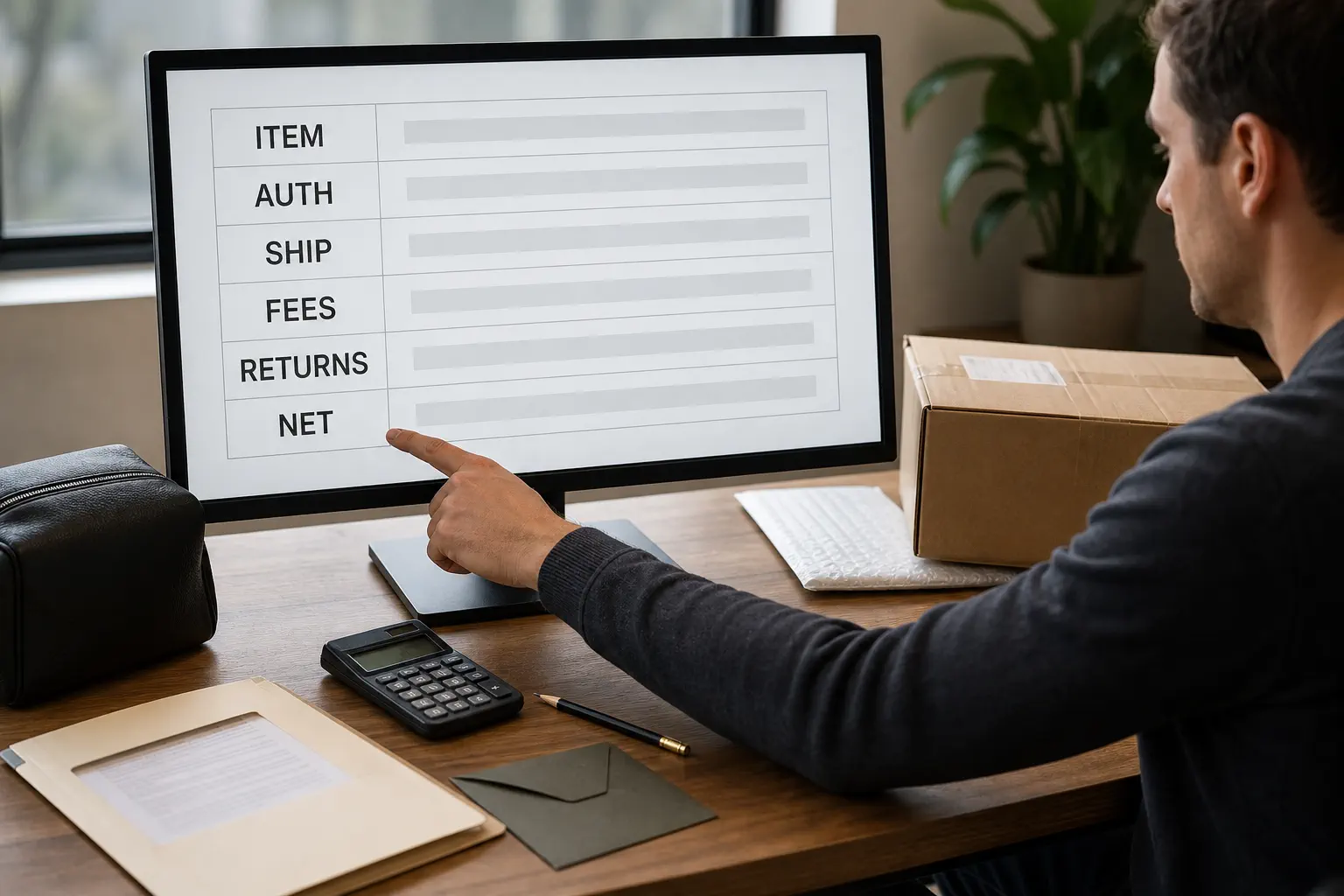
The model is financially viable only if one delivered order remains profitable after acquisition, verification, customer service, and downside risk. A famous retail price does not create a wholesale margin.
Use current figures for the exact item and customer destination:
Expected order result = customer payment − item acquisition − authentication − insured shipping − platform and payment fees − duties or taxes you bear − customer acquisition − service cost − expected return, loss, and dispute allowance
Do not use a generic margin percentage from a supplier article. Collect actual quotes and controlled test data, then calculate a normal case and a downside case.
The offer needs a credible reason to exist
For a new item available from the official store, a third-party seller may have no clear advantage in authenticity assurance, product access, price, returns, or service. Adding a markup can make the offer weaker; reducing the price can remove the reserve needed for fraud, loss, authentication, or returns.
A pre-owned seller can create value through item access, condition transparency, accurate photography, authentication, and a dependable transaction process. That value depends on possessing and understanding the specific item, not merely forwarding a product link.
Cash flow must survive a dispute
You may pay the source before your processor releases the customer’s funds. If the item fails authentication, is returned, or receives an authenticity dispute, you may need to fund a refund while the purchase cost and shipping remain tied up.
Calculate how many simultaneous purchases, holds, and refunds the business can support. Do not use money owed to one customer to cover another customer’s order.
Key Takeaway: Reject the route if the calculation works only when every item sells, every shipment succeeds, and no buyer returns or disputes an order.
Build a Controlled Pre-Owned Order Flow
A controlled pre-owned model treats every item as unique inventory with its own evidence and status. Automation can copy data, but it should never release a high-value listing or shipment without an item-level check.
Use this sequence:
- Acquire or consign the exact item through a documented legitimate source.
- Record its model, condition, included accessories, defects, measurements, and identifiers.
- Authenticate it through a process appropriate to the item and intended channel.
- Photograph the actual item and write an original, condition-specific description.
- Reserve or remove the item everywhere else as soon as one buyer purchases it.
- Recheck the item, packaging, insurance, delivery signature, and destination before dispatch.
- Keep the evidence and shipment record through the return and dispute period.
On eligible eBay handbag transactions, the Authenticity Guarantee process sends the sold item to an authentication facility before onward delivery. Eligibility depends on product, price, seller and buyer location, and other current conditions, so never assume the program covers every listing or market.
Returns require identity control
A return must be checked against the original item photographs, condition notes, identifiers, accessories, and security controls before it goes back into inventory. This protects both the buyer and seller when the returned item differs from the one sent or comes back in a changed condition.
Write the customer policy around the actual route. State who pays return shipping, where the item returns, how quickly it is inspected, what happens after an authentication failure, and which remedies apply under the selling channel and local law.
Choose a Safer Premium Product Strategy

The safer scalable route is usually a documented authorized brand relationship or an original premium product that does not borrow another company’s identity. Both routes give you a clearer product promise and a supply process you can test directly.
Route 1: Use documented authorized supply
Choose a branded distributor only when it can prove that its agreement covers the exact products, your company, intended channels, customer territories, content assets, order flow, and returns. Wholesale access does not automatically include direct-to-consumer shipment, and a general luxury-brand catalog does not prove access to Louis Vuitton.
Confirm the relationship independently and keep the current agreement. If the source cannot produce item-level invoices or the rights owner will not confirm the claimed authorization, do not list the products.
Route 2: Build an original premium product
Start with a customer need such as material, carrying capacity, construction, comfort, protection, care, or price position. Use original product shapes, patterns, names, photography, packaging, and marketing rather than asking a factory to remove a logo from an obvious copy.
The practical difference between building your own branded offer and reselling a famous brand is ownership of the customer-facing identity. You still need product and intellectual-property review, but you can control the supplier specification, packaging, inventory rule, and customer promise.
After demand is tested, private-label execution can add your own packaging, inserts, labels, and repeatable order rules. It must never be used to copy protected product designs, logos, certificates, or packaging.
Key Takeaway: Compete with documented authorization or original customer value. A private label is a path to your own brand, not a method for disguising somebody else’s product.
What a Private Dropshipping Agent Can and Cannot Do
A private dropshipping agent can execute an approved supply plan, but cannot grant trademark rights, certify an unknown item as genuine, or turn a counterfeit product into lawful inventory. The seller remains responsible for the product choice, evidence standard, markets, platform rules, and customer promises.
For an original product or a properly documented supply route, an agent may coordinate supplier communication, samples, product checks, packaging confirmation, order preparation, shipping options, tracking, and after-sales investigation. These controls make the physical process more visible; they do not replace brand authorization, professional authentication, legal advice, or marketplace approval.
Give the agent a written do-not-source list. Exclude third-party logos, copied monograms, false certificates, reused brand photography, counterfeit packaging, and products whose origin cannot be traced.
FAQ
Can I send a Louis Vuitton retail order directly to my customer?
Louis Vuitton allows genuine gifts to be sent to a recipient, but a gift-delivery option is not a wholesale, reseller, or dropshipping agreement. Repeated customer-address orders must still comply with the applicable purchase terms, stock limits, payment rules, resale laws, and your own customer obligations.
Can I copy Louis Vuitton product photos onto my store?
Not merely because you own or intend to resell the item. Ownership of a physical product does not automatically transfer copyright in the brand’s photographs, videos, or product copy. Use original images and descriptions unless you have documented permission to use supplied assets.
Is pre-owned Louis Vuitton consignment the same as dropshipping?
No. A controlled consignment model involves a specific item that is reserved, documented, authenticated, and removed from every other sales channel after purchase. Ordinary dropshipping usually relies on repeatable catalog inventory that the seller does not control item by item.
Can a private dropshipping agent source “1:1” Louis Vuitton products?
A legitimate private dropshipping agent should reject replicas, copied monograms, counterfeit packaging, false certificates, and unverifiable logo-bearing products. An agent can coordinate an approved supply process, but cannot grant trademark rights or turn a non-genuine product into lawful inventory.
Conclusion
The sensible decision is to reject ordinary new-product retail arbitrage and every replica or unverifiable source. A branded route needs traceable genuine items, defensible listing rights, current channel eligibility, complete order economics, and a return process that still works when a sale goes wrong.
If you already have an original product or a properly documented commercial source, Runtodropship can support supplier coordination, samples, product checks, packaging confirmation, order preparation, shipping arrangement, and after-sales follow-up as your China-based private dropshipping agent team. Send the product specification, authorization evidence where relevant, target markets, current order pattern, and required packaging so the team can assess a controlled test workflow.