

Your store has a product that sells, but recent orders tell different stories. One parcel arrived on time; another has a tracking number with no carrier scan, and a new quote cuts your margin. Switching suppliers now could leave those open orders without an owner. Compare zendrop alternatives by identifying the failing handoff, pricing the same product and destination, and testing a complete order before moving live volume.
Why look beyond your current Zendrop setup?
Look beyond your current setup when a repeatable cost, product, delivery, or support problem remains after you check your account’s existing options. One bad order warrants investigation; a pattern tied to one SKU or route warrants a comparison.
Name the failure you can measure
Start with the order that went wrong. Keep its product reference, variant, destination, provider charge, processing dates, first carrier scan, and outcome together. “Slow shipping” tells you less than orders with prompt labels but late carrier acceptance.
- Product: Was the received item or variant different from the approved sample?
- Cost: Did shipping, handling, or plan charges change the delivered margin?
- Execution: Did stock, processing, tracking, or a refund wait on someone else’s decision?
Check whether the current setup can fix it
Before replacing the order flow, ask whether its sourcing request, shipping route, stock option, or support path addresses the issue. Availability can depend on your account, product, and plan. Test any proposed fix against the same SKU; otherwise, carry the gap into your shortlist. Key Takeaway: A recorded failure gives procurement a testable requirement.
Which type of Zendrop alternative solves your problem?
The right alternative depends on which part of the order path needs a new owner. An automation app moves data, a supplier marketplace presents products, and a private agent can coordinate physical sourcing and fulfillment.
Separate data automation from physical execution
Look past the dashboard. Product imports, stock updates, and tracking sync do not tell you who receives a sample, checks a variant, packs the parcel, or authorizes a replacement. Shopify’s explanation of fulfillment methods distinguishes app-connected services from manual and custom arrangements.
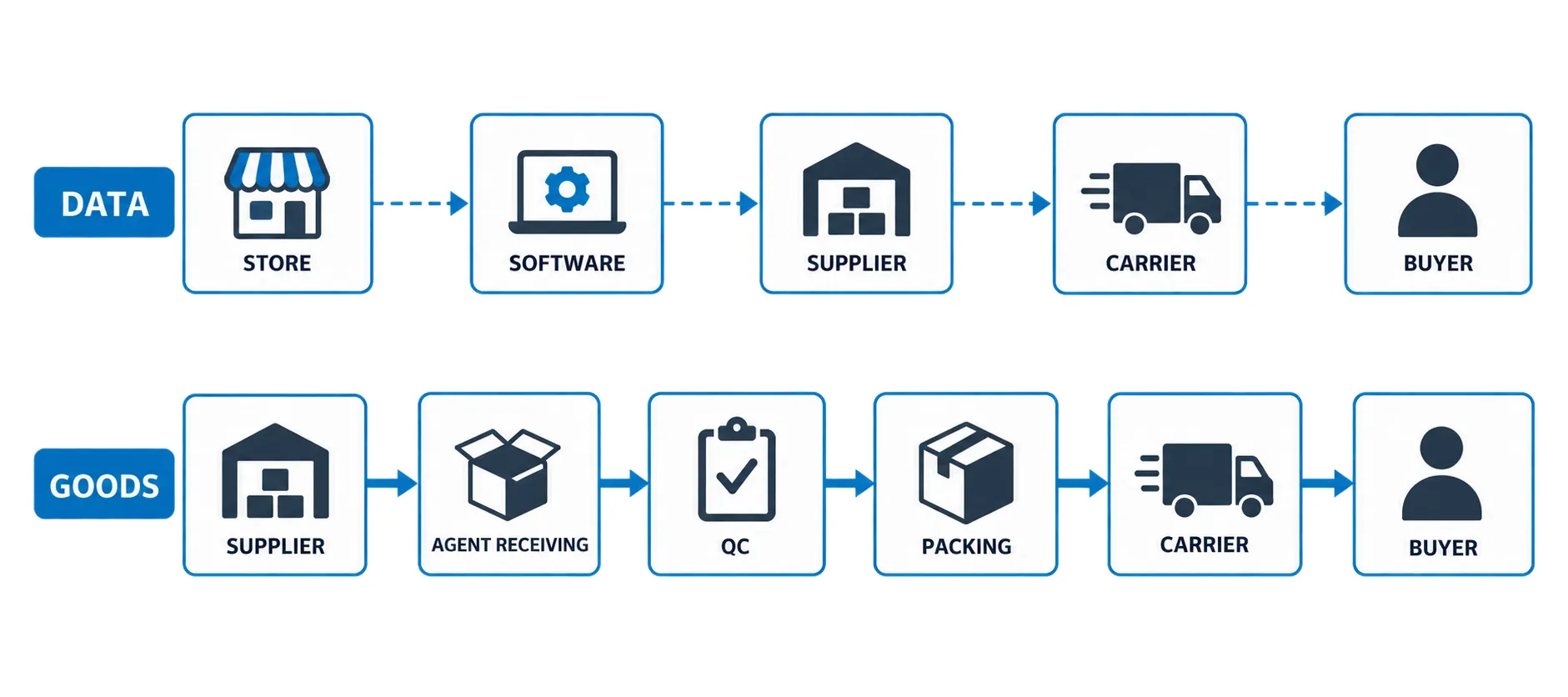
Match the model to the missing responsibility
- Choose an automation layer when order entry, price updates, or stock synchronization are the main burden and your suppliers already perform reliably.
- Choose a supplier network when product access and destination coverage are missing, then verify each listed supplier’s terms.
- Consider a private agent when the exact SKU needs sourcing, sample approval, QC, packaging, and exception coordination before dispatch.
If a provider says it “handles fulfillment,” ask which physical steps its team controls and which remain with a supplier or carrier. Key Takeaway: Buy the missing responsibility, then test the failing handoff.
How should you build a shortlist for your store?
Build a shortlist from your store’s hard requirements before comparing any advertised benefits. An option that cannot support your sales channel, exact product, or customer destination should leave the list even if its feature table looks impressive.
Filter by hard constraints
Write down one live SKU, its variants, a buyer destination, your storefront, and the service you expect. Ask each candidate whether it supports that combination today. “Ships to the US” does not establish stock for your product or a route that meets your promise.
- Can the provider accept this store’s order and return tracking without duplicate fulfillment?
- Can it source or hold the exact variant, not only a similar catalog item?
- Are the destination, product attributes, and packaging requirements supported on the proposed route?
Ask for evidence behind each offer
Request a written scope, a same-product quote, a sample path, stock-update rules, and an exception contact. The site’s questions to ask a dropshipping agent support a deeper interview for agent-led options. Key Takeaway: Evidence-based filtering saves sourcing time before price negotiation.
What will one delivered order really cost?
The meaningful price is the complete cost of delivering the same SKU to the same buyer under comparable service conditions. A cheaper subscription or product quote can lose its advantage once packaging, processing, shipping, and failed-order remedies enter the calculation.
Build a comparable order-cost worksheet
Put quotes side by side using the approved variant, packed weight, destination, and shipping service. Get charges in writing; leave a cell unknown until confirmed. Allocate monthly software fees across a realistic order count.
| Cost item | What to request | Why it changes the choice |
|---|---|---|
| Product and variant | Exact specification and quantity basis | Near matches make quotes incomparable |
| Receiving and checks | Handling and QC scope | An inspection promise may cover different tasks |
| Packaging | Material, setup, storage, and per-order use | Branded materials can require a separate commitment |
| Shipping | Packed weight, route, destination, and service | A low product price can hide a costly route |
| Software and payment | Plan, add-ons, transaction charges | Fixed fees matter differently at different order volumes |
| Remedy | Defect, loss, return, and reshipment terms | The seller may fund failures the quote omits |
The table exposes which quoted total is still missing a charge or a responsibility.
Stress-test the costs of failure
Ask who pays when a sample fails, an item is reshipped, or a buyer returns a parcel. You do not need to invent a refund rate to see the risk: one unclear remedy can erase the difference between two close quotes. Check whether a fee is per order, per parcel, per item, or per month, and compare the same billing period. Key Takeaway: Complete delivered-order cost protects a procurement decision from a deceptively low line-item price.
Can a new provider match your exact SKU and variants?
A replacement is viable only when its physical sample and every sellable variant match the product you have promised to customers. A sourcing quote is a starting point, not proof that a warehouse will dispatch the correct item repeatedly.
Inspect a sample against a written reference
Provide a specification for dimensions, material, finish, color, included parts, labels, and packaging where those details affect your listing. Compare the sample to that reference and photograph accepted and rejected details. Do not approve a vague “same as picture” promise.

Confirm stock and substitution rules
- Map every store variant to the provider’s exact source and internal SKU.
- Ask where stock is held, how often availability changes, and what happens when the source runs out.
- Require your approval before a substitute product or different specification reaches a buyer.
If you need to compare upstream sources rather than pick another ready-made listing, a China sourcing agent can coordinate supplier options and samples for that specific product. Confirm the service scope and quote before assigning orders. Key Takeaway: Sample and stock proof reduce wrong-variant shipments and surprise source changes.
What delivery proof should you request before switching?
Request a complete order-to-delivery record for your exact product and destination, with processing and first carrier acceptance shown separately. A tracking number alone may mean only that a label exists; it does not prove the parcel entered the carrier’s network.
Separate processing, label creation, and transit
Watch the first carrier scan. Record when the order was paid for, when stock was confirmed, when packing ended, when the label was made, and when the carrier accepted the parcel. Then follow the international and last-mile events through delivery. This sequence gives you a useful basis for the date you publish to buyers.
- Processing delay points to stock, purchasing, or warehouse work.
- A label without acceptance points to a handoff that still needs proof.
- Transit variation points to route, customs, or last-mile conditions.
Check the slow orders as well as the average
One fast test parcel cannot support a broad delivery promise. Run a small set across the destinations you actually serve, keep the dates, and ask the provider how it handles parcels that fall outside the stated window. Separate what was observed from what a sales page estimates, especially for remote addresses or a product with special shipping restrictions. Key Takeaway: Route-level evidence gives the seller a defensible delivery window and an escalation trigger.
Who owns quality issues, returns, and stalled orders?
Choose a provider only after each common exception has a named owner, required evidence, and an agreed remedy. The seller remains answerable to the customer even when the physical fix requires a warehouse, supplier, or carrier to act.
Write the exception matrix before signing
Run one problem through the chain. For a wrong variant, determine who verifies the pick record, who approves replacement stock, who pays the second shipment, and who tells the customer when it will leave. Do the same for a failed inspection, damage, a parcel with no movement, and a return to a different country.
- Record the event that triggers escalation and the proof each party must keep.
- Identify the person who can authorize a refund, reshipment, or substitute item.
- Check where returned goods go and whether they can be inspected or resold.
Test the escalation path
Ask the provider to walk through a sample exception before it holds a real order. A support inbox is useful only when the person answering can reach the team that controls the item or parcel. Keep the agreed response window and remedy terms with the quote, and revisit them when the product or route changes. Key Takeaway: Clear exception ownership protects the customer and limits the seller’s exposure after a normal order breaks down.
When is a private agent a better fit than another app?
A private agent is a better fit when your product needs coordinated sourcing and physical order work that another software layer will not perform. The decision follows the product’s complexity and the seller’s control needs; no universal daily-order threshold proves the model is right.
Specify the work that needs local coordination
A defined agent scope can cover supplier comparison, samples, receiving, variant inspection, packaging, and exceptions. Ask which tasks its team performs and which it coordinates through other companies. That distinction affects cost and accountability.

Run a limited pilot before committing stock
- Give the agent one exact SKU, destination, inspection standard, and parcel requirement.
- Request a written breakdown of product, handling, packaging, storage, and shipping terms.
- Approve a packed sample and follow a test order through tracking and any support question.
Keep the first commitment small enough that a failed pilot is manageable. A private relationship adds communication and setup work, so judge it by the handoffs it improves, not by a promise of automatic savings. Key Takeaway: A controlled pilot shows whether local coordination adds useful supplier and fulfillment control.
How can you switch without disrupting paid orders?
Switch by assigning every already-paid order to its current fulfiller and routing only an agreed set of new orders through the tested replacement. Changing the app connection before that ownership is clear can create duplicate shipments, missing variants, or tracking that no team recognizes.
Freeze the old-order ledger and test one SKU
Before changing a routing rule, export open orders with customer promise, SKU, variant, payment state, provider, tracking state, and issue owner. Keep the old path responsible for its queue while a single product moves through the new path. The Learn With Shopify test-order walkthrough is a useful visual supplement when checking how a trial order appears in a store; confirm the exact app behavior yourself.
- Check that the new source receives the right variant once, not twice.
- Confirm the store records the correct fulfillment and tracking updates.
- Keep a contact and remedy path for orders still held by the old provider.
Set cutover and rollback triggers
Move more orders only after product match, delivered cost, route evidence, tracking, and exception handling meet your written standard. Stop the cutover if the new path creates an unowned order or mismatched stock. The site’s guide to transitioning dropshipping agents details an open-order ledger and staged handoff for sellers taking that route. Key Takeaway: A staged switch protects current buyers while you learn whether the new workflow works in practice.
Conclusion
Choosing among Zendrop alternatives starts with the order problem you can document. Compare operating models by responsibility, put the same SKU and destination through each quote, and prove product, delivery, and remedy claims with a small trial before moving live volume. RuntoDropship can coordinate sourcing, quality checks, fulfillment, and shipping for sellers who need a Private Dropshipping Agent; the right scope depends on the product and order flow. If that is the help you need, contact RuntoDropship with one SKU and your target destination. We believe supply-chain decisions should rest on visible handoffs and written responsibilities.
FAQ
How do I know which Zendrop billing model applies to my account?
Check the plan and billing page in your own account. Zendrop describes Standard Plans and usage-based billing, and the model depends on how and when you signed up. Ask support to confirm your current terms before using a public price in your cost comparison.
Can one Shopify store use more than one fulfillment service?
Yes, Shopify supports different fulfillment methods for different products. The details depend on the apps and locations you use. Test product assignment, shipping rates, and tracking for a mixed order before routing paid customers through two services.
Can I keep my product page and reviews when changing suppliers?
Usually, the supplier can change behind an existing store product without creating a new customer-facing page. Keep the product record and check how your review app, variants, inventory, and fulfillment mapping behave. Avoid duplicating a live listing unless the products truly differ.
Can a product research app work alongside my current fulfiller?
Yes, if the research app only informs product choices and does not overwrite inventory, prices, or order routing. List which system owns each field before connecting another app. A research subscription does not itself inspect or ship a product.
What should I ask about unused branded packaging?
Ask who owns it, where it is stored, whether storage costs continue, and how it can be returned or disposed of if the SKU ends. Get the packaging quantity and setup terms in writing before buying materials. A small product test does not require committing to a large print run.