
You have a product that sells, and two apps appear able to fulfill it. Their listings may hide different shipping origins, plan charges, packaging, and return rules. A choice made from feature lists can become a stalled parcel or an unowned return. In a Zendrop vs Spocket decision, neither platform wins for every store. Test the exact SKU and destination, delivered-order cost, and exception policy before committing.
Where Do Zendrop and Spocket Differ in Practice?
Zendrop combines a catalog with sourcing and fulfillment routes; Spocket connects sellers with suppliers whose terms vary by listing. For either app, find out who controls stock, shipment, and remedies for your product.
What does each platform control?
Both apps can import products and send store orders into a supplier workflow. Check the following for your listing and plan:
- The supplier and actual ship-from location for your chosen variant.
- Whether the listing permits the destination and sales channel you use.
- Who holds the stock and confirms it before an order is accepted.
- Who approves a replacement or refund when the item fails.
Which seller constraint should come first?
Start with the condition you cannot trade away. Write down your product specification, destination, delivery window, and support capacity before comparing dashboards.
| Buyer constraint | Evidence to request | Decision consequence |
|---|---|---|
| Product and variant | Listing and sample | Reject a substitute that changes the offer |
| Ship-to market | SKU route | Exclude an ineligible destination |
| Order ownership | Exception contact | Close the support-to-supplier gap |
Key Takeaway: Choose a supplier model around the actual order you need to fulfill, then compare platform features that serve that order.
What Will One Delivered Order Really Cost?
Compare the full cost of the same product and basket on both platforms; a catalog price leaves out plan and delivery charges.
Which charges belong in the same calculation?
Build an order-level cost sheet. Hidden costs of Shopify dropshipping include shipping and exceptions that a product quote misses. Record:
- Product and shipping charges for the exact variant, destination, and basket.
- Plan cost allocated across a realistic number of orders.
- Payment, packaging, return, and replacement costs where applicable.

How do the actual billing models change the math?
Now check the billing model. Zendrop documents standard subscriptions and usage-based billing through Shopify; Spocket has its own plan and trial terms. Use the charge shown in your account, not an old comparison table.
What happens to margin when an order needs a remedy?
Subtract product, shipping, allocated plan, payment, and acquisition costs from the selling price. Run a separate replacement or refund scenario without inventing an incident rate.
| Cost line | Where to verify it | Effect on the decision |
|---|---|---|
| Product and shipping | Live SKU and destination quote | Sets normal delivered cost |
| Subscription | Current account billing screen | Changes cost per order as volume changes |
| Remedy scenario | Supplier policy and your records | Shows downside when an order fails |
Key Takeaway: The useful price comparison is the contribution left after a delivered order, with a separate, documented remedy scenario.
Can Each Catalog Supply the SKU You Need?
Neither catalog is a fit until a supplier can provide your product, variants, and customer route.
Where will the selected product ship from?
Ship-from location belongs to a listing, not a platform name. Zendrop’s US-supplier guidance separates its US supplier products from China fulfillment and limits the US route to domestic destinations. On Spocket, check the selected supplier’s origin and eligible markets too.
Do the variants and samples match your specification?
Next, compare the listed variant with a physical sample:
- Match color, size, material, accessories, and relevant safety details.
- Inspect packaging and markings the buyer will see.
- Map each storefront variant to a supplier variant, and keep the sample record.
What if the item requires a sourcing request?
Zendrop’s product-sourcing requests face plan and product limits; a Spocket listing may also miss part of your brief. Wait for a confirmed variant, quote, route, and sample before listing either one.
| SKU check | Pass evidence | Stop condition |
|---|---|---|
| Specification | Approved sample and variant map | A missing or substituted feature |
| Availability | Supplier confirmation for the chosen route | Stock or market is uncertain |
| Sourcing request | Accepted match and updated quote | Request pending or rejected |
Key Takeaway: Approve the product and route together; a close catalog match is not a supply commitment.
When Will the Customer Actually Receive the Order?
The full delivery wait includes processing, carrier acceptance, and transit; log each stage in a sample order.
What happens before the first carrier scan?
An order marked fulfilled may still be waiting for stock confirmation, packing, or carrier handoff. Record:
- Customer order and supplier acceptance.
- Packing, label creation, and first carrier scan.
- Delivery or a documented exception.
How can you test the route to your market?
A tracking number does not prove movement. Place a sample order to your market and keep its first scan and delivery history. If dispatch is the bottleneck, compare it with RuntoDropship’s fast shipping dropshipping service before changing routes.
Which delivery promise can you safely publish?
Publish a window supported by the selected route and samples, including time before handoff. Recheck it when stock location or carrier changes.
| Stage | Record this event | Question if delayed |
|---|---|---|
| Processing | Supplier acceptance to packed order | Was the SKU actually available? |
| Handoff | Label creation to first carrier scan | Has the parcel reached the carrier? |
| Transit | First scan to delivery | Is the route meeting the buyer promise? |
Key Takeaway: Base the customer-facing window on observed order-to-delivery time, with first scan visible as its own checkpoint.
What Can the App Automate, and What Still Needs People?
The apps move product, order, and tracking data; people still confirm stock, check goods, pack, and hand over parcels.
Which information moves automatically?
The connection and plan determine which updates move automatically. Test whether:
- Check that the correct SKU and variant reach the supplier queue.
- Watch whether an out-of-stock signal pauses the storefront listing.
- Compare tracking updates with carrier acceptance, not just label creation.
Who confirms stock, quality, packing, and handoff?
The physical handoff still has to happen. Ask for stock, inspection, packing, or carrier-scan evidence when a dashboard status leaves shipment risk unresolved.
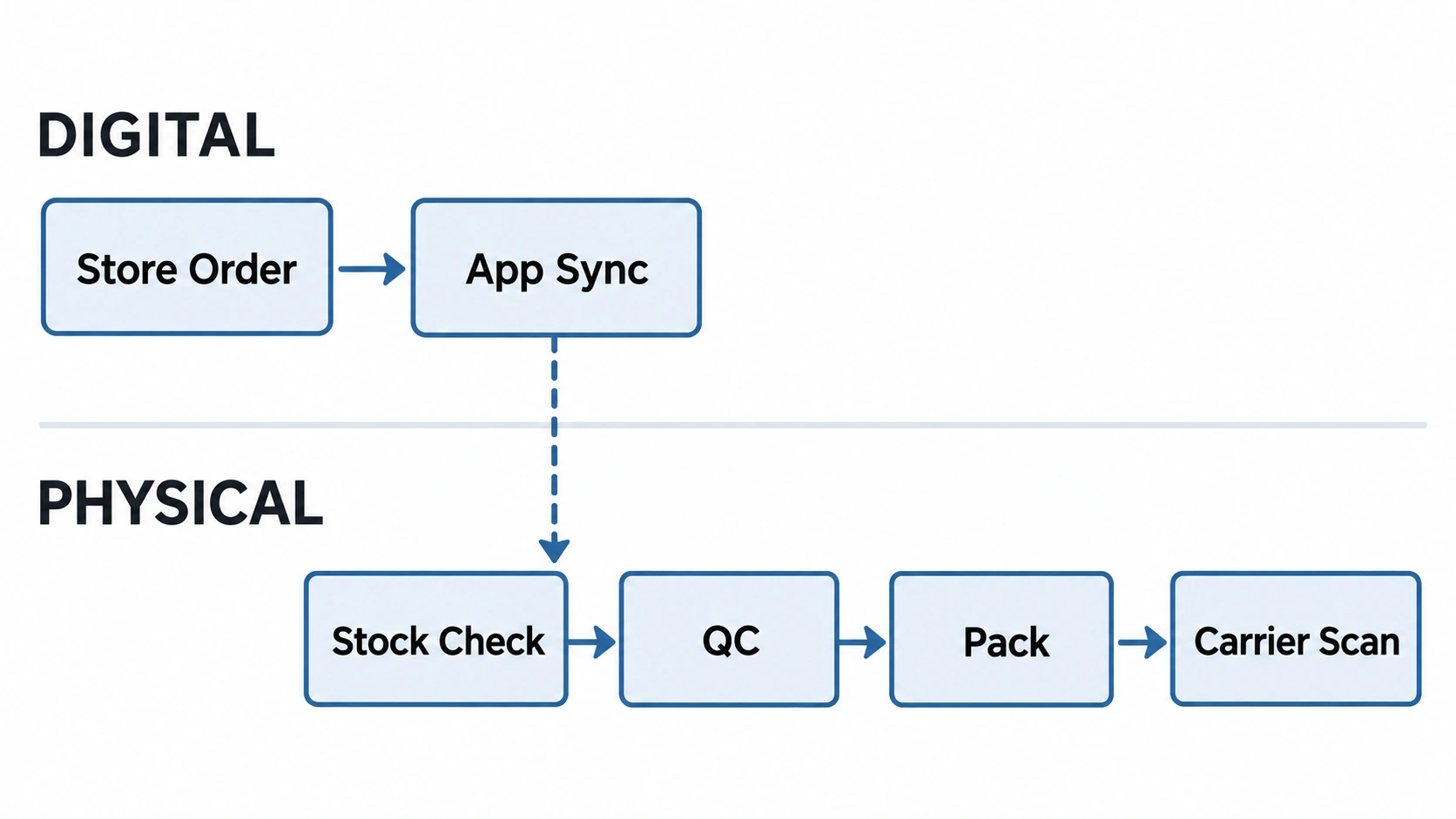
Where does an exception need an owner?
Give each failed checkpoint an investigator and a deadline. Record the escalation contact before sending paid traffic into the route.
| Event | App record | Physical or human proof |
|---|---|---|
| Order accepted | Imported order | Stock and variant confirmed |
| Order fulfilled | Status and label | Packed parcel and first scan |
| Exception opened | Support ticket | Named owner, evidence, next update |
Key Takeaway: Test where software stops and physical execution begins; a status field cannot replace proof of carrier handoff.
Who Handles a Wrong Item, Return, or Replacement?
The selected supplier policy and a named owner determine how a wrong item, return, or replacement is handled.
What do the published policies actually cover?
Spocket’s return guidance says policies vary by supplier; some listings may not permit refunds. Zendrop says its warehouse does not accept returns for its US-supplier route. Save the selected policy before promising a remedy.
Which evidence and decision owner do you need?
Set the process before an issue arises. RuntoDropship’s dropshipping quality control service describes pre-dispatch checks; a post-delivery issue still needs:
- The customer’s report, order variant, and photos.
- The reporting window, return address, and approval contact.
- An agreed payer, buyer update, and closure record.
What did one seller confirm about a replacement?
One seller we worked with wrote that a replacement was the best response for their customer and store reputation. They said they would pass the decision to the buyer. The message documents agreement, not the original issue or delivery of a replacement.

| Remedy step | Owner to name | Evidence to retain |
|---|---|---|
| Assess the issue | Seller and supplier contact | Order, photos, policy |
| Approve the remedy | Party with authority under agreed terms | Written replacement or refund decision |
| Close the case | Fulfillment owner and seller | Tracking or refund record and buyer update |
Key Takeaway: A useful return or replacement process names the decision maker, the evidence, and the next message to the buyer.
What Branding Can the Actual SKU Support?
Branding depends on the supplier route and SKU; verify each promised element in a shipped sample.
Is a branded invoice the same as branded packaging?
No. Spocket’s supplier instructions describe a retailer-branded invoice inside the parcel. Zendrop says custom branding is unavailable on its US-supplier route. Check the outer box and product before treating an invoice as private labeling.
When is custom packaging worth the commitment?
Start with the package a buyer opens. Confirm demand, quality, and margin before paying for custom stock, then check artwork, sample, storage terms, and the SKU’s minimum commitment.
What should the unboxing sample prove?
Inspect the delivered sample for:
- An unwanted supplier mark or missing insert.
- Product details and accessories that differ from the proof.
- A carton that failed to protect the item in transit.
| Brand layer | What a sample must show | Commitment to check |
|---|---|---|
| Invoice | Retailer identity inside parcel | Included for this listing |
| Outer packaging | No unwanted supplier marks; sufficient protection | Packaging and storage cost |
| Product mark | Approved, durable branding | Sample, minimum, and lead time |
Key Takeaway: Approve branding one physical layer at a time, beginning with what the selected SKU can actually ship.
What Breaks When Your Best Seller Starts Scaling?
Stock, variants, and exceptions can fail as orders rise even while the app looks normal.
Can inventory and variants keep up?
Before increasing ads, ask how the winning SKU is reserved and replenished:
- How often is stock reconciled with the storefront?
- Which variant risks shortage or substitution?
- What triggers a reorder, backup source, or sales pause?
How will support handle more exceptions?
A slow reply can leave several buyers waiting. Track open-case age and the person who can approve a remedy; reduce promises or ad spend if that route cannot answer.
When should you test a private agent?
Test an agent when a verified SKU needs supplier coordination, QC, stock planning, or clearer exception ownership. RuntoDropship is a Private Dropshipping Agent, not a manufacturer. A controlled agent transition protects orders already in motion.
| Signal | Check first | Possible action |
|---|---|---|
| Repeated stock mismatch | Variant and reservation record | Pilot an alternate source |
| Quality complaints | Sample and defect record | Add pre-dispatch checks |
| Unowned exceptions | Ticket owner and response trail | Trial a managed workflow |
Key Takeaway: Change the operating model only when a measured failure calls for more control, and test the replacement route before moving live orders.
How Should You Test Zendrop vs Spocket Before Committing?
A fair pilot uses the same SKU, destination, and scorecard for both routes.
Which orders belong in the pilot?
Start with the SKU you intend to sell and, if practical, an order that tests a likely failure point. Keep these constant:
- Product specification and destination.
- Cost record and package inspection.
- Timestamps from acceptance through first scan and delivery.
What belongs on the evidence sheet?
Then build one evidence sheet with the listing, supplier, quote, timestamps, photos, and support answers. Shopify’s supplier guidance adds legitimacy checks. The Learn With Shopify supplier walkthrough shows questions to ask before relying on a source.
How do you choose, pause, or walk away?
Set pass conditions before the packages arrive. If neither route meets the store’s cost, quality, delivery, and remedy minimums, pause the listing or test direct sourcing.
| Pilot result | Evidence | Action |
|---|---|---|
| Pass | SKU, cost, parcel, and remedy terms meet the brief | Launch with monitoring |
| Conditional | One correctable gap has an owner and deadline | Run another test |
| Fail | Core product or buyer promise cannot be met | Reject or change the route |
Key Takeaway: A platform choice is defensible when the same scorecard shows what passed, what failed, and who owns the remaining risk.
Which Option Should You Choose After Testing?
Choose Spocket when a verified listing meets your SKU, destination, return, and cost needs. Choose Zendrop when its confirmed route and billing terms fit. If neither owns stock, quality, or exceptions well enough, test a Private Dropshipping Agent.
RuntoDropship coordinates sourcing, quality checks, fulfillment, and after-sales. We ask sellers to define the SKU, destination, and exception owner before switching. Share those facts when you contact us today.
FAQ
Can I cancel a Spocket trial by uninstalling the app?
No. Spocket’s subscription policy requires cancellation in account settings before renewal; save the confirmation. Uninstalling the app is not that record.
What if a supplier will not accept my customer’s return?
Do not give the buyer an unapproved address. Check listing terms, arrange your own intake address or another agreed remedy, then give the buyer instructions.
Can I keep an app active while testing a private agent for one SKU?
Yes, if one provider owns each SKU and order line. Test Shopify routing with a split order first to prevent duplicate fulfillment.
What happens to orders already in transit when I switch providers?
Keep the original provider responsible for accepted orders. Track each parcel to delivery or case closure in an open-order ledger; route new orders only after the pilot passes.
What should I tell a buyer when tracking has no first scan?
State that the label exists but carrier acceptance is unconfirmed. Ask the supplier to locate the parcel and tell the buyer when you will update them.