

Your store gets an order for a household accessory found on AliExpress. The listing accepted a UK postcode, but the chosen variant now shows a different ship-from option. A premature delivery promise could leave you with a late parcel, an import bill for the buyer, and no return address.
AliExpress UK dropshipping can work as a limited test when you verify the exact item, destination, tax treatment, dispatch route, and customer remedy before listing it. The paid order and buyer-facing terms must support your promise, whether your business is based in Britain or abroad.
Is AliExpress a workable source for your UK orders?
AliExpress is a workable source for a UK order when the product and route pass the checks below. Your store still owns the description, delivery terms and buyer remedy. Because routes vary, test one SKU and one delivery area first.
What must be true before you list the product?
Check the chosen variant:
- The item is suitable for the intended UK buyer and its category can be sold with the required information.
- The selected variant can be ordered to the target postcode at a repeatable price.
- A supplier can explain stock, packing, dispatch and tracking for that order.
- You know who will handle tax, import charges, a failed delivery and a return.
For business registration and launch steps, use the UK dropshipping setup guide. Here, check whether this particular order can meet your terms.
Where does marketplace convenience stop?
The marketplace also helps you find products and order single units. However, you must verify the separate retail sale, the actual parcel, and your store policy. Hold the listing until the missing evidence is in hand.
Key Takeaway: Approve a UK order path only after the SKU, destination and responsible parties are clear.
Which UK destination and product checks come first?
Fix the UK destination and product category before comparing suppliers. England, Scotland and Wales form Great Britain; Northern Ireland can have different import VAT and product-safety treatment. The postcode and intended use set the checks.
Could this category need specific safety evidence?
The UK product-safety guidance for businesses requires sellers to avoid unsafe consumer goods and keep supplier traceability records. For this SKU, check:
- Materials, dimensions, included parts and intended users against the actual sample.
- Instructions, warnings, supplier identity and any category-specific documents.
- Whether a sector rule applies before relying on a generic mark or certificate.
Still, a photographed mark is weak evidence without the records required for that product category.

Why record the destination before comparing offers?
Test the delivery postcode, including Northern Ireland if you sell there. The government publishes separate Northern Ireland safety guidance; shipping options and charges also need an address-specific check.
Key Takeaway: Use the category and postcode to define the supplier evidence you need before accepting a product for sale.
What does a “UK warehouse” listing actually prove?
A “UK warehouse” option proves that the listing offers that selection now. Confirm where the chosen variant is held, whether stock is available, and where the paid parcel first moves. Those facts determine whether you can promise local dispatch.
Which listing details must survive checkout?
Save the details most likely to change:
- Exact SKU, colour or size, seller and live item price in GBP.
- Selected ship-from location, destination postcode and available shipping service.
- Delivery estimate, parcel quantity and any restriction shown at checkout.
When a variant or postcode changes, recheck.
What evidence confirms the dispatch point?
Ask where the stock is held and what happens if it runs out. Compare the reply with the order, first physical carrier scan and parcel label. However, a created tracking number alone does not prove handover.
If an order switches origin, service or seller without your consent, stop new sales of that SKU until you have a workable replacement route. Key Takeaway: Use order evidence for any local-dispatch claim.
Can the supplier meet stock and packaging requirements?
The supplier meets your UK order requirements when it confirms the variant, packing conditions and escalation contact, then follows through on a paid order. A rating also helps shortlist sellers; the parcel reveals what they packed.
Which questions matter more than ratings?
Instead, ask about the order you intend to place:
- Is this variant available for the selected UK address, and when will the parcel be handed over?
- Will the supplier substitute a material, size or component without approval?
- What invoice, promotion or other insert will the buyer receive?
- Who can answer a tracking, damage or return question after dispatch?
Use the AliExpress Dropshipping Center data guide to narrow the shortlist, then test seller replies and samples against the order requirements.
When should the listing be paused?
Pause the listing if the variant, material, price, origin or contact path changes after sample approval. For paid orders, identify affected buyers, confirm what can ship, and offer a remedy if the promise cannot be met. Also log each action against the order ID.
Key Takeaway: Keep ordering only while the supplier’s stock and parcel conditions can be verified.
Who handles VAT and import charges on a UK order?
Your business must establish the VAT treatment of its UK customer sale, while the import arrangement determines who receives any border or carrier bill. The separate AliExpress purchase and the goods’ location also matter. Yet VAT shown at the supplier checkout does not settle your retail sale.
Why are the two checkouts different tax questions?
For qualifying direct sales of goods outside the UK to Great Britain customers, HMRC’s direct-sales guidance says the seller must account for VAT on consignments valued at £135 or less. The limit uses the intrinsic value of the whole consignment. Northern Ireland imports, seller establishment and VAT-registered business customers can change the treatment.
Before reviewing the supplier purchase, check the customer sale:
- Where are the goods when your customer buys, and where will they be delivered?
- What is the value of the whole customer consignment, excluding separately shown transport and identifiable tax?
- Is the buyer a consumer or a VAT-registered business, and who is the seller of record?
The HMRC video on bringing goods into the UK explains the import process; the written guidance supplies the VAT rule.
What must be settled before you quote a delivered price?
Above £135, normal import VAT and customs rules can apply. The government’s parcel tax guide explains courier collection; the UK Trade Tariff helps check duty classification. Specifically, record the importer, bill recipient and whether the buyer may pay on delivery.
If those answers are unclear, hold the price and get seller-specific tax advice. Key Takeaway: Quote the UK order after naming the charge owner and the evidence behind the calculation.
How can a test parcel support a UK delivery promise?
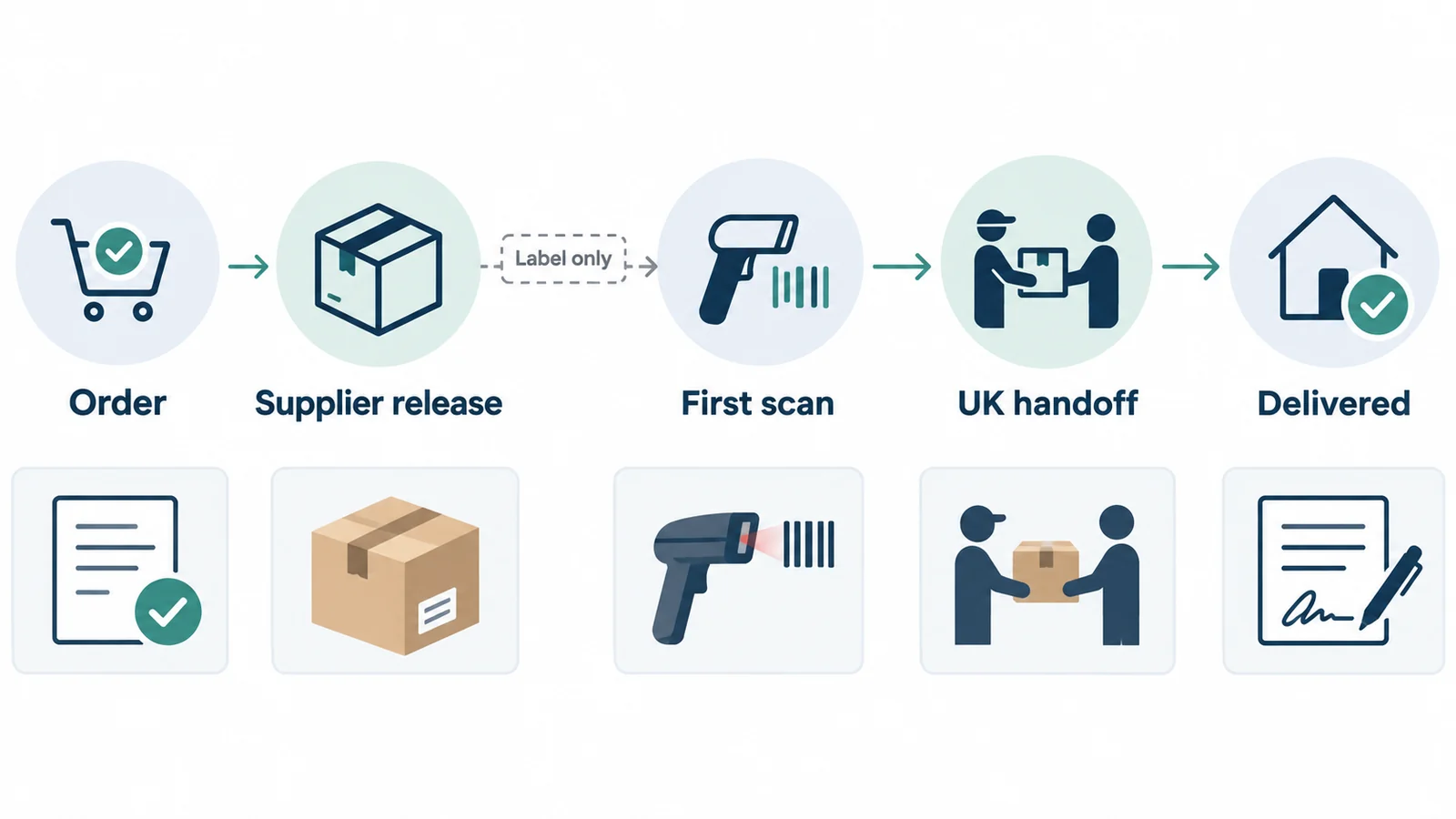
A test parcel supports a UK delivery promise when it uses the exact SKU, service and address you intend to sell. The paid order shows each stage and the buyer’s experience. Keep its record for comparison when a route changes.
Which events count as evidence of movement?
Track the stages separately:
- Order accepted and supplier release: the seller has taken responsibility for the item.
- First physical carrier scan: a carrier has received the parcel, beyond a created label.
- Border event and UK carrier handoff, where applicable: the route has advanced into local delivery.
- Delivered scan and parcel condition: the buyer promise can be checked against the actual result.
If a label exists without a first scan, ask about handover before telling the buyer the parcel is moving. Then set escalation from the tested route.
What will the customer see after dispatch?
Open the carrier’s buyer-facing tracking page. Check its messages, the label and any insert in the sample parcel before promising plain packing; the marketplace name can still appear in notifications. Also record who answers the buyer if tracking stops.
Key Takeaway: Set the delivery range from parcel events and buyer notices observed on the tested route.
What must the UK buyer know before paying?
Before paying, the UK buyer needs the total price, delivery terms, seller identity, cancellation information and a remedy route. Your store remains the retail contact when an AliExpress seller ships the parcel. So match the terms to the tested route.
Which information belongs on the product page and checkout?
The UK distance-selling rules require pre-order information on price including tax, delivery and cancellation. State the tested delivery range and any buyer-paid charge. Do not advertise “free UK shipping” while leaving a possible import bill unexplained.
Then check the page and checkout together:
- Product specification, included parts and the seller’s contact details agree.
- Delivery area, cost and estimated arrival use the tested service.
- Cancellation and return instructions name a real contact and address or process.
Who will resolve a cancellation or faulty arrival?
The store should handle the buyer before pursuing its supplier dispute. GOV.UK’s refund guidance describes the usual 14-day cancellation period after receipt and separate rights for faulty goods, subject to exceptions. Also decide who receives a return, pays for inspection and offers a replacement.
Key Takeaway: Publish only a customer policy your team can carry out without waiting to discover the supplier’s terms after a complaint.
Does the order still work after repeatable costs?
The order works when its repeatable delivered cost leaves room for support and remedies. However, a first-order promotion is a poor buying-price baseline. Compare the same variant and UK destination across repeat purchases.
Which costs belong in one decision sheet?
Keep each cost with its source and owner; leave unknowns visible:
| Cost or condition | Evidence to keep | Who resolves an unknown? |
|---|---|---|
| Repeat item price and variant | Signed-in supplier checkout for the planned quantity | Seller and supplier |
| Parcel service and packing | Selected UK postcode, service and packed details | Supplier |
| VAT, duty and collection | HMRC treatment, tariff check and import terms | Seller with qualified tax support |
| Payment and currency | Actual processor and conversion terms | Seller |
| Fault, return or replacement | Store remedy policy and receiving route | Seller |
Resolve any unknown tax, shipping or return cost before increasing sales volume.
What changes if the route or product fails?
Recalculate after a price increase, failed delivery, wrong variant or return. Count the work of answering the buyer and replacing an item, even if the supplier refunds its sale. Pause a SKU when the same defect or route problem recurs.
Key Takeaway: Select products using the cost of a delivered and supportable order.
When should you keep AliExpress or change the fulfilment model?
Keep AliExpress while a small UK test shows acceptable product, parcel and service results for that SKU. Repeated substitutions, dispatch delays or unresolved cases justify testing another arrangement. Compare the same product and buyer destination.
What evidence justifies a change?
Use the records you already collected to compare both options:
- Delivered-order cost and the costs of failed or returned orders.
- Stock accuracy, repeatable product specification and packaging control.
- First-scan timing, UK delivery evidence and who investigates exceptions.
- The customer remedy your store can actually provide.
Then change one SKU and test whether the new proposal fixes the recorded failure.

What should you ask a private agent to demonstrate?
Ask for the sourcing path, sample checks, packaging instructions, route visibility and issue owner. RuntoDropship is a Private Dropshipping Agent; its private sourcing service is one option when marketplace ordering fails those checks. Then verify the proposed process before moving live orders.
Key Takeaway: Move from marketplace ordering only when a recorded UK order problem shows which extra control you need.
Conclusion
AliExpress can help test a UK-bound SKU. Check its suitability, actual dispatch, VAT and charges, parcel movement, buyer terms and repeatable cost. Pause the listing when one of those checks fails.
RuntoDropship can review sourcing and order execution as a Private Dropshipping Agent. If a UK order has a stock, parcel or service problem, contact us today with the SKU and destination. We want buyer promises grounded in the orders meant to fulfil them.
Frequently Asked Questions
Can UK businesses sell on AliExpress itself, rather than source from it?
Those are different activities. Buying from a marketplace to fulfil your own store orders does not enrol your business as a marketplace seller. Check AliExpress’s current seller eligibility and terms for your entity if your plan is to list products there.
Can I use a retail AliExpress order to fulfil an eBay UK listing?
Do not assume so. eBay UK’s dropshipping policy permits fulfilment from a wholesale supplier but prohibits listing on eBay and then buying from another retailer or marketplace to ship to that customer. Check the channel policy before adding a SKU.
Can a welcome deal cover multiple units in one supplier order?
Only the live checkout can show which units receive a promotion. Test the intended quantity while signed in, save the order total, and budget future customer orders at a normal repeatable price. A one-off discount should not support a standing retail price.
Can two AliExpress sellers’ items be promised as one UK delivery?
No single-parcel promise is safe before the actual orders are consolidated and show consistent tracking. Treat items from separate sellers as separate deliveries in your customer terms, then update the buyer when the order records prove otherwise. Keep a contents record if a combined parcel arrives short.
What if a UK buyer refuses a courier’s import-charge request?
Ask the buyer for the bill and pause any claim that the parcel was delivered. Check the store’s disclosed charge terms, order value and import arrangement, then contact the carrier and resolve the customer order under applicable rights; do not assume the supplier will refund you. GOV.UK notes that unpaid parcels may be held and returned to the sender.