

Your warehouse ships orders, but your team still spends mornings chasing a forwarder, a carrier and another fulfillment site. A delivery problem becomes three conversations, and nobody can approve the next move. The 3PL vs 4PL question becomes urgent when those gaps delay decisions or leave your staff doing work you thought you had outsourced.
A third-party logistics provider supplies or manages agreed logistics services. A fourth-party logistics arrangement may coordinate several providers or broader supply-chain activities. Choose between them by identifying the work someone must accept, the decisions you will retain and the evidence that the arrangement works for your business.
What is the practical difference between 3PL and 4PL?
A 3PL provides or manages agreed logistics services, while a 4PL may coordinate several providers or wider supply-chain work. These are the working definitions used in the 2025 Third-Party Logistics Study; they describe scope rather than a universal contract standard.
Read the contracted service scope
The wider 3PL operating model includes arrangements for services such as warehousing, fulfillment and transportation. A capable provider may also plan operations, manage subcontractors and connect systems. One organization can offer both execution and broader management arrangements, so ask which role its proposal covers.
Map the proposed relationship before comparing labels:
- The executor performs or manages the specified logistics service.
- The coordination owner manages the agreed handoffs between providers.
- Your business retains the decisions that the agreement reserves for you.
What does a real coordination example show?
The US General Services Administration’s Customer Supply Center program documents a 4PL arrangement for federal customers. GSA integrates specialist suppliers, with one center managing acquisition, storage, merchandising, delivery and billing. It illustrates a documented coordination scope; it supplies no ecommerce savings, price or delivery promise, and it is not a RuntoDropship case.
For an academic explanation of provider roles, logistics professor Sebastian Kummer’s lecture offers further context. Key Takeaway: Request the actual service and management scope before judging a proposal by its logistics label.
Which decisions should stay with your business?
Keep approval over provider choices, spending, stock allocation and customer commitments unless you deliberately delegate those decisions within agreed limits. A 4PL proposal should explain both the authority it needs and the work your team will continue to own.

Set approval limits before handing work over
Start with decisions that can change your cost or service exposure:
- Adding or replacing a warehouse or carrier.
- Buying expedited transport or other exceptional work.
- Moving stock between providers or changing channel allocation.
- Accepting a substitution that changes the agreed service.
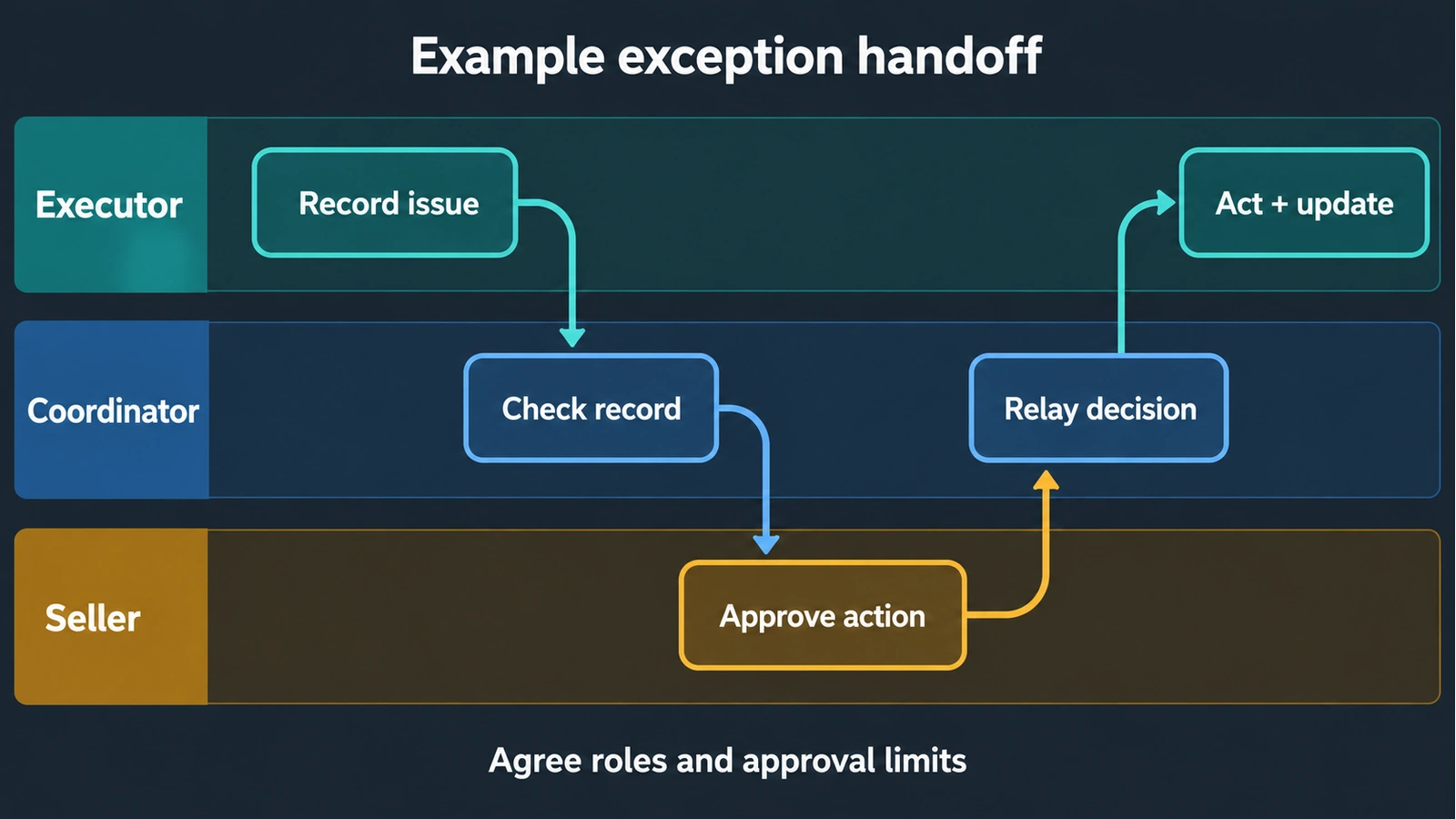
For each decision, name the person who recommends it, who approves it and who executes it. Specify the trigger, agreed spending limit and approval record; avoid an undefined instruction to “do whatever is necessary.”
Name the work your team will still do
Your business still needs to supply demand inputs, review budgets and decide which customer promises it can support. Retain a named internal decision maker and access to the records needed to make those decisions. Ask whether provider selection involves affiliated businesses.
Then test a simple exception: an inbound shortage reaches a named coordinator, who obtains the warehouse recount and requests your approval for the next action. Identify the action owner, backup and accessible decision record before accepting a single-contact promise. Key Takeaway: Delegate defined authority while keeping a practical route to approve, question and reconstruct decisions.
When does coordination justify a 4PL?
A 4PL is worth evaluating when recurring work between providers exceeds what your existing 3PL arrangement or internal team can manage effectively. Order volume alone cannot tell you whether an extra management layer will remove that work.
Find the gap your current arrangement leaves
A warehouse that repeatedly picks the wrong items presents an execution problem. Several capable providers waiting for one another’s decisions present a coordination problem. Before seeking another proposal, collect examples of the work your team performs between them:
- Which handoff requires someone to chase another party?
- What decision waits, and who has authority to make it?
- Which missing record prevents the next party from acting?
A software connection may move information without anyone accepting responsibility for the follow-up. Check who owns the work after the message arrives.
Compare three ways to close the same gap
Compare a broader 3PL service, internal coordination and external management against the same workload, retained approvals and total scope. A working 3PL can remain the executor if the proposed coordinator accepts that arrangement. Once you know the model you need, use relevant third-party logistics company comparisons to assess specific providers.
| Arrangement to evaluate | Work it must accept | Seller work remaining | Evidence to request |
|---|---|---|---|
| Broader 3PL service | Named additional services and handoffs | Coordination outside that scope | Service schedule and exception route |
| Internal coordinator | Seller-directed management across providers | Staffing, decisions and system oversight | Workload, authority and backup plan |
| Contracted 4PL management | Specified cross-provider coordination | Reserved approvals and business inputs | Responsibility map and tested handoff |
Choose the proposal that addresses your documented gaps within an acceptable total cost; none of these labels establishes a universal size threshold or automatic saving. Key Takeaway: Compare the management work accepted and the seller work remaining before replacing sound execution.
What data must you be able to access?
You need usable source records, clear update timing and agreed access and export arrangements under either logistics model. A shared dashboard can help, but it needs a traceable path back to the provider that recorded the event.
Verify the records behind a shared view
Ask the provider to trace an inbound discrepancy from the warehouse record through the coordinator’s view to your team. Check whether each stage preserves the information needed to investigate:
- The order, shipment or receipt identifier used by each party.
- The stock balance and the time it represents.
- The original event, adjustment reason and source provider.
- The owner of a failed update and the reconciliation procedure.
Check the delay between the source event and the shared view. If a screen shows a corrected quantity but cannot explain the adjustment, your team still lacks the evidence needed to act.
Agree access and export while you can test them
Request a sample export and confirm that your team can open, identify and reconcile its records. Agree the format, frequency, recipients and access during an outage or provider change. Data portability depends on the accepted arrangement, not the 4PL label.
For connected systems, NIST’s digital supply-chain guidance recommends defining supplier information-sharing rules and responsibilities. This voluntary cybersecurity guidance supports those digital checks; it does not certify a logistics operation or establish your contractual rights. Key Takeaway: Prove that you can obtain and use the underlying records before depending on a consolidated view.
How should you compare costs and incentives?
Price the same service workload and retained work, then examine how each proposed arrangement earns money and selects providers. A 3PL rate card and a 4PL management proposal are only comparable after you identify what each includes.
Build one comparable scope before comparing totals
Give each bidder the same product profile, shipment mix, stock pattern and exception examples. Ask for a worked invoice covering:
- Operating service charges and any coordination charge.
- Setup, integration and continuing support.
- Minimum commitments, exclusions and exceptional work.
- The staff work your business still performs.
- Exit, data export and physical transfer work.
Mark unquoted costs as unknown. Ask how changing the workload affects the bill, including which assumptions trigger a different charge.
Check provider-selection incentives
A coordination proposal may combine charges or separate them; the label supplies no universal fee formula. For example, the GSA’s 4PL procurement category specifies bundled product, service and freight rates for its federal program. That is a program-specific arrangement, not a private seller’s pricing rule.
Ask about affiliated execution companies, commissions, markups, selection criteria and access to alternatives. Establish who approves a provider change when the coordinator has a commercial interest in the choice. Key Takeaway: Require a total cost you can reconcile and a provider-selection process you can inspect.
Who acts when logistics go wrong?
The agreement should identify who can investigate and secure action from each executor, plus your approval route for the proposed remedy. A coordination contact needs the authority and working relationships to move an incident forward.
Look behind the single contact
Use an inbound shortage to test the route before signing. Ask the proposed team to identify:
- The warehouse person who can arrange a recount.
- The coordinator who follows the issue across providers.
- The backup and support hours for that route.
- The trigger for escalation and the agreed update window.
Trace the report to the person who can correct the physical count or record. Confirm who tells your team when the investigation is waiting for evidence or a decision.
Rehearse the evidence and decision handoff
Ask for the receipt, count and adjustment records the investigation would use. Have each party explain who investigates, who proposes the next operational action and who approves or disputes it. Repeat the handoff with the normal contact absent.
An action owner does not establish a legal finding about liability or reimbursement. Those questions require the applicable agreement and appropriate review. Key Takeaway: Evaluate a demonstrated route from report to operational action before relying on a promise of accountability.
What should you test before changing the arrangement?
Test a defined handoff against agreed acceptance criteria, with a stock-and-data transfer plan your team can carry out, before relying on the new logistics arrangement. Use the pilot to observe whether the proposed coordinator accepts the work your business needs to stop doing.

Accept a pilot against the work you are delegating
Agree the pilot’s scope and evidence before it starts:
- The selected flow, source records and opening stock balance.
- Expected approvals and the person responsible for exceptions.
- Evidence required to accept the handoff.
- Signoff, unresolved work and the fallback if it fails.
Compare the work the pilot removed with the tasks your team still performs. Record why any task returned to your staff, whether because the scope excluded it, an approval was missing or the provider failed to act.
Plan transfer and recovery before committing
Agree notice, outstanding balances, release work, stock counts, exportable records and the receiving party’s acceptance. Check the proposed exit charges and who coordinates the transfer. Negotiate these conditions rather than assume an unconditional right to immediate stock release.
Where the gap starts with China-side suppliers, dropshipping fulfillment support can be a relevant part of the handoff discussion. RuntoDropship’s Private Dropshipping Agent role covers the agreed sourcing-to-fulfillment work; it should not be assumed to include management of an entire international provider network. Key Takeaway: Keep a usable route into and out of the arrangement, with stock, records and outstanding work assigned to named recipients.
How can you choose between 3PL and 4PL support?
Choose the arrangement that accepts your execution or coordination gap while preserving the approvals, evidence and handoffs your business needs. Keep capable execution where it works, and evaluate additional management against the work it accepts and the cost your business retains.
RuntoDropship is a Private Dropshipping Agent for sellers discussing China-side sourcing, supplier coordination, QC and fulfillment requirements. Share your product profile, target market, current providers and recurring handoff problem with RuntoDropship so the relevant scope and open conditions can be discussed. We believe the operating responsibilities should be clear before anyone promises an outcome.
FAQ
Does a cancellation request mean the warehouse has stopped an order?
No. Obtain the warehouse’s acknowledgement against the current picking, packing or carrier-handoff stage before promising a successful cancellation. A request sent through a store or coordinator alone does not confirm that physical work stopped; agree the applicable cutoff and response process.
Can either model support branded packaging?
Possibly, if the actual executor accepts the work. Confirm the packaging specification, version, consumables and a sample pack with the warehouse. Where several sites participate, require the coordinator to pass the same approved instructions to each; neither model label proves that capability.
Where should customer returns go when several providers are involved?
Use the receiving address and authorization agreed for that return. Confirm who inspects the goods and may restock, quarantine or dispose of them. Keep that physical disposition separate from your customer refund decision, and verify that the chosen operator accepts returns processing.
Can I visit the warehouse when a coordinator manages it?
Only under the access arrangement accepted by the actual facility. Confirm the site, authorized visitor, notice, escort, inspection scope and permitted record. A portal login or coordinator agreement alone does not establish entry permission, including unannounced visits.
Does a 4PL arrangement include insurance for all my stock?
Do not assume that from the label or management charge. Ask a qualified insurance professional to check the actual insured parties, stock values, locations, custody and transit stages, limits and exclusions. Policy coverage and contractual liability require separate review; an operational escalation promise establishes neither.