

Your supplier says delivery to the 3PL warehouse is complete, but your store still cannot release orders. The cartons reached a warehouse; nobody has confirmed which units passed receiving or when they will become available. Meanwhile, customers are buying stock you may not be able to ship.
A third-party logistics warehouse stores and handles inventory for other businesses under an agreed service scope, usually covering receiving, stock control, fulfillment and dispatch. You still own the goods and remain responsible for your selling obligations. Before moving stock, establish what each warehouse event means, which records you receive and who resolves a mismatch.
What does a 3PL warehouse handle for your business?
A 3PL warehouse performs the storage and handling work you contract out, while your business retains responsibility for its products and customer promises. The broader 3PL operating model explains where warehousing sits within outsourced logistics; here, the decision concerns the physical stock and its records.
Separate the service from the space
Renting space gives you somewhere to put goods. A warehouse operator supplies staff, equipment and agreed handling procedures. The building owner, contracting company and day-to-day operator may be different organizations, so confirm who actually receives and controls your inventory.
You decide what may be sold, how products must be packed and which exceptions need approval. The operator needs usable instructions before staff can apply those decisions consistently.
Write down the warehouse handoffs
Give each activity an owner and a record:
- Receiving: the expected shipment, count method and discrepancy report.
- Storage: the SKU location, condition and stock status.
- Fulfillment: the authorized order and packing instruction.
- Dispatch and returns: the handoff event and permitted disposition.
- Escalation: primary and backup contacts, support hours and the route for issues reported while the warehouse is closed.
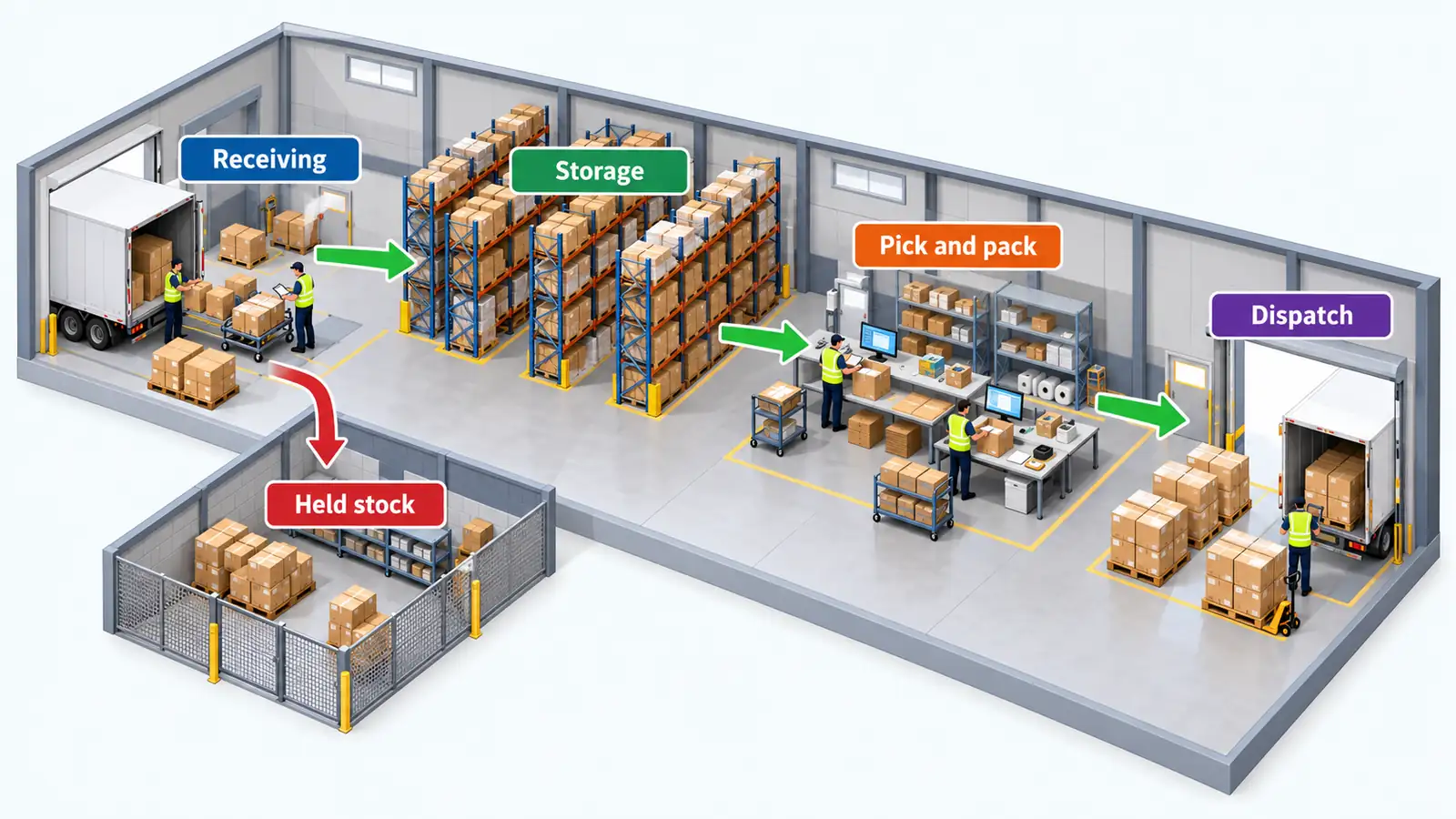
Ask which tasks cost extra, including relabeling, disposal, product pulls and unusual packing. A schedule of storage fees does not assign those extra tasks. Key Takeaway: Put the operator and exception owner beside each required task before requesting a warehouse quote.
When is received inventory ready to sell?
Received inventory is ready to sell only after the agreed checks and system updates make the correct units available for orders. A truck delivery, signed receipt and sellable stock balance describe different events.
Match expected stock to the actual receipt
Send an expected shipment record before arrival. Identify SKUs and variants, carton quantities, units per carton and any batch information your product requires. Agree whether receiving checks cartons, individual units or a defined sample; those methods do not provide the same evidence.
A delivery receipt is only the starting record. GS1’s receiving guidance distinguishes matching logistics-unit identifiers from checking contents and damage, with checks depending on the agreement. A successful barcode scan cannot establish that every unit was inspected.
- Match the receipt to the expected shipment reference.
- Record shortages, unexpected variants and visible damage.
- Identify who approves a discrepancy or supplier query.
- Keep unaccepted units out of the available balance.
Keep available stock separate from physical stock
Your store and warehouse should agree how each inventory status maps between systems. For example, Shopify defines on-hand inventory as available, committed and unavailable stock together; incoming stock is separate. Other systems may use different labels.
Verify the quantities and timestamps returned to your store, rather than assuming a connection keeps every state aligned. The same discipline helps prevent Shopify fulfillment errors caused by stock and order handling. Ask for one receipt-to-availability example using your own SKU mapping. Key Takeaway: Agree the evidence that releases received stock for sale, including who resolves quantities that remain on hold.
Which storage conditions do your products need?
Your products need storage and handling conditions suited to their materials, packaging, shelf life and applicable rules. A convenient address or attractive warehouse photograph does not establish that fit.
Turn the product profile into storage instructions
Describe what staff will handle, including the packaged unit and the inbound carton. A small item can still create difficult work if variants look alike, packaging crushes easily or individual batches must remain traceable. Use the product profile to rule out unsuitable storage:
- Packaged dimensions, weight and stacking restrictions.
- Batch, serial-number or expiry identification where required.
- Fragility, leakage risks and incompatible neighboring goods.
- Applicable temperature, sanitation or restricted-product conditions.
Have the operator confirm acceptance against that profile. Do not infer permission for batteries, food, cosmetics or other controlled goods from a generic service list.
Ask for evidence of the controls you need
Ask what staff check, where exceptions are held and how they identify affected stock. Check that any certificate or specialist approval applies to the facility, product and activity you need.
A February 2024 DOJ release reproduced by FDA describes a 2022 recall following unsanitary conditions at a retailer-operated Arkansas distribution center. This was a retailer’s warehouse, rather than a 3PL client example. Key Takeaway: Obtain product-specific acceptance and control requirements before choosing where to place inventory.
How should warehouse orders reach the carrier?
Warehouse orders should move through authorization, allocation, picking and packing before a documented carrier handoff. Held or failed orders need a visible reason and an owner who can act.
Test the order states that cause manual work
Test a routine order and one with an exception. Agree what staff and systems should do when a customer changes an address or inventory becomes unavailable after an order arrives.
- A short-stock order must wait or follow an approved split rule.
- A cancellation must reach staff before the agreed stop point.
- Bundles need the correct component and packaging instructions.
- A rejected label or missed pickup needs an exception record.
Check what returns to the selling channel after each event. Record any manual step and who performs it; an app connection does not prove every exception is automated.
Match dispatch claims to the actual event
Ask what event starts the warehouse’s handling clock and what event ends it. Order receipt, packing completion, label creation and carrier acceptance must remain distinguishable, with the relevant time zone and operating days.

UPS explains that “Label Created” means shipment details have been received. It is not evidence of physical carrier acceptance. Conversely, a delayed scan alone does not prove a parcel was never collected; compare tracking with the actual handoff record. Key Takeaway: Judge dispatch against agreed events and exception records, rather than treating a tracking number as a completed handoff.
How can you compare 3PL warehouse charges fairly?
Compare warehouse charges using the same stock and order workload, then connect each billed activity to its agreed rate, unit, quantity and date. A low headline pick fee cannot represent the whole invoice.
Build a quote from your stock and order profile
Give each candidate comparable assumptions. Include an ordinary period and the work created by a launch or busy period, with actual packaged dimensions and order characteristics where available. Ask when one inbound delivery becomes multiple chargeable receipts.
- Active SKUs, inbound cartons and units requiring receipt checks.
- Occupied or allocated storage space, and the daily snapshot, period-end or peak basis used for billing.
- Orders, units per order and packaging requirements.
- Returns, extra handling and projects needing approval.
Ask which charges count toward a minimum and which sit outside it. Separate warehouse work from transportation and identify how rate changes are communicated. Do not convert a sample quotation into a universal market price.
Check whether the invoice follows the agreed work
Compare the bill against the work that generated it. A receiving charge should identify its receipt; an order charge should identify the relevant order or activity. Storage charges need a measurement period and the agreed quantity basis.
For unexpected labor, request the task, authorization, time or units billed and applicable rate. Check whether the charge covers standard work or an approved exception. Key Takeaway: Request a traceable sample invoice using your workload before comparing the quoted monthly totals.
What evidence helps resolve stock loss or damage?
A dated custody trail helps investigate missing or damaged stock by showing the last agreed quantity and condition. A portal total alone cannot locate when a discrepancy arose or establish who caused it.
Build the incident record before debating the cause
Work backward from the last agreed count. Identify the affected SKU, quantity and location, then collect the handling records relevant to that interval. Keep observations separate from assumptions about a supplier, warehouse or carrier.
- Receipt counts and any original damage or shortage report.
- Location moves, adjustments and the reason for each change.
- Relevant photographs, order IDs and parcel references.
- Discovery time, notification time and the escalation owner.
Follow the agreed notice process promptly and preserve the underlying files. A useful incident packet supports investigation; it does not guarantee compensation or settle a disputed cause.
Match each handoff to the proof it needs
Use this record set to identify the unresolved question:
| Handoff | Evidence packet | Question still requiring agreement |
|---|---|---|
| Supplier to receiving | Expected shipment, receipt count, condition exceptions | What quantity and condition were accepted? |
| Receiving to available stock | Putaway and status-change records | Which units were released for orders? |
| Packing to carrier | Parcel identity, packing record, handoff evidence | Who had custody at the disputed event? |
| Warehouse to next operator | Closing count, transfer list, recipient receipt | Did both sides accept the transferred balance? |
Locate the earliest disagreement before asking another party to investigate. Name the stock balance, event and contact you need investigated. Key Takeaway: Keep the accepted balance and its custody evidence available before a loss or damage investigation begins.
What must you agree before stock moves in or out?
Agree the opening stock balance, initial live-order checks and eventual inventory release procedure before transferring goods.
Accept the opening balance and pilot orders
Have both sides confirm the transfer list and receiving exceptions. Test representative products and packaging rules before relying on the warehouse for ordinary orders.
- Match old and new SKU identifiers and quantities.
- Record accepted, held and disputed units separately.
- Confirm the packaging version and order-release authority.
- Name who signs off the opening balance and unresolved items.
For China-sourced products, upstream supplier coordination and QC create a separate handoff. RuntoDropship’s dropshipping fulfillment service addresses China-side supply-chain coordination; confirm its scope against the supplier, product and destination. Agree that China-side scope separately from the receiving warehouse’s responsibilities.
Document the stock release and data handover
Plan the release of inventory before you send it. Agree notice, remaining charges, removal work, collection arrangements and the records the next operator needs. Have the actual agreement reviewed where rights, balances or release conditions are uncertain.

At transfer, reconcile a dated closing count with the dispatch list and recipient’s receipt. Identify who investigates a short delivery and retain the relevant stock and order exports. A verbal promise that you can leave does not describe how the goods will move. Key Takeaway: Keep the physical stock transfer and its data handover in the agreement, with an owner for unresolved differences.
How can you decide whether a 3PL warehouse fits your business?
A 3PL warehouse fits when its actual product handling, stock controls, order process and total charges match your requirements. The decision needs an agreed operating scope and usable evidence for receiving, availability, dispatch and stock release. We expect supply-chain commitments to name who is responsible and which records sellers receive.
Request a written response using your SKU list, packaged dimensions, order profile and destination markets. RuntoDropship is a Private Dropshipping Agent that can discuss China-side sourcing, QC, inventory and fulfillment coordination under confirmed conditions. For China-side support, contact us with your product and order requirements to confirm the scope.
FAQ
Can I use my own carrier account with a 3PL warehouse?
It depends on the operator’s supported account and label workflow. Confirm permissions, who creates labels, who pays the carrier and any handling charge. Your account’s rates do not automatically apply inside another company’s system.
Does warehouse insurance cover the full value of my inventory?
Do not assume full-value cover. Warehouse liability, its insurance and your own property or transit cover can differ. Ask a qualified broker to check the actual locations, limits, deductibles and exclusions against your goods and agreement.
Can I visit the warehouse to check my stock?
Visits depend on agreed access and facility rules. Confirm scheduling, authorized visitors, permitted sampling and what evidence can be recorded. A tour and a documented stock audit serve different purposes; do not assume unrestricted entry.
Can storing stock in another state create sales-tax obligations?
It can, depending on the state and sales channels. California generally treats inventory at a third-party fulfillment center as an in-state business presence, while marketplace-facilitator rules include exceptions. Have a qualified tax adviser review your warehouse states and channels before placing stock.
Can order accuracy be high while stock counts are wrong?
Yes. Correctly fulfilled orders and inventory-count discrepancies measure different populations and events. Ask for each metric’s denominator and measurement window. A high percentage of correct orders does not establish an equally accurate inventory count.