

You pay for automation, yet your day still disappears into stock checks, duplicate listings, and orders waiting for someone to act. Looking at AutoDS alternatives feels like the next step. But a rushed switch can leave working product connections behind while the same supplier problems follow you into a new dashboard.
Choose an AutoDS replacement by the functions you use, the sales channel you operate, and who will execute each order. Confirm the required connections and test an order through delivery. A shorter feature list can be enough when it covers the work you actually use.
Which AutoDS alternatives cover the work you need to hand off?
Importify, DSers, Spocket, Zendrop, CJdropshipping, and Hustle Got Real cover different combinations of importing, supplier access, monitoring, and fulfillment. Use their published capabilities to build a shortlist, then check the plan and supplier conditions behind each function.
What can each candidate take over?
Start with the job you want to delegate. Importify emphasizes importing and preparing listings; DSers focuses on supplier mapping and AliExpress ordering. Spocket offers a supplier marketplace, while Zendrop combines catalog discovery with a fulfillment workflow. CJdropshipping offers sourcing and fulfillment services, and Hustle Got Real describes multi-channel listing, monitoring, and order workflows.
| Candidate to check | Work it can absorb | Work your team must still own |
|---|---|---|
| Importify | Product imports and listing preparation | Confirm ordering scope for each source |
| DSers | Supplier mapping and AliExpress order processing | Choose suppliers and verify the required plan features |
| Spocket | Supplier discovery and connected product workflows | Check product origin, terms, and return arrangements |
| Zendrop | Catalog-led sourcing and fulfillment | Confirm product availability and the store connection |
| CJdropshipping | Sourcing requests and order fulfillment | Agree on route, services, and complete costs |
| Hustle Got Real | Multi-channel listings, monitoring, and order workflows | Check support for the exact supplier and channel |
| Private agent | Supplier coordination and physical order execution | Agree on stock ownership and exception responsibilities |
The remaining work in the last column belongs in your comparison alongside the subscription.
Which responsibilities stay with the seller?
Before choosing a candidate, decide who will approve purchases, resolve unavailable stock, and answer customer complaints. A supplier directory, ordering app, and warehouse service create different obligations.
- Confirm the product and its variations, including size and color.
- Identify who pays the supplier and handles failed purchases.
- Keep responsibility for the promises made in your storefront.
Key Takeaway: Shortlist candidates by the work they can take over and the responsibilities your team can manage.
How do you decide which AutoDS functions to keep?
Keep the imports, monitoring, approvals, or tracking updates that work reliably, and replace the specific process causing the problem. A complete switch is unnecessary when a narrower change addresses the bottleneck.
What should your replacement preserve?
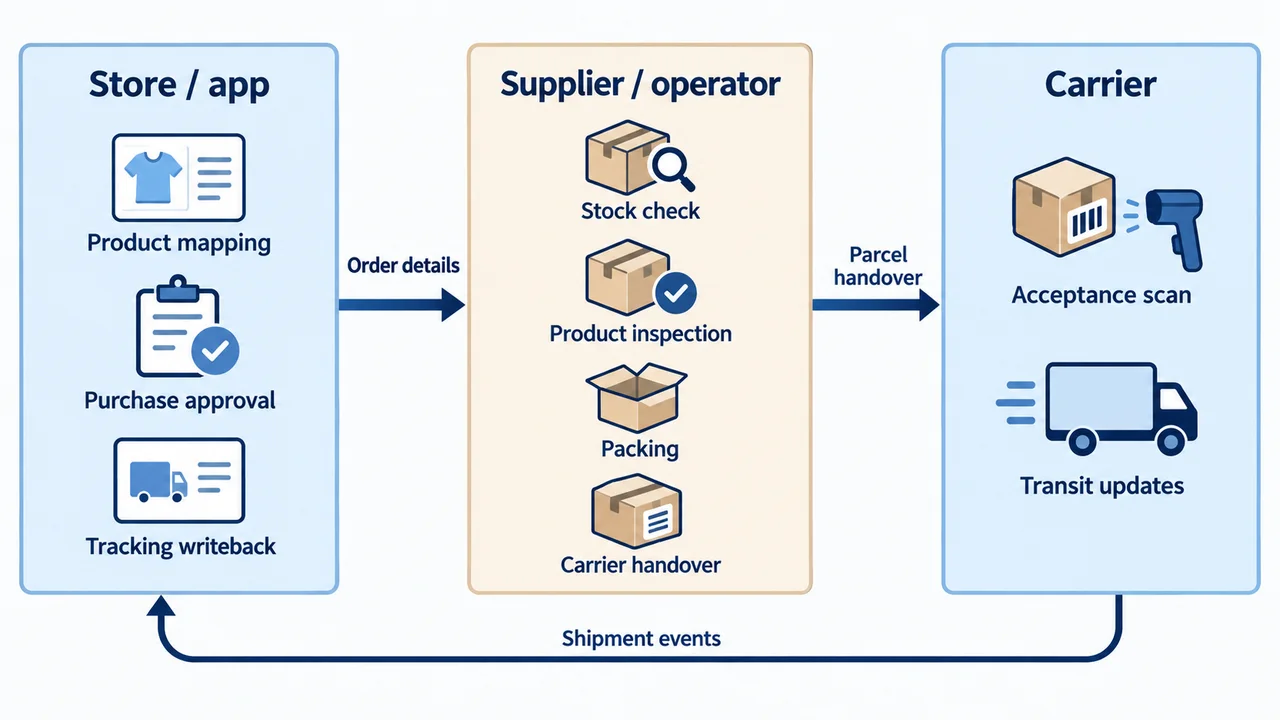
Write down the current route from a store order to a supplier purchase. Mapping means connecting a store product or variation to the correct supplier item; that connection needs to survive the change.
- Product imports and existing variation connections.
- Stock checks and rules for changing retail prices.
- Purchase approval, order placement, and tracking updates.
What would you lose by removing the old tool?
Check the loss before paying for the replacement. An importer may create good listings while leaving ongoing stock checks to you. A sourcing service may ship products without reproducing the monitoring rules you use across other suppliers.
If your choice has narrowed to those two apps, our DSers vs AutoDS workflow comparison explains their different operating scope. Keep the replacement decision tied to the functions your own store uses.
Key Takeaway: Record every working function and assign its new owner before disconnecting the old route.
Will the replacement work with your store and suppliers?
The replacement fits only when it supports your actual store, supplier source, and required order actions. A platform name on a landing page does not establish that every function works for every connected supplier.
Which connections need a live check?
Ask what the connection transfers. A direct store integration can carry order information automatically; a CSV workflow requires someone to move a spreadsheet. A product importer might transfer listings while order processing remains separate.
- Check order receipt and product-variation mapping.
- Confirm stock updates and purchase approvals.
- Verify how tracking returns to the customer order.
For Shopify-specific discovery, our guide to dropshipping apps for Shopify covers the broader app selection.
Which sourcing arrangements need separate approval?
Check the selling channel's rules before testing a new supplier route. For example, review eBay's dropshipping and product-sourcing policy against the arrangement you intend to use. Installing a listing tool does not establish an approved supply relationship.
Key Takeaway: Verify the connection and the supplier arrangement separately; a working import is only one part of the decision.
How far can a free plan take your order workflow?
A free plan can cover useful software actions, but it does not remove product, shipping, or service costs. It also needs to include the particular monitoring and ordering functions your store requires.
What is free and what still costs money?
Read what free access permits. DSers publishes a continuing Basic plan, while AutoDS advertises a time-limited trial. Other offers may provide free catalog browsing or account access while charging for importing, automation, or physical services.
- Check whether free access expires or renews into a paid plan.
- Separate importing from ongoing stock and price updates.
- Confirm who pays for goods, shipping, and handling.
When should you pay for a feature?
Pay when a required function or an active limit justifies it. A higher product allowance offers little value if the unresolved issue is supplier response time. Conversely, reliable monitoring may be worth paying for when manual checks consume your working day.
When comparing free AutoDS alternatives, run the same required actions on each plan. Note which ones need an upgrade or a manual step.
Key Takeaway: Choose a free tier only after confirming that its actual permissions cover your order workflow.
What will each setup cost for the same delivered order?
Compare the same product variation, package, destination, and shipping route, including software charges and staff work. Different products or fulfillment origins can make a cheaper subscription look like a cheaper operation.
Which costs belong in the comparison?
Request a complete quote rather than a product price alone. Keep the upfront billing commitment separate from the monthly amount used for comparison.
- Product, packaging, handling, and shipping charges.
- Subscription allocation and charges for processing actions.
- Payment fees and applicable import costs.
- Staff time, replacements, and other order exceptions.

How do you include manual work and mistakes?
Count the work the trial leaves behind. Record how often someone checks a purchase, repairs a product connection, or follows up on a stalled order. Keep these observations separate from the supplier's promises.
Use a consistent order period when allocating fixed fees. Dividing a monthly subscription by the orders actually processed gives a different result from dividing it by a hoped-for future volume. Include overlap costs while both systems remain necessary.
Key Takeaway: Compare complete costs for an equivalent delivered order, including the labor and exceptions you observed.
How can you test stock, variants, and tracking before switching?
Test representative product variations and order paths before relying on the replacement. Include stock changes, purchase approval, address handling, carrier handover, and tracking returned to the store.
What should the test orders expose?
Use the products and destinations you intend to sell. Agree with the provider on a controlled way to check an unavailable item rather than risking an actual customer's order.
- Match the purchased variation to the storefront selection.
- Check what happens when supplier stock or price changes.
- Follow payment approval and an order needing manual attention.
- Confirm that the tracking link opens the correct shipment.
Shopify's shipping and fulfillment walkthrough explains packaging, shipping settings, labels, and tracking. Use it to identify the physical and administrative steps your proposed setup must handle.
What would make you reject the setup?
Set the rejection conditions before the trial. Untracked stock, incorrect variations, duplicate purchases, or an exception without an owner need resolution before more orders move. A printed label alone does not demonstrate that the carrier has received the parcel.
Key Takeaway: Move volume only after the required order paths work and you know how a failed step will be handled.
When is a private agent a practical part of the replacement?
A private agent is relevant when supplier coordination, product checks, packaging, inventory, or shipping execution are the unresolved tasks. These require someone to manage goods and suppliers as well as order information.
Which physical tasks need an accountable operator?
RuntoDropship is a Private Dropshipping Agent. We coordinate sourcing, supplier communication, quality checks, inventory, packing, shipping, and after-sales work. Match those responsibilities to the work your store needs handled.
- Agree on product specifications and inspection requirements.
- Identify who confirms stock and prepares each package.
- Assign the contact for shortages, defects, and shipment exceptions.
Our guide to supply-chain execution beyond automation explains that broader operating responsibility.
What should you confirm before handing over orders?
Confirm the order connection, quote scope, stock ownership, packaging, and procedure for exceptions before handing over live orders. RuntoDropship's product-sourcing and supplier-coordination service is relevant when China-side sourcing is part of that requirement.
You can keep a software-led setup when it already covers the work you need. An agent relationship should address a specific physical or supplier-management gap.
Key Takeaway: Agree on the physical tasks and exception owner before transferring purchasing or fulfillment responsibility.
How do you move orders without duplicate fulfillment?
Assign one fulfillment owner to each order, and move a limited set of checked product connections before expanding the replacement. Both systems may remain accessible during the transition, but their purchasing permissions need clear boundaries.
Which records and routes need a controlled handoff?
Prepare the handoff while the old information is available. Record existing listing and variation identifiers so that reconnecting a supplier does not unnecessarily create another storefront product.
- Separate existing open orders from newly assigned orders.
- Identify which system may place or approve each purchase.
- Check the supplier connection and tracking destination.
- Record unresolved orders and the person responsible for each.

What stays active until the handoff is verified?
Keep the information and access needed to finish open orders and resolve their exceptions. Confirm the actual access and data-retention terms before making an account change. AutoDS's current help guidance says it does not offer a product or order-data export feature, so manually preserve necessary records rather than assume an export will be available.
If the new route fails, use the agreed fallback without allowing both systems to buy the same order. Expand only after the limited handoff is reconciled.
Key Takeaway: Keep one purchasing owner per order, preserve necessary records, and retain a usable fallback during the transition.
Conclusion
Choosing a replacement means matching the store's required functions, supplier arrangement, complete order cost, and migration conditions. Keep the parts that work, test the proposed route, and give each unresolved task an owner.
RuntoDropship can help coordinate China-side sourcing and fulfillment when those physical responsibilities are part of your replacement plan. We favor clear product requirements and agreed order responsibilities before committing a workflow to live volume.
What should you share before requesting a quote?
Bring the details that determine the actual scope:
- Product links and variations.
- Sales channel and customer destinations.
- Current order route and the work you need replaced.
To assess that fit, discuss your sourcing and fulfillment requirements with RuntoDropship before moving orders.
Key Takeaway: Request a product-specific workflow and quote, then test the agreed handoff before expanding it.
FAQ
Can I stop renewal charges by closing my AutoDS account?
Yes, completing the relevant subscription cancellation stops future renewal under AutoDS's current guidance. Merely uninstalling the app or stopping your store is different. Check every active plan and add-on, cancel through the required billing route, and retain confirmation before assuming charges have ended.
Can I get a refund for an unwanted trial renewal?
Possibly, depending on the payment and applicable terms; cancellation alone does not guarantee a refund. Check the current refund policy promptly, identify the charge and billing cycle, and submit the required request with supporting records. Do not assume that eligibility means a full refund without deductions.
Can I use product research without an ordering app?
Yes, if you arrange ordering and fulfillment separately. A research tool can help form a shortlist, but it does not necessarily place supplier purchases or return tracking. Decide who will perform those actions before paying for research-only access.
How do I judge an affiliate tool recommendation?
Check the commercial disclosure, exact plan tested, demonstrated workflow, and stated limitations. An affiliate relationship alone does not prove a recommendation false. Give more weight to a reproducible demonstration of your required task than to endorsements or an unexplained ranking.
Can a new tool make an unproven product profitable?
It cannot establish demand by itself. Lower costs or easier order processing can help an existing operation, but you still need evidence that customers want the product at your offered price. Treat research estimates as leads to investigate, not proof of future sales.