The supplier calls a China-to-U.S. quote “duties included.” After the shipment arrives, the courier bills you for brokerage and government charges. To plan customs fees from China to US, list ordinary duty, additional tariffs, government taxes and fees, and carrier or broker charges separately. Then check the product, origin, value, and payer on the entry paperwork before you compare quotes.
What counts as customs fees from China to US?
Match each quote or invoice line to the step when the charge arises. Customs clearance is the larger entry step that these charges sit inside. Once you see that step clearly, the invoice is easier to unpack.
Ordinary customs duty is the official charge tied to the goods and to the current Harmonized Tariff Schedule. Under the U.S. transaction-value method, the price paid or payable excludes international freight and insurance. Keep the goods price and international shipping charges separate on your worksheet. Use the U.S. customs valuation statute or ask your broker which adjustments apply. Additional tariffs are not automatically the same thing. They can apply on top of ordinary duty, yet the current official sources still have to be checked for the shipment in hand. This page will not quote a current extra-duty or Section 301 rate as advice.
Official taxes or statutory fees are another layer. Official taxes and statutory fees can apply alongside duty. They are still not a carrier brokerage, disbursement, or handling charge. If a blog or a calculator mixes every line into one “customs fee,” treat that total as a rough commercial picture only. CBP explains duty, taxes, and other import fees in its public help materials, including Duty, Taxes, and other Fees. Use that official page as a planning destination.
Keep the layers visible when you compare quotes. Write official duty on one line. Possible additional tariffs belong on a second line. Official taxes or statutory fees belong on a third line. Broker or carrier charges should go on a fourth line. Then you can see which figure came from an official source and which figure came from a commercial invoice.
How should you keep official and commercial lines apart?
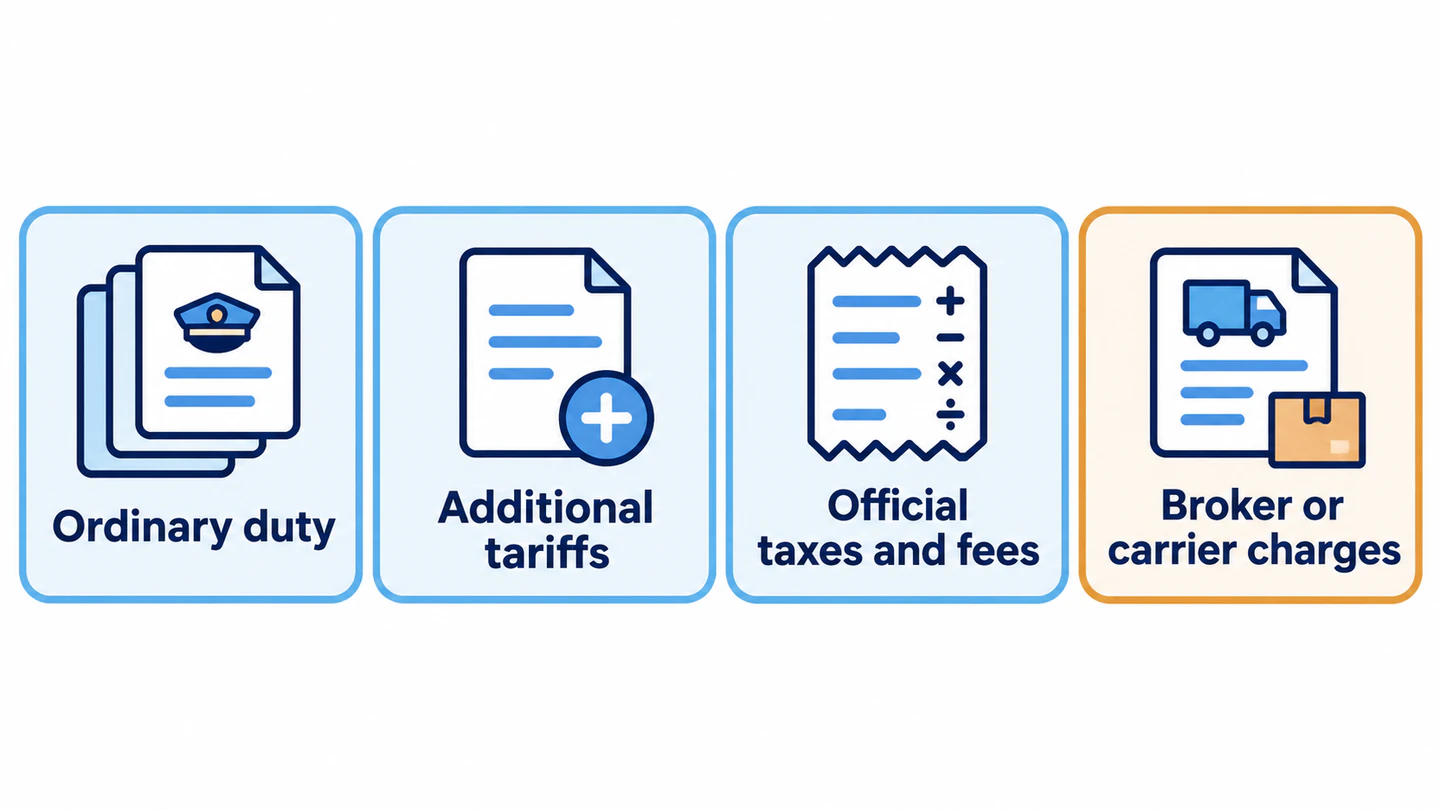
A calculator can give you a rough budget. Only the customs officers in the country where the goods clear can make the final determination. Therefore a supplier quote, a freight estimate, or a tool output is not the official charge. Consult the current official USITC HTS and official CBP materials; do not treat a blog rate or calculator output as the official amount due. Plan official duty, additional official assessments, and carrier or broker invoices as separate layers, and confirm who is responsible under the actual documents.
What evidence determines duty, and when should you ask a broker?
Applicable duty depends on official facts, not on a casual product nickname. The current official classification, the country of origin, the entered value, and the other details on the entry all matter. Collect a clear description, packing details, the commercial invoice, and any code someone already printed. Note the quantity, the material, and the intended use when those facts change the heading. Then compare those facts with the current official schedule. If two documents disagree, stop and reconcile them before anyone files an entry.
The Harmonized Tariff Schedule lists U.S. import duty rates and statistical classifications. It builds on the international Harmonized System. Open the Harmonized Tariff Schedule and check which revision applies on the date of entry.
CBP also explains how readers can approach a duty rate in How do I determine the duty rate on my goods?. A supplier, carrier, marketplace, or software code remains a claim to verify. If the number cannot be found in the current official edition, or the description disagrees, do not file it as-is. This page will not assign a heading. A printed number that cannot be found, or that names a different product, should go back to the seller or to a licensed broker. Do not repair it by guessing a nearby heading.
How should you use a public walkthrough and licensed help?
Use this walkthrough for a basic look at finding product codes for U.S. imports. Check the current official HTS and CBP materials for the entry in front of you.
https://www.youtube.com/watch?v=nEiOgh0BG7E
The official ITA overview mentions locating a broker or shipper, including established carrier and broker-association channels, to help locate duty and tax information. When the classification, origin, value, or a disputed charge is unclear, ask a licensed customs broker or use official ruling channels rather than relying on a supplier or carrier code alone. Still, this article is not licensed customs representation. It cannot issue a ruling for you.
Who is responsible for paying under the actual arrangement?
Payment follows the actual sale and the entry documents. Incoterms allocate commercial duties between the parties. However, they do not replace the importer-of-record name on the entry, and they do not erase a later carrier bill by themselves. Read who is named, who promised to pay, and what happens if the goods are still billed to the consignee. The person who receives the parcel is not automatically the importer of record. The party named on the entry can still face official liability even when a seller said the fees were included.
In addition, a DDP or “duties included” quote is a commercial promise. It is not proof that official duty has already been paid. Before shipping, ask who will make the entry and who will send you the entry documents once they exist. Get the charge breakdown in the quote. If the quote is far below any serious official estimate, pause. A missing invoice, or a second invoice with a different description, is a warning sign rather than a shortcut.
This page cannot rewrite a contract. Moreover, it cannot decide legal liability for a specific shipment. Confirm the arrangement in writing before the goods leave, then keep the documents with the shipment record.
How should you treat de minimis and low-value parcel changes?
For a commercial parcel shipped from China to the U.S., budget for applicable duties, taxes, and fees even if the parcel is worth $800 or less. The general de minimis duty exemption for low-value merchandise is suspended. CBP codified the postal and nonpostal suspensions effective June 24, 2026. Use the international mail rule for a postal shipment and the nonpostal rule for a courier or other mode.
What should you check for international mail?
The new postal informal entry process took effect July 24, 2026. It covers eligible U.S. Postal Service deliveries valued at $2,500 or less. A party with the right to make entry submits the filing to CBP and pays the applicable duty. Ask your postal operator who will file the entry and how the charges will be collected.
CBP moved the compliance deadline for two specific postal formal-entry requirements to January 20, 2027. The October 22 notice identifies the provisions. If your goods are regulated by another federal agency or fall into one of the listed tariff or preference categories, ask the party filing the entry which requirements apply to your shipment.
What should you check with an express courier?
A courier shipment valued at $800 or less that would have used the exemption now needs formal or informal entry. Confirm that the carrier uses a commercial courier service for this shipment. Ask the courier or broker which entry they expect to use, who will file it, and who will pay the government charges. Get their service fees as separate line items before you price the order.
How should you read a post-delivery carrier or broker invoice?
Start with the line items on a bill that arrives after delivery. Official duty or tax should be separate from brokerage, disbursement, and processing charges. A large paperwork fee can sit beside a small official amount, or beside no government fee at all. Ask the carrier to identify each line as a government charge or as its own service fee. If the invoice uses a vague label such as “customs charges,” ask for a breakdown. Vague labels are a common source of confusion, not proof of official duty.
Keep the commercial invoice, the packing list, the tracking record, and any entry summary you received. Those papers are what a carrier review or a licensed broker can actually use. If a line looks wrong, ask the carrier in writing to explain the basis for the charge.
This page cannot settle a carrier dispute. It can only help you see which questions to ask and which documents to keep together. After you have the breakdown, compare it with the commercial invoice and the entry summary. If a government line still looks wrong, take those papers to a licensed broker rather than arguing from memory.
How does a fee plan fit a China-to-US shipment?
Fee planning sits inside a longer international move. Freight mode, cutoffs, and who files the entry all affect the paperwork you will have at the border. They do not replace official classification or official assessment. If you still need a service path around that border step, a freight forwarder for China-to-US cargo can help you organize documents and timing. Even then, the official determination stays with CBP. Therefore, give the forwarder the same evidence you would want at entry: a clear product description, origin, value, and the commercial invoice. A well-prepared file makes later review easier. Even so, it still does not replace official assessment.
Use the same shipment reference on the records you give the forwarder and keep it with the quote and invoice. When a charge arrives later, the reference helps you match the bill to the right set of goods and entry documents.
What questions should you ask before you accept a quote?
Ask what official classification, origin, and value will be used, and whether those facts can be documented. Find out which quoted lines are official duty or taxes, and which are broker or carrier fees. Confirm who is the importer of record, and what happens if a carrier still bills the consignee.
Ask for the quote line by line. If someone offers a different code or a second invoice with a different value to change the charge, stop and resolve which details the records support. That kind of shortcut can create serious entry problems. Verify the description against the current official HTS, and get licensed help if the quote still will not explain itself.
Ask when the official charges will be paid, and who will receive the entry summary. If nobody can answer those questions, the quote is incomplete. A clear quote is a planning aid. It is not a CBP determination, and it is not a reason to skip the documents.
Conclusion
Plan customs fees from China to US by separating government assessments from the carrier’s or broker’s charges. Confirm the product details, origin, value, and payment arrangement before entry. Use the applicable official sources and bring disputed classifications or bills to a licensed broker.
RuntoDropship is a private dropshipping agent that helps sellers organize shipment records and coordinate handoffs. Send RuntoDropship the product description, declared origin, and current supplier or carrier quote so the team can help you scope the shipping handoff.
FAQ
Which date controls the rate on an informal mail entry?
For a parcel released under postal informal entry, CBP uses the duty rates in effect when the entry is properly transmitted. Ask the postal operator for the entry transmission date if a policy changed between ordering and delivery.
What if the supplier promised DDP but the bill names me?
Send the supplier the written term and the entry or tracking number. Ask whether they will pay the carrier directly or reimburse you, and get the amount and due date in writing. Keep the carrier’s payment or dispute deadline on a separate record.
Could a brokerage bill survive a refused delivery?
Check what the carrier did with the original invoice after the return scan. Ask whether it cancelled the invoice, issued a credit, or kept it open for a service already performed. Keep the return tracking and invoice number together.
What if the carrier refuses to revisit a disputed duty code?
Get the entry number and date, then identify the party that filed the entry. Give the filer or a licensed broker the disputed line and the product evidence. Ask which correction or review route is still available and which deadline applies.
How can I compare two customs estimates that disagree?
Ask both preparers to list their inputs on one sheet. Compare product code, origin, entered value, effective date, and the charges included. Check one difference at a time. If one estimate includes brokerage and the other does not, compare those lines separately before judging the difference.