

A Xianyu dropshipping model can fail after the first customer order even when the product looked perfect on-screen. The original listing may disappear, the seller may stop replying, or the parcel may reach a China warehouse with missing accessories. What looked like ordinary dropshipping has become a chain of manual decisions that the storefront never showed.
The xianyu dropshipping model can work for curated, scarce, or condition-sensitive products, but it should be treated as a controlled sourcing workflow rather than a stable supplier catalog. You need to confirm each listing, preserve evidence, inspect the actual item, calculate landed cost, and define what happens when a purchase fails before promising anything to a customer.
1. What Is the Xianyu Dropshipping Model?
The Xianyu dropshipping model means finding products on Xianyu and selling them through another ecommerce channel while a China-side operator handles purchasing, receiving, inspection, and international dispatch. It is different from running a domestic Xianyu store, where a seller relists goods from other Chinese platforms and fulfills orders to Xianyu buyers.
Alibaba describes Xianyu as a Chinese consumer-to-consumer community and marketplace for second-hand goods. Its listings may come from individuals, resellers, clearance sellers, or professional merchants, so the marketplace itself does not establish repeatable supply, uniform condition, or export readiness.
Why does the model require more control than standard dropshipping?
Xianyu transactions begin with the item and seller, not a supplier feed designed for overseas stores. Alibaba Cloud’s description of Xianyu calls the transaction pattern “chat and buy,” which explains why seller communication matters before payment.
For an overseas store, that produces extra operating work:
- Confirm that the exact item is still available.
- Clarify condition, model, quantity, measurements, and accessories.
- Complete a domestic Chinese transaction and receive the parcel locally.
- Decide whether the received item matches the customer-facing promise.
- Arrange export packing, international shipping, tracking, and exceptions.
The model therefore depends on item-level decisions rather than automatic catalog fulfillment.
2. When Does Xianyu Fit an Ecommerce Store?
Xianyu fits stores that earn margin from curation, scarcity, or access to items that are difficult to source through ordinary export catalogs. It is a weak fit when the store requires identical replenishment, uniform condition, automated purchasing, or aggressive paid-traffic scaling.
Which store conditions make the model workable?
The model becomes more practical when you operate a small, controlled catalog and can pause sales quickly. Products should have enough margin to absorb seller communication, failed purchases, inspection, repacking, international freight, and after-sales work.

| Store condition | Better fit | Warning sign |
|---|---|---|
| Product value | Scarce, discontinued, collectible, or curated | Commodity product sold mainly on price |
| Inventory need | One-off or small controlled quantity | Continuous identical replenishment |
| Condition | Can be described and checked visibly | Condition is subjective or hard to test |
| Store operations | Manual approval and rapid status changes | Fully automated, high-volume listing flow |
| Customer promise | Qualified wording and flexible availability | Fixed delivery and availability promises |
The comparison shows why a cheap listing alone does not make Xianyu suitable. Key Takeaway: use Xianyu only when product uniqueness pays for the added control work and your store can stop sales as soon as availability becomes uncertain.
3. How Does a Xianyu Order Move From Listing to Customer?
A Xianyu order moves through two linked systems: the domestic marketplace transaction and your customer-facing ecommerce order. The store remains responsible for the customer promise even when a seller, agent, warehouse, and carrier perform separate parts of the physical work.
Who owns each step?
Before any order moves, a defined China sourcing agent workflow should name who confirms the listing, communicates with the seller, pays, receives, inspects, releases, ships, and reports exceptions. A forwarding address, however, does not perform all of those jobs.
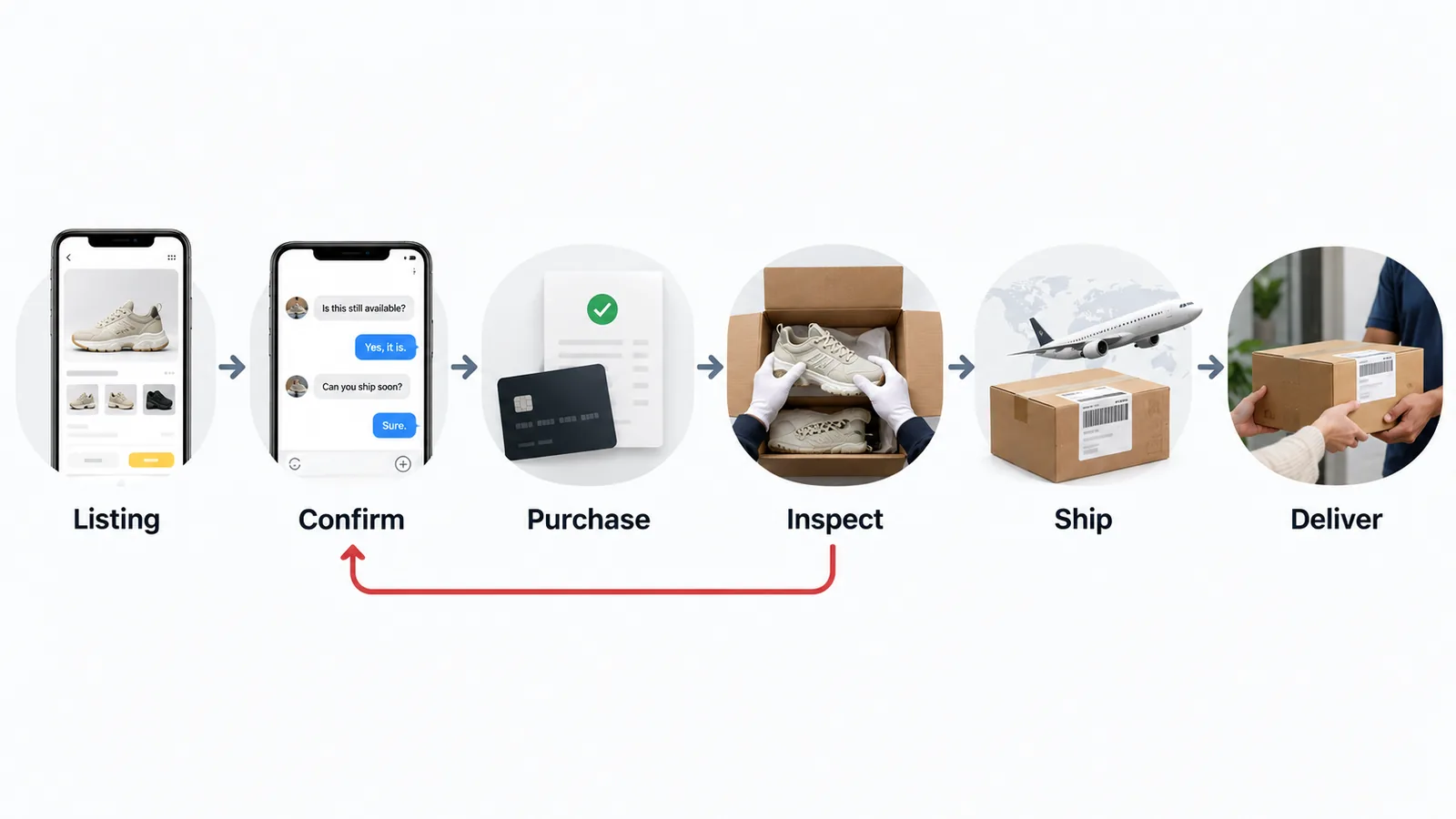
| Stage | Required decision | Evidence to retain |
|---|---|---|
| Listing review | Is this the exact sellable item? | Link, screenshot, model, condition, price |
| Seller enquiry | Is it available and correctly described? | Replies, current photos, measurements |
| Domestic purchase | Who approves price or changes? | Order record and payment status |
| Warehouse receipt | Does the parcel match the instruction? | Intake ID, photos, inspection result |
| Release or hold | Ship, reject, or escalate? | Named decision and reason |
| International dispatch | Which route can carry the item? | Packed weight, declaration, tracking |
| Customer service | What happens if status changes? | Store message, refund, or replacement path |
The practical goal is one traceable chain from the listing to the customer order. Missing ownership at any stage turns a small product issue into a support problem.
4. How Should You Check a Listing and Seller Before Paying?
You should check the exact item, the seller’s evidence, and the transaction conditions before authorizing payment. A strong profile signal may reduce uncertainty, but no badge or review count proves that one listing is accurate.
What belongs in a pre-payment evidence pack?
Save enough information for another person to identify the item after the live listing changes or disappears:
- Full listing screenshot and share link.
- Seller name or account reference.
- Model, color, size, quantity, and visible condition.
- Included and missing accessories.
- Seller-provided current photos or video when needed.
- Agreed price, domestic shipping, and payment route.
- Questions asked and the seller’s replies.
An agent should stop when the seller refuses necessary evidence, pushes unrelated off-platform payment, changes the item materially, or cannot confirm availability. The video below supplements the listing-navigation context; your operating checklist still controls whether an item is safe to offer.
5. How Should You Control Condition, Authenticity, and QC?
Control begins by converting every customer-facing product claim into an observable item check. “Looks good” is not a usable standard; the check should name the surface, measurement, component, accessory, identifier, or function that matters.
What can ordinary warehouse QC prove?
For example, ordinary dropshipping quality control can confirm visible condition, model labels, quantity, included parts, measurements, obvious damage, and packing. Function testing requires the right equipment and instructions, while specialist authentication requires separate expertise that a normal warehouse photo does not provide.

Use four release states:
- Accept: observed checks match the approved instruction.
- Accept with disclosure: a documented difference is still sellable and the product page or customer accepts it.
- Hold: evidence is incomplete and a named person must decide.
- Reject or escalate: the item is wrong, damaged, materially different, or carries unresolved authenticity or compliance risk.
Do not ship an unclear item merely because returning it is inconvenient. Define the check and rejection authority before purchase, since inspection after arrival cannot repair a vague promise made on the storefront.
6. What Costs Determine Whether the Model Is Profitable?
Profit depends on the full cost of securing and delivering a sellable item, not the Xianyu price alone. The relevant unit is cost per successfully fulfilled customer order after normal exceptions.
How should you calculate landed cost?
Before pricing the item, use this structure without assuming any universal rate:
Product price + China domestic shipping + purchasing service + inspection or testing + warehouse handling + export packing + international shipping + payment cost + expected exception allowance + customer-service time
The same logic appears in a broader Shopify dropshipping cost audit. With one-off or condition-sensitive inventory, an item may need to be rechecked, rejected, or sourced again.
| Cost question | Decision use |
|---|---|
| What is paid before the item reaches the warehouse? | Sets cash exposure before inspection |
| Which checks cost extra or cannot be performed? | Defines evidence limits |
| What happens when the seller cancels? | Exposes repayment and delay risk |
| Can the item be returned domestically? | Sets the loss or negotiation path |
| What is the packed chargeable weight? | Replaces an unreliable listing estimate |
| How much work does one exception create? | Tests whether margin survives support work |
Key Takeaway: reject a product when one failed purchase, inspection issue, or customer dispute can erase the margin from several successful orders.
7. How Can One-Off Inventory Break Customer Promises?
One-off inventory breaks customer promises when your store treats a marketplace listing as reserved stock. The item can sell, change price, disappear, or arrive in a different condition between product research and the customer’s payment.
Which controls reduce overselling and delay?
Use risk scenarios to design rules, not to imply past client results:
- When the item sells before purchase, pause the store SKU and offer a refund or separately approved alternative.
- A seller price change requires new margin approval rather than a silent reduction in quality or profit.
- Differences in accessories or measurements should hold the item until the customer-facing decision is updated.
- Failure to ship should start an exception clock and customer-message path.
- When the listing disappears, rely on the saved evidence pack rather than memory.
For US orders, advertised shipping statements need a reasonable basis; the FTC’s merchandise shipping rule is one reason not to promise a dispatch or delivery time that the purchasing workflow cannot support.
Connect listing status with the store’s sellable status, advertising status, and customer-message rule before accepting live orders.
8. Which Stop Rules Should You Set Before Scaling?
Stop rules should end or redesign the test when the workflow cannot produce a verified item, defensible margin, and reliable customer status. Scaling a fragile process increases the number of exceptions; it does not remove them.
What should a controlled test measure?
Before scaling, track outcomes rather than choosing an impressive order count:
- Purchase confirmed versus unavailable or cancelled.
- Item accepted, held, or rejected after inspection.
- Time from customer order to verified domestic purchase.
- Time from shipment release to first usable tracking event.
- Support contacts, refunds, replacements, and disputes by cause.
- Real cost per successfully fulfilled order.
- Hours spent resolving seller and item exceptions.
Set the decision before the test: continue, narrow the catalog, change the service process, move the product to a stable supplier, or stop selling it. Key Takeaway: a winning product still fails the test when availability, evidence, cost, or support work cannot support the customer promise.
9. When Is 1688, Taobao, or Direct Sourcing a Better Choice?
Choose another source when repeatability matters more than access to one unusual listing. Xianyu can win on scarcity and discovery, while wholesale or supplier-direct routes usually provide a clearer path to repeated SKUs, production terms, and planned replenishment.
How do the options compare on the same criteria?
| Route | Strongest use | Inventory pattern | Main operating burden |
|---|---|---|---|
| Xianyu | One-off, discontinued, used, or niche finds | Item-level and unstable | Seller communication, condition, evidence, exceptions |
| Taobao | Domestic retail products and small tests | More repeatable than one-off C2C | Retail availability, variant checks, domestic purchasing |
| 1688 | Wholesale sourcing and repeatable catalog tests | Supplier and batch based | Supplier verification, MOQ, quality, production consistency |
| Direct supplier | Proven product and planned scaling | Negotiated supply | Qualification, samples, terms, forecasting, ongoing QC |
The site’s 1688 dropshipping workflow is the more relevant next comparison when your store needs repeated inventory rather than individual marketplace finds.
Key Takeaway: use Xianyu for a controlled opportunity that can survive item-level review; use a repeatable sourcing route when customers expect the same product to remain available.
Conclusion
Choose a Xianyu product only after one person owns availability confirmation, evidence capture, inspection, release, tracking, and customer exceptions. If the same item cannot be secured again or described consistently, keep it in a small controlled test rather than building a permanent catalog or paid campaign around it.
RuntoDropship does not operate Xianyu or authenticate branded goods. As a private dropshipping agent, it can assess a qualified sourcing and fulfillment request within its confirmed service scope. Share the product link or screenshot, destination markets, expected order volume, condition requirements, and the customer promise your store needs to support.
What else do sellers ask before testing Xianyu?
Can I research Xianyu products without a Chinese phone number?
Sometimes browsing remains possible, but account and verification behavior changes by device, region, and platform controls. Do not build a sourcing process around an unofficial workaround. Ask a China-side service to confirm whether it can identify and enquire about the item from a link or screenshot.Is Goofish the same marketplace as Xianyu?
Yes. Goofish is the English-facing name commonly used for Xianyu. Confirm the domain or app source before submitting an item, because community posts and agents may use either name while unrelated pages can use similar wording.Can several Xianyu purchases be combined into one international parcel?
They can be consolidated when the receiving warehouse supports multiple sellers and can match every domestic parcel to your account. Wait for intake and inspection before requesting a final packed quote, because category restrictions, fragile items, batteries, and volumetric weight can change the best shipping plan.Can an agent negotiate a Xianyu listing price before purchase?
Sometimes, but negotiation is a request rather than a guaranteed saving. Confirm whether seller communication is included, who approves a counteroffer, how long the offer remains valid, and whether the item can sell to another buyer during the discussion.Can I sell Xianyu-sourced products through Shopify or eBay?
The sales channel does not remove your responsibilities. You still need the right to use product content, an accurate condition description, evidence for branded goods, a workable return policy, and compliance with the marketplace rules that apply to your account and product category.