What is HTS code? It is the United States number used to describe imported merchandise on the official tariff schedule. Importers, brokers, and carriers use it to report what a shipment is for duty and statistical purposes.
In practice, that number is not a casual product nickname. It is also not a number you should copy from a supplier invoice without checking the official schedule.
This guide explains how an HTS code relates to the international HS. It also shows how a US import heading differs from an export Schedule B number. You will see how to consult the official US schedule, and when a licensed broker or a ruling is the safer next step. This article does not assign a classification to your goods.
What is an HTS code, and how does it relate to the HS?
An HTS code sits inside the Harmonized Tariff Schedule of the United States. That schedule is the legal US text for import tariff lines and statistical reporting. If you still need the wider entry process, start with our guide to customs clearance. An HTS code is one of the details that process depends on.
The Harmonized Tariff Schedule of the United States (HTS) was enacted by Congress and made effective on January 1, 1989, replacing the former Tariff Schedules of the United States.
That enactment date is the starting point for the current legal text.
The Harmonized Tariff Schedule of the United States (HTS) sets out the tariff rates and statistical categories for all merchandise imported into the United States. The HTS is based on the international Harmonized System, which is the global system of nomenclature applied to most world trade in goods.
In short, the HS is the shared international backbone. An HTS code is the US extension of that backbone for goods that enter the United States.
What is HTS code, and what official structure does the HTS add?
The HTS comprises a hierarchical structure for describing all goods in trade for duty, quota, and statistical purposes. This structure is based upon the international Harmonized Commodity Description and Coding System (HS), administered by the World Customs Organization in Brussels ; the 4- and 6-digit HS product categories are subdivided into 8-digit unique U.S. rate lines and 10-digit non-legal statistical reporting categories.
Read those digits as layers, not as a single invented string. The first six digits follow the HS heading and subheading. Next, the eighth digit is the unique US rate line. The tenth digit is a statistical reporting category. That tenth digit is not itself a legal rate line.
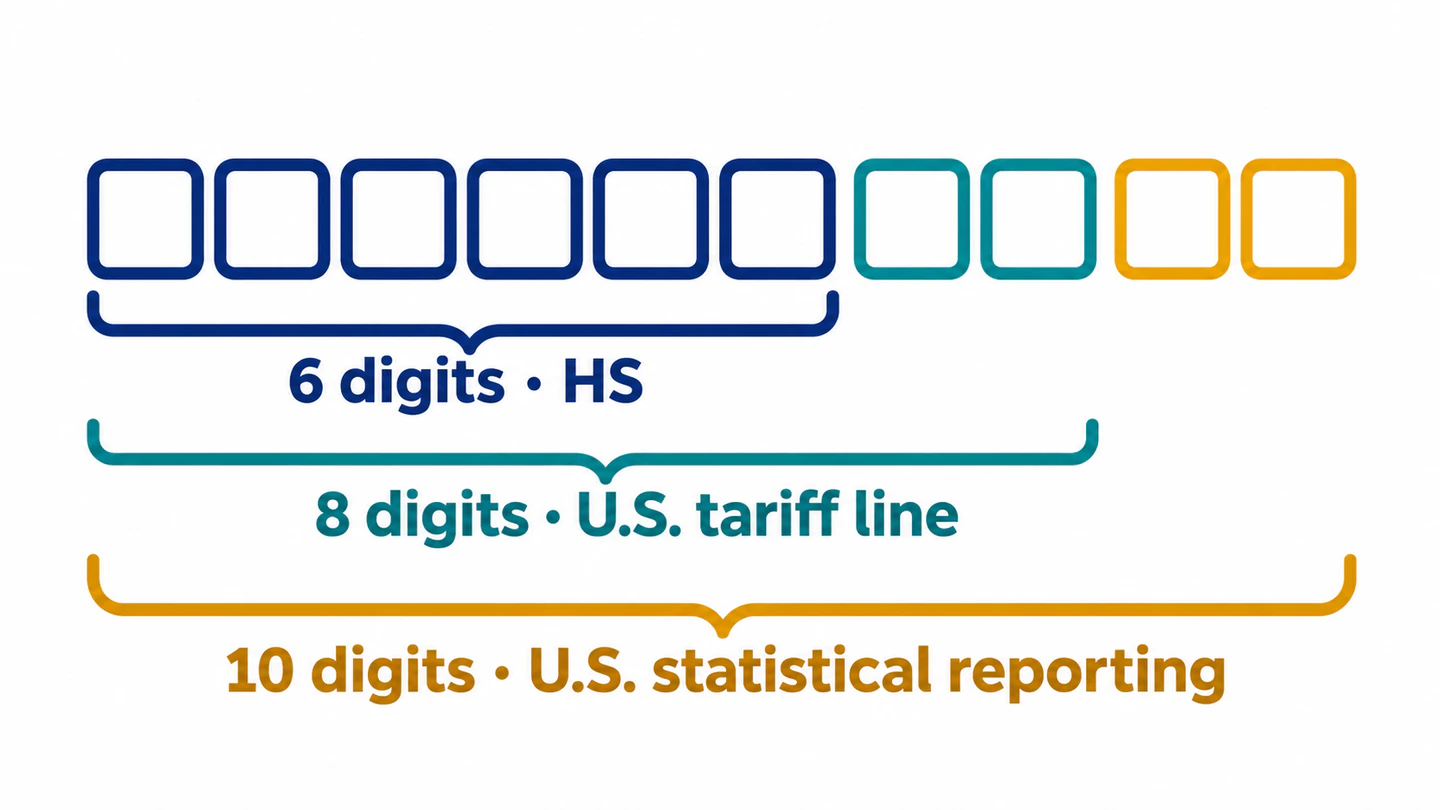
This structure is why two products can share a six-digit HS heading and still need different US lines. A supplier may send only six digits. That is not enough for a complete US import report.
Which legal notes and interpretation rules apply?
Classification of goods in this system must be done in accordance with the General and Additional U.S. Rules of Interpretation, starting at the 4-digit heading level to find the most specific provision and then moving to the subordinate categories.
Start with the heading, the legal notes, and those rules. Do not jump to a familiar 10-digit number because it looks close. Section and chapter notes can exclude goods that seem similar at first glance.
The USITC maintains and publishes the HTS (in print and on-line) pursuant to the Omnibus Trade and Competitiveness Act of 1988; see the preface to the HTS for additional explanatory material. However, the Bureau of Customs and Border Protection of the Department of Homeland Security is responsible for interpreting and enforcing the HTS.
Embargoes, anti-dumping duties, countervailing duties, and other very specific matters administered by the Executive Branch are not contained in the HTS.
So an HTS code tells you the schedule line. It does not, by itself, list every extra measure that may still apply to the same goods.
How is a US HTS heading different from an export Schedule B number?
Importers and exporters often treat these numbers as interchangeable. They are not. An HTS code describes merchandise imported into the United States. A Schedule B number is an export commodity code.
The two systems share the HS backbone, so early digits can look alike. That similarity is a trap. A number that works on an export filing is not automatically the right US import line. The agencies also differ. Meanwhile, the USITC publishes the HTS. The US Census Bureau maintains Schedule B.
International Trade provides a Schedule B Commodity Search Tool. This search tool provides a smarter, more intuitive, and more accurate way to classify products.
Treat that Census wording as a description of the export tool, not as permission to skip a review. Use the Schedule B tool when you are coding an export. Use the official HTS when you are coding a US import. If a shipment moves both ways, check each direction on its own schedule.
Jurisdiction matters as well. A carrier or foreign supplier may use a different country's tariff extension. That foreign extension is not a US HTS heading and is not a Schedule B number.
Keep a US import HTS heading distinct from an export Schedule B number and from a 6-digit HS used in another country.
How do you consult the official HTS without trusting a supplier code?
Do not treat a supplier, marketplace, or freight-tool string as the official classification. Those sources can lag or truncate digits. Instead, open the official schedule and compare the legal text to the actual goods.
You can consult the current edition in the official Harmonized Tariff Schedule published by the USITC. Search by description or by a candidate heading, then read the notes around that heading.
The official USITC HTS database retrieved for this article identified the then-current edition as 2026 HTS Revision 21.
That edition label is a retrieval fact from the official page at the time we checked it. It is not a promise that the same revision will remain in force later.
A 2005 US tariff chapter can still appear in search results. Use it only as history. Do not treat it as the current schedule.
The "general" rates of duty subcolumn contains U.S. normal trade relations duty rates; products of some NTR countries may be eligible for preferential tariff programs, as reflected in the "special" subcolumn. Column 2 (the so-called "statutory rates") applies to countries listed in general note 3(b); the general notes set forth the rules for applying the HTS.
Read those columns after you have a candidate line, not before. Do not quote a rate from a blog, a quote sheet, or last year's entry as advice for a new shipment.
This short walkthrough can help you move through the official schedule.
https://www.youtube.com/watch?v=zDnjfsml-j4
The title of that video is "How to Use the Harmonized Tariff Schedule of the United States." Use it as a navigation aid. It does not replace the current official edition, and it does not classify your goods.
When should you ask a licensed broker or look for a ruling?
Ask a licensed customs broker when the goods sit near a heading boundary, when the composition is unclear, or when a duty program depends on the exact line. The same review is wise when the invoice description is vague. It also matters when two plausible headings would change the result in a material way.
This article cannot assign a classification and cannot act as a licensed broker. A well-written overview is not a ruling.
CROSS is a searchable database of CBP rulings that can be retrieved based on simple or complex search characteristics using keywords and Boolean operators.
Rulings collections are separated into Headquarters and New York and span the years 1989 to present.
Please be aware that not all rulings issued by HQ and NY since 1989 are yet included in the database.
A CROSS result can support your reading. It is not automatic coverage for your facts. Compare the ruling's merchandise, date, and reasoning to your shipment. If no ruling matches, or if the facts are close but not the same, do not stretch the text.
Request a binding ruling via the eRulings portal.
That official path is available when you need a binding answer from CBP. A licensed broker can also tell you whether a ruling request is the right move, or whether a clearer product description is enough to proceed.
How does an HTS code fit a China-to-US shipment?
On a China-to-US shipment, an HTS code belongs on the import side of the file. The commercial invoice, packing list, and product details should describe the same goods that the entry will report. If those documents disagree, fix the file before you treat any code as settled.

A factory may print a code because a prior buyer used it. That habit does not make the number official. Confirm the description, material, function, and any retail set packing against the official heading text.
If you are still choosing the movement itself, review our guides to a freight forwarder from China to the US and to shipping from China to the USA. Those pages cover routing and service choices. They do not replace an official classification review.
Keep air and sea files equally careful. Mode of transport does not decide the heading. The goods do.
How should you review a code that a broker or carrier already used?
A prior entry can be a useful clue. However, it is not a standing classification for every later shipment. Compare the old invoice, the old packing details, and the current goods. If the product changed, the old number may no longer fit.
Ask who selected the code, and on what facts. If a carrier or software tool filled the field, treat that value as a draft. If a licensed broker selected it, still confirm that this shipment matches the description the broker used.
Look for truncated digits, mixed import and export codes, and headings copied from a different colorway or kit. Then go back to the official schedule and read the current line, not a screenshot of last year's entry.
What questions should you ask before you reuse last year's number?
What is HTS code on the current shipment? Has the official schedule changed since that entry was filed? Did the product, materials, or set composition change? Was the old number an export Schedule B code rather than a US import line? Did a supplier change the wording while the physical goods stayed the same, or the reverse?
If any answer is uncertain, do not reuse the number on autopilot. Open the current official edition. Read the heading and the notes. If the line is still unclear, ask a licensed broker, or consider a ruling, before the next shipment leaves.
A stable product line can keep the same heading for a long time. Stability is something you verify, not something you assume.
Conclusion
What is HTS code, in short? It is the US import number that extends the international HS for goods entering the United States. That number is not the same as an export Schedule B number. It is not a string you should copy from a supplier or from last year's file without a check.
Consult the current official USITC HTS, not a historical schedule page or a code copied from a listing. Ask a licensed customs broker, or look for a CBP ruling, when the heading is uncertain or two reviews disagree. For more China-to-US shipping context, visit RuntoDropship.
FAQ
What does HTS mean?
HTS means Harmonized Tariff Schedule. In US import practice, people say "HTS" when they mean the official US tariff schedule, or the code drawn from it. The schedule is based on the international Harmonized System, then extended into US rate lines and statistical categories.
What does HS code stand for?
HS stands for the Harmonized Commodity Description and Coding System, often shortened to the Harmonized System. It is the international nomenclature administered by the World Customs Organization. An HTS code uses that HS backbone and then adds the US subdivisions.
What are the latest HTS codes for 2026?
There is no single static list that this article can certify as forever current. The official USITC HTS database retrieved for this article identified the then-current edition as 2026 HTS Revision 21. Check the official USITC database for the edition in force when you file, because revisions can continue after a retrieval date.
How do I find my HTS code?
This article cannot find or assign your code. Open the official USITC HTS database, start at the four-digit heading, and read the legal notes and the General and Additional U.S. Rules of Interpretation. If the heading is still unclear, ask a licensed customs broker, or consider a binding ruling.
What does HS code 99050000 represent?
This article does not assign 9905.00.00, or any other number, to a product. Heading 99 is a special part of the schedule, and a six- or eight-digit string in a search box is not a classification of your goods. If you need to know whether a Chapter 99 provision applies, ask a licensed broker or review a matching official ruling. Do not treat a search-result snippet as the answer.