
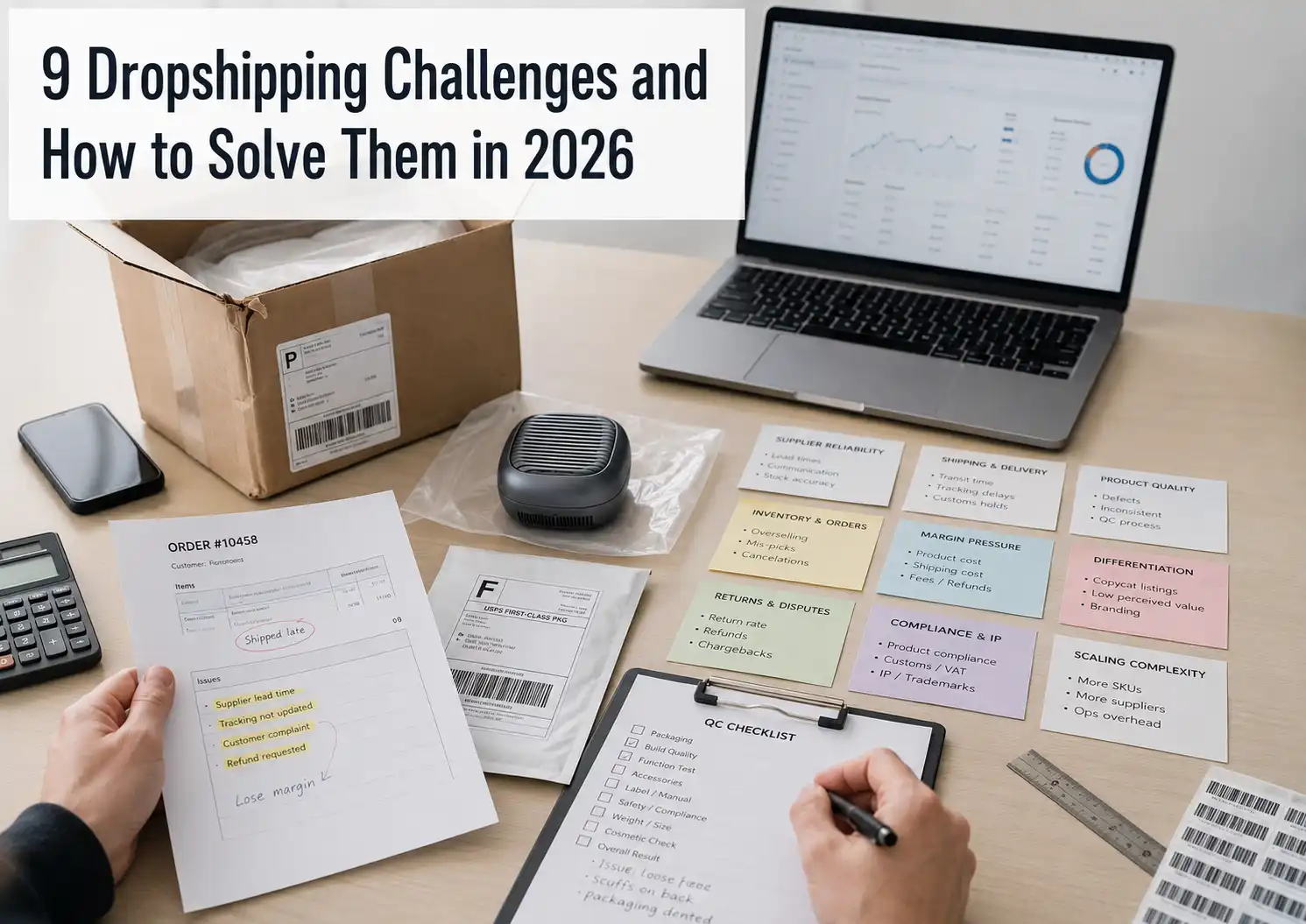
Dropshipping challenges usually appear at the handoffs between your store, supplier, warehouse, carrier, and customer. An order can be profitable when it is placed and still become a loss because stock changed, the wrong variant shipped, tracking stalled, or a return had no clear owner.
The practical way to manage these problems is to identify the warning sign, fix the process that caused it, and create a fallback before the same failure reaches more customers.
| Challenge | Main Risk | First Fix |
|---|---|---|
| Unreliable suppliers | Failed orders | Qualify a backup supplier |
| Unpredictable shipping | Delays and complaints | Track the complete delivery route |
| Inconsistent quality | Refunds and bad reviews | Approve a sample and QC standard |
| Inventory and order errors | Overselling and wrong shipments | Control SKU, stock, and order data |
| Thin margins | Unprofitable growth | Calculate contribution margin |
| Weak differentiation | Price competition | Improve the offer and customer experience |
| Returns and disputes | Support costs and chargebacks | Build an exception workflow |
| Compliance and IP | Blocked products or claims | Verify requirements before selling |
| Scaling complexity | More fulfillment mistakes | Standardize execution before volume grows |
1. How Do You Manage Unreliable Dropshipping Suppliers?
A supplier becomes a risk when price, stock, processing time, product specifications, or communication can change without warning.
Do not judge a supplier only by the listing price or a successful sample. Test the workflow around the product.
If Alibaba is part of your sourcing process, this Alibaba dropshipping supplier-check workflow shows what to verify before order volume increases.
Before sending meaningful order volume, confirm:
- The exact SKU and variants being supplied
- Current product specifications
- Normal order-processing procedure
- Packaging requirements
- How stock is confirmed
- How price changes are communicated
- What happens when an item is unavailable
- Who handles defective or incorrect units
Keep the approved product specification outside the supplier’s marketplace listing. If the supplier changes a material, accessory, color, packaging format, or factory source, you need something against which the new batch can be checked.
A backup supplier is also useful for important SKUs. The backup should be sampled before the primary supplier fails, not discovered during a stockout.
If stock, price, processing time, or product specifications keep changing independently, the problem is supplier control, not simply supplier communication.
Fix: Turn supplier selection from a one-time search into an ongoing supplier qualification process
2. How Can You Reduce Long and Unpredictable Shipping Times?
Shipping problems are difficult to diagnose when every delay is treated as one event.
A customer delivery actually contains several stages:
Order received → supplier processing → warehouse dispatch → carrier acceptance → international transport → customs → local delivery
A slow order may therefore be a supplier problem, a shipping-line problem, or a last-mile problem.
Start by recording the real timeline of test orders to your main destination countries. Check when the order was submitted, when the parcel physically left the warehouse, when the first carrier scan appeared, and when delivery occurred.
Then compare routes by more than advertised transit time. Look at:
- Dispatch consistency
- Tracking visibility
- Destination coverage
- Restricted-product limitations
- Remote-area performance
- Exception handling
- Delivered cost
Do not promise customers a delivery window based only on the carrier’s line-haul estimate. Your storefront promise needs to account for processing and the complete route.
Shopify’s dropshipping fulfillment guide also identifies shipping issues as one of the recurring operational challenges in dropshipping fulfillment.
If warehouse dispatch is on time but the first carrier scan is repeatedly late, investigate the warehouse-to-carrier handoff before changing the advertised shipping route.
Fix: Measure shipping from paid order to customer delivery, not from warehouse dispatch to destination country.
3. How Do You Control Product Quality Without Holding the Stock?
A successful sample does not guarantee that later production will match it.
The useful control is an approved standard that follows the SKU.
For a product you intend to keep selling, record the details that matter:
- Material
- Dimensions
- Color or finish
- Function
- Included accessories
- Variant
- Labeling
- Packaging
The warehouse or inspection team can then compare units against that standard before dispatch.
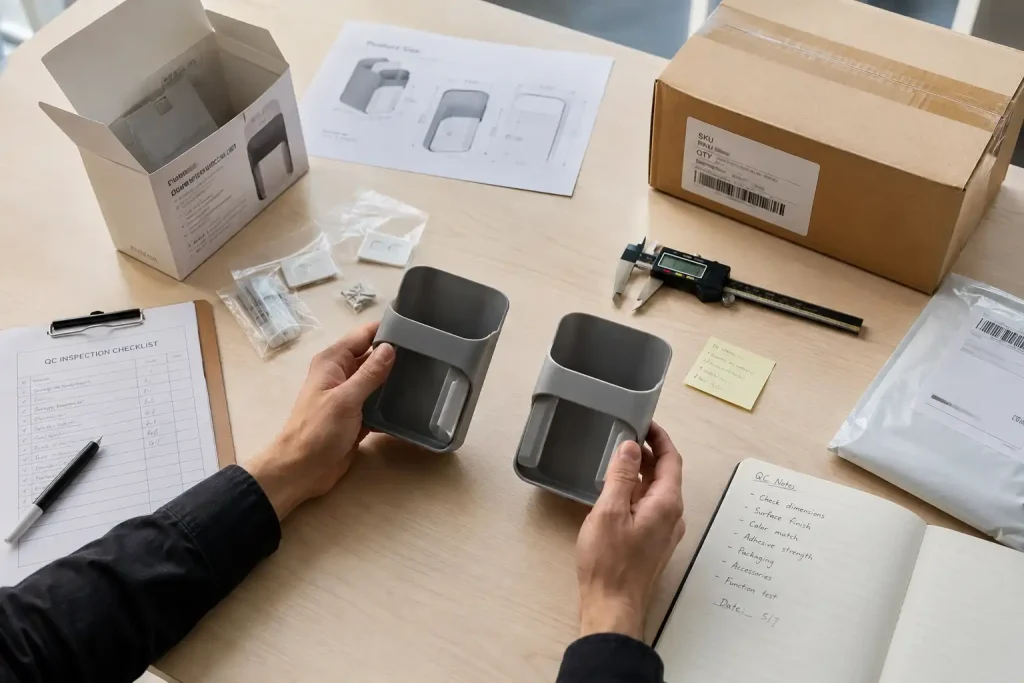
QC should focus on failures that would cause a customer complaint. A simple product may need a visual and functional check. Electronics may require power, accessory, compatibility, or battery checks. Apparel may require size, color, stitching, and labeling checks.
Packaging should be part of the same process. A correct product can still arrive damaged if the packing method is unsuitable for its shipping route.
Amazon’s dropshipping guide notes that dropshipping can leave sellers with less control over product quality, packaging, and shipping timelines.
Fix: Use an approved sample and written specification as the reference for future batches, then inspect against that reference.
4. How Do You Prevent Inventory, Pricing, and Order Processing Errors?
Dropshipping inventory is difficult because your storefront can only sell accurately when the supplier’s information is accurate.
Common failures include:
- A product remains live after supplier stock runs out
- A supplier changes price without the store noticing
- The wrong variant is mapped to an SKU
- An order reaches the wrong supplier
- A paid order is missed
- Tracking is not written back to the store
- One supplier changes a product while the listing remains unchanged
Inventory software can reduce manual work, but automation does not correct bad supplier data. Shopify’s inventory guidance similarly warns that weak inventory management can lead to lost sales and dissatisfied customers.
If store-to-supplier automation is the bottleneck, compare DSers vs AutoDS for product data, order routing, stock updates, and tracking workflows.
For important products, maintain one clear SKU record containing the supplier, variant, current cost, approved specification, shipping route, and backup source.
You also need an exception queue for orders that cannot move normally. Examples include out-of-stock products, address problems, price changes, failed tracking creation, and variant mismatches.
Do not let these orders disappear inside the normal fulfillment flow.
Separate stock failures, SKU-mapping errors, supplier price changes, and order-routing failures because they may produce the same failed order but require different fixes.
Fix: Separate normal orders from exception orders and assign an owner to every exception.
5. How Do You Protect Profit When Costs Keep Changing?
Revenue does not tell you whether an order is worth scaling.
Calculate the contribution from each order:
Selling price
− product cost
− shipping
− payment and platform fees
− customer acquisition cost
− expected refunds and replacements
− variable packaging or handling
= contribution margin
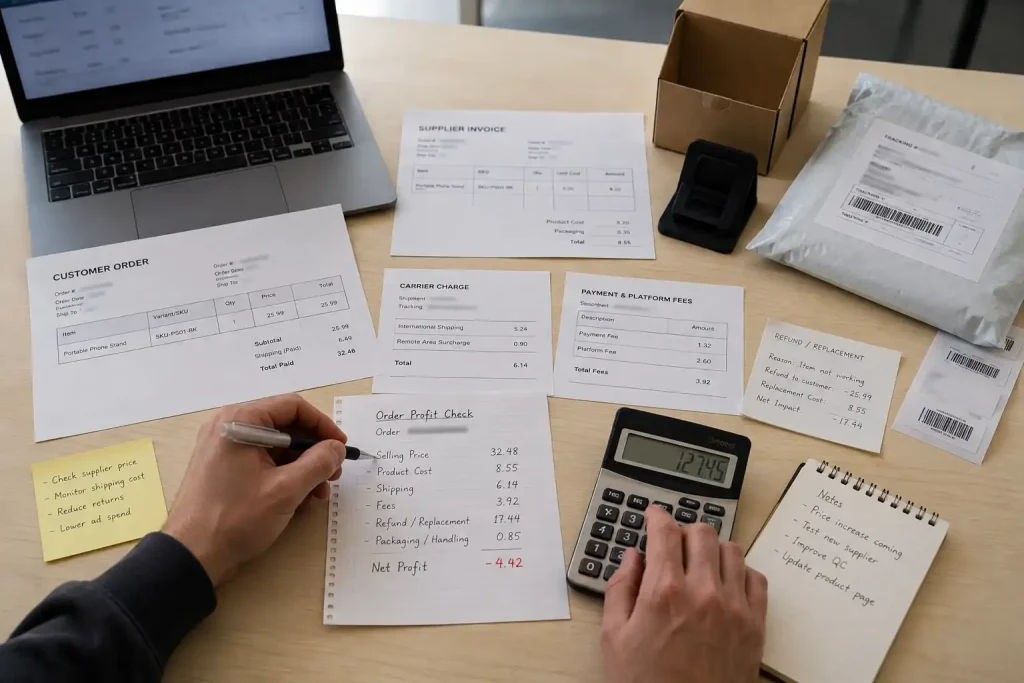
Do not use an industry-wide percentage to decide whether your margin is healthy. Product size, destination, advertising channel, return behavior, duties, and shipping method can make two stores with the same selling price produce very different results.
When margin becomes weak, identify the component causing it before changing the retail price.
Possible improvements include:
- Renegotiating product cost at stable volume
- Comparing shipping routes by delivered cost
- Reducing defects and reshipments
- Increasing average order value through bundles
- Removing unnecessary packaging cost
- Improving repeat purchases
- Stopping products whose exception cost is consistently too high
Low margins are also repeatedly identified as a central dropshipping fulfillment challenge.
Fix: Optimize the complete order economics, not just supplier price.
6. How Do You Compete When Other Stores Sell the Same Product?
If multiple stores can access the same supplier listing, the product alone provides little protection from competition.
The weakest response is simply lowering the price. Instead, change what the customer receives or how the offer is presented.
Possible differentiation includes:
- Better product bundles
- Clearer product information
- Original product photography or demonstrations
- More useful instructions
- Faster or more predictable delivery
- Improved packaging
- Better post-purchase communication
- More reliable support
For products with stable demand, branding can go further through custom packaging, inserts, labels, or product modifications.
The objective is not to make a generic item look artificially unique. It is to create an offer and buying experience that a customer cannot reproduce by comparing two supplier listings.
Fix: Build differentiation around the complete offer, not only the product itself.
7. How Should You Handle Returns, Support Issues, and Chargebacks?
Many payment disputes begin as ordinary order exceptions.
A typical sequence is:
Delivery problem → customer contacts support → problem remains unresolved → refund request → payment dispute
Create a support workflow before volume makes individual cases difficult to track.
Start by classifying the problem:
- No tracking movement
- Delivered but not received
- Wrong product or variant
- Damaged parcel
- Defective product
- Product does not match the order
- Customer wants to return an acceptable item
Each category should have a predefined next action and evidence requirement.
For example, a damaged-product claim may require customer photos and the warehouse packing record. A tracking problem requires the carrier timeline. A wrong-variant claim should be checked against the original order and SKU mapping.
Returns also need a practical destination. Sending a low-value product internationally can cost more than the item itself, while higher-value products may justify inspection and restocking through a domestic return arrangement.
Fix: Resolve exceptions through a defined workflow instead of negotiating every case from zero.
8. How Do You Manage Compliance, IP, Customs, and Platform Rules?
A supplier being willing to sell an item does not mean you are automatically allowed to sell or ship it to every market.
Before listing a product, verify four separate questions:
- Can you legally sell the product in the destination market?
- Does the product or creative create intellectual-property risk?
- Can the chosen carrier accept and transport it?
- Does your ecommerce platform or marketplace allow it?
Requirements become especially important for categories involving batteries, cosmetics, children’s products, electronics, liquids, branded goods, and other regulated or sensitive products.
Keep product documents linked to the relevant SKU instead of waiting until a customs, marketplace, or customer issue appears.
Rules also vary by market and can change. Verify current requirements with the relevant government, carrier, marketplace, or other authoritative source before selling into a destination.
For a concrete brand example, Louis Vuitton dropshipping shows why authorization, trademark use, counterfeit risk, and product sourcing must be checked before listing branded goods.
Counterfeit goods and intellectual-property violations can create liability for the retailer even when another supplier fulfills the order.
Fix: Make compliance part of product approval, not an emergency check after an order is blocked.
9. How Do You Scale Without Losing Fulfillment Control?
Scaling exposes weak processes because every small failure starts happening more often.
Before increasing order volume, standardize the parts of fulfillment that should not depend on memory:
- SKU and variant mapping
- Approved product specifications
- Supplier ownership
- Backup suppliers
- QC requirements
- Packaging standards
- Shipping routes
- Tracking updates
- Inventory alerts
- Exception ownership
- Returns procedure
Proven products may also justify buffer inventory when the cost of a stockout is higher than the cost of holding a controlled quantity of stock.
As operations become more complex, sellers may move from individual marketplace suppliers to a more coordinated sourcing and fulfillment setup. A private dropshipping agent can be useful when the real bottleneck is supplier coordination, QC, packaging, shipping execution, inventory handling, or after-sales coordination.
RuntoDropship is designed for this operational stage: sourcing, supplier coordination, QC, packaging, shipping execution, tracking, inventory handling, and after-sales exceptions can be managed through one fulfillment workflow instead of being split across unrelated supplier relationships.
That change does not fix weak demand, an unprofitable advertising campaign, or a poor product offer. It only makes sense when the problem sits inside the supply chain.
Fix: Add fulfillment infrastructure when operational complexity requires it, not because an arbitrary daily-order number has been reached.
A Practical Dropshipping Challenge Checklist
Before scaling a product, you should be able to answer:
- Who is the primary supplier?
- Is there a qualified backup?
- What exact product specification has been approved?
- How is stock confirmed?
- How are supplier price changes detected?
- What happens when an order cannot be fulfilled normally?
- What route will each main destination use?
- How is product quality checked?
- What evidence is retained before dispatch?
- How are returns and replacements handled?
- Are product, carrier, customs, and platform requirements verified?
- Who owns an exception until it is resolved?
If several answers are unclear, the next priority is not more automation. It is defining the missing control.
Final Takeaway
The hardest dropshipping challenges usually come from a lack of visibility between the customer order and the final delivery.
Reliable operations make those handoffs visible: the supplier is known, the SKU is defined, stock is checked, quality has a standard, shipping is measured, exceptions have owners, and costs are recorded at order level.
Fix those controls one by one. When order volume increases, the same framework can be standardized across suppliers, warehouses, shipping routes, and customer-service workflows without changing the promise made to the customer.
Frequently Asked Questions
What is the biggest challenge in dropshipping?
There is no single problem for every store. Supplier reliability, shipping, quality, inventory accuracy, and margin control are common pressure points. The biggest challenge is the one currently causing paid orders to fail or lose money.
How can I identify my biggest dropshipping problem?
Track each order from payment through supplier processing, dispatch, delivery, and any after-sales issue. Group failures by cause instead of treating every refund or complaint as a separate event.
Can automation solve dropshipping fulfillment problems?
Automation can transfer order, inventory, and tracking data, but it cannot make inaccurate supplier information correct or physically verify a product. Automate stable processes after ownership and exception rules are defined.
Do I need a backup supplier for every product?
Not necessarily. Prioritize products that generate meaningful order volume or revenue. A backup becomes more valuable when one supplier failure would interrupt a large share of your orders.
When should I consider a private dropshipping agent?
Consider one when supplier coordination, QC, packaging, shipping, inventory, or exception handling has become difficult to control across individual suppliers. The decision should be based on operational needs rather than a fixed order threshold.