

Dropshipping Philippines can be worth testing, but it is not passive income and it is not automatically low risk. You still own the customer promise, so choose one buyer market, validate one product, confirm the full payment and delivery route, register correctly, and judge the idea by delivered orders—not by how easy a supplier makes the setup look.
The model removes the need to buy a large batch before the first sale. It does not remove product risk, advertising cost, customer service, failed deliveries, taxes, or refunds.
A common beginner sees a wide catalog and a large gap between supplier price and selling price, then launches before checking COD failures, route costs, or product rules. The safer response is to reduce the idea to one product, one market, and one complete test order before paying for broader traffic.
Dropshipping Philippines: Is It Worth Starting?
It is worth starting only as a controlled business test, not as a shortcut to guaranteed profit. The model is most useful when you want to test demand before committing to inventory, but it becomes unattractive when weak margins, long delivery routes, or poor supplier control make the customer promise impossible to keep.
In a dropshipping order, you publish the offer and collect the order. A supplier prepares and ships the product, while you remain responsible for the listing, price, payment experience, delivery promise, customer messages, complaints, refunds, and compliance that applies to the sale.
The real advantages
- You can test an online retail idea with a smaller initial inventory commitment.
- You can change products without clearing a large stock position.
- You can focus early spending on samples, content, customer acquisition, and order testing.
- You can learn which product and market deserve a deeper supply arrangement.
The reasons to walk away
Do not launch when the supplier will not provide a sample, current stock cannot be confirmed, the delivered cost leaves no room for failed orders, or the delivery promise is too uncertain to state honestly. A popular product is not a viable offer when the complete order loses money or creates predictable customer complaints.
Key Takeaway: Start only if you can test the entire customer journey with money you can afford to lose and stop without debt.
Choose the Philippine Market or an Overseas Market First
Choose one customer market for the first test because domestic and overseas sales require different payment, delivery, return, and compliance setups. Being based in the Philippines does not force you to sell only to Filipino buyers, but one unproven store should not make several market promises at once.
| First market | Best fit | Main limitation |
|---|---|---|
| Buyers in the Philippines | You understand local buyer language, local platforms, COD expectations, and available delivery coverage | COD failures, remote-area delivery, and local price competition can reduce the result |
| Buyers overseas | You understand a specific destination, can accept its payments, and have a proven supplier-to-customer route | Advertising, customs, tax, privacy, returns, and customer support change by destination |
Choose local buyers first when you can verify domestic or cross-border delivery to the exact Philippine areas you will serve and can support the selected payment method. Choose an overseas market first when you already understand that destination’s customers and can prove the complete route before advertising.
Do not choose by market size alone. Write one sentence that defines the test: “We will sell this product family to this buyer in this destination through this channel with this payment and delivery promise.”
Key Takeaway: One market, one promise, and one route produce a test you can interpret; mixing markets hides which part actually worked or failed.
Validate Product Demand and Find the First Customer
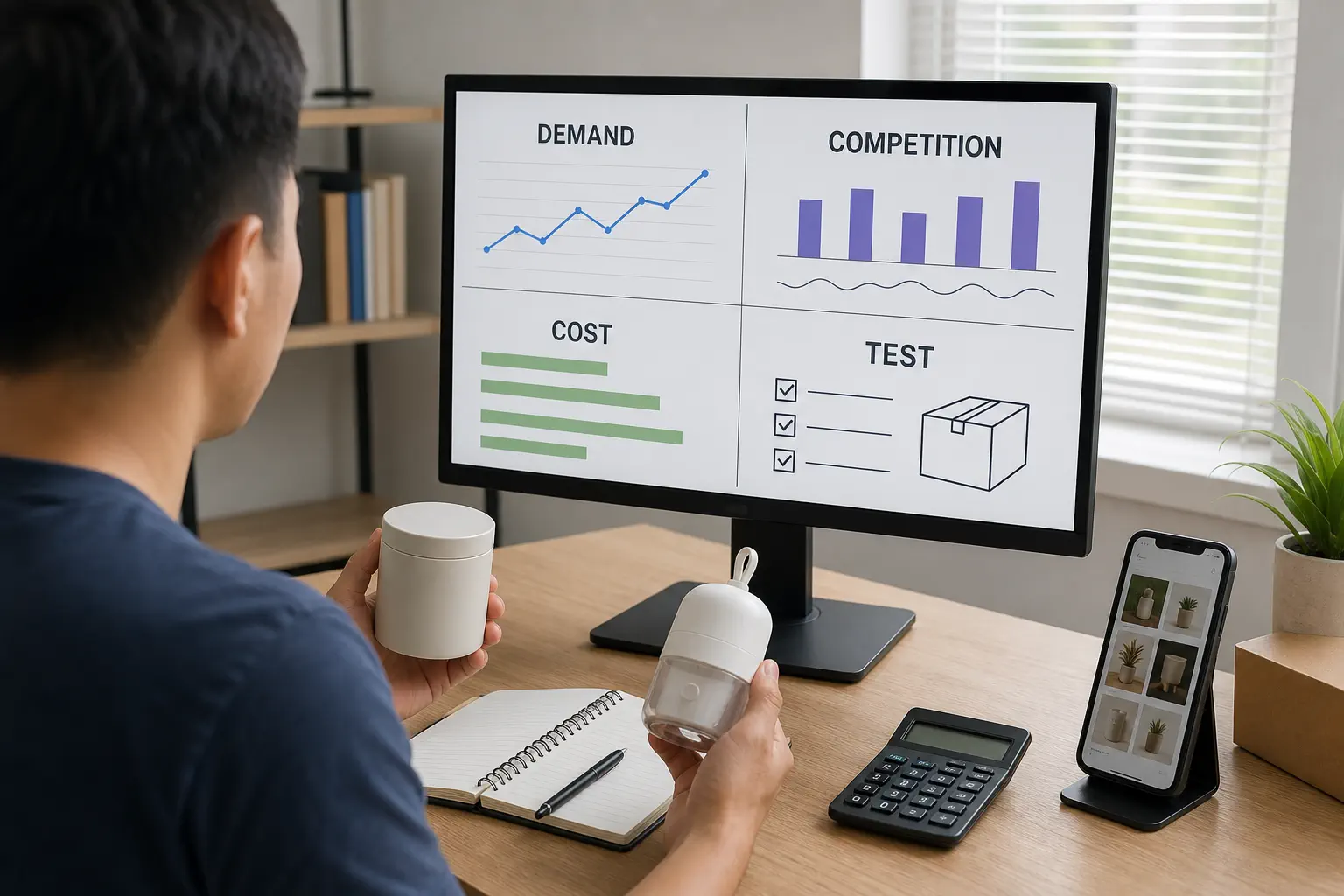
Validate demand with several buyer signals and a small live offer before expanding the catalog. Product popularity alone is weak evidence because heavy competition, fragile margins, unsafe claims, or difficult delivery can make a trending item unsuitable.
Check demand and competition together
Search the product on the channel where you plan to sell. Record the price range, review themes, common complaints, delivery promises, offer bundles, and how many sellers present the same undifferentiated item.
Use search trends, marketplace activity, social comments, and competitor reviews as different signals. A structured product research process is valuable because it connects buyer interest to product risk, supplier availability, and a testable offer instead of treating a trend as proof of profit.
Reject products that are regulated or unsafe for your knowledge level, depend on claims you cannot prove, break easily, have confusing variants, or leave too little room after all costs. Order a sample before using supplier images or promising quality.
Acquire the first customer through one method
Match the customer-acquisition method to the channel. On a marketplace, improve the listing and use a capped promotion only after you know the delivered-order economics. On TikTok Shop, test clear product demonstrations and creator-style content. On an independent store, send one defined audience to one offer instead of buying broad traffic.
The first useful result is not a click or even a placed order. It is a delivered order with known acquisition cost, payment outcome, customer questions, delivery experience, and after-sales result.
Key Takeaway: Approve a product only when demand, competition, safety, delivered cost, and one realistic acquisition method fit the same offer.
Choose Shopee, Lazada, TikTok Shop, or an Independent Store
Choose the selling channel by how customers will discover the product and how much control you need, not by which account is fastest to open. Seller eligibility, fees, logistics programs, and product rules can change, so confirm the current Seller Center terms for your exact account before launch.
| Channel | Choose it when | Accept this tradeoff |
|---|---|---|
| Shopee | You want marketplace demand, built-in checkout, and a familiar local buying flow | Strong price comparison and platform control over seller operations |
| Lazada | Your category fits its marketplace demand and available seller logistics | Similar price pressure and dependence on current platform rules |
| TikTok Shop | The product is easy to demonstrate and you can keep producing content or work with creators | Creative output and fast order handling are part of the operating model |
| Independent store | You want control over brand, offer, customer journey, and data | You must create your own traffic and connect payments, delivery, support, and analytics |
Shopify is the simpler hosted route for many independent stores, while WooCommerce can provide more technical control when you can maintain the site. An independent store does not automatically outperform a marketplace; it changes who must create demand and operate the checkout.
Do not open every channel at once. Prove the listing, payment, supplier, and delivery workflow on one channel, then add another only when the new channel solves a clear limitation.
Key Takeaway: Start with the channel that can produce the cleanest complete test, not the channel with the largest audience or the most fashionable content format.
Set Up COD and Online Payments Before Launch
Treat cash on delivery and online payments as operating systems, not checkout buttons. Each method must connect customer collection, order confirmation, supplier payment, settlement timing, failed-delivery costs, refunds, and record keeping.
When COD makes sense
Offer COD only when the marketplace, courier, or other approved arrangement can collect the money, remit it to you, report failed delivery, and return the parcel under terms you have reviewed. An overseas supplier does not create a COD service merely by shipping to the Philippines; the collection and settlement arrangement must exist at the destination.
Confirm who pays outbound shipping and return-to-origin charges when a customer refuses or cannot receive the parcel. Use address checks and clear confirmation messages where the channel permits them, but never promise that confirmation eliminates failed delivery.
When prepaid methods make sense
Cards, bank transfers, e-wallets, and payment gateways can reduce collection risk, but eligibility, fees, disputes, settlement timing, and refund procedures still matter. The Department of Trade and Industry advises online merchants to establish an appropriate account before using an online payment platform.
Keep enough working capital to pay suppliers and handle refunds while customer funds are unsettled. Never use gross sales as if all of that money is available profit.
Key Takeaway: Enable a payment method only after you can map money from customer collection through supplier payment, settlement, failure, and refund.
Choose a Local or Overseas Supplier

Choose the supplier by the customer promise you need to keep, not by unit price alone. Local and overseas suppliers can both work, but they create different tradeoffs in selection, delivery, returns, cost, and control.
| Supplier route | Possible advantage | Main check |
|---|---|---|
| Local supplier | Shorter domestic route and easier sample or return coordination | Confirm the supplier owns the stock, supports blind shipping, and can update inventory |
| Overseas supplier | Wider product choice and more sourcing or customization options | Confirm processing, cross-border delivery, import responsibility, tracking, and returns |
Before approval, ask for a current sample, exact variant data, stock-update method, processing cutoff, packaging photos, tracking method, return address, and responsibility for wrong or damaged items. Place a test order to the real destination and inspect what the customer receives, including labels, invoices, inserts, and supplier branding.
A public supplier platform can suit early product discovery, while a private arrangement becomes more relevant when repeat demand requires direct coordination, consolidated information, product checks, or custom packing. A dropshipping supplier comparison should therefore evaluate responsibility and route fit, not just catalog size.
When a proven product needs supplier screening, sample coordination, and clearer China-side communication, a dropshipping sourcing agent can add that execution layer. It should not replace demand validation or make an untested offer safe.
Key Takeaway: Approve the supplier only after a physical sample and a complete test order support the quality, packaging, tracking, and delivery promise in your listing.
Plan for Philippine Delivery, COD, and Return Risks
Plan delivery by exact destination coverage because an archipelago creates route differences that a single nationwide promise can hide. A service that works for one city or island may use different handoffs, surcharges, timelines, or return procedures elsewhere.
Ask the carrier or platform which postal codes are served, which areas accept COD, how remote locations are handled, when tracking begins, what counts as a delivery attempt, and where failed parcels go. For cross-border orders, identify the importer, product classification, duties or taxes, and any permit before the listing goes live.
The Philippine Bureau of Customs distinguishes prohibited and restricted imports; regulated goods may require permits or clearance from the relevant agency. Check the current import restrictions for the exact product rather than assuming that a supplier listing proves import eligibility.
Build a simple exception routine:
- Pause new orders when stock or route status is unclear.
- Contact the customer when an address or delivery attempt needs action.
- Record the carrier event and supplier response in one order file.
- Decide whether to resend, refund, or wait under the published policy.
- Review repeated failures by product, supplier, area, and payment method.
Key Takeaway: Promise delivery only for destinations, payment methods, and exception paths that you have confirmed; “nationwide” is not an operating plan.
Check Legality and Register the Business

The business model is not automatically illegal in the Philippines, but the seller must comply with business, tax, consumer, product, import, privacy, and platform requirements that apply to the actual setup. Using a supplier to ship the parcel does not transfer the online merchant’s legal responsibilities to that supplier.
For a deeper explanation of the responsibilities that apply to online businesses in the Philippines, this DTI Philippines consumer webinar explains the obligations of online merchants under the country’s e-commerce framework.
Follow the registration route for your legal form
The DTI’s online-business guidance gives the basic sequence: register a business name with DTI for a sole proprietorship, or the legal entity with SEC for a corporation or partnership and CDA for a cooperative; obtain the applicable LGU or mayor’s permit; register with BIR; and complete employee or sector registrations when they apply. Requirements vary by legal form, location, employment status, and product, so verify the current online-business registration steps and the relevant agency instructions.
A DTI business-name certificate gives a sole proprietor a registered business name, but the BNRS FAQ states that it is not a license to operate; the business still needs the appropriate local permit. BIR maintains current business registration requirements, and its NewBizReg service provides an online submission route for eligible applicants.
Complete the current online-business display requirements
Business registration is not the end of the online-seller checklist. DTI’s current E-Commerce Philippine Trustmark guidance states that online merchants and other covered e-commerce businesses must register for the Trustmark to conduct e-commerce in the Philippines. The current application requirements include the applicable DTI, SEC, or CDA registration, BIR Certificate of Registration, the online channels used for selling, and an internal customer-redress process.
The Trustmark and the BIR Registration Seal Badge are separate requirements issued by different agencies, so do not treat one as a substitute for the other. Check the current DTI and BIR implementation instructions for the exact channels and business pages you operate before launch.
In 2026, BIR also introduced a Registration Seal Badge for online businesses through RMC No. 38-2026. After registration, check whether and how the current online seller badge requirement applies to every store page you operate.
Check the product and customer-data rules
Do not list a regulated product until the correct agency confirms that the seller, importer, product, and advertisement are permitted. This is especially important for categories involving food, cosmetics, medical products, toys, chemicals, electronics, plants, animals, or products that make health or safety claims.
Order details contain customer data. The National Privacy Commission tells online sellers to limit collection, protect personal data against unauthorized use or disclosure, restrict access, and dispose of records securely when retention is no longer justified; review its guidance for online sellers before sharing order information with suppliers and couriers.
Key Takeaway: Register the real business and verify the real product route; “dropshipping” is not a legal exemption or a substitute for agency guidance.
Calculate Startup Capital and Per-Order Profit
There is no responsible universal minimum startup amount because registration, product risk, channel, supplier, destination, acquisition method, and COD reserve differ. Your minimum startup budget is the total cash required to complete one legal setup and one controlled test without depending on uncollected customer money.
Build the budget from quotations and current terms:
- business and permit costs that apply to your legal form and location;
- product samples and at least one complete test order;
- store, marketplace, payment, or technical setup;
- product photos, content, and a capped customer-acquisition test;
- working capital for supplier payments, failed COD, returns, refunds, and settlement delays.
Calculate expected contribution per delivered order as:
selling price − product cost − outbound delivery − channel and payment charges − acquisition cost − expected failed-delivery and return allowance − taxes and other order costs
Use your own current quotations and records for every input. If the result is weak before paying yourself or covering overhead, reduce cost, improve the offer, change the route, or reject the product; do not solve the problem by assuming more volume.
A dropshipping business plan becomes useful when it converts these assumptions into a cash requirement, test limit, and decision rule instead of a revenue forecast.
Key Takeaway: Fund the whole test and its failure reserve, then judge profit from delivered orders after every variable cost—not from the gap between selling price and supplier price.
Run a Small Test Before You Scale
Run one narrow test that can reveal whether the product, offer, payment, supplier, and delivery route work together. More products or channels create more data, but they do not automatically create clearer evidence.
Use this launch sequence
- Define one buyer market, product family, selling channel, payment setup, and supplier route.
- Verify registration, product eligibility, customer policy, and import responsibility.
- Approve a physical sample and complete a test order to the target destination.
- Publish an accurate offer with a capped content or advertising test.
- Track inquiries, placed orders, confirmed orders, delivered orders, acquisition cost, failed delivery, refunds, and customer questions.
- Compare the result with the stop rule written before launch.
Continue when delivered orders support the customer promise and the complete expected cost. Revise when one identifiable part—such as the listing, price, address confirmation, or supplier packaging—causes the problem. Stop when the product cannot meet legal, quality, route, or economic requirements without optimistic assumptions.
If repeat demand eventually requires direct supplier coordination, product checks, custom packing, or more stable order execution, a private dropshipping agent may fit the next stage. That decision should follow evidence from the test, not replace it.
Key Takeaway: Scale only after delivered-order evidence passes a prewritten continue rule; placed orders and supplier assurances are not enough.
FAQ
Can I start without my own website?
Yes. An eligible marketplace or social-commerce channel can support the first test if its seller, product, payment, and delivery rules fit your setup. Use an independent store when you need more control and can generate your own traffic.
Can a supplier outside the Philippines support COD?
Possibly, but supplier origin does not create COD. You need a marketplace, courier, or other approved destination-side arrangement that collects the payment, remits it, reports failed delivery, and handles returns under known terms.
Can I sell to Philippine and overseas customers from one store?
Yes, but only after each market has a separate accurate promise for currency, payment, delivery, duties, returns, privacy, and customer support. Prove one path first so problems from different destinations do not hide each other.
When should I move from a supplier platform to a private dropshipping agent?
Consider moving after repeat demand shows that you need direct supplier communication, product checks, consolidated order handling, custom packing, or more accountable route coordination.
Conclusion
A sound launch begins with one market and one testable customer promise. You now have a way to choose the channel, payment method, supplier origin, delivery route, legal setup, and budget without treating low inventory as low responsibility.
When your test shows repeat demand and you need direct sourcing, samples, product checks, packing coordination, order processing, and shipping arrangements from China, Runtodropship can help as a private dropshipping agent team. Better dropshipping is built on visible execution, not invisible assumptions—bring your product, target market, expected orders, and delivery destination to start a practical fit check.