

A polished ecommerce development project can still fail the first time a real order reaches the warehouse. Product variants may not match supplier SKUs, checkout may promise an unsupported delivery option, or a branded insert may exist only in a chat message.
Ecommerce development is the work of turning a selling model into a functioning system that connects the storefront, product data, checkout, payments, inventory, fulfillment, tracking, and post-purchase service. A useful development brief covers page layouts, features, business rules, and operating handoffs.
1. What Does Ecommerce Development Include for a Seller?
Ecommerce development includes every digital component required to present products, accept orders, move reliable data, and support customers after payment. The visible store is one layer of a larger operating system.
Which layers make an ecommerce store work?
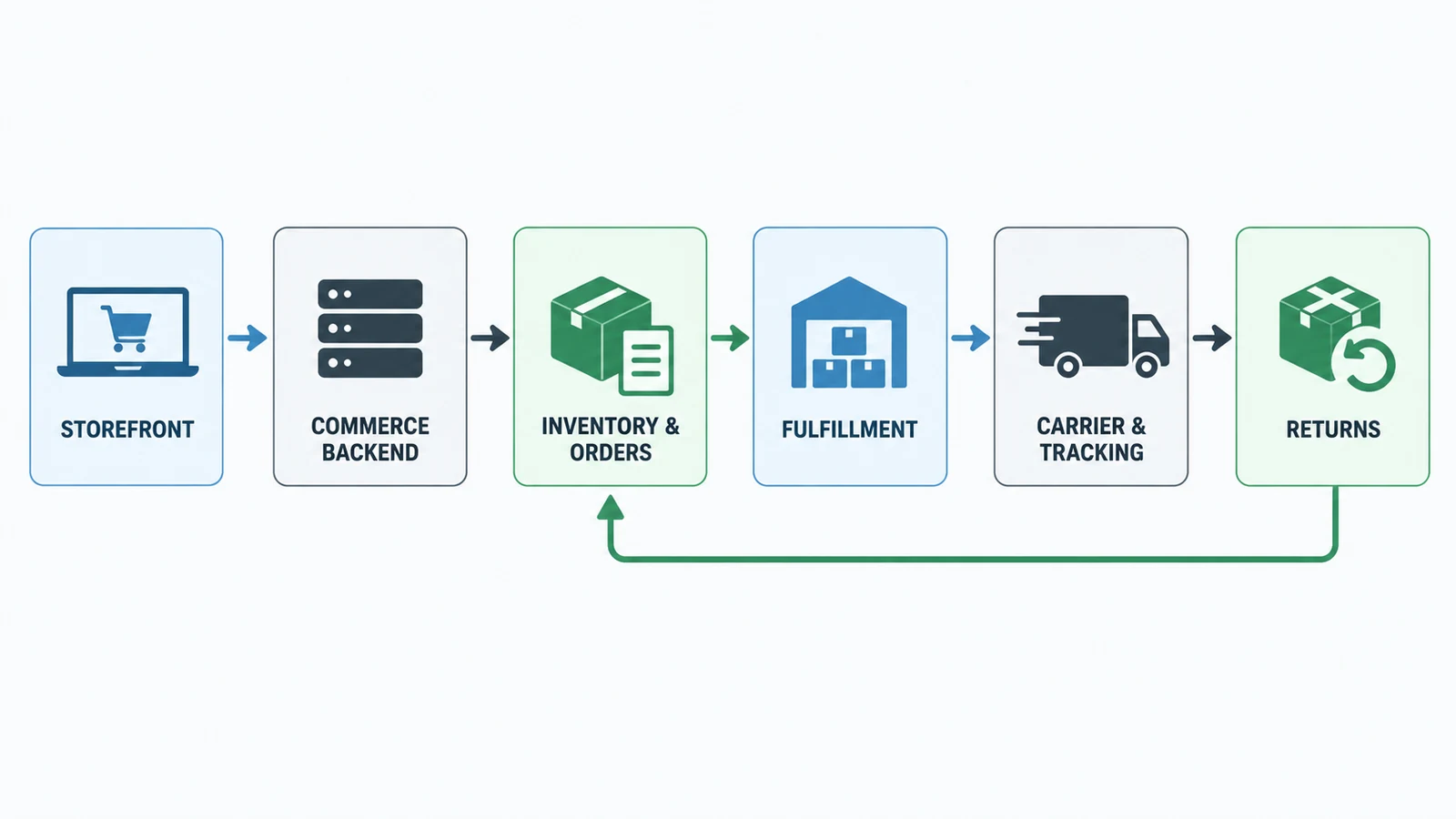
Begin with what the store must do. Most projects combine several connected layers:
- A storefront, for example, handles navigation, product discovery, accounts, and checkout.
- A commerce backend meanwhile manages catalogs, prices, discounts, orders, and customer records.
- The store also needs payment, tax, shipping, analytics, and customer-service connections.
- Finally, operations need inventory, fulfillment, tracking, returns, and accounting systems.
A change in one layer can affect the others. A new bundle, for example, changes product data, stock logic, packing instructions, order value, and sometimes the shipping method.
What should be documented before anyone writes code?
Document the decisions that control revenue, customer promises, and operational work. Give each decision an owner and describe the evidence that will prove the finished store follows it.
| What to define before build | Owner | Evidence before sign-off |
|---|---|---|
| Before build: product and variant rules | Merchandising | Approved catalog and test products |
| When an order changes stock | Operations | Test orders and inventory changes |
| When payment or refund occurs | Finance | Authorized, failed, and refunded payments |
| When an item ships or returns | Operations and support | Valid rates, tracking, and exception tests |
This table turns a feature discussion into a reviewable operating agreement. Key Takeaway: Define the business result and its proof before selecting themes, apps, or developers.
2. Which Development Approach Fits Your Business Stage?
The right ecommerce development approach is the least complex option that can meet your verified requirements. A hosted platform may suit a straightforward launch, while open-source or custom architecture becomes relevant when standard behavior cannot support the business model.
When do hosted, open-source, and custom builds make sense?
Let documented constraints choose the architecture. Compare the approaches through operating consequences:
- Hosted platforms generally reduce infrastructure and routine maintenance work.
- Open-source systems offer deeper control but require technical ownership.
- Custom or headless builds, by comparison, support unusual workflows at a higher delivery and maintenance burden.
- Low-code tools may speed up validation when the catalog and integrations remain simple.
Sellers still testing a model can review AI dropshipping website builder options before paying for custom behavior they may not need.
Which conditions should change your choice?
Catalog complexity, customer roles, pricing rules, integration count, market coverage, and internal technical capacity should drive the decision.

| Approach | Strong fit | Main burden |
|---|---|---|
| Hosted platform | Standard store and fast launch | Platform limits and recurring dependencies |
| Open source | More control with technical resources | Hosting, updates, and security ownership |
| Custom or headless | Distinct workflows and complex integrations | Delivery risk and continuing engineering cost |
The simplest workable architecture usually leaves more budget for product validation and operations. Key Takeaway: Increase technical complexity only when a documented requirement makes it necessary.
3. What Requirements Should You Define Before Development Starts?
Define customer, catalog, market, and operating rules before development starts. Vague requirements force developers to make business decisions that belong to the seller.
Which customer and catalog rules belong in the brief?
Make every rule testable. Record the conditions that change what a customer sees or what the team must do:
- Define customer roles, account approval, and B2B or retail pricing before development starts.
- Document every product, variant, bundle, subscription, and restricted item when the catalog includes special offers.
- Set currencies, languages, tax inputs, and address rules by market because each market has its own rules.
- Define discount priority, stock messages, order limits, and cancellation windows when promotions overlap.
- Assign ownership for product content, images, search filters, and categories before handoff.
Google's ecommerce site guidance treats product data and site structure as development concerns.
How do you turn requirements into acceptance criteria?
Write scenarios that name the starting condition, customer action, expected result, and proof. Include failures and exceptions alongside the normal purchase path.
| When this happens | Expected result | Evidence |
|---|---|---|
| When a variant is unavailable | Purchase is blocked or routed by the agreed rule | Store and inventory records |
| When a discount conflicts with a B2B price | Approved priority rule applies | Test account and order |
| When an address is unsupported | Customer receives a clear next action | Checkout test |
| When a refund is approved | Payment and order status remain aligned | Refund record and notification |
Acceptance criteria give procurement, operations, and development one definition of completion. Key Takeaway: A requirement is incomplete until the buyer and delivery team can recognize whether it passed.
4. How Should Products, Inventory, and Orders Connect?
Products, inventory, and orders should connect through named systems of record and explicit events. Synchronization becomes unreliable when two systems can change the same record without a conflict rule.
Which system should own each data record?
Decide ownership before synchronization. Assign one authoritative source for each critical object:
- Choose the source of truth for product identity, SKU, variant, and bundle data before data sync begins.
- Name the system that owns sellable stock, reserved stock, and replenishment status when stock changes.
- Name the system that owns each order, payment, fulfillment, tracking, return, and refund record when an order is paid.
- Likewise, assign ownership for packaging versions, insert instructions, and market-specific handling rules.
The software connection should move approved data without obscuring its owner. A dashboard that shows stock does not automatically control stock.
What events must pass between the store and operations?
Map the full order lifecycle: payment confirmation, stock reservation, sourcing or allocation, fulfillment acceptance, shipment, tracking, delivery exception, cancellation, return, refund, and replacement. The operational layer is explained further in dropshipping supply-chain execution.
RuntoDropship's private-label workflow records packaging as order data before branded orders go live. Approved packaging versions, artwork revisions, and SKU rules become fulfillment instructions. Missing or unclear rules need an exception path, while the development brief defines identifiers, eligibility, version status, and fallback behavior.
| When this event occurs | Sending system | Receiving action |
|---|---|---|
| When payment is confirmed | Store or payment service | Reserve stock and release order |
| When fulfillment accepts the order | Warehouse or agent | Pick, check, pack, and dispatch |
| When a shipment is created | Fulfillment system | Return carrier and tracking data |
| When a return is approved | Support or returns system | Route item and refund decision |
The diagram and table expose handoffs that a page mockup cannot show. Key Takeaway: Design the order lifecycle and exception states before choosing integration tools.
5. What Must Checkout, Shipping, and Returns Handle?
Checkout, shipping, and returns must translate the seller's real policies into consistent customer-facing behavior. The store should never promise an option that downstream systems cannot execute.
Which decisions belong in checkout rather than after purchase?
Checkout promises continue after payment. Define these items before development:
- Define payment authorization, failure, retry, capture, and refund behavior before launch.
- Set the validation, service-region, shipping-method, and delivery-message rules for when an address is invalid.
- Define confirmation, preorder, split-shipment, and substitution rules for when stock is limited.
- Name the party that supplies each tax or duty input, since the data may come from outside providers.
- Record required consent, customer notices, and return-policy access before checkout.
Payment scope deserves explicit review. The PCI Security Standards Council maintains the applicable card-data security standard, while the merchant and its providers still need to define their respective responsibilities.
Which edge cases should be specified and tested?
Test duplicate notifications, failed payments, partial stock, invalid addresses, split parcels, cancellations, refunds, replacements, and unavailable packaging. Accessibility testing should cover the complete purchase process; WCAG 2.2 treats a multi-page transaction as a complete process.
| Edge case | Required decision | Test result |
|---|---|---|
| Payment succeeds twice | Idempotent order or refund rule | One valid order outcome |
| One item is unavailable | Hold, split, replace, or cancel | Approved path is visible |
| Tracking is delayed | Escalation and customer message | Status and owner recorded |
| Return arrives damaged | Inspection and refund rule | Consistent case record |
Exception tests connect customer policy with technical behavior. Key Takeaway: Protect the order's failure paths with the same care given to the normal checkout.
6. How Do You Choose an Ecommerce Developer or Agency?
Choose a developer or agency by comparing the same scope, evidence, ownership terms, and support boundary. A low quote can exclude migration, integrations, testing, documentation, or post-launch work.
What should a proposal define before price is compared?
Compare like with like. Require every proposal to state:
- Require deliverables, exclusions, assumptions, milestones, and an acceptance method before comparing prices.
- Name the platform, hosting, and third-party services, as well as all recurring costs.
- Define migration, redirects, integrations, test data, and launch responsibilities when data must move.
- Confirm ownership of domains, accounts, code, designs, data, and documentation before signing.
- Finally, set the warranty, support window, maintenance options, and change pricing.
Do not accept “integration included” without naming the systems, objects, directions, triggers, and exception handling.
How can you verify delivery capability before signing?
Ask the supplier to explain an architecture decision, show a test or handoff sample, describe a failed integration, and identify what happens when a dependency changes. References should match the project's platform and complexity.
| Evidence | What it reveals | Warning sign |
|---|---|---|
| Architecture explanation | Decision quality | Technology chosen without requirements |
| Acceptance-test sample | Delivery discipline | Only visual approval is planned |
| Handoff package | Ownership readiness | Accounts stay with the supplier |
| Support boundaries | Post-launch responsibility | No incident or update process |
These checks reveal working method before the contract transfers risk to the buyer. Key Takeaway: Evaluate how the team decides, tests, and hands over the system; proposal adjectives carry no evidence.
7. How Should You Test an Ecommerce Store Before Launch?
Test the complete order journey, the connected systems, and the recovery path before launch. A page can render correctly while payment, stock, fulfillment, or tracking silently fails.
Which end-to-end flows need acceptance testing?
Test the operation behind the page. Use representative combinations of:
- For example, test by product, variant, bundle, market, currency, device, and customer role.
- Then run search, cart, discount, checkout, payment, and order creation.
- Verify fulfillment acceptance, tracking, cancellation, and return behavior when stock changes.
- Also, force a failed payment, duplicate event, unavailable item, and delayed shipment.
Use production-like configurations without exposing real customer data, then save the result, evidence, owner, and retest status.
What launch controls reduce avoidable failures?
Use staging, tested backups, redirects, monitoring, access control, error logs, rollback criteria, and a named incident owner. Security acceptance can draw from the OWASP Application Security Verification Standard, while performance checks should include field and lab evidence for Core Web Vitals.
| Launch gate | Evidence | Owner |
|---|---|---|
| Order journey passes | Test order records | Product and operations |
| Integrations recover from failure | Retry and exception logs | Development |
| Redirects and crawl paths work | URL checks and sitemap | SEO and development |
| Rollback is usable | Restored backup or release procedure | Technical owner |
The official platform walkthrough shows setup; the launch gate verifies the seller's actual workflow. Key Takeaway: Launch only after business flows, integrations, and rollback have named owners.
8. How Should You Plan Time and Budget Without Guessing?
Plan ecommerce development time and budget from deliverables, dependencies, and uncertainty rather than one universal price or deadline. Two stores on the same platform can require very different work.
Which factors change development effort?
Estimate each dependency. The largest drivers usually include:
- Check requirement clarity and approval speed before estimating.
- Allow more work when catalogs, pricing, customer roles, or markets become more complex.
- Include design, migration volume, and content readiness because original design and large migrations add work.
- Also, assess the number and quality of integrations.
- Allow for security, accessibility, and deeper testing when business logic is custom.
- Finally, budget for documentation, training, stabilization, and maintenance.
Unknown integrations should become a discovery task or an explicit allowance.
How should the project be phased and controlled?
Separate discovery, prototype, core commerce, integrations, migration, QA, launch, stabilization, and continuing maintenance. Price or approve scope changes before implementation, with their effect on acceptance and schedule.

| Phase | Decision produced | Budget control |
|---|---|---|
| Discovery | Approved requirements and risks | Resolve unknowns before build |
| Core build | Working commerce flow | Demo against acceptance criteria |
| Integrations and migration | Verified data movement | Test with representative records |
| Launch and stabilization | Operable production system | Reserve support and rollback capacity |
Phasing keeps unverified assumptions from consuming the full budget. Key Takeaway: Lock acceptance criteria and approve scope changes before they become code.
9. How Do You Keep Development Aligned With Operations?
Keep development aligned with operations by assigning ownership after launch and reviewing every change against the order lifecycle. Ecommerce software will continue changing after the first release.
Who owns the store after launch?
Handoff decides what happens next. Record the owner and recovery path for:
- Record domain, hosting, platform, code repository, and deployment access before handoff.
- Also, assign payment, analytics, email, search, and third-party accounts.
- Name owners for inventory rules, fulfillment connections, and reports when product or stock data changes.
- Likewise, assign monitoring, backups, updates, security patches, and incidents.
- Finally, save documentation, training records, vendor contacts, and renewal dates.
Checkout, payment, inventory, and fulfillment changes deserve staging and end-to-end retesting.
When does a Private Dropshipping Agent enter the workflow?
A developer builds or configures the commerce system. A Private Dropshipping Agent coordinates physical sourcing, supplier communication, QC, inventory, fulfillment, shipping, tracking, and after-sales work. Qualified Shopify sellers can connect those responsibilities through a Shopify dropshipping agent workflow after the store's product and order rules are clear.
| Responsibility | Development team | Private agent or operations team |
|---|---|---|
| Storefront and checkout | Build and maintain | Supply operational requirements |
| Order-data connection | Implement and monitor | Confirm required fields and statuses |
| Product and package execution | Represent rules in data | Source, check, pack, and release |
| Tracking and exceptions | Display and route updates | Return actual status and resolve cases |
The roles depend on each other without becoming interchangeable. Key Takeaway: Connect the digital store with physical execution through explicit data and responsibility boundaries.
10. How Should You Move From a Plan to a Reliable Store?
Move from plan to reliable store by documenting operating rules, choosing the least complex workable approach, contracting on comparable scope, testing full order journeys, and assigning post-launch ownership. Turn these decisions into one reviewable brief.
RuntoDropship does not develop ecommerce websites. As a private dropshipping agent, it can help qualified sellers define the sourcing, packaging, inventory, fulfillment, tracking, and after-sales information that their store or developer must support. To discuss that connection, share your platform, product link, destination markets, expected order volume, and current order-handling problem.
Can I build an ecommerce store without hiring a developer? Yes, when a hosted platform supports your catalog, checkout, and integrations. Add development help when required behavior exceeds standard settings.
What's the best approach: hosted, open-source, or custom? Choose the least complex approach that meets documented requirements. Compare control, maintenance, integrations, internal skills, and expected changes.
How do I know if a development quote covers the real scope? Match every quote against the same scope, integrations, migration, testing, ownership, documentation, launch, and support checklist.
What should I test before an ecommerce site goes live? Test complete journeys from product discovery through payment, order creation, inventory change, fulfillment, tracking, cancellation, refund, and return. Include failure states and verify rollback.
Can a developer also manage sourcing and fulfillment? Only if that operational service is explicitly included and evidenced. Development and supply-chain execution are different responsibilities, so define the handoff, data, owner, and exception path for each.