

You are arranging cosmetics fulfillment for a batch of face cream your supplier has finished. The cartons carry a lot code, and the jars show a period-after-opening symbol, but the operator asks which expiry to enter. Guessing a date can turn an unresolved product question into an instruction that staff follow on every order. Leaving the question unanswered can hold up stock you expected to sell.
Cosmetics fulfillment covers receiving, storing, picking, packing and dispatching finished cosmetic products under an agreed operating scope. For unopened inventory, a usable release decision needs product-specific dating information, applicable handling conditions and a clear agreement about which stock can ship. Start by checking what your evidence establishes before asking a provider to act on it.
What should a cosmetics fulfillment brief establish?
A cosmetics fulfillment brief should identify the finished products, who supplies their dating information and which checks the operator agrees to perform. When comparing quotes for end-to-end order fulfillment, make those responsibilities part of the same discussion as receiving and dispatch.
Keep product evidence and operator checks separate
The manufacturer supplies the product’s shelf-life basis; the operator needs instructions it can apply to the stock it handles. Ask the brand or other product-responsible party to obtain the maker’s answers and identify who can approve unresolved questions. Before selling makeup without inventory, reject suppliers that cannot identify the legal manufacturer or provide formula-specific documents, batch traceability, stable shade mapping and representative samples.
- Identify the exact product, formula or variant and container.
- State the intended sales market and receiving channel.
- Name the person supplying the dating and handling information.
- Specify the checks and records you expect the operator to maintain.
Define the decision before requesting a quote
First establish whether you are dealing with a cosmetic-only product. In the United States, intended use and claims can affect whether an item is a cosmetic, a drug or both; sunscreen and acne-treatment products need their separate requirements checked. A warehouse service description cannot settle that classification for you.
Key Takeaway: Give prospective partners a product-specific evidence brief so their proposals cover the checks you need and identify questions outside their authority.
Warehouse sorting scene from the existing media library.
What do the dates and symbols on the pack actually prove?
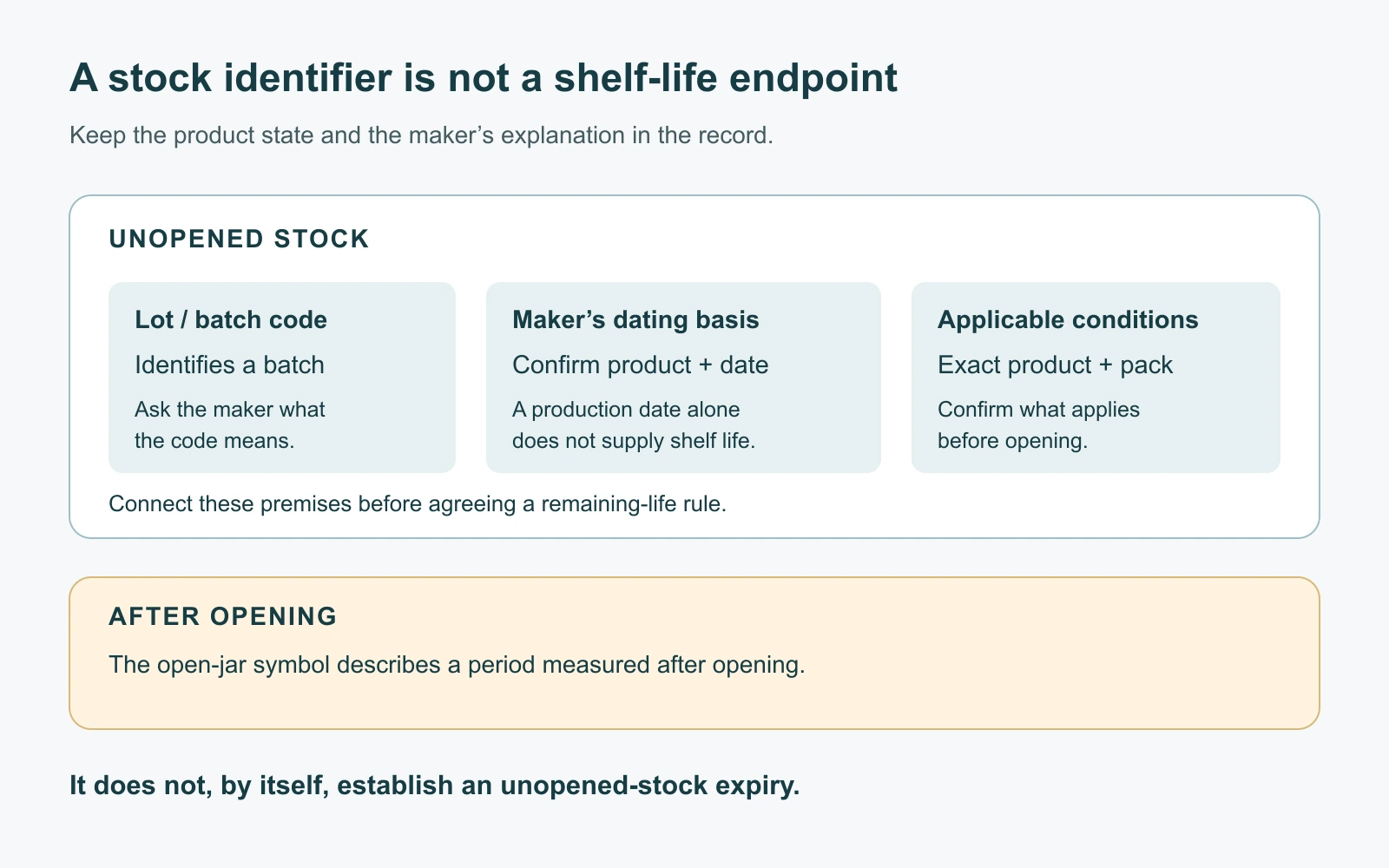
A lot code identifies a batch, a maker-confirmed manufacture date identifies production, a printed expiry states an endpoint, and the open-jar symbol describes time after opening. Keep the original marking alongside the manufacturer’s explanation rather than replacing it with your own interpretation.
Separate identifiers from usable dates
A batch code can identify stock without revealing its production date. Even when a code resembles a month and year, ask the maker what it means and which product or package it applies to.
- Keep a photo and the exact characters of the marking.
- Record who confirmed its meaning and which product it covers.
| Marking or field | What it can establish | What you still need to confirm |
|---|---|---|
| Lot or batch code | Identity of a maker-defined batch | The maker’s code meaning and product match |
| Manufacture date | Production date, when confirmed by the maker | The applicable unopened-life basis |
| Printed expiration date | A stated endpoint | Its product scope and applicable conditions |
| Period after opening | A period measured after opening | Separate evidence for unopened stock |
Use the final column in your own records to assign the next question to the product owner; filling every date field is not the objective.
Read the open-jar symbol in its proper scope
The European Commission’s explanation of the open-jar symbol describes time after opening. That symbol alone gives you no unopened-stock endpoint from which to calculate remaining life. Check your sales market’s rules about labeling separately.
Key Takeaway: Ask for the missing meaning or dating basis before turning a package marking into an inventory instruction.
What if the cosmetic has no printed expiration date?
Ask for the manufacturer’s dating basis and the receiving channel’s actual acceptance requirement when a cosmetic has no printed expiry. An absent label field does not decide whether a particular lot meets your commercial agreement.
Get a usable answer from the product owner
FDA’s cosmetics shelf-life guidance says U.S. cosmetic-only products are not universally required to have specific shelf lives or labeled expiration dates. FDA still treats determining shelf life as the manufacturer’s responsibility. That leaves a practical question for your stock:
- What unopened-life information does the maker supply for this product?
- How does that information connect to the actual lot or production date?
- Does the receiver require a printed date, a data field or another documented basis?
Resolve the requirement without inventing a date
Send the actual label and maker’s explanation to whoever controls the receiving requirement. Ask how the product should be represented when the required information is unavailable. Keep the field unresolved until an authorized answer supports it; a software system accepting an entered date does not establish that date’s validity.
Key Takeaway: Resolve the mismatch between product evidence and receiving requirements before booking stock against an assumed expiry.
Which conditions apply while the stock is unopened?
Use the conditions that apply to the exact unopened cosmetic and its packaging, supported by the maker’s instructions. An after-opening direction answers a different handling question and cannot supply missing sealed-stock specifications.
Match the instruction to the actual stock state
For example, the words “refrigerate after opening” specify when that instruction applies. Ask the manufacturer separately what applies before opening. Check the instruction against:
- The exact formula, container and closure being supplied.
- Whether the stock remains unopened during the proposed process.
- The stated storage and handling conditions.
- The evidence the operator can retain about those conditions.
Check conditions through each handoff
Ask what happens between storage and dispatch as well as on the storage shelf. A claim such as climate-controlled storage needs an applicable range and evidence of the conditions maintained; it does not establish what the product needs. Use warehouse storage and acceptance checks to turn that discussion into specific operating questions.
FedEx describes its liquid-packing video as a guide to limiting spills and spoilage. Its written liquid-shipping guidance applies only to non-hazardous, non-dangerous liquids. Keep that packaging scope separate from shelf-life validation or permission to carry a particular perfume or another potentially restricted product. Key Takeaway: Compare the product’s unopened-state requirements with what each handling stage can maintain and document.
How should you agree a remaining shelf-life requirement?
Agree a minimum remaining unopened life only after you have a valid product-specific endpoint or dating basis and know where in the process the requirement is measured. The commercial acceptance window is a separate decision from interpreting the maker’s information.
Start with the endpoint and the measurement stage
Before discussing a minimum remainder, put the premises in writing:
- The applicable unopened-life endpoint or documented dating basis.
- The actual lot and confirmed date information used.
- The conditions under which that basis applies.
- Whether the minimum is checked at receipt, dispatch or delivery.
Then ask the brand or channel to confirm the acceptance window for that stage. A requirement at dispatch and one at delivery ask the operator to assess different points in the order journey.
Set an exception path before routine picking
Name who decides when a date is unreadable, a required input is missing or an order no longer meets the agreed window. Choosing the oldest arrival or the earliest valid expiry is a stock-sequencing choice; neither creates a missing endpoint. Keep affected stock or orders outside routine release until the authorized decision is recorded.
Key Takeaway: Specify when staff check the release rule and what they should do if required information is missing or the stock no longer meets it.
How do lot records make a release rule usable?
Lot records make a release rule usable by connecting its instructions to identifiable stock and, where supported, the orders or recipients supplied from that stock. A product-level inventory total leaves the batch-specific question unanswered. Jewelry needs a different counting rule: a jewelry warehouse partner should record each sellable piece, pair or named set with its required components and variants.
Connect the instruction to identifiable stock
The GS1 traceability framework describes batch identification and events such as receiving, packing and shipping. Use that principle to ask a provider to show the relationships it can retain:
- Product and lot identity.
- The applicable dating information and instruction version.
- The stock covered by the release decision.
- The supported link to outbound orders or recipients.

Illustrative sealed-stock scene.
Check what happens after the stock leaves
A March 2019 public recall announcement identified eyeshadow SKU 84716 and lot 08/17; the FDA-hosted notice now marks that recall completed and terminated. The historical notice illustrates why a lot-specific instruction needs to be matched to stock and recipient records. It supplies no evidence about how a fulfillment provider performed, and the lot string should not be decoded as an expiry.
Key Takeaway: Before relying on lot-specific release instructions, check that the provider can show which stock and supported outbound records they apply to.
What should a provider demonstrate before you commit?
Ask a cosmetics fulfillment provider to demonstrate how its proposed process handles a known product record and an unresolved date. Use a worked example with the fields your stock requires to assess the proposed process.
Use an unknown date in the demonstration
Give the prospective operator the product information you have, with a missing or unreadable field clearly identified. Ask it to show:
- Where it retains the original marking and maker’s explanation.
- How the unresolved field appears to staff.
- Which instruction prevents an unsupported default date.
- Who can approve an exception and where that answer is recorded.
This is a proposed onboarding check, so confirm the actual capability rather than assuming every provider has the same system.
Agree the limits of coordination and QC
Keep agreed visual and packaging QC separate from the manufacturer’s shelf-life work. Inspection can address the specified visible checks; it cannot supply an absent stability basis. Likewise, sourcing products with handling restrictions requires product-specific decisions beyond a general beauty-category listing.
Ask RuntoDropship, a Private Dropshipping Agent, about private-agent support for cosmetics orders, including the supplier coordination, QC and packaging tasks in your brief. Bring the product evidence and proposed checks so the applicable scope can be confirmed. Key Takeaway: Choose a partner whose demonstrated records and agreed responsibilities match the product decision you need carried out.
Conclusion
Preparing unopened cosmetic stock for dispatch requires a usable connection between the product, its dating basis, applicable conditions and the release agreement. Establish those premises before asking an operator to apply a remaining-life rule or trace a lot through orders.
RuntoDropship can discuss supplier coordination, QC and packing support within its role as a Private Dropshipping Agent. To talk to RuntoDropship, bring the product details, label images, maker’s dating information and intended market. We believe operating instructions should reflect the product evidence available and make unresolved questions visible before dispatch.
FAQ
Does intake preparation include the customer parcel?
Only if that is the agreed final packing arrangement. Have the operator identify the parcel the customer will receive and any repacking or outer protection it adds. An inbound preparation instruction alone leaves that handoff undefined.
Can opened cosmetic returns go back into saleable stock?
Do not return an opened or uncertain-condition cosmetic to saleable stock solely because a refund has been processed. Follow the product owner’s agreed assessment and disposition instructions, including who can approve release. The customer’s refund and the unit’s stock status require separate decisions.
Does a delivery scan confirm the warehouse unit count?
Check what the carrier record establishes, then reconcile the expected SKU and quantity against the operator’s receiving record. A delivery status leaves the unit-count question unresolved when those records disagree. Agree who investigates the discrepancy instead of treating one status label as the full account.
How should I check compensation for missing stock?
Ask which written valuation rule applies, together with its required records, limits and claim timing. Check this before assuming compensation will equal retail price or product cost. The actual agreement needs to supply that answer; a peer’s reimbursement does not establish your terms.
Does a return label mean a perfume can be sent back?
A supplied label can leave questions about the actual return unresolved, particularly when the product has been opened or its packaging has changed. Confirm that the item, package and reverse route match the responsible carrier’s requirements before directing the customer to send it. Give the buyer instructions confirmed for that return.