

Your dashboard shows a strong completion percentage, yet customers still report missing items. Your supplier’s report and your store report also disagree. Changing stock levels or blaming a fulfillment team at this point could mean acting on two different measurements. Fulfillment rate is the percentage of eligible orders, lines or units that meet a stated fulfillment condition. A useful report identifies the counted unit, eligible population, success event and observation cutoff. Those choices let you reproduce the result and compare it with another report fairly.
What does fulfillment rate measure?
A fulfillment rate measures demand meeting a defined condition; the percentage needs a counting unit and success rule to be meaningful.
Locate that event within your order fulfillment process, so everyone knows which part of the work the report evaluates. A stock-availability measure and a completed-shipment measure need their respective conditions stated.
Name the success condition before the percentage
APQC defines order fill rate as the percentage of sales orders filled completely. Its order-fill measure provides a complete-order definition. In MIT’s inventory model, item fill rate is the fraction of demand filled from inventory on hand.
A report’s counting rule identifies:
- The eligible demand population.
- Whether the unit is an order, line or product quantity.
- The event that qualifies as success.
- Any stock-availability or timing condition.
Which question should this measure answer?
A complete-order report asks whether the customer’s required order was filled. In MIT’s model, the item fill rate counts demand filled from stock on hand. The MIT inventory lecture also distinguishes a different inventory measure: Cycle service level measures the probability of no stockout during a replenishment cycle.
Key Takeaway: Define the counted unit, success event, eligible population and reporting cutoff before comparing fulfillment percentages.
How do order, line and unit fill rates differ?
Order, line and unit fill rates apply different completeness tests, so the same demand can produce three different percentages.
Keep the numerator and denominator in the same unit
An order can contain several lines, with each line identifying a product or service. APQC defines order-line fill rate as the percentage of order lines filled completely. Its line-fill definition uses lines in both counts. For a complete-order measure, check every required line before marking the order complete.
In this constructed teaching example, all quantities use the same countable base unit and one observation cutoff. A line is complete when its filled quantity equals its requested quantity; an order is complete only when all its lines are complete:
- A: three lines, filled at 2/2, 1/1 and 7/7 units.
- B: two lines, filled at 9/10 and 1/1 units.
- C: one line, filled at 5/9 units.
What does one illustrative dataset reveal?
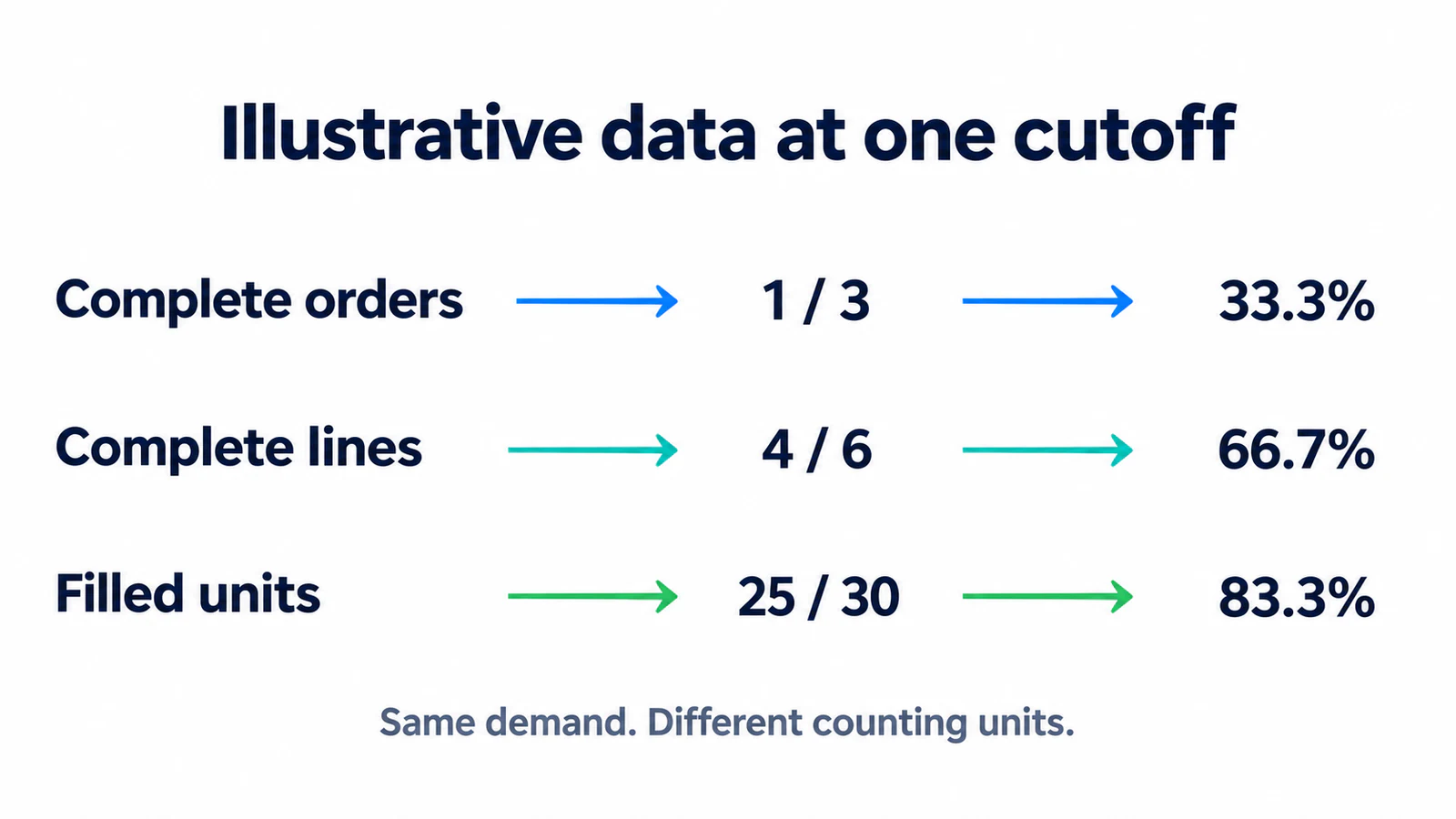
The synthetic example has 1/3 complete orders, 4/6 complete lines and 25/30 filled units, giving 33.3%, 66.7% and 83.3% at one stated cutoff. These are arithmetic illustrations, not customer or company results; no inventory-on-hand condition is assumed.
| Measure | Calculation | Question answered |
|---|---|---|
| Complete orders | 1 ÷ 3 × 100 = 33.3% | How many orders have every required line complete? |
| Complete lines | 4 ÷ 6 × 100 = 66.7% | How many lines have their full required quantity? |
| Filled units | 25 ÷ 30 × 100 = 83.3% | How much requested quantity is filled at the cutoff? |
Most units are filled, while only Order A is complete. Key Takeaway: Whole-order completion and quantity completion answer different questions; the larger percentage cannot substitute for the other measure.
Which orders and cutoff belong in your calculation?
Your calculation needs one defined order population observed against the same success event and cutoff.
Define the cohort and the clock
A cohort is the group of orders selected for the report. Shopify’s Orders over time report counts orders received in the selected period; Orders fulfilled over time counts orders fulfilled, shipped or delivered in that period. The official report descriptions therefore describe different event-based totals.
Use matching order populations for numerator and denominator; do not divide unrelated receipt-period and fulfillment-period totals and call the result a completion rate. A reproducible reporting specification records:
- Cohort start and end timestamps, with timezone.
- Counted unit, eligibility and exclusion rules.
- Completion event and first-attempt or final-completion rule.
- Observation cutoff and applicable operating calendar.
Separate the first attempt from later completion
Report first-attempt or stated-cutoff performance separately from later completion. An order completed after an initial cutoff belongs in a later-completion view under that rule. A working-day deadline also needs its operating calendar recorded so another reader can reconstruct the same cutoff.
Shopify rolling report ranges include the current period by default, even while it is in progress. Compare closed periods or explicitly mark the unfinished part of the current period. Key Takeaway: A supplier’s percentage needs its cohort dates, event, timezone and observation cutoff before you can reproduce its meaning.
How can you check the records behind the percentage?
You can check the result by rebuilding the qualifying count from records belonging to the same eligible population.
Reconcile order counts and line quantities
Shopify order exports place additional line items from one order on separate CSV lines. Shopify’s documented order export has separate Created at, Fulfilled at and Canceled at fields, plus line-item quantities. When using a multi-line order CSV, count unique order identities for an order-level measure.
To reconcile the counts, the documented export structure provides a useful platform-specific example for checking:
- Order identity and the source’s line-level identity.
- Requested quantities and quantities qualifying by the cutoff.
- Created, completed and canceled dates.
- Repeated rows or events and any exclusion reason.
Check exclusions against individual records
Document cancellation, hold and order-change treatment before calculating the rate, and retain the reasons for exclusions. This is a reporting convention to declare, rather than a universal instruction to remove canceled or delayed demand. The numerator should remain the qualifying subset of the denominator you defined.
Your order execution records and exceptions provide the workflow context for tracing release and handling decisions. For an included or excluded record, the useful question is whether its identity, quantity, event and reason explain its treatment.
Key Takeaway: An aggregate becomes reviewable when an individual record can be traced to the stated counting rule.

What should you investigate when the rate falls?
A falling fulfillment rate calls for checking the missed records by stage before choosing a stock or process intervention.
Trace exceptions to their actual stage
APQC’s warehousing scope includes receiving and inspecting deliveries, tracking product availability, picking, packing, shipping and checking inventory accuracy. Investigate each missed physical-goods order using the applicable stock, receiving, release, handling and shipment records before choosing a corrective action.
For each missed order, the investigation can ask:
- Stock or supplier receipt: was the required quantity available at the relevant time?
- Release or hold: what reason and timestamp were recorded?
- Picking or packing: do recorded quantities match the required lines?
- Dispatch or handoff: does the evidence meet the report’s chosen event?
- Data: is an event absent from the report or absent from the operation?
Choose the next check from the evidence
For a Shopify seller investigating stock-record discrepancies, Shopify inventory controls are a relevant next resource. The question is which stock settings or synchronization records explain the discrepancy. Grouping comparable misses by product or channel keeps that investigation tied to actual counts.
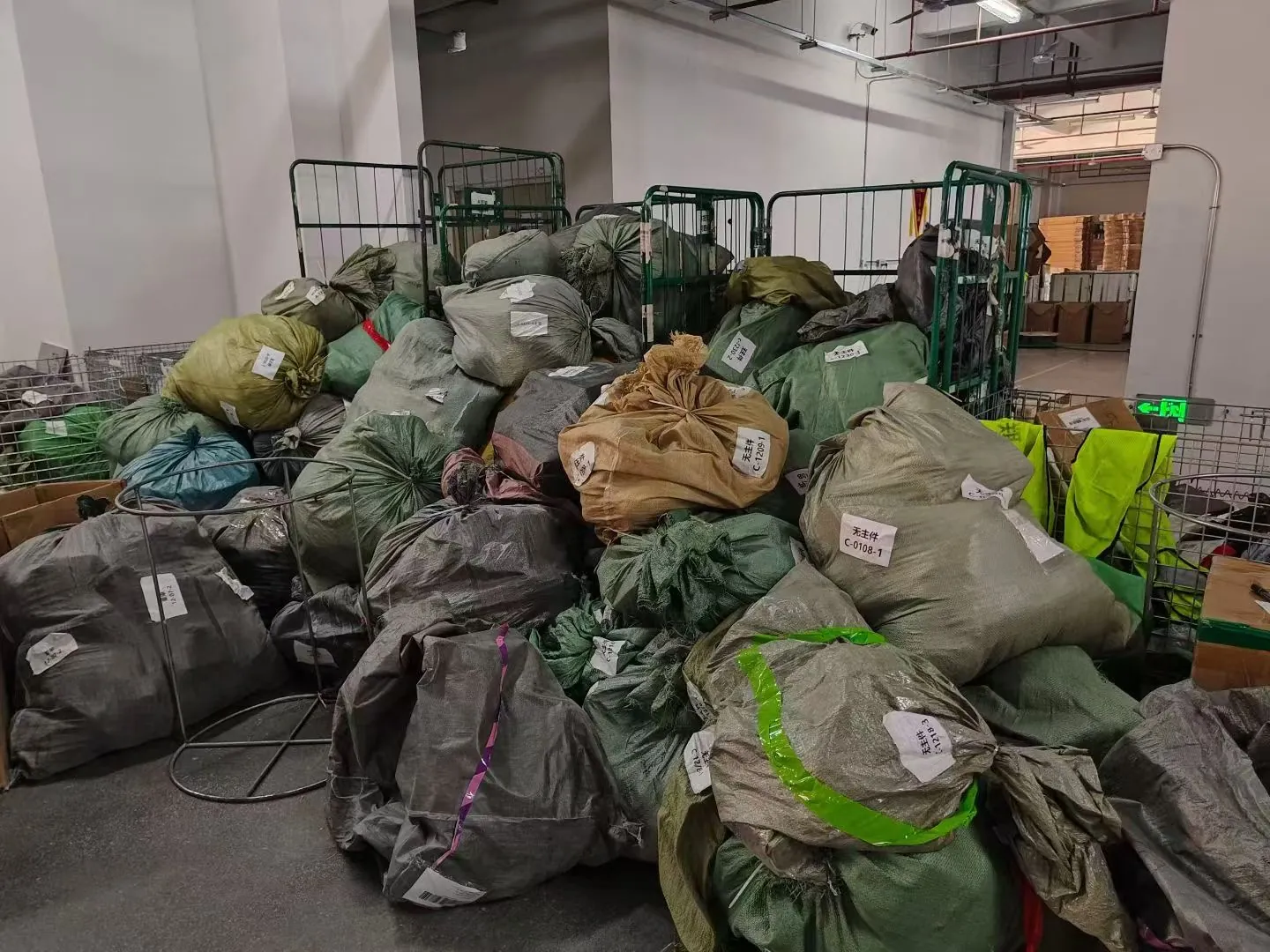
The warehouse photograph shows loaded freight sacks beside cage trolleys. Use product-level demand and quantity records for the calculation, rather than counting freight containers in a warehouse photograph. Key Takeaway: The next check belongs with the stock, release, handling, shipment or data record implicated by the missed order.
How can you compare fulfillment targets and providers?
Fulfillment targets and provider percentages are comparable only when they describe equivalent demand, counting rules and service responsibilities.
Ask for the counts and reporting conditions
A provider comparison needs the same information as an internal report:
- Unit, eligible products and sales channels.
- Completion event, cutoff and first-versus-final rule.
- Treatment of holds, cancellations and changes.
- Qualifying count, eligible count and supporting records.
- The work included in each party’s responsibility.
An unsourced general benchmark does not settle your target. A result covering stocked orders only answers a different question from one covering all eligible demand, unless your own reporting definition makes those populations identical.
Set a target that matches the service scope
MIT’s inventory-planning framework weighs cost and service objectives. Set a target for the metric you actually measure, your service promise and the relevant inventory and shortage costs. For an agent arrangement, the dropshipping fulfillment responsibilities help frame which sourcing, inventory and handling work the service comparison covers.
For comparable, nonoverlapping groups, calculate the overall rate from the combined qualifying and eligible counts. An unweighted average of the group percentages gives each group equal weight.
Key Takeaway: A useful comparison names both the reporting conditions and the party responsible for the measured work.
What can a high fill rate still leave unresolved?
A high fill rate leaves delivery quality unresolved when its success rule tests only completeness or quantity.
Separate completeness from customer delivery quality
SCOR perfect-order fulfillment includes timing, documentation and condition requirements as well as product and quantity. In the SCOR calculation, an order is perfect only when all of its line items are perfect. The SCOR definition uses a joint success test, with each required component meeting its condition. Review fill rate together with separately defined timeliness, damage and documentation measures when judging complete customer delivery performance.
The UC3M Digital lesson explains perfect-order fulfillment alongside other supply-chain performance measures.
- Were the correct products and quantities provided?
- Was the customer’s agreed timing met?
- Were condition and documentation requirements met?
Use returns evidence without assuming a cause
Does a return record describe a wrong item, damage or a preference change? Is that account supported by an inspection or shipment record? For physical goods returned for examination, returns inspection and disposition is a relevant supporting workflow; the return itself does not identify which fulfillment condition failed.
Key Takeaway: Fill-rate evidence belongs alongside the relevant delivery and quality records when you evaluate the customer’s completed order.
Conclusion
A useful fulfillment percentage has a defined unit, eligible population, qualifying event and cutoff. With those conditions recorded, you can separate complete orders from filled quantities, reconstruct the result and compare the service work behind it.
RuntoDropship is a Private Dropshipping Agent. RuntoDropship coordinates sourcing, quality checks, inventory, order fulfillment and international shipping. You can share your reporting definition and a small anonymized exception sample with our China dropshipping agent for data-driven sellers. Our position is that service discussions should start with observable records and clearly assigned responsibilities, so the reported percentage has a meaning both sides can examine.
FAQ
How do I count bundles when the export lists components?
Count the level your report defines after checking how the app represents the bundle. Shopify documents bundles as nested groups of line items in some order views, while included items appear as individual lines where handled separately. The Shopify Bundles app lists individual-item SKUs in orders rather than the bundle SKU.
Choose and document whether a line-level report counts bundle components or the sold group, and test a sample bundle so parent and component records are not counted twice. Other integrations need their actual mapping checked.
Can I compare periods after changing my product SKUs?
Yes, after checking the underlying records. Shopify’s documented order export includes an order ID and a line-item SKU field. Inspect old order records and document SKU mappings before comparing periods after a SKU change. Those fields do not establish that renaming a SKU automatically rewrites every historical record.
Should replacement or exchange work count as new demand?
For an initial-demand report, keep recovery work separate. Shopify return processing can include releasing exchange items and then fulfilling them. Distinguish the original-demand completion cohort from subsequent replacement or exchange fulfillment work, while retaining the link between their records.
That separation is a reporting choice; it does not mean every exchange creates a new order or is automatically excluded from every report.
Does ready for pickup mean an order has been completed?
It does not establish customer collection. Shopify pickup-in-store fulfillment distinguishes ready for pickup from picked up after customer collection. Keep a carrier-based shipment measure separate from pickup completion, or explicitly define the different valid events in a broader all-method report.
Why can a digital gift card still need fulfillment?
The documented Shopify gift-card product workflow sends a digital gift card when the order is fulfilled. Shopify gift-card fulfillment is automatic after payment by default, but merchants can change the setting and medium/high-risk orders are not automatically fulfilled.
For a warehouse-only physical-demand metric, identify which lines actually require physical fulfillment and disclose the treatment of digital lines separately. Physical gift-card products need their own scoped treatment.