
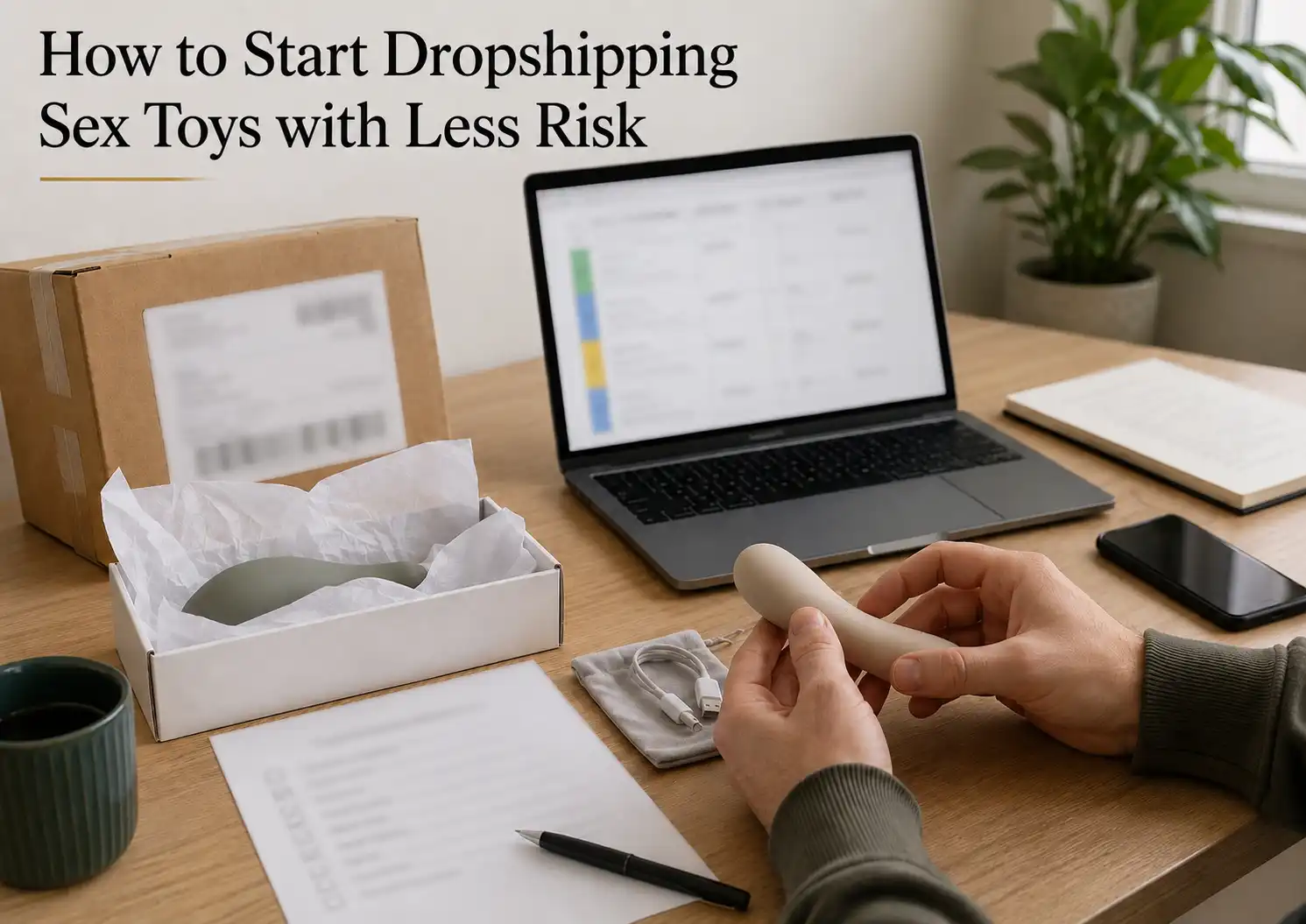
Dropshipping sex toys can work, but it is a trust-sensitive retail model rather than an easy catalog play. You need a focused offer, verifiable product information, discreet and truthful delivery, an approved payment route, realistic customer-acquisition options, and a supplier that can repeat the same product and order process.
Do not begin by importing hundreds of listings. Choose one customer need, compare the supply paths below, test a small product group, and place a complete customer-style order before you spend heavily on promotion.
Dropshipping Sex Toys: 5 Supply Paths to Compare
The five practical supply paths differ in catalog access, control, setup effort, and responsibility. Start with the lowest-commitment route that can prove the exact item, packaging, delivery path, and exception process you need.
1. Specialist regional adult-product dropshipper
A specialist regional dropshipper suits a seller who wants ready stock, category knowledge, and customer delivery from the same broad market. Its strongest advantage is a purpose-built adult catalog and an established process for plain outer packaging.
- Offer: Ready-stock adult products sent one order at a time.
- Best fit: A focused store testing demand in the supplier’s supported destinations.
- Material limitation: Your product range, shipping countries, integrations, return process, and branding choices stay inside that provider’s program.
- First validation action: Open the correct trade account and place a paid order to an address you control.
2. Adult-product app or catalog integration
An app or catalog integration suits a seller who values faster product importing, stock syncing, and automatic order forwarding. It can reduce manual data work, but it does not prove that every listing has accurate materials, stable specifications, or suitable customer packaging.
- Offer: Store connection, product feed, inventory updates, and order routing.
- Best fit: Shopify or WooCommerce operators who want to test a curated range quickly.
- Material limitation: Access to a large feed can make weak products look approved when they have only been imported.
- First validation action: Trace each shortlisted item to its actual supplier, stock source, return address, and shipping origin.
3. General marketplace supplier
A general marketplace supplier suits early product discovery and low-commitment sampling. It gives you broad choice, but quality, materials, packaging, stock, and seller behavior can vary by listing and by order.
- Offer: Many unbranded products from independent sellers or factories.
- Best fit: Comparing ideas and ordering initial samples before a public launch.
- Material limitation: Marketplace reviews and listing badges do not prove that the next unit will match your approved sample.
- First validation action: Buy the exact variant through the same order method and destination you plan to use for customers.
4. Direct manufacturer or wholesale distributor
A direct manufacturer or wholesaler suits a seller who wants clearer specifications, recognized brands, a stable range, or a route toward custom packaging. The trade-off may be account approval, minimum purchases, manual integration, or a separate process for single-customer orders.
- Offer: Direct product knowledge, wholesale terms, and possible customization.
- Best fit: Stores with validated demand and a defined product standard.
- Material limitation: Wholesale availability does not automatically include blind shipping, single-order processing, or permission to use every brand asset.
- First validation action: Separate the wholesale terms from the dropship terms and confirm eligible items in writing.
5. Private-agent or hybrid supply route
A private-agent route suits a growing seller that already has order evidence and needs coordinated sourcing, samples, product checks, packaging instructions, order execution, shipping choices, and after-sales handling. A hybrid version can keep experimental items supplier-direct while moving proven products into controlled stock or small-batch production.
- Offer: One agreed workflow across supplier communication and pre-shipment execution.
- Best fit: Growing stores, agencies, mentors, and operators managing repeat orders or several projects.
- Material limitation: An agent cannot make a prohibited item legal, override a sales channel, or replace product-market validation.
- First validation action: Send the exact product, target destinations, order pattern, required checks, packaging needs, and current problems for a route review.
For a first test, shortlist a specialist regional adult-product dropshipper when destination-local stock and a ready adult catalog matter, an adult-product app or catalog integration when speed and stock syncing matter most, or a general marketplace supplier when you are still comparing samples. Move toward a direct manufacturer or private-agent workflow only after real demand justifies more control.
Key Takeaway: Pick a supply model for the proof it can provide, not for the number of products it can import. A smaller verified range is more useful than a huge catalog with unknown materials, packaging, and order behavior.
Decide Whether the Category Fits Your Store
This category fits stores that can compete on trust, education, privacy, and dependable execution rather than price alone. It is a poor fit if your plan depends on copying a supplier feed, running explicit ads everywhere, or leaving product questions and returns to the supplier.
| Potential advantage | Operating difficulty | Viability question |
|---|---|---|
| No large opening inventory for an initial test | Products can look interchangeable across stores | Can you curate a clear audience and product promise? |
| Private online shopping suits the category | Buyers need confidence in materials, use, care, and discretion | Can you publish accurate product information? |
| Compact items may be practical to ship | Batteries, liquids, sizes, and destination rules can change the route | Can you verify every sellable item and destination? |
| A focused range can support repeat buying | Advertising and payment options may be narrower | Do you have an acquisition and payment plan before launch? |
Your store needs a reason to exist beyond access to the products. That reason might be a carefully selected beginner range, inclusive sexual-wellness education, couples’ products, quiet and travel-friendly devices, premium design, or unusually clear product guidance. Choose one audience need that you can support without making health or performance promises you cannot prove.
The seller remains responsible for the promise made at checkout. When the wrong item arrives, the parcel is not discreet, tracking fails, or a defect is reported, the customer contacts your store rather than the hidden supplier.
Key Takeaway: Enter this category only if you can own the customer experience from product information to after-sales resolution. Low inventory commitment does not mean low responsibility.
Build a Small, Verifiable Product Range
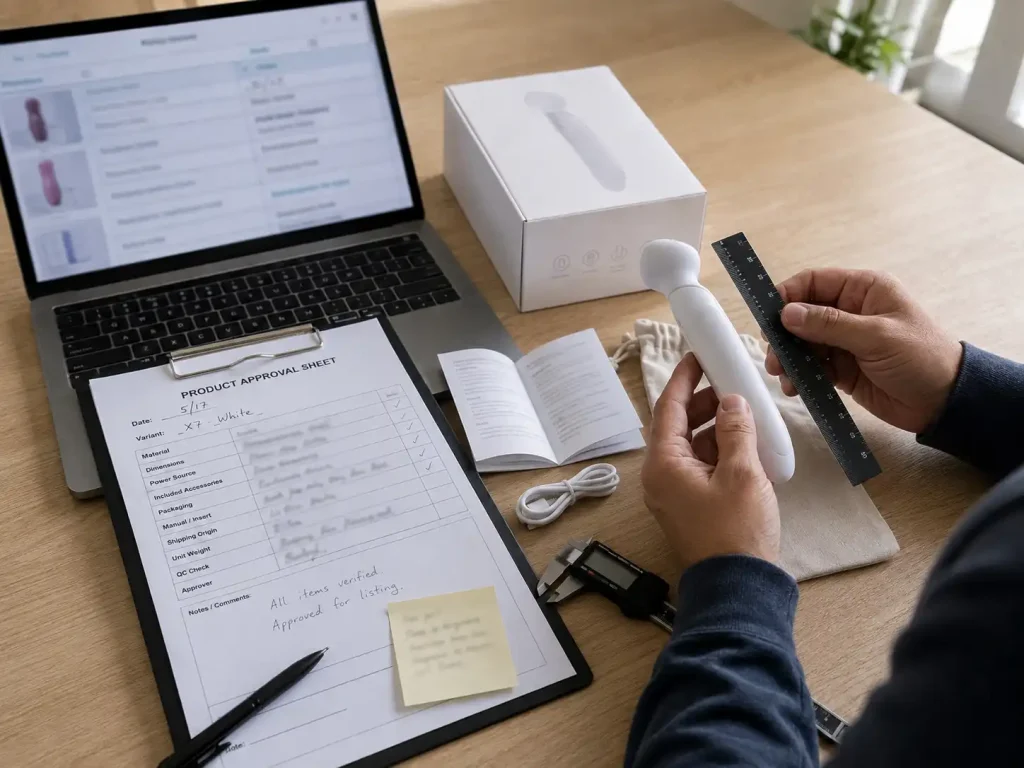
Start with products you can explain, inspect, ship, and support consistently. A controlled opening range gives you enough variation to learn without multiplying unknown materials, chargers, liquids, sizes, apps, and return conditions.
Use a product approval record
For every shortlisted item, record the exact supplier and variant, material declaration, dimensions, power source, charging method, included accessories, water-resistance claim, instructions, warnings, packaging, shipping origin, target destinations, and available supporting documents. Treat a certificate title or logo as a lead to verify, not as proof by itself.
Ask for documents that identify the exact sellable item and manufacturer. A report for a different model, material, battery, or factory does not establish the product you will send to customers.
Prefer simpler first tests
A simple non-connected product or a basic rechargeable device is usually easier to verify than an app-connected item, a product bundled with liquid, or a large mixed kit. This is not a safety guarantee; it is a way to reduce the number of systems and suppliers that can fail during the first test.
Products with lithium batteries, liquids, aerosols, powders, or magnets may need a different shipping service and different documents. Build a product-and-route record for these items rather than assuming one shipping line covers the whole catalog; the same discipline applies to other sensitive products in dropshipping.
Check the listing against the sample
The product page should state only what the sample and reliable documents support. Verify materials, dimensions, included parts, cleaning and care instructions, noise or power information when relevant, compatible chargers or apps, and any limitation a buyer needs before ordering.
Avoid vague phrases such as premium, body-safe, medical grade, waterproof, or hypoallergenic unless you have suitable evidence for the exact item and market. A supplier description is a starting input, not an independent verification.
Key Takeaway: Approve products one exact variant at a time. If the material, power system, instructions, or supporting document cannot be tied to that item, remove the claim or reject the product.
Vet the Supplier and Test the Customer Experience
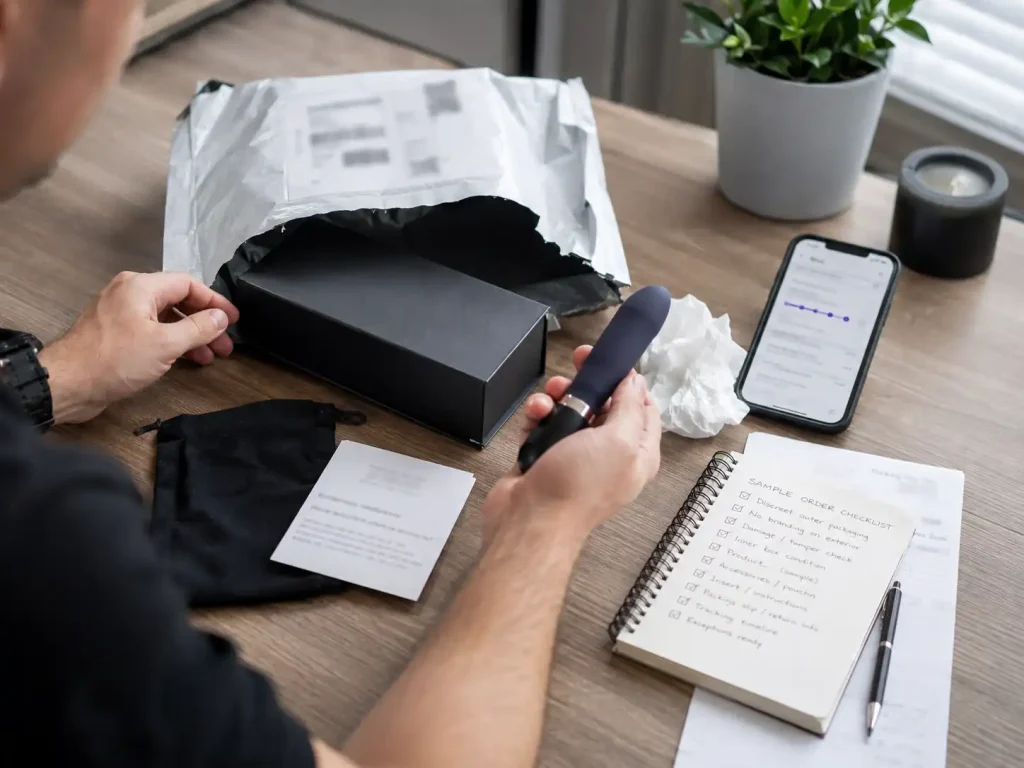
A suitable supplier must repeat the approved product and the agreed customer-order process. Evaluate the physical item, the parcel, the data flow, and the response to problems together.
Order the exact product
Place a paid sample order through the method you expect to use after launch. Compare the delivered item with the supplier listing and approval record: material, size, color, finish, motor or controls, charger, instructions, accessories, seals, inner box, and outer parcel.
If a relevant product characteristic cannot be checked visually, use appropriate independent testing or narrow the claim. Do not convert an appearance check into a safety or performance conclusion.
Inspect discretion as a complete chain
Plain outer packaging is only one part of discretion. Check the sender name, return address, label description, tracking messages, packing slip, invoices, marketing inserts, inner retail box, and the information shown to anyone who handles a return.
Discreet does not mean false. Customs, carrier, tax, and payment information still needs to be accurate for the route.
Test stock and exception handling
Ask how often stock and price data update, what happens when an item is discontinued, who approves a substitute, when tracking is returned, and how the supplier handles wrong, damaged, missing, or defective products. Written answers are useful, but a controlled order and a realistic support question show whether the process works.
When you compare a private-agent route, these questions to ask a dropshipping agent help separate sourcing, samples, product checks, costs, tracking, and exceptions. For repeat orders, define a product quality control record that another person can apply to the next unit rather than treating the first sample as permanent proof.
Key Takeaway: Approve one complete customer experience: exact product, accurate listing, discreet parcel, correct tracking, and a tested problem-resolution path. A supplier claim is not finished evidence until the order reaches a destination you control.
Check Store, Payment, Advertising, and Market Rules
Treat the store platform, sales channel, payment provider, advertising channel, destination law, and shipping route as separate approvals. Acceptance by one service does not mean the others accept the same product, creative, or market.
Separate Shopify from Shop and Shopify Payments
Using Shopify software does not automatically approve every product for every Shopify service. Before using the Shop sales channel or Shopify Payments, check the current product rules and the country-specific terms linked from Shopify Payments eligibility for your business and market.
Confirm your exact products, business location, selling markets, website content, and billing model with the payment provider before building the store around it. Stripe’s restricted-business guidance states that it cannot currently work with businesses selling adult content or services and includes sexually oriented items within that scope. Check the official Stripe guidance against your exact business and account.
Build acquisition around real channel limits
Do not assume paid social or broad display advertising will carry the launch. Google’s current sexual content advertising policy classifies sexual merchandise, including sex toys, as restricted and limits where and how qualifying ads can serve. Check the official Google Ads policy before planning a campaign.
Useful educational content, search demand, email from properly consented subscribers, suitable creators, referrals, and adult-industry placements may reduce dependence on one ad account. Check each channel’s current rules, creative restrictions, age handling, and target-country limits before producing a campaign.
Screen every target market
Rules for adult products, consumer information, taxes, imports, batteries, privacy, returns, and age controls vary by country and sometimes by product. Choose the seller entity, buyer destination, sales channel, payment route, and shipping method first, then obtain qualified advice where the answer affects legality or regulatory compliance.
Do not advertise worldwide by default. Publish only destinations that have passed your product, payment, channel, carrier, and legal checks.
Key Takeaway: Build a market-by-market approval sheet before launch. Your store is ready only when the same product is acceptable to the seller’s jurisdiction, destination market, payment route, acquisition channel, and shipping service.
Price the Complete Order and Define Returns Before Launch
Price from the expected cost of a delivered and supported order, not from the difference between retail and supplier prices. Use your own quote, payment terms, test shipment, campaign data, and support assumptions.
Use this working calculation:
Expected contribution per delivered order = customer payment − product cost − supplier handling − inspection − packaging − payment and platform fees − shipping − seller-paid duties or taxes − customer acquisition cost − refund, replacement, chargeback, and support allowance.
Run it for a normal order, a bundle, a replacement, and a refunded order. If one ordinary exception removes the expected contribution, change the product, price, route, or policy before increasing traffic.
Match the customer policy to the supplier process
Intimate products may have strict hygiene conditions, but your customer-facing obligations depend on the market where you sell. Confirm what happens to unopened items, broken seals, defective products, wrong items, transit damage, warranties, and returns that the supplier refuses.
State the policy before checkout in plain language. The supplier’s refusal to accept an item does not by itself answer what your store must do for the customer.
Keep enough cash for ordinary friction
You may avoid a large opening inventory purchase, but you still need working cash for samples, store tools, payment holds, customer acquisition, supplier charges before payout, replacements, refunds, and support. Separate this startup cash need from per-order profitability.
Key Takeaway: A product is viable only when the complete delivered-order calculation survives ordinary problems. Set a stop rule before launch instead of hoping later volume will repair weak unit economics.
Run a Controlled Launch Before You Scale
A controlled launch should prove both demand and repeatable order execution. Increase traffic only after the product page, checkout, payment, supplier, parcel, delivery, and support process tell the same story.
- Publish a small approved range for one defined audience and a limited destination set.
- Place customer-style orders through the real checkout and payment flow.
- Compare every delivered item and parcel with the approval record.
- Track stock changes, order forwarding, processing, tracking, delivery, and customer messages.
- Submit a realistic product or defect question and follow it to resolution.
- Recalculate contribution with the actual costs and record approve, fix and retest, or reject for each item.
Repeat the check when a supplier changes the product, factory, material, battery, app, packaging, shipping origin, or route. A successful first sample does not prove that later units will remain unchanged.
RuntoDropship is a private dropshipping agent for growing sellers and operators with real order needs. Its relevant role can include supplier coordination, samples, product and packing checks, packaging instructions, warehouse-side order execution, shipping options, and after-sales coordination within an agreed scope; it does not replace the seller’s market obligations, a manufacturer, a payment decision, or carrier approval.
Key Takeaway: Scale only when demand and execution pass together. More traffic magnifies supplier, payment, packaging, and support defects that a controlled order would have exposed earlier.
FAQ
Can products from two adult-product suppliers arrive in one package?
Usually not. They can arrive together only when both items first reach the same approved dispatch point and a written consolidation process covers inspection, discreet packing, shipping documents, tracking, and destination acceptance; otherwise show separate parcels and delivery expectations before checkout.
Can I reuse a supplier’s product photos and descriptions?
Only when the supplier or rights holder gives permission and the content accurately represents the exact item you sell. Ask which images, videos, brand names, manuals, and descriptions you may use, keep the written authorization, and replace any claim that your own sample or documents cannot support.
Are app-connected adult toys different from ordinary rechargeable toys?
Yes. The app, account setup, phone compatibility, wireless connection, firmware support, privacy information, and long-term app availability add dependencies beyond the physical device, so test the complete user journey and define what happens if the app changes or stops working.
What should I do if a supplier discontinues a live product?
Pause new orders before substituting another item. Review paid but unshipped orders, tell affected customers when the original promise cannot be met, and approve any replacement through the same product, listing, packaging, cost, and route checks before reactivating the listing.
How should I sell a bundle when its items ship separately?
Describe it as a multi-parcel order before checkout. Show which items may arrive separately, avoid one delivery promise for different routes, provide every tracking number, and calculate whether duplicated shipping and support still leave the bundle viable.
Conclusion
Adult toy dropshipping works best as a controlled trust business: a focused customer need, a verified product record, a suitable supply path, discreet and truthful delivery, approved payment and acquisition routes, complete cost math, and a tested resolution process. Those controls tell you what deserves more traffic and what should be fixed or removed.
When repeat orders make supplier communication, samples, product checks, packaging, order execution, shipping choices, and exceptions too important to coordinate through disconnected messages, RuntoDropship can assess whether a private-agent workflow fits. Strong adult-product brands are built when the physical order protects the privacy and product promise made at checkout; send your product links, target markets, current order volume, and main operational concerns to plan a sample and test-order review.