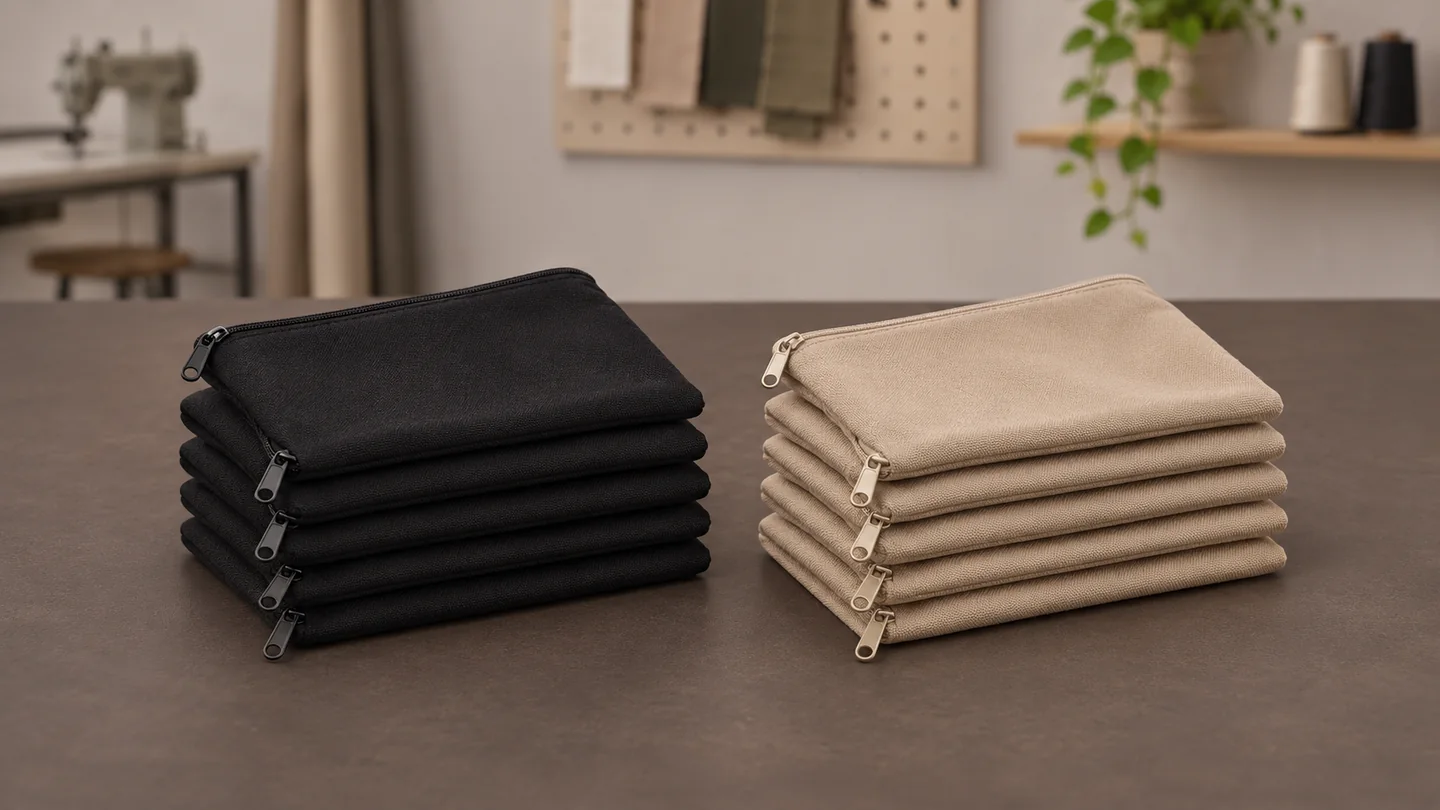
Your supplier quotes “MOQ 100” for a product you want in black and sand. You plan to buy 60 black and 40 sand, but the quote does not say whether the colors can be combined. If the minimum applies to each color, the two-color order needs 200 pieces. That can change how much you pay, how much room you need, and whether the order still makes sense for your store.
To understand the MOQ meaning in a quote, read the unit and item group beside the number. MOQ means minimum order quantity, the smallest quantity a supplier agrees to sell on the stated terms. Check the group first, then test your proposed quantities, case increments, and any separate packaging requirements against the offer.
What does MOQ mean on a supplier quote?
MOQ is the smallest quantity the seller will accept for the item, variant, or group named in the quote. If a seller quotes 100 pieces for one color, ordering 100 pieces across several colors meets the minimum only if the seller allows that mix. The number is useful once you know what the supplier counts.
Start with the purchase unit. One supplier may quote pieces, another may quote boxed sets, and a third may only sell sealed cases. For a refresher on who sets the terms and accepts the order, see how a wholesale order works. Then read the MOQ as one specific term of that purchase.
What does the number cover?
Ask the supplier to answer in the same units you use to build the order. A request for 12 cases can be mistaken for 12 pieces in a message. On the order, those quantities can be far apart. A set that your store sells as one item may contain several pieces that the supplier counts individually.
- Get the minimum with its unit, such as pieces, sets, or cases.
- Confirm the product or group to which the minimum applies.
- If the supplier sells cases, write down the number of saleable units in each case.
Key takeaway: Record the MOQ and its unit together. You can then convert quantities consistently between the quote, the purchase order, and your inventory plan.
Which units count toward the supplier’s minimum?
The supplier’s grouping rule decides which units count together. A supplier can require a separate minimum for each variant. A variant is a specific version, such as a medium shirt in black. Other suppliers may allow buyers to pool several variants of the same item or count eligible products across an entire order.
Start with the exact assortment you expect to buy. A supplier can allow colors to mix and still require each size to be bought in packs. Check both the level at which the minimum applies and the level at which the seller counts each pack. Then compare the resulting quantities with your actual demand by variant.
How does the same mix pass or fail?
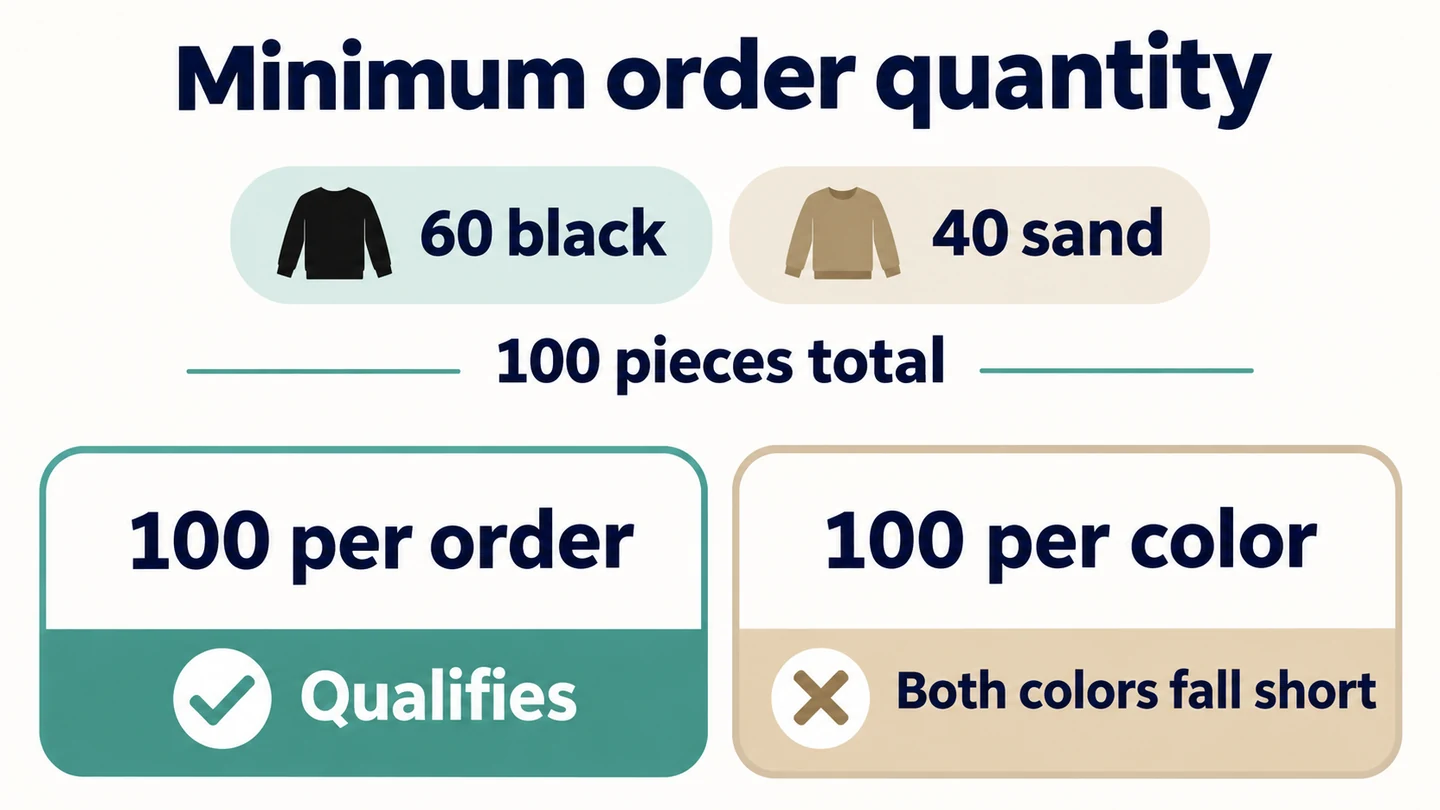
Consider 60 black pieces and 40 sand pieces. That mix meets a 100-piece order-wide minimum when both lines count. The mix also meets a 100-piece minimum per item when the supplier treats the two colors as variants of the same item and counts them together. A separate minimum of 100 pieces per color puts both lines below the floor and requires 100 pieces of each color.
- List each proposed item, color, size, and quantity on its own line.
- Ask which products and variants the supplier will count together.
- Keep unrelated products separate when checking a per-item minimum.
- If there is an approved mix, record it by line as well as by overall quantity.
Key takeaway: Send the proposed mix with your question about the minimum. The supplier can confirm the order you actually want to place.
Why might a quote show more than one minimum?
A quote can show several minimums because different parts of the purchase are counted differently. A quantity minimum and a minimum order value can apply to the same purchase. Meeting a product’s quantity minimum leaves the order-value floor to check. Budgeting enough for the order value leaves each required line quantity to check.
The product and its packaging can have separate minimums. Suppose a supplier agrees to make 160 units but says the printer requires 480 custom boxes. Check whether you are buying all 480 boxes, who will hold the 320 left after packing, and whether a later run can use them. The answer affects your cash and may affect where you can place the next order.

How do separate minimums appear on one offer?
Project Fragrance’s published U.S. wholesale terms specify an opening-order dollar minimum and separate minimum quantities by scent and bottle format. The maker’s wholesale terms put both conditions on the same program. A retailer comparing one scent with an assorted opening order has to check the product counts as well as the order total.
- Write the overall purchase floor on a separate line from the quantity floors.
- A component supplier can set a minimum for its own parts. If a zipper maker sells only full packs, ask whether the finished product price covers the pack or whether the supplier will charge you separately for the unused zippers.
- Ask who pays for any packaging that remains after the first run.
Key takeaway: Keep the product, packaging, and order-value conditions visible until they all balance. Use the item count to check the order and the separate obligations to confirm what you will pay.
How do minimums, case packs, and price breaks work together?
The minimum, increment, and price break are separate fields. The minimum says where the order starts. The purchase increment sets the steps in which you can increase the quantity. A price break indicates when a different unit price applies. Published B2B catalog documentation shows that quantity rules and volume pricing can be set together or independently.
Take a hypothetical quote with a minimum of 36 pieces, sold in cases of 12, and a lower unit price at 60 pieces. You can buy 36 or 48 pieces at the starting price. At 60 pieces, you meet the discount threshold. An order of 42 pieces meets the stated minimum and still misses the case increment.
What is the next valid order size?
To find it, put the quantities from the quote on a single scale. A case of 12 and an order minimum of 36 pieces give you a first order of three whole cases. If you want 40 pieces, ask whether the seller can split a case or whether the next available size is 48 pieces.
| Quoted rule | Example | Effect on the order |
|---|---|---|
| Minimum quantity | 36 pieces | Start with at least three cases |
| Purchase increment | One case of 12 | Order 36, 48, 60 pieces, and so on |
| Lower price starts at | 60 pieces | Apply the lower quoted price only at a qualifying quantity |
| Variant grouping | Confirm on the quote | Check whether multiple variants count toward any of those thresholds |
- At the minimum, you can leave two cases off the order and buy the 36 pieces at the starting price.
- Convert piece, set, and case quantities to one basis before comparing the thresholds.
- Verify how the seller applies the cheaper price and whether variant rules also apply.
- Calculate the payable total for the smallest valid quantity and the next price level.
Key takeaway: Find the smallest shipment that meets the actual rules. Compare extra units against expected sales before adding another case.
Which minimum gives you a workable first buy?
A workable minimum fits the cash you can commit, the storage you have, and the sales you can reasonably expect. Compare delivered cost and the amount of stock you will carry. The order with the lower cost per unit can take more cash today and require months of additional sales.
Use the same product specification, destination, and saleable unit for both quoted options. If the comparison includes freight, ask what that freight covers. Use your forecast to estimate how long each option lasts. Check the slowest variant as well as the total if you cannot sell one color in place of another.
What do you pay for the smaller lot?
In this hypothetical comparison, an 80-piece order at $6 each plus $80 delivery comes to $560, or $7 per piece. A 240-piece order at $4.50 each plus $120 delivery comes to $1,200, or $5 per piece. At a steady 40 sales per month, the first option is about two months of stock and the second is about six. The larger lot commits an extra $640 before any sales come in.
- Note the delivered amount due and the difference in cash between the offers.
- Divide the saleable quantity by the monthly sales estimate. Try a slower sales estimate as well.
- Compare both with available storage and cash already reserved for other products.
Key takeaway: Treat the larger purchase as an additional stock commitment. Choose it only if your budget and expected sales support carrying those extra units.
What can you change when the MOQ is too high?
You can ask about a smaller quantity with the same specification, or change one feature that makes the order harder to produce. A standard wholesale product can have a different minimum from a custom build. Ask for a revised quote that shows what changes with the smaller lot. A lower minimum loses value if the item no longer meets the requirements you need to sell it.
Start with the requirement driving the minimum. If color is the constraint, compare one color with your intended assortment. If branded packaging is the constraint, ask about the standard pack or a separately priced label. When the supplier offers an in-stock version, get its specification and count before comparing it with the custom offer.

What can stay standard?
Tell the supplier which features you need for the product to be saleable and which can change. Keep any accepted sample, size, and material requirements visible while discussing pack or quantity alternatives. If you need several quotes from China, this bulk order sourcing checklist covers the other checks that belong with the offer. For help coordinating the same order brief across China suppliers, discuss the proposed quantities with a sourcing agent.
- Ask for a smaller lot at the same specification and its delivered total.
- Ask for a standard material or pack where the original choice imposes the minimum.
- Compare the revised count, unit price, delivery, and any change in specification.
Key takeaway: Change one constraint at a time. A quote that shows the exact difference is easier to compare with the original offer.
What belongs in the approved order?
The approved order should list the exact units and variants, the quantities that meet the minimum, the applicable price tier, and any separately owed packaging. Get the supplier to confirm the exact item mix before you send payment. A written count tells the seller what to prepare and gives your receiving team a number to check.
Put any agreed exception in the same order record. If the supplier permits a short first lot or mixed colors, write the permitted quantities next to the affected lines. Record the quote date or revision, especially when the supplier has sent several versions.
Who confirms the mix?
Ask the person who can accept the order to confirm the line breakdown and final amount in writing. Compare their reply with the terms you used to budget the purchase. If a quantity or charge changed, ask for the full updated order before paying against it.
- Match the order line to the quote version and the supplier’s item or variant code.
- Write the pieces per case, number of cases, and separate packaging quantity where relevant.
- Keep the seller’s confirmation with the invoice and give the receiving team the accepted count.
Key takeaway: Save one agreed version with the quantity and group visible on every affected line. You can refer to it if packing or invoicing changes later.
Conclusion
Read an MOQ alongside its unit and the exact item group it governs. Test your planned quantities against applicable case rules, any order minimum by value, and any extra packaging the supplier requires. Compare what each option will cost to receive and how much stock it will leave you to sell.
RuntoDropship is a private dropshipping agent that helps ecommerce sellers coordinate sourcing, product checks and order fulfillment. We start with the order information the seller and supplier can confirm. Send the proposed item mix and the supplier’s quote to the RuntoDropship team if you want help reviewing the order before committing.
FAQ
How is MOQ different from EOQ?
MOQ is the supplier’s threshold for accepting an order. Economic order quantity is a planning calculation for ordering and holding costs. If the quantity suggested by your model is below the supplier’s minimum, work with a quantity the supplier accepts or check another offer.
What if the listing and written quote show different minimums?
Ask which minimum applies to your exact variant, packaging, and order date. Save the listing and ask the supplier to explain the difference in the dated quote. If you have already placed the order, check the accepted terms and use the platform’s dispute or support channel if necessary.
Can a consolidated shipment meet the MOQs of several suppliers?
Putting goods into one shipment does not by itself combine purchase commitments. Check the accepted minimum with each selling party before arranging consolidation. If an intermediary offers one purchase, ask which terms it is agreeing to cover.
Does a marketplace’s displayed price apply at its listed MOQ?
It may depend on the variant, purchase unit, quantity tier, and included services. Ask the seller to quote the actual mix and break out unit price, required extras, and delivery. Use that written amount to budget the purchase.
Should I promise a larger reorder to get a smaller first run?
Only make a purchase commitment you are prepared to honor. You can share a demand forecast and ask the supplier whether the proposed first-run price requires a later order. Write any future quantities, timing, and conditions plainly before agreeing.