

Walmart dropshipping is possible when you sell on Walmart Marketplace and a legitimate supplier ships orders for you, but you remain responsible for the product, inventory, delivery promise, packaging, tracking, returns, and customer service. Buying an item from another retailer only after a Walmart customer orders and asking that retailer to deliver it is prohibited retail arbitrage, not a compliant supplier-direct model.
The practical question is therefore not simply whether you can avoid holding stock. You need to prove that your business and supply route are legitimate, connect accurate inventory, build enough margin for returns and payment delays, and keep every order inside Walmart’s current performance standards.
A typical seller starts with a supplier catalog and automation software, then discovers too late that stock changes, branded packaging, slow carrier scans, domestic returns, and payout timing still need human control. When those gaps reach live orders, a low-inventory model can produce cancellations, complaints, or account action. A safer start is one documented product, one verified supplier, and one end-to-end test order before catalog expansion.
Is Walmart Dropshipping Allowed?
Walmart allows seller-managed fulfillment, including orders shipped by a legitimate supplier, but it does not allow you to buy from another retailer and have that retailer ship directly to the Walmart customer. Walmart’s current Shipping and Fulfillment Policy also makes the Marketplace seller responsible for valid tracking, delivery promises, customer-facing documents, and compliant packaging.
Three arrangements are often confused:
| Arrangement | What happens | Practical status |
|---|---|---|
| Supplier-direct Marketplace sale | You list on Walmart; a manufacturer, wholesaler, or contracted supplier ships for your business | Possible when the seller and supplier meet all policies |
| Retailer-to-customer order | You buy from Amazon, Target, another marketplace, or another retailer after receiving the Walmart order | Prohibited retail arbitrage |
| Walmart Drop Ship Vendor | An approved first-party supplier sells inventory to Walmart and ships orders under a separate Walmart program | Not the normal third-party Marketplace seller route |
Do not assume software changes the nature of the supply route. An automation tool can pass orders and tracking data, but it cannot turn a consumer retail receipt into a documented supplier relationship or transfer seller responsibility away from you. If you need a deeper model comparison, the operating difference between retail arbitrage and supplier-based dropshipping is the first boundary to understand.
Key Takeaway: Use a manufacturer, wholesaler, or contracted agent that can document the supply chain and ship on your behalf. Do not fulfill Walmart orders by purchasing from another retailer after the sale.
Check Whether You Can Qualify as a Marketplace Seller
You should check business eligibility before researching hundreds of products. Walmart’s current seller registration guide asks for a business tax ID or business license number, documents verifying the business name and address, a history of marketplace or ecommerce success, compliant product identifiers, and fulfillment through WFS or another B2C U.S. warehouse with returns capability.
Prepare the following before you apply:
- A registered business whose legal name, address, tax details, bank details, and contact information match across documents.
- Evidence of ecommerce performance from an existing store or marketplace account.
- A preliminary catalog with valid GTIN or UPC data where required and no prohibited products.
- A U.S. order-shipping plan that can meet the delivery dates shown to customers.
- A valid U.S. return center and a process for receiving, inspecting, and resolving returns.
- A payout account supported for the country where your company is incorporated.
Approval is not a promise that every product or fulfillment method is acceptable. Treat account approval as permission to complete setup, then verify product rights, fulfillment details, and performance controls before publishing offers.
Choose Products You Can Legally and Reliably Sell
A profitable dropshipping product selection framework should pass three tests: you have the right to sell the item, Walmart allows it, and your supply route can keep the offer accurate. High demand does not rescue a listing that lacks authentic sourcing documents, required safety information, brand authorization, or stable stock.
Verify selling rights and product identity
Ask who owns the brand, who authorizes resale, and what documents connect your business to the goods. For branded items, a supplier saying “authentic” is not enough; request commercial invoices and any authorization Walmart or the rights owner may require.
Match identifiers, variants, pack quantities, dimensions, materials, and included accessories to the physical product. A wrong UPC, color, bundle count, or model number can cause customer complaints even when the shipment arrives on time.
Filter for operating fit
Favor products with stable replenishment, low breakage risk, clear specifications, predictable packed dimensions, and straightforward returns. Be more cautious with regulated, ingestible, medical, hazardous, age-restricted, branded, or high-value goods because documentation and after-sales exposure are higher. For consumer electronics products, also confirm model version, plug type, battery configuration, accessories, labels, and protective packaging before listing.
Before listing, order a sample to the destination market. Check the actual item, manufacturer packaging, carton strength, product labels, packing slip, carrier scan, delivery time, and return path rather than relying only on catalog data.
Vet a Supplier Before You List Anything

A supplier is suitable only if it can support your Walmart obligations in writing and in a test order. Low unit cost is secondary to accurate inventory, compliant packaging, traceable shipping, product documentation, and a workable exception process.
Confirm the commercial relationship
Request a business license, commercial invoice format, product source, warehouse address, return address, brand authorization where relevant, and a named operational contact. Make sure invoices identify your business and the products clearly enough to support an account or product review.
Supplier evaluation should also cover questions that only become visible after orders start: cutoff times, weekend processing, stock reservation, damaged-item evidence, wrong-variant handling, address changes, replacement approval, and who pays when the supplier causes an error. A structured set of questions for a dropshipping agent helps turn vague assurances into testable responsibilities.
Lock the customer-facing rules
Walmart’s Packaging Policy permits neutral packaging and prohibits other retailers’ packaging and promotional materials. Confirm the box, label, packing slip, inserts, return address, and carrier before launch.
Your agreement should require the supplier to:
- send inventory changes before stock reaches zero;
- ship only the approved product and variant;
- use the agreed processing time and carrier service;
- provide valid tracking only after carrier handoff;
- keep other retailers and unapproved promotions out of the parcel;
- preserve inspection and shipment records for exceptions; and
- respond within a defined operational window.
Run at least one test order through the same workflow used for a real customer. If the supplier changes packaging, tracking, service level, or return handling during the test, fix the process before listing more items.
Key Takeaway: Choose the supplier that can prove product origin and execute a controlled test order, not the supplier that merely promises a low price or “fast shipping.”
Calculate Order Economics and Working Capital
Profitability depends on the complete cost of a delivered and supportable order, not the difference between your selling price and the supplier’s quote. Walmart currently charges no setup or monthly marketplace fee, but it deducts a category-based referral fee after a sale; the current percentages are listed on Walmart’s Marketplace pricing page.
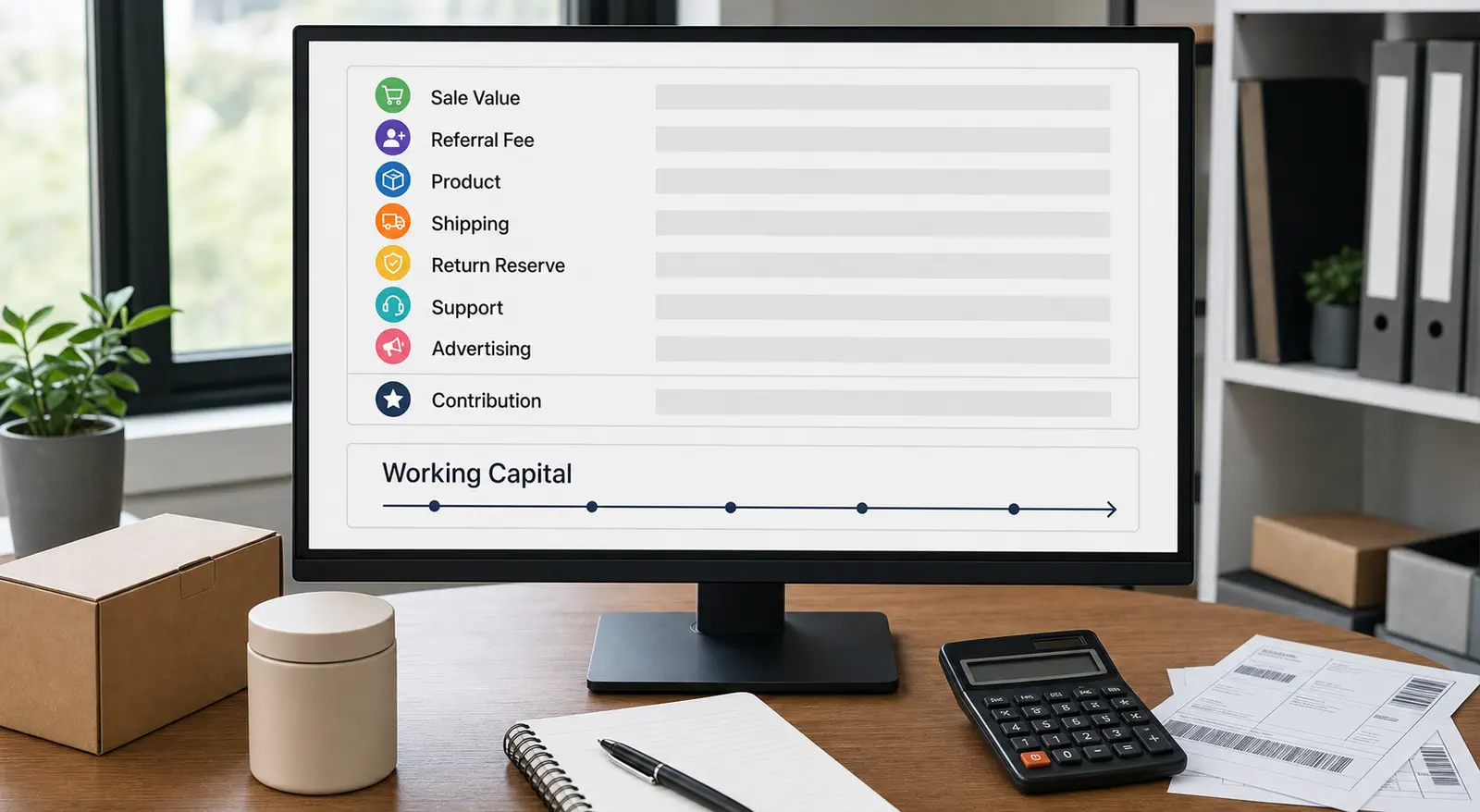
Use this calculation for each SKU:
Contribution per delivered order = selling price - referral fee - product cost - outbound shipping - payment or currency costs - expected return and refund cost - customer-service cost - advertising cost - exception reserve
Do not mix contribution per order with startup capital. Startup cash must also cover samples, software, product identifiers, packaging tests, possible advertising, and the time between paying a supplier and receiving marketplace funds.
New sellers should plan for delayed cash availability. Walmart’s current New Seller Payment Hold Policy describes a rolling delay and conditions that must be met before the new-seller hold ends, so you may need to fund several supplier orders before related proceeds become available.
Stress-test the SKU with four non-ideal events: the supplier raises price, the parcel needs a more expensive service, the customer returns the item, and the order must be refunded before the product is recoverable. If one ordinary exception removes the expected profit from several successful orders, the offer is too fragile.
Key Takeaway: Approve a SKU only after its full delivered-order contribution and cash requirement remain workable under a realistic return or shipping exception.
Build the Catalog, Inventory, and Order Connection
Your system must keep the Walmart offer synchronized with what the supplier can actually ship. A large catalog with stale quantities creates more cancellation exposure than a smaller catalog whose identifiers, stock, price, and delivery settings are controlled.
Create clean product data
Use accurate product identifiers and match the correct item when a catalog record already exists. Write factual titles, key features, descriptions, variants, and attributes; do not copy protected images or claims from another retailer.
Map each Walmart SKU to one supplier SKU, including the exact variant and pack count. Record packed weight and dimensions from a sample or reliable supplier data because they affect shipping cost and service choice.
Set inventory safeguards
Choose a safety buffer so a low supplier balance becomes unavailable on Walmart before the last unit is sold elsewhere. Sync stock and price often enough for the supplier’s volatility, and stop an item automatically when the feed fails or the cost rises beyond your approved margin.
Connect the order fields
Transmit the customer name, address, phone requirements, SKU, quantity, promised service, and order reference accurately. Protect customer data, limit supplier access to what is needed for fulfillment, and map the supplier’s tracking response back to the correct Walmart order.
Keep a manual exception queue for rejected addresses, split shipments, changed tracking numbers, partial stock, carrier mismatches, and orders approaching their ship deadline. Automation should surface these problems, not hide them.
Watch: How Walmart-approved integrations connect to Seller Center
Walmart Marketplace’s Seller Academy shows how to connect an approved Solution Provider and review the inventory, order, and account data you authorize it to access.
Set Shipping, Packaging, Returns, and Customer Care
The operating setup must make the delivery promise achievable before the offer goes live. Select the shipping location, order cutoff, fulfillment lag, operational days, carrier, and carrier service from measured test-order results rather than the supplier’s best-case estimate. Check that the Expected Delivery Date shown to the customer remains realistic under the selected settings.
Monitor the current performance standards
Walmart evaluates seller performance over rolling periods. As of April 29, 2026, the official Seller Performance Standards list these account standards:
| Metric | Current standard | What your workflow must prevent |
|---|---|---|
| Cancellation rate | 2% or below | Out-of-stock, pricing, address, and expired-window cancellations |
| On-time delivery rate | 90% or above | Late handoff, service mismatch, missing scans, and unrealistic promises |
| Valid tracking rate | 99% or above | Invalid, misleading, late, or non-integrated tracking |
| Seller response rate | 95% or above | Customer messages waiting more than 48 hours |
| Negative feedback rate | 2% or below | Defects, inaccurate descriptions, and poor issue handling |
| Return rate | 6% or below | Wrong, damaged, late, or misleading items |
| Item not received rate | 2% or below | Lost parcels and delivery failures |
| Late shipment rate | 5% or below | Late carrier handoff and missing valid scans |
These standards can change, so review Seller Center and the official policy rather than hard-coding thresholds into a permanent supplier agreement.
Design the return path before the first sale
Walmart’s current seller-fulfilled returns policy requires at least one valid U.S. return-center address and generally requires a minimum 30-day return window, with category and exemption details in the policy. Eligible Marketplace goods may also be returned in Walmart stores.
Decide who receives the return, photographs it, grades its condition, stores or disposes of it, and supplies evidence for a dispute. A coordinated returns management process matters because a supplier that can ship outbound orders may still be unable to receive domestic returns or inspect what came back.
Customer questions remain your responsibility. Route delivery, cancellation, item, return, and refund messages into a queue with an owner and deadline; do not expect the supplier to communicate with the Walmart customer.
Run a Test Order Before You Scale
A test order should reproduce the full live path from inventory update to return readiness. Do not test only whether the supplier can create a tracking number.

Use this launch sequence:
- Publish a small set of fully documented products with conservative stock.
- Place a real test order to a normal customer destination.
- Confirm the order reaches the correct supplier SKU and variant.
- Inspect packaging, labels, packing slip, carrier acceptance scan, and delivery event.
- Simulate a customer message and verify the response queue works.
- Confirm the return label and U.S. return-center handoff.
- Recalculate the order with the actual packed weight, shipping charge, and processing time.
After launch, review orders daily until the system is stable. Watch inventory feed failures, cancellations, late carrier handoffs, invalid tracking, delivery misses, negative feedback, returns, item-not-received reports, and unanswered messages at SKU and supplier level.
A phased backend rebuild for store growth is safer than pushing more volume through an unstable supplier, SKU, or shipping route.
Set a stop rule before volume increases. Pause the affected SKU or supplier when a process exception repeats or a metric approaches its standard; do not wait for an account warning to diagnose a known source of failure.
Key Takeaway: Scale only after a real end-to-end order proves the product, parcel, tracking, delivery, message, return, and cost workflow—not after a successful listing upload.
Decide Whether the Model Fits Your Business
This model is a better fit for an established ecommerce operator with documented suppliers, reliable U.S. delivery and returns, enough working capital, and a team or system that monitors exceptions. It is a poor fit when the plan depends on consumer retail purchases, slow or unpredictable international delivery, missing invoices, thin margins, or unattended automation.
The main advantages are a large marketplace audience, no setup or monthly marketplace fee, and the ability to test catalog breadth without buying every unit in advance. The tradeoffs are strict seller accountability, less direct control over the supplier’s work, category referral fees, return exposure, payment timing, and the possibility that one supplier failure affects account-level metrics.
Use this final go/no-go check:
- Can you prove the commercial source and your right to sell every item?
- Can the supplier keep stock, price, packaging, and tracking accurate?
- Can the delivery and return route meet current Walmart requirements?
- Does the complete order contribution survive normal exceptions?
- Can you fund orders during payment delays?
- Can your team detect and pause failures before they reach account level?
If any answer is no, fix that dependency before applying or listing. Holding a small buffer of proven inventory, using WFS for selected items, or choosing another sales channel may be safer than forcing a supplier-direct model that you cannot control.
Key Takeaway: Proceed only when you can document the supply chain and control the customer promise from stock update through return; low upfront inventory alone is not a sound reason to choose the model.
FAQ
Can I use Amazon Multi-Channel Fulfillment for Walmart orders?
Yes, under Walmart’s current policy, but the shipment must use neutral packaging and unbranded delivery vehicles, and Amazon Logistics must be blocked as a carrier. Confirm the current Shipping and Fulfillment Policy before relying on this setup because Walmart can change its requirements.
Can I include an invoice in a Walmart Marketplace shipment?
Yes, but another retailer’s invoice is prohibited, and an original supplier invoice showing your costs should not be included. Use a compliant packing slip or customer invoice that identifies only the permitted seller or manufacturer information.
Can a terminated Walmart Marketplace account be appealed?
No. Walmart’s current Seller Performance Standards state that termination appeals are not accepted, although an appeal may be available for some suspensions or suppressions. Treat policy and performance warnings as urgent because the available remedy depends on the account action.
Conclusion
A workable supplier-direct Walmart business starts with the right distinction: a documented supplier may ship for you, but another retailer cannot become your on-demand source for Marketplace orders. From there, seller eligibility, product rights, supplier controls, complete order economics, synchronized inventory, compliant packaging, delivery performance, returns, and daily exception monitoring must function as one system.
For growing sellers, mentors, agencies, or operators managing multiple stores, RuntoDropship can act as your private dropshipping agent for supplier coordination, product checks, packing confirmation, order execution, shipping arrangement, and after-sales support. We believe sustainable marketplace growth comes from a backend you can inspect and improve—not from hiding responsibility behind automation. Send your current product links, destinations, order volume, and Walmart requirements to discuss a documented sample and test-order workflow.