
How to choose a dropshipping agent comes down to one discipline: judge candidates the way you would hire an operations manager. Check what they actually handle, test them with real orders before you scale, and get every fee and standard in writing. The agents worth working with welcome that scrutiny, because their whole business is being more reliable than a marketplace listing.
We run a private dropshipping agency in Yiwu and Shenzhen, and we sit on the other side of this decision every day. Sellers come to us after a supplier ships the wrong variant once too often, or after a “cheap” agent turns out to be one person reselling someone else’s service. If you are working out how to choose a dropshipping agent you can rely on, this guide is the standard we would want a seller to hold us to: what to check, how to test, and which answers should end the conversation.
What does a dropshipping agent actually do?
A dropshipping agent is your operator on the ground in the sourcing country. One accountable partner handles the chain that a marketplace seller otherwise manages alone across a dozen supplier chats:
- Sourcing — finding factories and wholesalers for your products, negotiating prices, and sourcing items that are not in any public catalog.
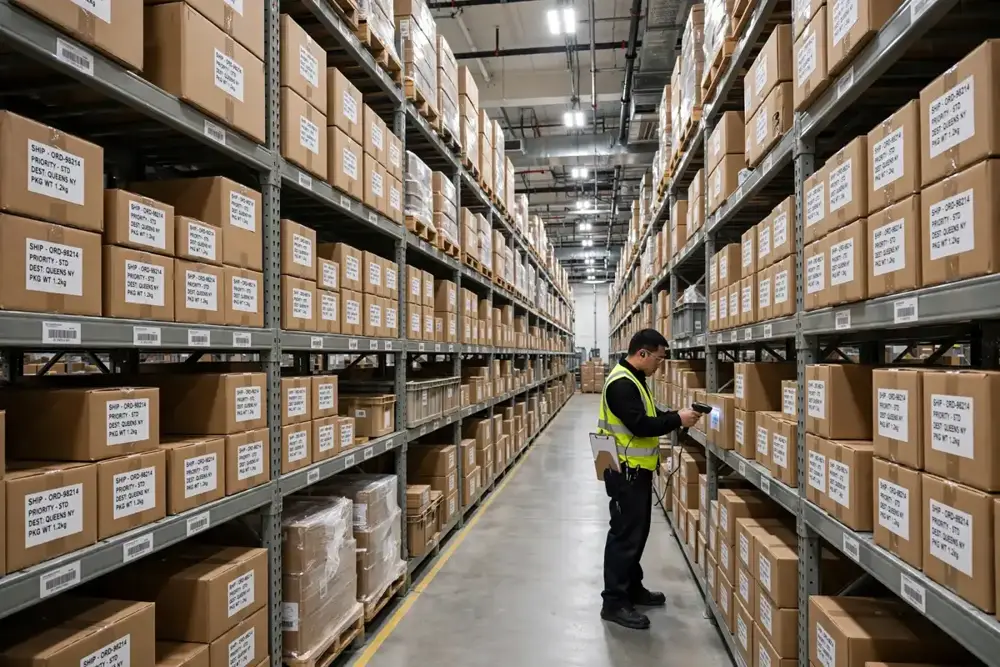
- Quality control — inspecting goods when they arrive at the warehouse, before they are packed, against the standard you agreed.
- Warehousing and fulfillment — holding stock, picking, packing, and handing orders to the carrier, with tracking uploaded to your store.
- Shipping — choosing the right line for each destination and product type, including lines that can carry batteries or liquids.
- Branding — custom packaging, labels, thank-you cards, and inserts that make the parcel yours.
- After-sales — handling returns, reships, and problem orders under rules agreed in advance.
Just as important is what an agent does not do. An agent does not pick your products, run your ads, or guarantee sales. If a candidate promises revenue instead of operational standards, you are talking to a salesperson, not an operator.
When do you need an agent, and when don’t you?
You need an agent when fulfillment has become the thing limiting your store. The usual signals: you are selling steadily and supplier inconsistency is eating your margin in refunds; you want your own packaging instead of a supplier’s poly bag; you need delivery times a marketplace seller cannot commit to; or you are spending more time chasing tracking numbers than growing the store.
You probably do not need one yet if you are still testing whether a product sells at all. At that stage, a marketplace order or an app is a cheap way to learn, and an agent’s quality control and branding only pay off once real orders flow. A good agent will tell you this honestly. We onboard testing sellers with no minimum order quantity for exactly this reason: test first, and let the volume decide when the full service earns its fee.
The stage you are in changes what “good” looks like. A testing seller needs low commitment and fast samples. A scaling seller needs fulfillment capacity, system integration, and stable shipping lines. A brand builder needs packaging, inserts, and quality evidence on every batch. Choose against your stage, not against a generic checklist.
What should you check before choosing an agent?
1. Sourcing depth
Ask where your products will actually come from. A strong agent works with a wide factory network — we source through more than a thousand partner factories — and can source a product you found anywhere, not only items in their own catalog. If every answer points back to a fixed catalog, you are looking at a reseller with a storefront, not a sourcing operation.
2. Quality control you can see
Quality control is the easiest service to claim and the hardest to fake — if you ask for evidence. Ask what is inspected, when, and what you receive as proof. Our standard: every batch is checked within 24 hours of arriving at the warehouse, and before dispatch we send photo or video confirmation of the actual goods and packaging. An agent who cannot show you your own products before they ship is asking you to trust a promise instead of a process.
3. Fulfillment speed and warehouse location
Processing time is where agents quietly differ by days. Ask how fast orders are inspected, packed, and handed to the carrier: our first scan lands 18–36 hours after an order is placed. Then ask where the warehouse sits relative to your factories. Shenzhen is the hub for electronics and anything with a battery; Yiwu is where small commodities concentrate. If your products are made in Shenzhen but fulfilled from Yiwu, expect one to three extra days before your shipping time even starts. We keep warehouses in both cities for this reason.
4. Shipping lines, named and tiered
Ask which carriers the agent ships with — ours are YunExpress, 4PX, and Yanwen — and what delivery options exist per destination. A serious operation offers tiered lines (for the US, think 4–6, 5–8, and 6–10 day options running in parallel) so you can match speed to margin instead of accepting one mystery line. Vague answers like “special line, very fast” with no carrier name are a warning, covered again in the red flags below.
5. A fee structure you can compare
You will meet three models: a service fee per order, a commission on sales, and membership or monthly fees, sometimes combined with charges for storage, inspection, or branding extras. The model matters less than whether every line is written down. Section six shows how to compare two quotes fairly; here, the check is simple: if a candidate will not itemize product cost, service fee, and shipping separately, stop comparing and move on.
6. Branding capability
If building a brand is on your roadmap, check packaging before you need it: custom boxes, printed labels, thank-you cards, and inserts, and the minimums attached. Our custom packaging starts at 100 units, which lets a seller test branded packaging on one product before committing. An agent who can only offer a logo sticker is not a branding partner.

7. Communication and a named contact
You are hiring across time zones, so test communication before you sign anything: send detailed questions and time the answers. Check whether you get a named contact who knows your products or a rotating support queue, and what the response commitment is — ours is a support team responding around the clock, 7 days a week. During peak season, this is the difference between a problem solved in an hour and a chargeback.
8. Systems that connect to your store
Manual order forwarding does not scale. Check for a Shopify app or ERP/API integration that syncs orders, inventory, and tracking automatically. Send a test order through the connection before real volume: the tracking number should land back in your store without anyone copying it by hand.
How do you vet an agent in five steps?
Step 1: Build a shortlist of two or three.
Use referrals from seller communities, platform app stores, and reviews that mention specifics — shipping times, quality, problem handling — rather than star ratings alone. Two or three candidates are enough; more turns vetting into a second job.
Step 2: Ask the hard questions in writing.
Before prices, ask about inspection standards, who physically handles your goods, what happens with defective items, and how exceptions are charged. We published the full list we would want to be asked: 15 questions to ask a dropshipping agent before hiring. Written answers matter: they become the baseline you hold the agent to later.
Step 3: Order samples as a customer would.
Buy your own products through the agent and judge what arrives: product accuracy, packaging, inserts, delivery time. A sample only tests sourcing, though — the real test is fulfillment under order conditions.
Step 4: Run paid test orders with checkpoints.
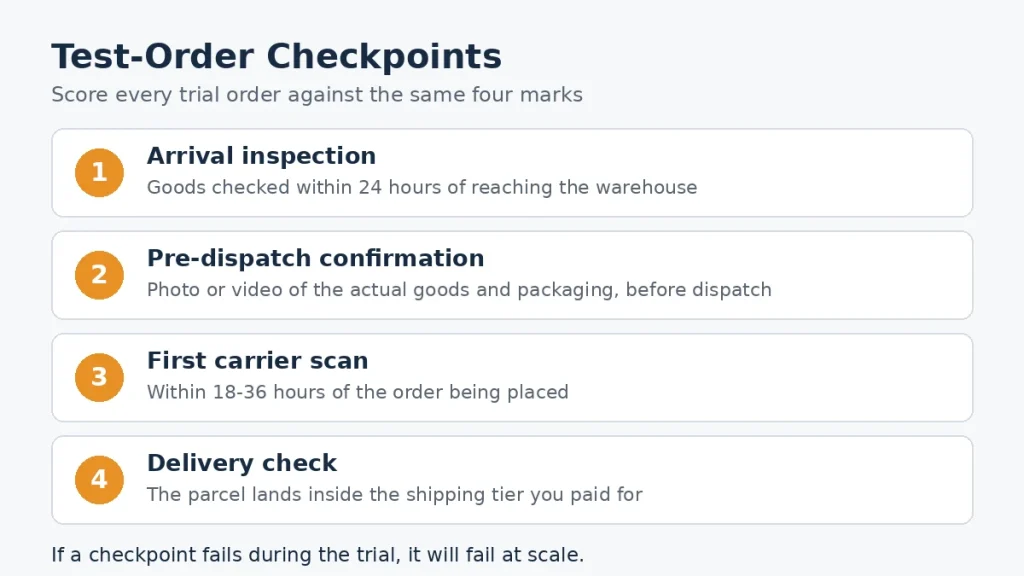
Place a small batch of real orders and score them against fixed checkpoints: goods inspected within 24 hours of warehouse arrival, photo or video confirmation before dispatch, first carrier scan within 18–36 hours, and delivery inside the promised tier.
This is where weak operations show themselves. In our own test orders, the arrival inspection is the checkpoint that earns its keep most often. It has caught listing mismatches — a material or size that did not match what the supplier advertised — before packing. The pre-dispatch photo check has also stopped packaging that would not have survived the trip. Every one of those orders would otherwise have become a refund, a reship, or a one-star review on the seller’s store, not on ours. Our dispute rate across 2025 orders ran at about 0.2%, and it stays there because problems are intercepted at these two checkpoints instead of at the customer’s door.
Step 5: Trial at small volume, then scale in writing.
Run two to four weeks at real but limited volume. If the checkpoints hold, agree the scale-up terms in writing: pricing tiers, inspection standard, exception handling, and what happens if you ever part ways. A clean trial with nothing written down is still an informal arrangement.
If you want to see how an experienced seller runs the finding step itself, this walkthrough of sourcing suppliers and agents is worth your time:
What are the red flags when choosing a dropshipping agent?
Walk away from any agent who shows two or more of these. Each one is something you can verify on the spot, not a gut feeling:
- Nothing in writing. No written terms for pricing, inspection standards, or exception handling means every dispute becomes an argument.
- Refuses samples or test orders. An operation that will not be tested before volume is telling you how it handles scrutiny.
- Cannot name its carriers. “Fast special line” without a carrier name means you cannot verify a single delivery claim.
- No quality evidence. If they cannot show inspection photos or videos of real client goods (with permission) or of your own test batch, the quality control is a slogan.
- Prices far below every other quote. Sourcing below factory reality is paid for somewhere: thinner packaging, swapped materials, or a slower line than promised.
- No warehouse you can verify. Ask for a live video walk-through or dated footage of the facility your goods would move through. A real warehouse is easy to show.
What does a dropshipping agent cost?
There is no standard price, because the service is not standard. Expect one of three structures — a fee per order, a percentage of sales, or a monthly membership — plus, at some agents, separate charges for storage, inspection, custom packaging, and returns handling. Storage is free at our warehouses, for example, while another agent may charge by the pallet; neither fact tells you which quote is cheaper.
Compare quotes the way you would compare anything else: on the total cost of one delivered order. Take the same product, the same destination, and the same shipping tier, then line up product cost, service fee, and shipping side by side. The quote with the lowest product price often carries the slowest line or the thinnest service fee — which reappears as your refund rate. Ask for the breakdown in writing, and treat a quote that cannot be broken down as the most expensive one on the table, whatever its total says.
Agent, supplier, or app: which do you actually need?
These three solve different problems. A supplier sells you goods and ships them; price is their main lever, and everything else is your job. An app automates ordering from marketplaces and is hard to beat on convenience while volumes are small. An agent is an operating partner: sourcing, inspection, warehousing, shipping, branding, and after-sales under one accountable roof, paid for with a service fee instead of your hours.
If your problem is verifying suppliers themselves — how to check a factory or a marketplace seller before trusting them — that is a separate discipline, and we cover it in our separate guide to choosing dropshipping suppliers. Choose the model that matches your current bottleneck, and revisit the choice when the bottleneck moves.
Conclusion
The right agent is the one whose operation survives your testing: inspected goods, named carriers, itemized fees, and standards in writing. Run the five vetting steps, keep the checkpoints fixed, and let a small trial — not a sales pitch — make the decision. If you are moving away from an agent who is failing those checkpoints, plan the handover itself with the same care; our guide on how to transition dropshipping agents walks through switching without losing orders in the process.
If you want to test RuntoDropship against this standard, start with a sample or a small test batch. We would rather earn the volume at step five than promise it at step one.
FAQ
How much does a dropshipping agent charge?
It depends on the model: a per-order service fee, a percentage of sales, or a monthly membership, with possible extra charges for storage, inspection, or branding. There is no honest single number without knowing your products and destinations. Ask every candidate for an itemized quote for the same product and shipping tier, and compare the total cost per delivered order.
Where can I find a reliable dropshipping agent?
Start with seller communities and referrals, platform app stores, and agencies you can verify — a real company, a real warehouse, and reviews that describe specifics. Shortlist two or three, then let samples and paid test orders, not marketing pages, decide reliability.
What is the difference between a private agent and a dropshipping company?
A private agent is usually an individual: flexible and cheap, but limited in capacity, systems, and backup when something goes wrong. A company runs a team, warehouses, and integrated systems, which costs more and scales further. Stores with steady daily orders generally need the company’s infrastructure; very small stores may not.
Can I switch agents later without disrupting my store?
Yes, if the switch is planned: keep the old agent fulfilling while the new one passes samples and test orders, reconcile inventory and packaging, and move volume in stages. The risky way is cutting over overnight. Our transition guide covers the sequence in detail.
Should I choose an agent in Shenzhen or Yiwu?
Choose the city that matches your products. Shenzhen concentrates electronics and battery-powered goods, with air routes that accept them; Yiwu concentrates small commodities like apparel, bags, and home goods. If your factory and your warehouse sit in different cities, add one to three days before shipping starts. An agent with warehouses in both cities removes that trade-off.
Do I need an agent if I am just starting out?
Not necessarily. While you are only testing whether a product sells, marketplace ordering keeps your commitment at zero. An agent starts paying for itself when orders are steady enough that quality problems, slow shipping, or unbranded packaging are costing you money. A good agent will run your test orders with no minimum quantity while you find out.