

Suppose two campaigns in your marketing fulfillment plan request the same brochures while a shared display is still booked at another event. Several campaigns may draw on the same base stock of promotional materials. An approved audience or budget leaves a practical question unresolved when the materials have already been promised elsewhere.
For those campaigns, fulfillment coordinates physical materials against approved requests, stock commitments and agreed delivery or return dates. A useful plan distinguishes giveaway quantities from reusable-asset bookings, identifies who can approve each decision and keeps unresolved commitments visible before a deadline becomes a packing problem.
What does marketing fulfillment cover?
Marketing fulfillment can cover physical campaign materials, from printed collateral and branded merchandise to kits sent to offices, events or individual recipients. The governing request might support recruitment, a sales team or an event rather than a paid consumer purchase.

The broader order fulfillment process explains the product-order lifecycle. A campaign adds its own material allocation and distribution purpose, even when some of the physical handling uses an existing product flow. Promotional fulfillment services therefore need a clear assignment of the materials and destinations involved.
A real recruitment-kit program
In an April 2026 report, La Sierra University described admissions welcome boxes being mailed to admitted students. The team had sampled the contents, settled item designs and prepared the received boxes for mailing. For your own campaign, connect these inputs:
- Approved physical materials and quantities.
- Intended recipients or delivery locations.
- Usable stock and the agreed need date.
Identify the campaign, material and distribution population before promising a release. Key Takeaway: Define the physical campaign request before choosing the handling arrangement or treating a creative approval as a shipment instruction.
Which distribution method fits your campaign?
Choose bulk delivery, named-recipient dispatch or route-selected printed mail according to the campaign’s delivery unit. An office allocation, an individual gift and a postal-route mailing require different distribution inputs.
Lee College’s own guidance distinguishes giveaway items from general tablecloths loaned for events. The delivery method and the material class are separate decisions: a loaned display needs a dated availability commitment, while a giveaway needs a quantity allocation.
Match delivery units and material classes
USPS EDDM Retail uses selected mail routes and addresses pieces to “Postal Customer,” rather than requiring a list of named recipients. The official USPS route overview illustrates that printed-mail approach; individual kit distribution needs its own agreed recipient arrangement. Match your request to the relevant unit:
- A bulk location and its allocated quantity, with responsibility for any onward distribution agreed.
- Each named recipient and their assigned material, kept distinct from the campaign’s total allocation.
- Selected postal routes for an applicable printed mailing.
Key Takeaway: Specify the delivery unit and whether the material is consumed or loaned; those choices determine what the campaign must commit.
How do you allocate stock across competing campaigns?
When requests compete for giveaway stock, identify usable quantity and existing commitments at one stated time, then refer the conflict to the agreed decision owner. The stock figure needs a material identity and unit before you can compare the requests. A quotation for more brochures is still an expected supply input; it does not increase the usable units in the current snapshot.
Lee College reviews catalogue requests for eligibility, quantity and stock availability separately from its annual funding allocation. A funded request still needs a material decision based on the actual stock and earlier commitments.
Compare two approved requests
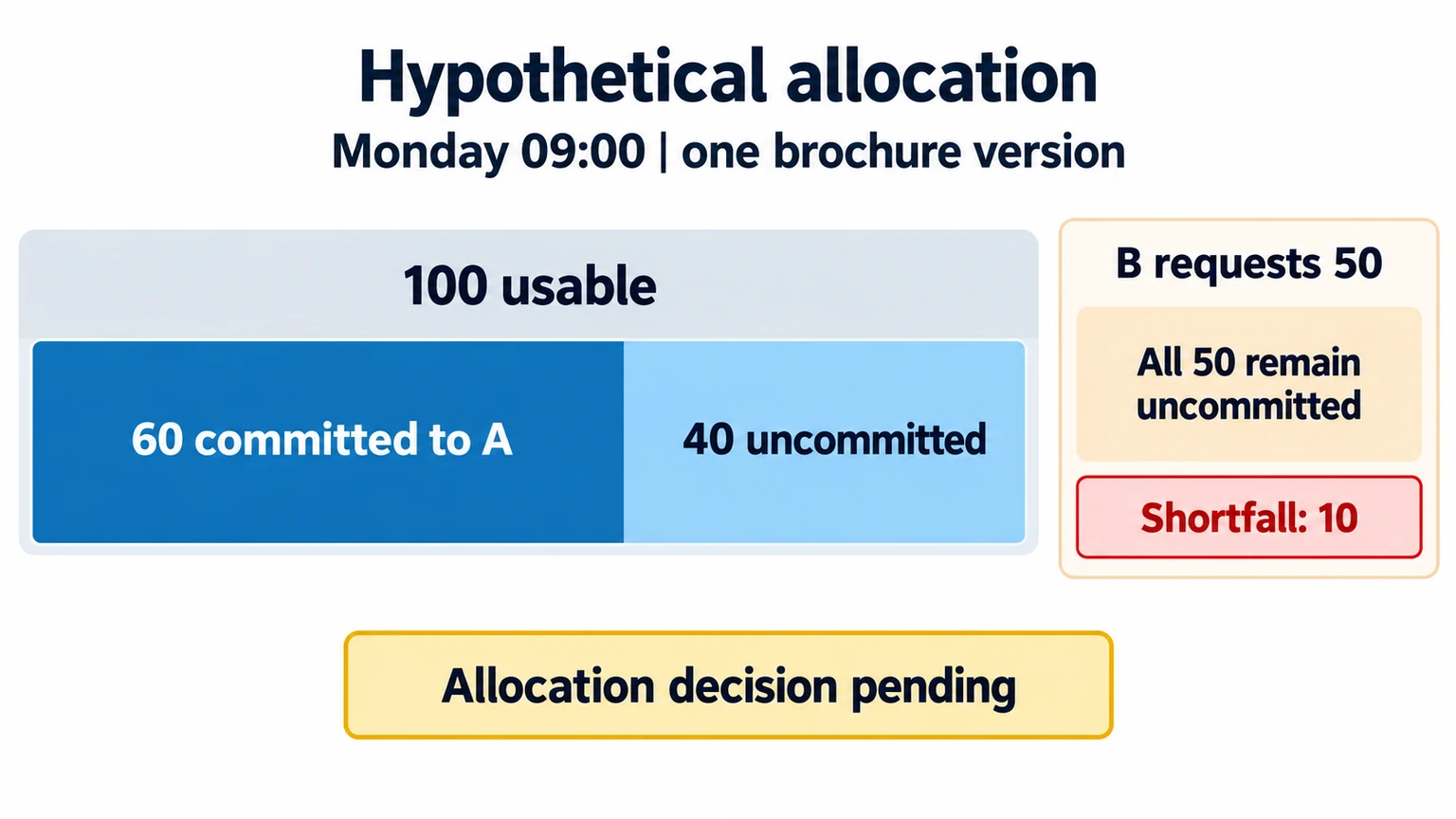
This is a hypothetical planning example using one brochure version at Monday 09:00. Assume 100 usable brochures, with 60 already committed to Campaign A and 40 still uncommitted. Campaign B has an approved demand for 50 brochures, but none has been committed to it. The allocation owner has several possible routes:
- Obtain approval for a revised B quantity or date.
- Confirm additional usable brochures before the agreed need date.
- Change an earlier commitment through its affected approvers.
| Campaign | Approved brochure demand | Already committed from the pool | New allocation requested |
|---|---|---|---|
| A | 60 | 60 | 0 |
| B | 50 | 0 | 50 |
All 50 brochures requested by B remain uncommitted; 10 is the shortfall requiring resolution before the full quantity can be promised. The 40 uncommitted units are potential availability, not an automatic B reservation. A’s 60 committed brochures are already part of the 100 usable units; counting them again as new demand would overstate the request. Key Takeaway: Resolve the shortfall and obtain the allocation decision before turning an approved campaign audience into a material promise.
Who may authorize a campaign’s distribution request?
The designated campaign approvers authorize the recipient, quantity and funding decisions within their assigned scopes. Agree who can approve the request, its recipients or locations, its quantity and its funding; record each scope separately.
The Lee College request asks for the event, audience, funding allocation and requested quantity. ESD123 separates Communications approval of externally distributed branding from the requesting department’s responsibility to pay. These are examples of locally assigned responsibilities, rather than one role structure every business must copy. For example, a budget holder could approve spending while a campaign owner decides which office receives the material.
Keep approval scopes separate
If the approved population or quantity changes, have the responsible owner decide the revised commitment before executing the change. Trace the affected field:
- The campaign audience or delivery locations, including which office the authorization covers.
- The material quantity requested from the shared pool, including a change to the approved quantity.
- The funding source or spending approval, including which department retains responsibility for the charge.
When a campaign card accompanies paid Shopify orders, the insert-placement workflow supplies the separate order-level packing context. Key Takeaway: Keep campaign allocation authority tied to the actual decision, including who must approve a change.
When can an event asset be reserved for another campaign?
An event asset can be reserved for another campaign when its requested interval fits existing bookings and the agreed return, preparation and transfer assumptions. For reusable event materials, record the agreed pickup-to-return interval and check it against the next request. The event’s closing time may precede the point when someone can collect, prepare or transfer the physical asset.
ESD123 asks departments to check existing bookings and provide both pickup and return dates when reserving shared display materials. An event-material record can connect shipment, arrival and expected return dates with future-event planning.
Separate booking from readiness
In the same hypothetical example, A collects a display on Monday and agrees to return it on Friday. B’s Thursday pickup overlaps that booking, so its asset request remains unfulfilled unless an authorized date or asset change resolves the conflict. Allow a future reservation to remain conditional on return and agreed preparation assumptions; confirm actual usable readiness separately before its next release. A nonoverlapping request for the following Monday can be planned on those agreed assumptions, with the dependency still recorded:
- An agreed date or custody change that resolves the overlap and is recorded for both campaigns.
- Another identified asset whose availability is confirmed against its own bookings and usable condition.
- An unfulfilled request with an owner and a contingency if neither option supports the required pickup.
Use warehouse receiving and stock checks to agree what the later physical-readiness confirmation must cover. If the return slips, the next booking’s assumptions change even when the scheduled event itself has already finished. The decision owner then has to confirm whether the same reservation remains feasible or an agreed alternative is needed. Key Takeaway: Keep a conditional future booking and verified readiness distinguishable, so an expected return never silently becomes a confirmed resource for the next release.

How do you close out campaign materials and costs?
At closeout, state the material, unit and time snapshot, and keep giveaway quantities, reusable-asset returns and financial charges in separate records. Dispatch totals, current physical stock and outstanding commitments can describe overlapping parts of the same material history.
Campaign closeout can include reporting on leftover inventory. The actual record depends on the agreed reporting scope and the material information the responsible party provides. Operational spending and campaign sales outcomes remain separate measures. At the same time, identify what the agreed transport estimate includes and who owns any separate venue receiving or event-handling charge.
Close the commitment at a defined snapshot
A brochure count, a display’s custody status and a departmental charge need different fields. Before the next request uses the balance, review the relevant records:
- Giveaways: issued quantity, counted usable remainder and outstanding reservations.
- Loaned assets: agreed return, verified custody or condition and the next booking’s dependencies.
- Charges: agreed cost owner and the production, storage, packing, carriage or event-handling costs included in the estimate.
The returned display does not add brochures to the giveaway pool, and a cumulative dispatch total is not another current-stock bucket. Key Takeaway: Carry forward the current material availability and remaining commitments separately, with spending assigned to the agreed owner.
What should a marketing fulfillment partner demonstrate?
Ask the provider to demonstrate your proposed request, allocation, reservation and closeout handoff, including who makes unresolved decisions. A marketing fulfillment partner’s agreed scope should be visible in that demonstration. A sample walkthrough can use your material and request fields without presenting a generic dashboard as evidence that the required responsibilities have been agreed.
Match each service to its actual scope
For a store also fulfilling paid customer orders, dropshipping fulfillment support concerns the product-order side of the brief. If a campaign uses the same product stock, the demonstration should show which quantities remain reserved for paid orders before the provider accepts a separate promotional request. Map the included work before adding that campaign request:
- Product sourcing or stock already assigned to store orders.
- The approved product-packing and dispatch instructions.
- Additional campaign tasks that need a defined scope and owner.
If the campaign uses a branded product pack, private-label packaging support concerns sourcing and coordination of that pack. Confirm who owns the remaining campaign work. Key Takeaway: Match each service to its actual assignment instead of treating a general fulfillment label as proof of every campaign capability.
Conclusion
A workable campaign plan identifies what is authorized, what is committed and which future bookings still depend on a return. RuntoDropship is a Private Dropshipping Agent. RuntoDropship can discuss product sourcing, quality checks and packaging coordination for the items in your brief, subject to confirming the required work.
Send the actual item and packaging requirements to RuntoDropship and confirm which sourcing, quality-check or packing-coordination work it can accept. We believe the approved product brief and agreed operating scope should determine the coordination work.
FAQ
How can I send a promotional gift without knowing the address?
If you do not have a delivery address, confirm whether the selected service lets the recipient accept an invitation and enter it before any physical gift is dispatched. A supported invitation-based gifting flow can let recipients accept a gift and provide their own delivery address, size and color preferences. The arrangement must support those steps for your item and program.
Should I check a recipient’s employer gift policy before sending?
An employer’s policy may restrict which business gifts a recipient can accept. Before sending a corporate gift, check the recipient organisation’s applicable gift policy and route any acceptance question to its designated contact. Use that actual policy rather than assuming the sender’s budget approval supplies permission.
What should I do when a recipient has not supplied an apparel size?
If the apparel size is unknown, confirm the offered item and size options and let the recipient select the size through a supported acceptance flow instead of assigning an assumed fit. Agree how the program handles a missing response; a delivery address alone does not identify the garment variant.
Can the same promotional gift go to recipients in every country?
Eligibility depends on the actual contents, destination and service. Check the actual item against the selected carrier and destination requirements before adding it to a sample or gift kit. USPIS warns that some materials are prohibited in USPS mail and others are restricted by quantity, packaging, labeling or transport requirements.
What if a recipient does not want branded merchandise?
For an optional gift run, consider a defined choice of items within the approved budget before dispatch, if the selected service supports it; agree what happens when an invitation is not accepted. Gift-choice options can include a budgeted catalog or a collection of items selected by the sender. Confirm the actual terms of the arrangement offered.