

An advance shipping notice (ASN) describes a particular shipment. When ASN shipping information differs from your purchase order or a warehouse count, first establish what each number describes. An approved partial shipment and a difference found at receiving raise different questions. Treating them as one shortage can send your team after the wrong evidence.
For a store with existing orders, the practical work is to connect the notice to the goods, understand the receiving partner's requirements and preserve the quantities needed for a fair comparison. You also need to know which party can confirm the packed contents. A notification alone cannot settle every question about dispatch, delivery or acceptance.
What does an ASN tell you about a shipment?
An advance shipping notice (ASN) is a shipment notification; EDI 856 is one electronic format used to communicate shipment information. X12 calls that transaction set a Ship Notice/Manifest and describes information about shipment contents and related details. The notice can support preparation for incoming goods before the receiving team has those goods in front of it. X12's public definition describes the message's purpose.
Within the wider order fulfillment workflow, an ASN belongs with shipment information. A carrier handoff record, delivery record and receiving count describe subsequent physical events. Compare their identifiers and dates before using one to explain another.
For example, a notice showing ten units does not by itself establish that ten units were loaded, delivered, counted or accepted. Those are separate assertions requiring the relevant records. Changing a notice cannot, by itself, correct a physical difference at receiving. The parties still need to establish what happened to the particular shipment.
Who sends an ASN and verifies its shipment details?
In X12’s public 856 definition, a message receiver can be any organization interested in the shipment or its information. The electronic recipient and physical destination therefore need to be identified from the actual arrangement. A sender's office, packing operation, transport provider and receiving organization may hold different parts of the evidence.
Ask the responsible sender for the shipment reference already assigned to the shipping notice. The retrieved Belk 2024 map describes BSN02 as a unique shipment identifier assigned by the original shipper. That field definition is specific to the published map. The sender should identify the reference used for your shipment and the receiver's required field.
The person transmitting a file also needs reliable packing information. If another team prepares the cartons, agree how its final contents and applied identifiers reach the sender. A China-side fulfillment arrangement should make those responsibilities clear for the agreed order checks, packing and handoff work. Any required EDI mapping or receiver connection needs its own confirmation.

Why must the ASN follow the receiver's own guide?
Confirm the required party and shipment references, purchase-order and item identifiers, quantity units, physical-unit identifiers and structural levels. Familiar names do not establish that two partners accept the same message layout.
The retrieved Belk 2024 map lists hierarchical structure code 0001 as Shipment, Order, Packaging, Item. The retrieved Kroger initial guide requires Shipment, Order, Tare and Pack levels. The same guide says Item-level information is not used at that time and will be ignored if sent.
The retrieved Belk and Kroger guides demonstrate that these published implementations cannot be collapsed into one generic hierarchy. They also differ in version and program context. Use the Belk map and Kroger startup guide as documentary examples, not confirmation of a current account's requirements.
Check the receiver’s current guide and agreed instructions before using an ASN example as an implementation map. Your team needs the applicable version, supported packaging arrangement and agreed interpretation of each required field. A conceptual diagram cannot certify that a production message will be accepted.
How do shipment, order, carton and item records connect?
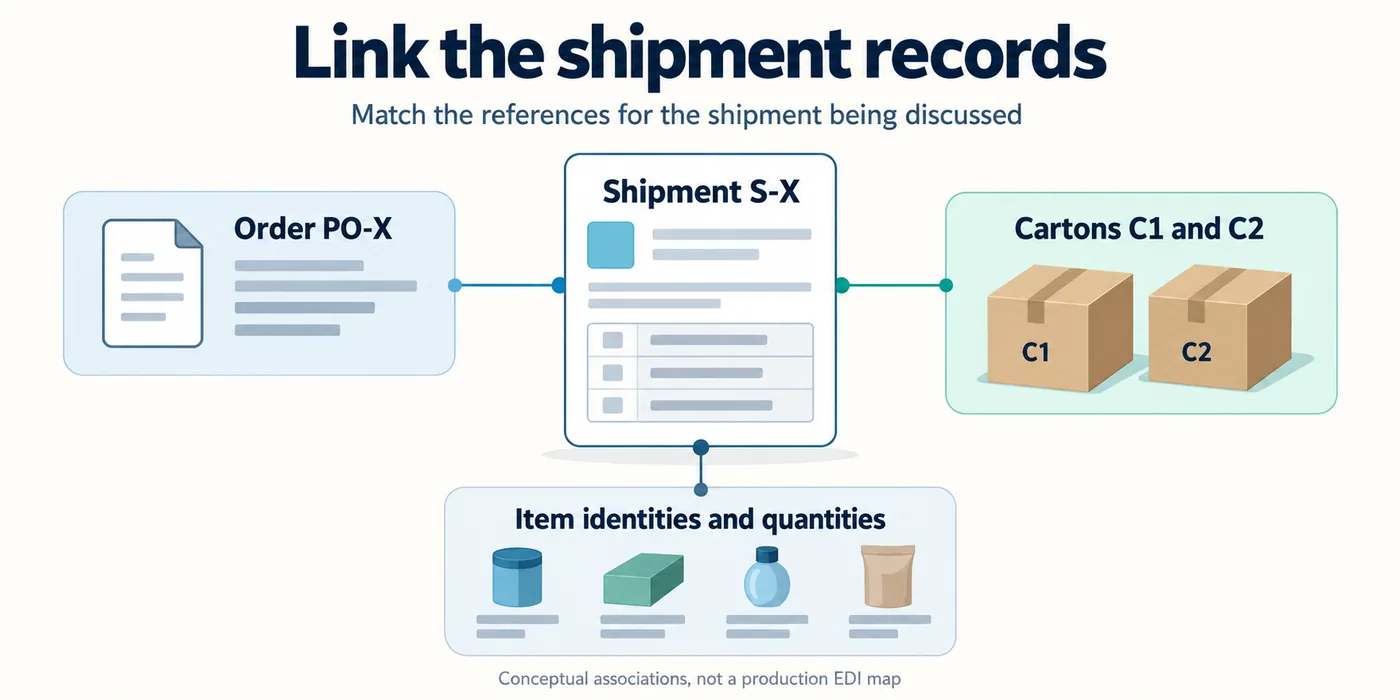
Shipment, order, package and item associations are useful concepts to check, but a conceptual association is not a universal EDI 856 implementation map.
Start with a particular shipment reference. Establish which purchase order it concerns, which physical units belong to it and which item quantities are recorded inside each unit. When an item spans several cartons, a total alone loses the carton-level location of a later difference. When a shipment contains more than one order, the item quantity also needs the correct order association.
The shipment reference locates the dispatch being discussed; the order reference locates the commercial requirement; the physical-unit reference locates the carton or other unit; and the item information describes its recorded contents. Actual implementation levels can organize this information differently.
Keep the relevant item identities and quantity basis visible through that chain. The worked example below uses teaching references to make these joins readable. It supplies neither a production EDI payload nor valid physical labels.
When should an ASN be sent or corrected?
Check the packed goods, physical-unit identifiers and agreed quantity units before confirming the ASN. An ordered quantity can be an input to preparation, but the notice should describe the particular shipment being advised.
The GS1 Logistic Label Guideline retrieved for this discussion is Release 1.3, July 2019. The same retrieved GS1 guideline recommends sending the advice upon staging or loading to improve its match with the actual shipment. It also recommends that the receiver process the advice before the goods arrive. These recommendations explain the relationship between timing and useful shipment information; the actual receiving partner's deadline still needs to be established.
Belk’s retrieved 2024 guide says a replacement ASN for data errors keeps the shipment identifier and overrides the earlier data. Follow the partner’s agreed correction process; do not assume that every replacement ASN uses the same identifier or message code.
Kroger’s retrieved guide describes an EDI 997 response reporting EDI-standard violations. The same Kroger guide describes application edits after EDI-standard checks, with an EDI 824 reporting those edit results and rejection when Kroger’s specifications are not met. Check technical responses, application rejections and physical receiving records separately.
When reviewing data handoffs and repeated messages, establish which response your team received and what it confirms. The Kroger example does not establish that every partner uses those response documents or that a successful response proves physical receipt.
How do physical unit IDs differ from tracking records?
An SSCC, or Serial Shipping Container Code, identifies a logistic unit in GS1’s logistic-label system. The retrieved GS1 Logistic Label Guideline recommends specifying each logistic unit’s SSCC and contained trade items in the Despatch Advice/ASN.
That association helps a receiving team connect an identified unit with information about its contents. Carrier tracking concerns a carrier's shipment or movement record. An appointment concerns a booking. A delivery record and receiving observations concern events or checks. One identifier should not silently substitute for another merely because all of them concern the same goods.
The practical question is whether the identifier on the physical unit corresponds to the unit described in the notice. A successful scan does not establish that every item was inspected. Any decision to accept contents using unit identification, inspect further or record a difference depends on the applicable arrangement and actual evidence.
A historical example from GS1 UK
The GS1 UK case says it was first produced in May 2013. The historical account reports that scanning loaded pallets triggered Dairy Crest’s system to send Tesco an ASN. It also describes Tesco scanning each pallet’s SSCC on arrival to check it against the ASN. This public case illustrates the reported connection between an identified physical unit and its notice in that historical operation.
How do you separate a partial shipment from a receiving difference?
Keep an approved unshipped order balance separate from a count difference against that shipment’s ASN. GS1’s retrieved RECADV material distinguishes received-and-accepted quantities from ordered or despatched quantities. That distinction helps keep the comparison's basis explicit; it does not make a counted quantity automatically accepted.
A fictional two-carton worksheet
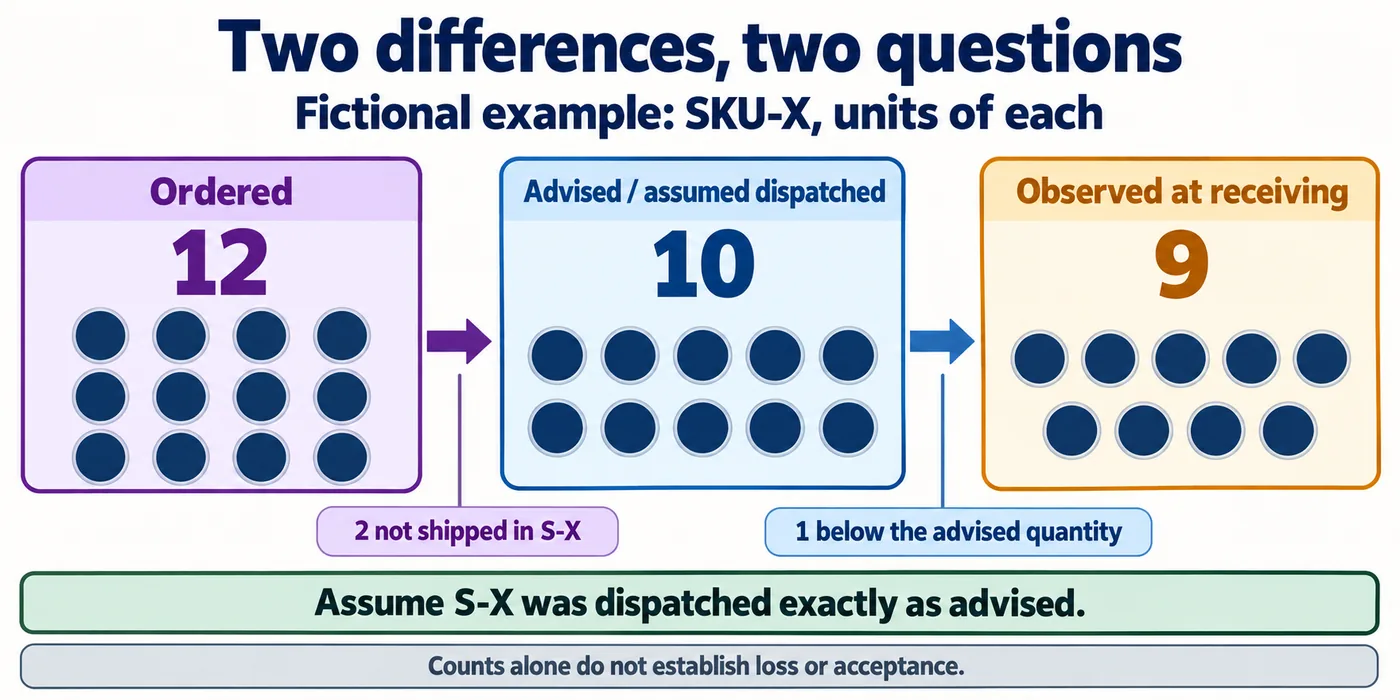
The following worksheet is fictional. Assume the buyer approves shipping ten of twelve SKU-X units now, the receiver permits the illustrated mixed cartons and unit-count checks, both records use the same item identities and each units, and S-X was dispatched with exactly the advised quantities. PO-X, S-X, C1 and C2 are teaching references, not valid SSCCs or live records.
| Record | SKU-X, each | SKU-Y, each |
|---|---|---|
| PO-X ordered | 12 | 8 |
| S-X advised in carton C1 | 6 | 4 |
| S-X advised in carton C2 | 4 | 4 |
| S-X total advised | 10 | 8 |
| Receiver observed in C1 | 5 | 4 |
| Receiver observed in C2 | 4 | 4 |
| Receiver total observed | 9 | 8 |
Interpreting the two differences
Under the declared fictional assumptions, SKU-X has 2 units not shipped in S-X and a separate receiving count 1 unit below the shipment’s advised quantity. SKU-Y reconciles at eight ordered, eight advised and eight observed. The carton records locate the X difference at C1; C2 agrees with its advice. The unshipped amount here depends on the explicit dispatch assumption. With only an ASN, the order-to-advice difference would not establish what actually left.
Investigating the unshipped order balance concerns the buyer's agreement for the remaining order quantity. Investigating the receiving difference concerns the actual packing, dispatch and receiving evidence for S-X. Combining the two gaps and calling them lost would add a cause that these numbers do not establish. They also do not authorize a credit, deduction or reshipment.
Use the applicable warehouse receiving evidence to establish what was recorded at each stage. If your arrangement includes product-specific quality checks, keep their scope and findings distinct from quantity reconciliation. The worksheet establishes no product condition, acceptance decision or available-stock posting.
Conclusion
An ASN becomes useful when its shipment reference, physical units and recorded quantities can be compared with the correct order and receiving evidence. The same comparison must preserve approved unshipped quantities separately from a difference against the shipment's advice.
RuntoDropship’s service page describes China-side order checks, picking, packing and parcel handoff, with supplier selection and procurement coordination where needed. As a private sourcing and fulfillment agent, RuntoDropship provides a point of contact for the agreed work. Send RuntoDropship your SKUs, order volume and destination countries to discuss an agreed China-side sourcing and fulfillment scope. Include the receiving partner's requirements so the requested work and information handoff can be assessed explicitly.
FAQ
How should mixed lots or dates be shown for the same item?
Keep each lot or applicable date tied to the correct item and quantity in the detailed records, and confirm the receiver’s actual mapping. The retrieved GS1 July 2019 guideline allows only one batch number on a logistic label. A label therefore cannot supply every batch distinction within a mixed unit; preserve the underlying detail.
How do I compare quantities when the pack size changes?
State the quantity unit and pack factor before comparing records that use different pack sizes. Belk’s retrieved map distinguishes assortment and EA units, illustrating why quantity units must be checked before comparing records. Equal pack counts can represent different underlying item quantities when the contents per pack change. Use the actual agreed factor for the item.
Why can goods be registered but not marked received?
Microsoft’s Supply Chain Management documentation distinguishes marking products as Registered from later posting them as Received. Business Central’s documentation combines receipt and put-away in methods A–C, while method D posts receipt before registering put-away. Check the current product, warehouse configuration and posted receipt record before interpreting a registration status. These are product-specific examples, rather than one universal sequence for every system.
How can I retrieve an older shipment message sent through EDI?
Ask the system owner to demonstrate retrieval of an older original EDI file or retained version. Check the shipment reference together with any retained version, timestamp or original-message metadata to establish which historical message the file represents. A current record on a screen does not establish that the older original is retained or recoverable. Agree access and retention with the responsible owner.
Can I reuse an SSCC number or label?
Before reusing an SSCC or label, distinguish an unchanged logistic unit from a new unit or reassigned number, then check the applicable assignment and receiver rules. GS1 US’s February 2019 introduction says a new SSCC is needed for a new logistic unit created by breaking down and repacking a unit. A canceled platform shipment, continued use of a unit's label and numeric reallocation are different situations; none supplies blanket reuse permission.