

You have orders to ship, a supplier comparison to review and a sample awaiting a decision. Your fulfillment partner needs product instructions, while the person collecting supplier information is waiting for approval. Adding another service can leave those same decisions unresolved, with another handoff to manage. Supply chain outsourcing means using an outside party to perform selected supply-chain activities.
The agreement should specify the work the outside party will do and the approvals you will retain. Begin with one task you can describe and assess, then connect its result to the next commitment.
What does supply chain outsourcing cover for an online seller?
Supply chain outsourcing can cover supplier-facing work, purchasing support, product checks and logistics execution or coordination. CSCMP defines supply chain management to include sourcing, procurement, conversion, logistics and coordination across companies. ASCM’s SCOR model separates Source, Transform, Fulfill and Return as process categories.
Are you buying execution or coordination?
Start by locating the order fulfillment work being delegated within the wider chain. An execution task might involve checking a sample or preparing an agreed order. Coordination might involve collecting supplier answers and passing an approved instruction to the party doing the work. Describe which result you are buying:
- A supplier comparison against your stated requirements.
- A sample and the observations you requested.
- Purchasing support within an approved instruction.
- Physical preparation or logistics work with an agreed handoff.
A public example of selective outsourcing
NIKE’s FY2025 filing lists design, development, marketing and selling as its principal activity and says nearly all products were manufactured by independent contractors. NIKE’s FY2025 filing identifies Air Manufacturing Innovation as a wholly owned subsidiary supplying cushioning components.
Key Takeaway: Name the activity and its execution party before deciding how much surrounding coordination to delegate.
Which activities are ready to move outside your business?
An activity is ready to outsource when you can describe the required result, supply its inputs and name who will accept it. Suppose your team can approve a storage-pouch specification but cannot spare someone to collect and compare supplier responses. Buy that defined comparison while keeping supplier appointment with your team. If staff can perform and review the comparison within the available working time, you can keep that assignment internal.
NIST MEP’s supplier-selection guidance recommends reviewing quality-system documentation and production and inspection records. When buying supplier research, agree which relevant records the comparison needs and which unanswered questions should remain visible. Request evidence appropriate to the work and products involved.

Specify the deliverable before you delegate
For each proposed activity, specify its input, permitted work, acceptance evidence and retained approval before requesting a quote. Identify the party performing each quoted activity, any subcontractors, and the records relevant to that party’s actual work. For logistics work a 3PL can accept, make the receiving, preparation or transport task part of the request.
- Keep it internal when your team still needs to decide what result it wants or make the commercial choice.
- Delegate it when an outside party can return a defined result that your team can assess.
- Split the work when you need outside research or execution while retaining the decision that follows.
- If an input is still unknown, commission its investigation as a separate assignment and agree how the provider will report unanswered questions.
Key Takeaway: A supplier comparison can be a defined first assignment while the supplier appointment remains your decision.
Which supplier and purchase decisions should you retain?
Keep supplier appointment, specification acceptance and purchase authorization with named approvers in your business. Then state what the outside party may do between those decisions. Someone collecting quotations needs a different instruction from someone placing an approved order.
For sourcing work, specify whether the agent may request quotes, place an approved purchase order or change a supplier or product specification. Record where that permission ends, so the next person can distinguish a proposal from an authorized instruction.
Name the decision before authorizing the work
For sample coordination, specify what will be checked, which evidence you need, and who may accept the specification before purchasing proceeds. With China-side sourcing coordination, describe the supplier research, quotation or sample task you want handled and the decision that must return to you.
- Supplier appointment: identify who accepts the proposed supplier after reviewing the comparison.
- Specification acceptance: identify the product reference the buyer approves after reviewing the sample evidence.
- Purchasing: identify who authorizes the instruction, quantity and spend before an order is placed.
Key Takeaway: Keep approval of the business commitment separate from permission to collect the information supporting it.
What should each outsourced activity hand over?
Each activity should hand over its agreed result, supporting records and any open issue affecting the next commitment. The recipient needs to know which brief or product reference the result answers. An unanswered supplier question can be part of an agreed research result; describe its status so the buyer does not mistake it for confirmation. Keep an administrative research deliverable proportionate to that task.
GS1 distinguishes tracking events from the data describing each event. GS1 describes traceability data through who, what, where, when and why, and says end-to-end traceability needs data from multiple organizations. Its published event materials also list the official video on traceability, efficiency and visibility.
Connect the requirement, result and next step
For physical handoffs, request the product or order reference, the event, party, location and timestamp, plus the next action when records disagree. The following illustrative worksheet uses a pouch brief and sample labels as examples; agree the actual content with the parties involved.
- Attach the agreed brief or reference version to the returned work.
- Keep unanswered questions beside the activity they affect.
- Identify the person receiving and assessing the result.
| Purchased activity | Agreed input | Result or evidence | Next commitment |
|---|---|---|---|
| Supplier research | Product brief and comparison criteria | Comparison with requested facts and open questions | Seller decides whether to appoint a supplier |
| Sample coordination | Pouch brief, revision B, and requested closure check | Sample S-01, brief revision B, closure observations and open questions | Named approver accepts the specification before purchasing |
| Purchasing support | Approved supplier and order instruction | Confirmation tied to the authorized instruction | Differences are resolved before preparation |
| Fulfillment handoff | Accepted product and order instructions | Agreed preparation and handoff records | Next party receives the records its work needs |
A completed comparison can support supplier selection while the sample decision remains open. Where you arrange agreed China-side fulfillment support, define the product and order instructions passing from purchasing into preparation. Key Takeaway: Accept each result against its own assignment before using it to authorize the next activity.
How can you compare quotes for the same work?
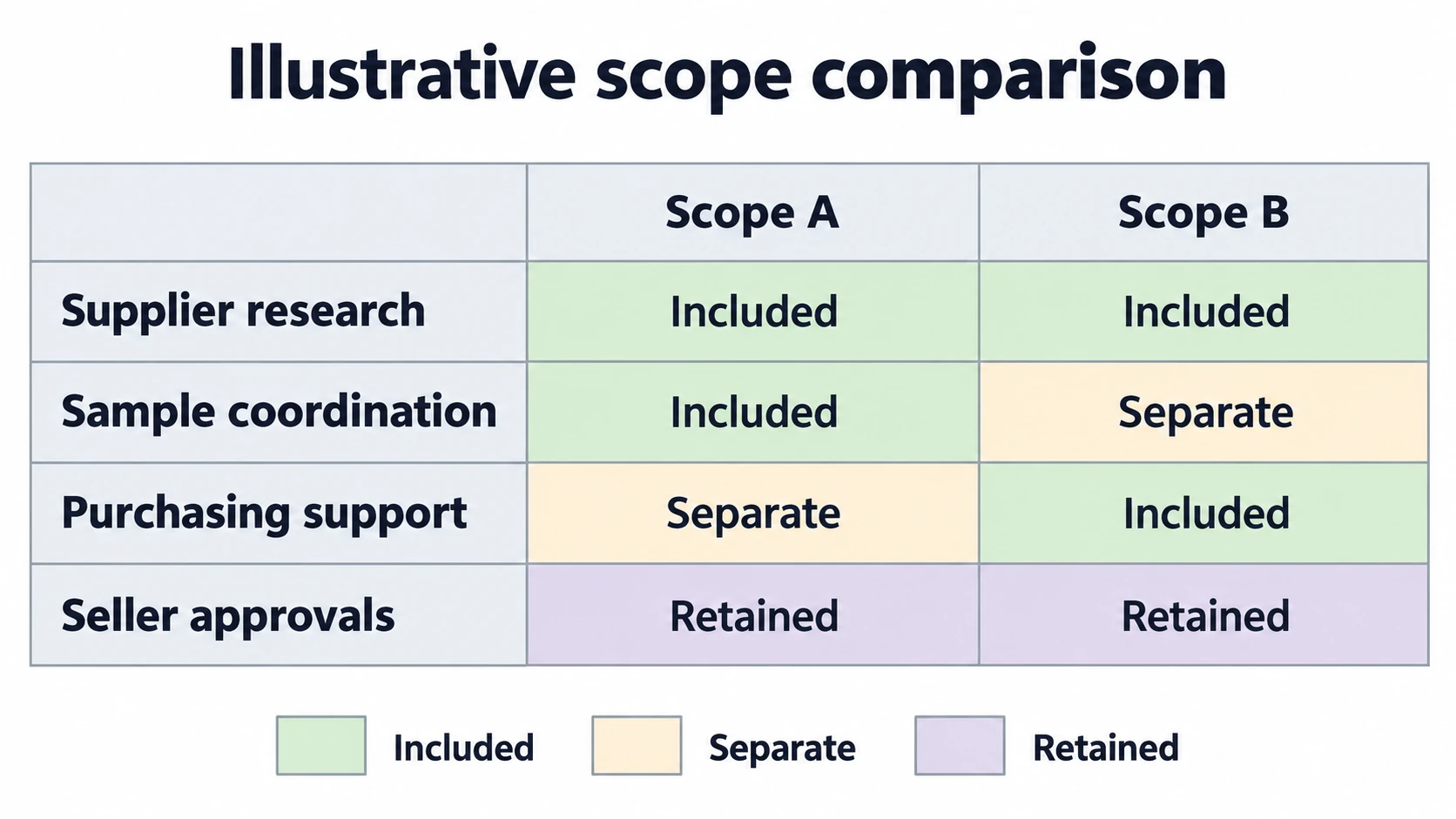
Compare quotes against the same activity and assumptions, including the work your team will retain. A total means little if one proposal includes supplier follow-up and another leaves it with you. Mark that difference before judging the price.
NIST MEP’s guidance includes freight, tariffs, inventory costs and supplier-management overhead in total cost of ownership. Use the relevant categories for your selected work; do not assume every task incurs every cost.
Price an identical scope
Compare quotes for the same activity, volume and inputs, and identify which setup, freight, inventory and exception costs are actually included. Use the same product brief, quantity and, where relevant, destination and service assumptions. For a logistics-management decision, refer to the work and cost behind logistics coordination so retained coordination is included in that comparison.
- Included work: the deliverables and follow-up explicitly covered by the quote.
- Excluded work: additional tasks that need a separate instruction or charge.
- Retained work: the approvals, information gathering and follow-up your team still performs.
- Change and transition work: setup or revisions that the proposal prices separately or leaves unresolved.
- Clarify whether another supplier response or a revised comparison is included, or needs a new instruction.
Key Takeaway: Ask for a scope correction when proposals cover different work; compare totals after the included and retained activities are visible.
What happens when the delivered work fails your requirements?
Make an explicit accept, correct or reject decision against the agreed requirement before authorizing the dependent commitment. Describe the missing result and who can decide the next step. Keep any decision to proceed with uncertainty visible.
Consider an illustrative brief for a storage pouch with a zipper closure. You commissioned a supplier comparison that confirms whether each supplier can make that closure and explains how the requested sample would be obtained. The returned worksheet contains prices but no closure-capability answer or sample approach.
Correct the mismatch before the next commitment
For this example, ask for the missing closure-capability answer and sample approach before authorizing the pouch purchase. The seller’s named approver can request that correction or expressly accept the remaining uncertainty. Record the decision against the brief so the next person knows which instruction governs purchasing.
- Identify the unanswered closure-capability and sample questions.
- State which purchase or approval depends on resolving it.
- Name the person who can accept a correction or authorize another course.
- Keep the corrected result and the acceptance decision together.
Key Takeaway: Close the purchased activity against its agreed deliverable, and record any uncertainty the buyer expressly accepts carrying forward.
What must change when you change the outsourced scope?
A scope change needs a revised instruction and a decision about the dependent commitments it affects. Identify what the new request supersedes before people continue using the earlier brief, sample reference or quote. Keep the old and new requirements distinguishable.
A 2016 guest RFP guide published by NIST recommends defining scope and quality needs, identifying subcontractors and requiring customer approval for process or design changes. Apply that approval principle to the work you have agreed with your provider.

Follow a change through dependent work
RuntoDropship coordinates product changes with upstream manufacturers. In another constructed example, an approved pouch brief changes from an open top to a zipper closure. Seek a renewed supplier capability answer and sample approval against the revised closure requirement. Before authorizing the purchase, confirm the revised work through the following checks:
- Mark the open-top reference as superseded and identify the new closure requirement.
- Ask which supplier-comparison findings still apply and which closure questions need a new answer.
- Obtain sample/specification acceptance against the revised reference.
- Confirm the purchasing instruction and quote/work basis reflect that accepted change.
- Keep the earlier sample tied to its old reference while the revised sample decision remains open.
Key Takeaway: Follow the changed requirement into the decisions and instructions that depend on it, so the next commitment uses the approved version.
Conclusion
Choose the activity, define the result and name the decision that follows it. That gives you a practical scope to discuss with an outside provider and a basis for judging the returned work. Start with an assignment your team can describe and accept.
RuntoDropship is a Private Dropshipping Agent for ecommerce sellers. RuntoDropship supports product sourcing, QC, order fulfillment, international shipping and tracking. Bring the activity you want handled, its current requirements and the approvals you plan to retain to our China dropshipping agent for lean ecommerce teams. We favor clearly defined responsibilities and records that the people doing the work can use.
FAQ
Can I give an agent access to only part of my store?
Shopify lets you limit collaborator access to specified apps and channels. Review the partner’s requested role and the permissions set inside any connected app. Ask why each permission is needed, and remove collaborator access when the work ends.
Do I need insurance for inventory held by another company?
Coverage depends on the actual policies and storage arrangement. Give your broker the warehouse location, stock values and transit details, then ask for confirmation of covered losses, limits and deductibles. Compare that protection with the provider’s contract so you know what still needs cover.
How do I check whether a supplier’s test report is genuine?
Ask the issuing laboratory to verify the complete report. Find the verification instructions through its official website and provide the document as requested. If the issuer cannot confirm it, keep its authenticity marked as unresolved.
Should I share design files before agreeing confidentiality?
Agree how the partner may use and share sensitive design files before sending them. Identify the files needed for the quote or sample, who can access them and any confidentiality terms. Get specialist advice for valuable designs or ownership of new design work.
Can I combine colors and sizes to meet a supplier’s MOQ?
You need the supplier’s confirmation for the exact mix. Ask for the minimum per color or size, the total quantity and the price for that allocation. Confirm whether customization or material choices change those terms before placing the order.