Air freight from China to USA is the fast way to move stock that cannot wait for a ship. It is also easy to overpay for. Airlines bill by space as well as weight, quotes cover different parts of the journey, and some cargo is refused at the airport. This guide shows where the charges come from and how to reduce them.
What Is Air Freight, and How Is It Different from Express?
Air freight is one of three main ways to ship across the Pacific. If you are still choosing between ocean, air and express, read our guide to shipping from China to USA first, then come back here to plan the air leg.
In air cargo, a forwarder books space on an airline, and the goods fly on an air waybill. Express is different: a courier such as DHL, FedEx or UPS carries the parcel on its own network from pickup to your door. Epic Sourcing notes that express courier services typically bundle clearance into the price. With standard air freight through a forwarder, you usually need a separate customs broker.
Goodhope Freight describes airport-to-airport as the traditional form of air cargo. A Chinese forwarder books the space and tenders the cargo at the Chinese airport, and a US forwarder clears it at the American airport. Goodhope says import clearance, duties and inland delivery in the USA are separate services under that model.
When Does Air Cargo Beat a Courier on Price?
Start with the size of the shipment. Several forwarders use 45 kg as the dividing line. Global China Forwarder says smaller shipments under 45kg often face higher per-kilogram rates because carriers charge minimum handling fees. It also notes that many forwarders apply a 45kg minimum billing weight. Below that weight, an express courier is often the cheaper and simpler choice.
Above that line, air cargo usually wins on cost per kilogram, but it asks more of you. Use this checklist before you choose:
- Weight and volume. Shipments of several cartons or a pallet usually suit air cargo. One or two small cartons usually suit express.
- Who clears customs. Express usually includes clearance. Air cargo needs a broker, unless your forwarder arranges one.
- Who delivers the last mile. Express ends at your door. Airport-to-airport air cargo ends at the US airport.
- How urgent the goods are. Both modes are far faster than ocean. If the goods can wait several weeks, compare our guide to sea freight from China to USA.
How Is Chargeable Weight Calculated?
Airlines do not bill only on what the scale shows. Tonlexing explains that airlines compare the actual weight with the volumetric weight, also called dimensional weight, and charge on whichever is higher. That higher figure is the chargeable weight.
The common formula for air cargo is:
Volumetric weight (kg) = length x width x height (cm) / 6000
Tonlexing adds that for some express and courier services the divisor may be lower, such as 5000. A lower divisor gives a higher chargeable weight for the same carton. Always ask which divisor a quote uses.
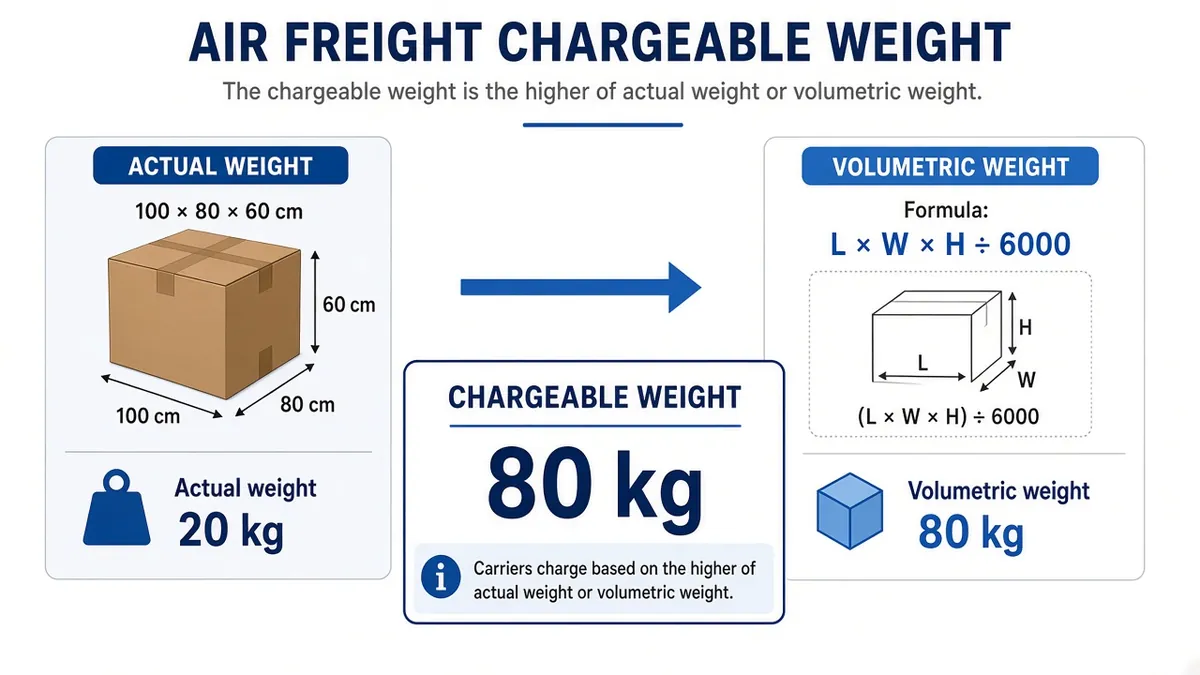
| Carton | Actual weight | Volumetric weight (divisor 6000) | Chargeable weight |
|---|---|---|---|
| 100 x 80 x 60 cm | 20 kg | 80 kg | 80 kg |
| 50 x 40 x 30 cm | 15 kg | 10 kg | 15 kg |
| Pallet 120 x 100 x 120 cm | 180 kg | 240 kg | 240 kg |
In Tonlexing’s first example, the airline charges based on 80 kg, not 20 kg, because the carton takes up more space than its weight suggests. Light, bulky goods such as pillows or lampshades are billed by volume. Dense goods such as metal parts are billed by weight. The pallet in the table shows the same effect at a larger scale: the 60 kg gap between actual and volumetric weight is still billed.
Three habits lower the chargeable weight:
- Measure the packed carton. Use the final outer size, not the product size.
- Cut empty space. A smaller carton or tighter inner packing reduces volume.
- Combine shipments. One larger shipment often reaches a better rate band than several small ones.
What Does an Airport or Door-to-Door Air Quote Cover?
Two quotes with the same rate per kilogram can end with very different bills. The difference is usually scope. Goodhope says airport-to-airport service includes airline booking, the air waybill, delivery to the Chinese airport customs supervision warehouse, export security screening, build-up and China export customs declaration on the origin side, and airline handling on arrival. Door-to-door service adds US import clearance and delivery to your address.
| Cost line | Airport-to-airport | Door-to-door |
|---|---|---|
| Pickup from factory in China | Sometimes | Included |
| China export declaration | Included | Included |
| Air freight to the US airport | Included | Included |
| US customs clearance | Separate | Included |
| Duties and taxes | Separate | Separate unless stated |
| Delivery from airport | Separate | Included |
The base rate is rarely the full price. Global China Forwarder notes that fuel surcharges and security fees are often calculated on top of the base freight rate. Ask each forwarder to list these lines:
- Fuel and security surcharges
- Origin handling and export declaration
- Terminal or airport handling at the US airport
- Customs brokerage and any bond
- Delivery, including liftgate or appointment fees
- Storage if the cargo is not collected quickly
The trade term also decides who pays for which part. Goodhope explains that under FOB, the seller’s obligation ends when the cargo is handed over at the named Chinese airport. From that point, the air freight, US clearance and delivery are the buyer’s cost. Under EXW you also pay for pickup and export steps in China. Under DDP the seller quotes a delivered price, but you should still ask what the price includes.
When you compare offers, check the chargeable weight, the divisor and the scope first. Then compare the total.
Which Cargo Can Airlines Refuse?
Airlines screen cargo before it is loaded, and some goods need special handling or cannot fly at all. Batteries are the most common problem for online sellers. PHMSA, the US hazardous materials regulator, states that “Lithium cells and batteries offered for transportation must have passed the design tests found in the United Nations (UN) Manual of Tests and Criteria, Section 38.” Ask your supplier for the UN 38.3 test summary before you book space.
Under 49 CFR 173.185, some battery shipments must carry a CARGO AIRCRAFT ONLY label, which means they cannot travel in the hold of a passenger plane. That limits which flights can take them.
Other goods that often need extra paperwork or are refused include:
- Liquids, aerosols and perfumes
- Magnets and products containing strong magnets
- Powders that cannot be identified on screening
- Goods declared with vague descriptions such as “parts” or “samples”
US security filing also starts before the flight. Under the Air Cargo Advance Screening rule in 19 CFR 122.48b, “The ACAS data must be submitted as early as practicable, but no later than prior to loading of the cargo onto the aircraft.” Your forwarder or the airline files it, but the data comes from your shipment details. A clear commodity description avoids holds.
How Long Does Air Freight Take from Door to Door?
The flight is the shortest part of the trip. Epic Sourcing gives a flight time of 13-16 hours between major Chinese hubs and major US gateways. It also says standard air freight usually lands at 5-10 days door-to-door once trucking, export customs, consolidation, US clearance and final delivery are added. Treat both as one forwarder’s estimates, not a delivery promise.
Days are usually added at these points:
- Factory to airport. Goods must reach the airport before the cut-off for the booked flight.
- Space and routing. Some cargo flies via other hubs instead of direct.
- Split shipments. Goodhope notes that airlines split large consignments across several flights when the load exceeds the capacity of one departure. The balance follows on a later flight.
- Customs holds. A missing document or an exam stops the clock.
- Delivery booking. The truck and the receiving warehouse both need a slot.
Plan from the date you need the stock on the shelf. Then work back and add buffer for each step. For example, if stock must be on sale on a set date, allow time for warehouse receiving, the delivery appointment, customs release, the flight, the airport cut-off and the factory finishing the order. Ask your supplier for a firm ready date before you book space, because a missed cut-off can push the cargo to a later flight.
How Does US Customs Clear Air Cargo?
Air cargo goes through the same formal entry process as ocean cargo. Under 19 CFR 142.2, “Merchandise for which entry is required will be entered within 15 calendar days after landing from a vessel, aircraft or vehicle.” In practice, brokers usually file before the plane lands so the goods can be released on arrival.
CBP’s importer tips say that “many first time importers and exporters consult a licensed customs broker.” A broker files the entry, classifies the goods and arranges the bond. Send the broker these documents as soon as the flight is booked:
- Commercial invoice with the value, currency and a clear description of each product
- Packing list with carton counts, weights and sizes
- Air waybill number from the forwarder
- Product details for classification, such as materials and use
CBP may also choose cargo for an exam. Its guidance says that “you, the importer, must bear the cost of such cargo exams.” Accurate invoices and clear product descriptions reduce the chance of a hold, but they cannot rule one out.
How Do You Get Air Cargo from the Airport to Your Warehouse?
Once cleared, the cargo still has to leave the airline’s terminal. Under an airport-to-airport service, that step is yours to arrange. A US forwarder or trucking company recovers the cargo from the airline and delivers it by local truck or LTL (less than truckload) freight.
Prepare these details before the flight lands:
- Recovery order. Tell the trucker which airline terminal holds the cargo and when it will be available. Collect it promptly, because terminals can charge storage on cargo that is not picked up.
- Pallets and labels. Every carton should carry a label that matches the packing list.
- Receiving appointment. Many warehouses accept deliveries only by appointment.
- Partial arrivals. If the airline split the shipment, the warehouse should expect more than one delivery.
Send the warehouse an advance notice of what is coming. Our guide to ASN shipping explains how an advance shipping notice speeds up receiving. If you need storage and order fulfillment once the cargo lands, compare options for a 3PL warehouse before you book the flight.
Conclusion
Air freight from China to USA costs less when you control what you are billed for. Check the chargeable weight and the divisor, compare quotes by scope, and clear batteries and other restricted goods before you book. File the entry on time and arrange the airport pickup before the flight lands.
RuntoDropship supports online sellers in China with factory sourcing, supplier coordination and inspection before dispatch. If you are preparing an air shipment, contact the RuntoDropship team with your product list, carton sizes and target arrival date.
FAQ
How much does air freight cost from China to the USA?
There is no fixed price. The bill depends on chargeable weight, the airports, the season, the cargo type and how much of the journey the quote covers. Ask each forwarder for an itemized quote that names the divisor and every surcharge.
Has China resumed shipping to the US?
Yes. Air cargo and express services from China to the United States are operating. Check current flight space and cut-off dates with your forwarder when you book.
Are shipments from China delayed today?
Delays change week to week. Peak seasons, holidays in China and weather at hub airports can all slow cargo. Ask your forwarder for the current lead time before you promise a date to customers.
Why are freight rates from China going up?
Air rates rise when demand for space grows faster than flight capacity, as in the fourth-quarter peak. Fuel costs also feed into surcharges. Ask how long a quote stays valid and book early in busy months.
Can I get stuff shipped from China to the USA?
Yes, if the goods are allowed to fly and are declared correctly. Small orders usually go by express courier. Larger shipments go as air cargo through a forwarder, with a customs broker handling the US entry.