

A retailer’s replenishment order can look ready to ship while its receiving requirements remain unresolved. The cartons may contain the right products, yet the buyer expects a different case configuration, delivery window or shipment reference. Repacking, a refused delivery or a disputed quantity can tie up stock and create work long after dispatch. B2B fulfillment handles the preparation and delivery of business orders against their agreed requirements, connecting what the buyer ordered with the goods packed, the shipment handed over and the receiving result.
Who is B2B fulfillment designed to serve?
B2B fulfillment serves business buyers purchasing for resale or use in their operations. Buying products from a supplier is one business transaction; fulfilling your own business customer’s order is the outbound task considered here. The complete order fulfillment process connects stock handling, preparation and delivery, providing the wider sequence for these buyer-specific checks.
Compare the actual fulfillment work
Start with the work the receiving customer expects. Order size alone will not tell you which instructions to follow: a business order may travel as parcels, cases or a pallet load, depending on the goods and agreed service.
- Identify the buyer, receiving location and order reference.
- Confirm the selling unit and required packing configuration.
- Establish any receiving labels, shipment messages and delivery conditions.
Ask whether the proposed operation can carry out those particular instructions. Key Takeaway: Give the operator a business-order brief before asking it to price or accept the work.
What must the buyer approve before you release an order?
Confirm the buyer’s applicable order instructions and obtain any approval needed for a proposed departure before releasing the affected goods. A general statement that an operator handles wholesale fulfillment leaves those order-level decisions open.
Identify the governing instructions
If the PO and receiving guide conflict, hold the affected release until the buyer confirms which instruction governs. Keep the answer with the purchase order, including the instruction version and the person authorized to approve the change.
- Check the receiving site named on this order.
- Separate agreed requirements from an operator’s usual practice.
- Obtain permission for a changed pack, quantity or delivery arrangement.
Requirements can differ even within one buyer’s operation. LTL stands for less-than-truckload. For example, Best Buy requires a unique packing slip for each LTL pallet but only encourages that per-pallet practice for truckload shipments. Its receive-ready instructions show why a rule should be checked against the actual buyer and transport mode.
Keep one order-specific release record
Use a short record that identifies the unresolved decision and whose answer allows dispatch:
| Question | Record to check | Who confirms? | Hold the affected release if… |
|---|---|---|---|
| Which instruction governs? | PO and receiving-guide version | Authorized buyer contact | The two instructions conflict |
| What quantity and pack are accepted? | Ordered unit, pack contents and any split approval | Buyer; operator confirms feasibility | A short quantity or changed pack lacks permission |
| Which labels and messages apply? | Buyer-required output and checked sample | Buyer’s receiving contact; operator | Required output is unconfirmed |
| When can this site receive? | Arrival requirement and booking confirmation | Agreed booking party and receiver | The required receiving arrangement is unresolved |
An operator can confirm what it can execute; a change to the buyer’s requirement still needs the appropriate approval. Key Takeaway: Make the reason for holding an order visible alongside the person who can resolve it.
How do you keep quantities and packing instructions aligned?
Keep business-order quantities aligned with the stock actually available for the job. Confirm the ordered unit, the physical pack and the permitted treatment of any short quantity before picking.
Check each, case and carton quantities
Write down what the order’s quantity represents. A sellable case, its individual contents and the outer carton used for transport may be different objects; the picker needs an unambiguous instruction.
- Match the buyer’s item reference to the correct product and pack.
- Confirm units inside each ordered pack and packs inside each shipping carton.
- Identify the stock location and any goods still awaiting checks.
Stock shown as received may still need approval before use. The warehouse checks that make received stock available explain that upstream distinction; apply it before allocating the business customer’s order.

Decide what to do with unavailable or unsuitable stock
A shortage needs a decision before someone changes the shipment. Ask whether the buyer accepts a later balance, a revised quantity or another proposed arrangement, and retain that answer with the order.
For product-specific pre-dispatch checks, agree the specification, quantity and packaging checks needed for the product. Keep damaged, incorrect or unapproved stock outside the allocation until its disposition is decided. Key Takeaway: Give purchasing and packing teams the same approved quantity and exception instructions.
Which labels and shipment data must match the goods?
Use the identifiers, labels and shipment messages required by the buyer’s agreed workflow, and check them against the actual packed goods. EDI stands for electronic data interchange. Confirm those requirements individually rather than assuming every business order needs the same EDI connection or pallet label.
Distinguish product codes from handling-unit codes
GTIN means Global Trade Item Number; SSCC means Serial Shipping Container Code. GS1 uses GTINs to identify trade items that are priced, ordered or invoiced. An SSCC is an 18-digit identifier assigned to a logistics unit. When GS1 Logistic Labels are used, each logistic unit is identified by a unique SSCC.
- Confirm the product and packaging level the buyer ordered.
- Identify the physical handling unit to which the required label belongs.
- Check the link between that unit, its contents and the shipment reference.
The code on a product and the code identifying a shipment unit answer different questions. The official GS1 video explaining SSCC use introduces that relationship; use the buyer’s current instructions and the GS1 logistics-label guideline for the applicable implementation.
How should the notice reflect the packed goods?
ASN stands for Advance Shipping Notice. GS1 recommends sending the ASN when goods are staged or loaded so it is more likely to match the actual shipment. GS1 also recommends listing each unit’s SSCC and contained trade items in the ASN, with variable data matching the goods. Ask for a label and message check against the actual packed goods before handing the shipment to a carrier.
A 2017 GS1 US case reports that Land O’Lakes generated SSCCs at manufacture and checked that information before sharing it with warehouses. It sent an ASN as each shipment departed so recipients could plan the arrival and check the shipment’s contents. Key Takeaway: Confirm the buyer’s required message timing and contents; a historical operating sequence does not establish your account’s rules.
How should you arrange delivery and record each handoff?
Arrange business delivery around the receiver’s agreed arrival conditions, with a named booking party and records of the actual handoffs. A planned dispatch date and an accepted receiving window answer different scheduling questions.
Agree the arrival conditions before dispatch
A vehicle booking leaves another question open: can the receiver accept this load at that time? Confirm the arrival requirement before using it as the basis for the shipping plan.
- Check the receiving address, contact and any applicable appointment requirement.
- Confirm the transport mode and site constraints relevant to that load.
- Identify who obtains the booking and reports a delay or rejection.
- Agree which quoted charges cover the actual cartons, handling and delivery service.
If a required booking is unconfirmed, refer the release decision to its owner. Do not turn an estimated transit time into a confirmed receiving appointment.

Preserve the physical handover evidence
Keep collection, carrier delivery and receiver acceptance as separate records. Record the shipment reference, handling units or package count shown at each handoff, together with the time, party and any noted exception.
A shipping label or electronic notice can exist before the goods move. Ask for the record of the physical event being claimed, and keep gaps visible when that record is unavailable. Key Takeaway: Save the confirmed receiving arrangement and the actual handover references with the order.
What happens when the buyer reports a discrepancy?
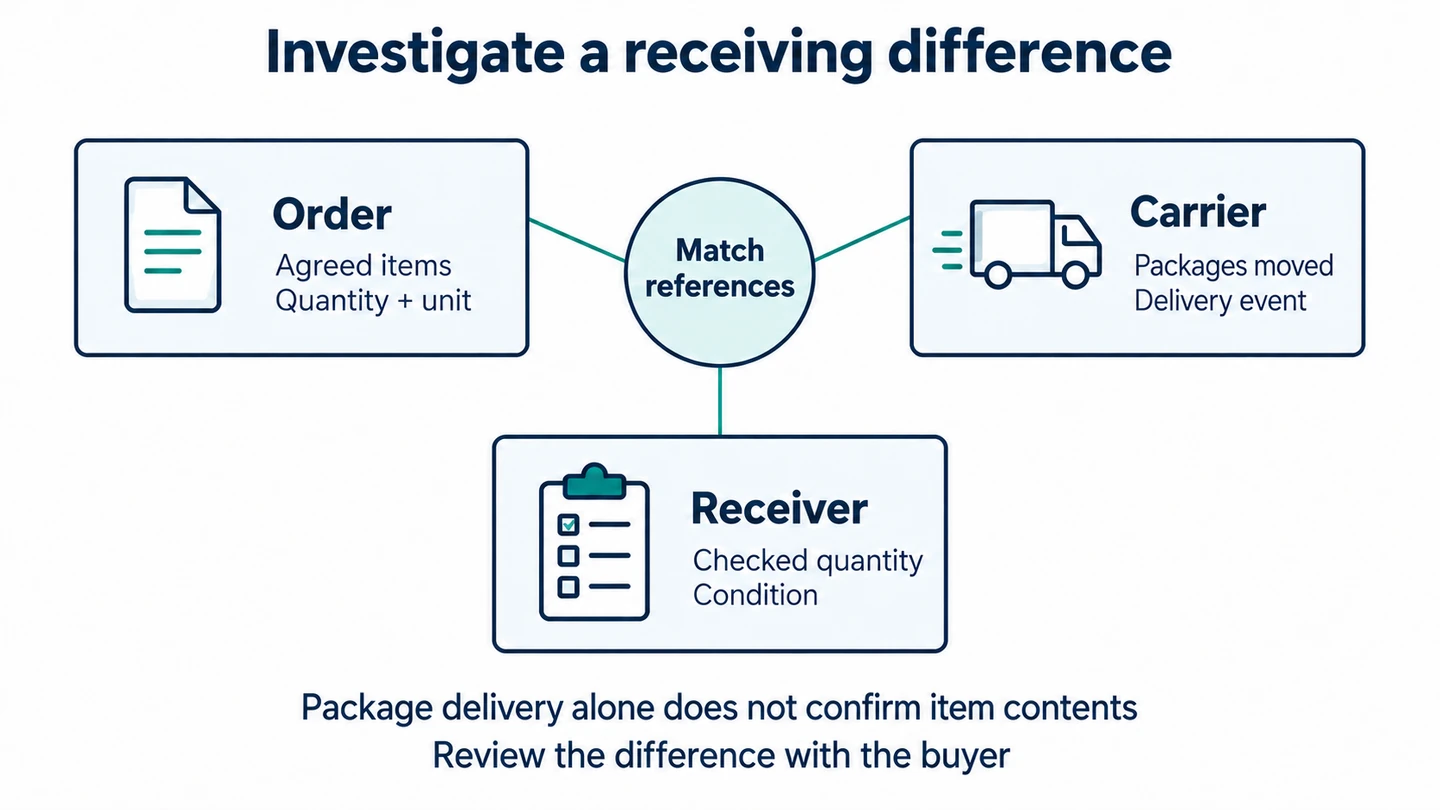
Investigate the receiving difference against the agreed trade order and the available physical records before choosing a correction. GS1 says checks of shipment contents and damage depend on the supplier–receiver agreement.
Establish what each record actually proves
A shortage report changes the immediate task from dispatching goods to explaining a difference. Start with the objects counted in each record:
- The PO states the items, quantities and units agreed for the order.
- Packing records describe the goods assigned to the shipment’s handling units.
- Carrier records may establish package movement or delivery, with the detail actually recorded.
- The receiver’s check identifies the quantity and condition it reports finding.
A carrier-confirmed carton count does not, by itself, settle a disputed item count inside those cartons. Compare matching order and shipment references, then ask which quantity or condition still needs confirmation; do not fill an evidence gap by assuming the missing event occurred.
Take the variance to the right decision maker
GS1 describes receiving advice as a way to confirm all products received or report missing or damaged goods. Where that message is not used, agree another way to capture the receiver’s findings and relate them to the original order.
Use the receiving discrepancy to agree the next action; do not assume a replacement, credit or deduction is already authorized. Name who will assess the difference, what further evidence is needed and who can approve the commercial response. Key Takeaway: Keep an unresolved receiving variance open until its decision and responsible person are recorded.
What should you confirm before repeating a buyer’s order?
Confirm how the last trade order passed through this buyer’s receiving process, including any unresolved difference, before repeating or expanding the release. A dispatch confirmation alone leaves the downstream result unanswered.
Confirm this buyer’s receiving and exception feedback
Before repeating the order, resolve the failed or unconfirmed step with that same buyer and operator. Review the actual result against the instructions used for that shipment:
- Were the required labels, messages and physical goods consistent?
- Was the delivery received through the agreed path?
- Which quantity, condition or approval question remains open?
If you still need to assess an operator’s scope, checking a provider’s retail-order capabilities covers that separate evaluation. For China-sourced goods, define the agreed China-side order preparation and fulfillment work, then confirm separately who can meet the buyer’s specific receiving and data requirements. Key Takeaway: Base the next release on this buyer’s current instructions and the unresolved issues from its previous order.
Conclusion
A workable business-order process connects the buyer’s instructions to the physical goods, shipment handoffs and receiving result. Confirm the governing requirements, keep quantities and records aligned, and give unresolved differences an authorized next decision.
RuntoDropship is a Private Dropshipping Agent. We can coordinate agreed China-side sourcing, quality checks and order preparation. To assess that scope, share the buyer’s PO, packing requirements and destination instructions with our China dropshipping agent for B2B sellers. We favor specific, checkable commitments when sellers plan larger orders.
FAQ
Can a business buyer use its own carrier account?
Potentially, if the actual carrier and shipping operator support the arrangement. Confirm the carrier’s billing permission, the account to charge and who will create the labels before using a buyer’s account. Also agree who receives shipment updates and handles any billing query; entering an account number alone does not answer those questions.
Can a B2B buyer collect the order instead of receiving delivery?
Only when collection is supported and agreed for that order. Agree the collection point, authorized collector and proof of handover before releasing the goods. Make the buyer’s selection clear to the team preparing the order so a collection request is not treated as an ordinary delivery booking.
Must purchase orders, invoices and shipments use the same grouping?
They need not share one grouping, but the arrangement must preserve the underlying order references. Keep each PO identifiable even when the buyer permits several orders to share a consignment. For combined billing across separate deliveries, check that each delivery remains traceable to the commercial order; confirm the actual document outputs before using that setup.
What should a packing slip show for a partial shipment?
It should clearly distinguish what is enclosed from the total order. Check the packing slip against the goods in that shipment, with any unshipped balance shown separately if the buyer requires it. Inspect an actual printout for the current fulfillment rather than assuming the template uses the correct quantities.
Can one corporate order be delivered to several individual recipients?
That depends on the agreed sales arrangement and supported fulfillment setup. Agree the billing arrangement and keep each recipient’s delivery record distinct before accepting a multi-address business request. Check how recipient details and shipment references will reach the operator; this is a different physical task from sending one bulk load to a retailer’s receiving site.