
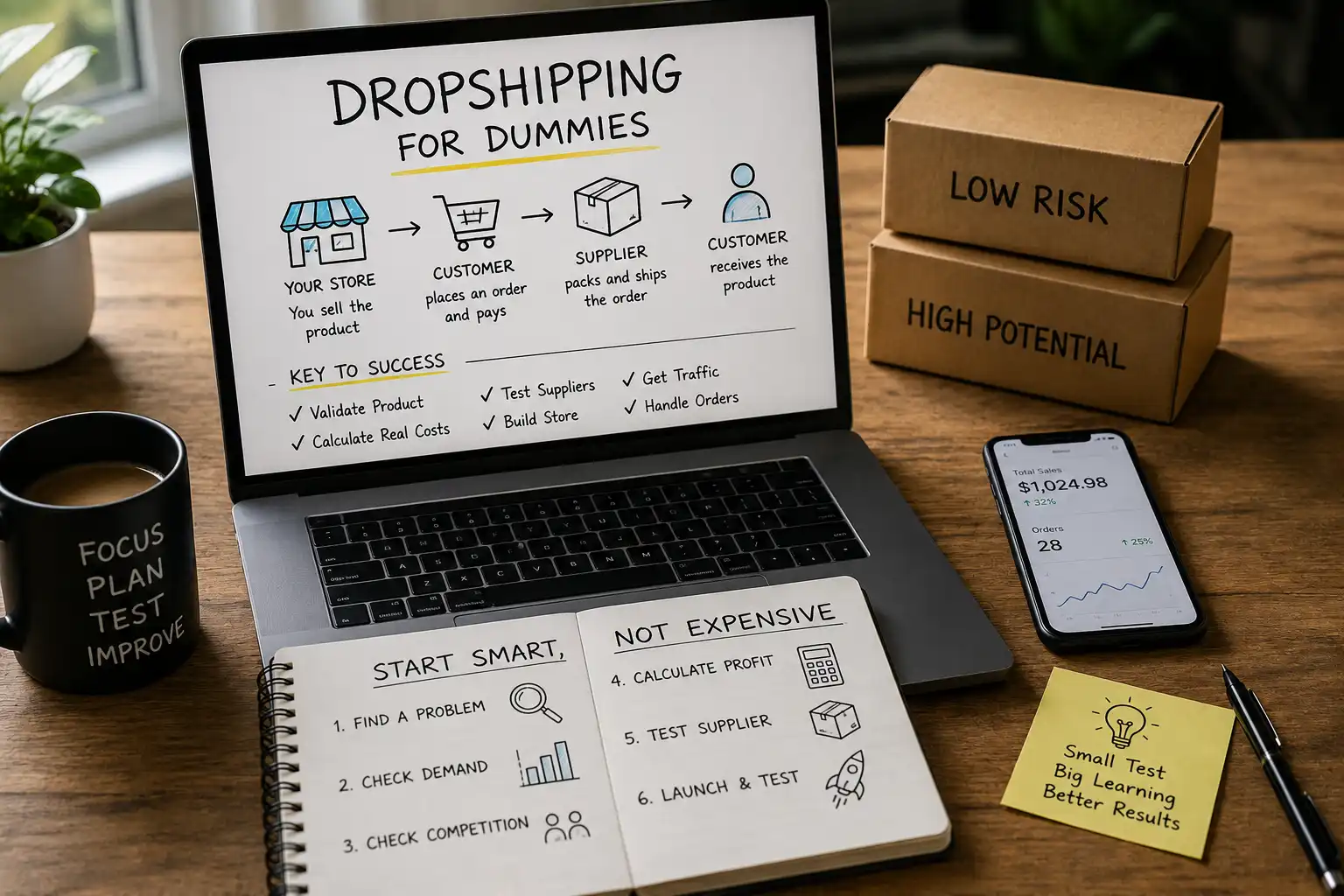
Dropshipping for dummies is a plain-language way to learn an ecommerce model in which you sell a product, a customer pays your store, and a supplier sends the order directly to that customer. You avoid buying a roomful of stock first, but you still own the harder parts of retail: choosing what to sell, attracting customers, setting honest expectations, protecting your margin, and solving problems after the sale.
The sensible beginner goal is not to build a perfect store or chase instant profit. It is to prove one small business loop: a defined customer wants the offer, the numbers can work, the supplier can deliver what you promised, and you can support the order responsibly.
Dropshipping for Dummies: What the Model Actually Means
Dropshipping separates the sale from the physical handling of the product. Your store presents the offer and takes the order; your supplier stores the item, packs it, and sends it to the delivery address you provide.
The customer still buys from you. That means you cannot pass every problem to the supplier when an item is late, damaged, different from the listing, or no longer available.
Follow one order from checkout to delivery
The basic order flow is short:
- A customer places an order and pays your store.
- Your system or team sends the order details to the supplier.
- You pay the supplier for the product and shipping.
- The supplier packs and dispatches the parcel.
- You send tracking updates and answer the customer’s questions.
- You handle any refund, replacement, or delivery problem under your store policy.
Your gross spread is the difference between the selling price and what the supplier charges. It is not your final profit because payment fees, advertising, refunds, apps, taxes, and other operating costs still have to be paid.
Know what the supplier does not replace
A supplier can handle stock, packing, and dispatch, but it does not create demand for your offer. You still need a clear customer, useful product positioning, accurate product information, a trustworthy storefront, customer acquisition, and after-sales service.
This division of responsibility is the first reality check. Dropshipping removes an inventory commitment; it does not remove the work of running a retail business.
Decide Whether This Business Model Fits You
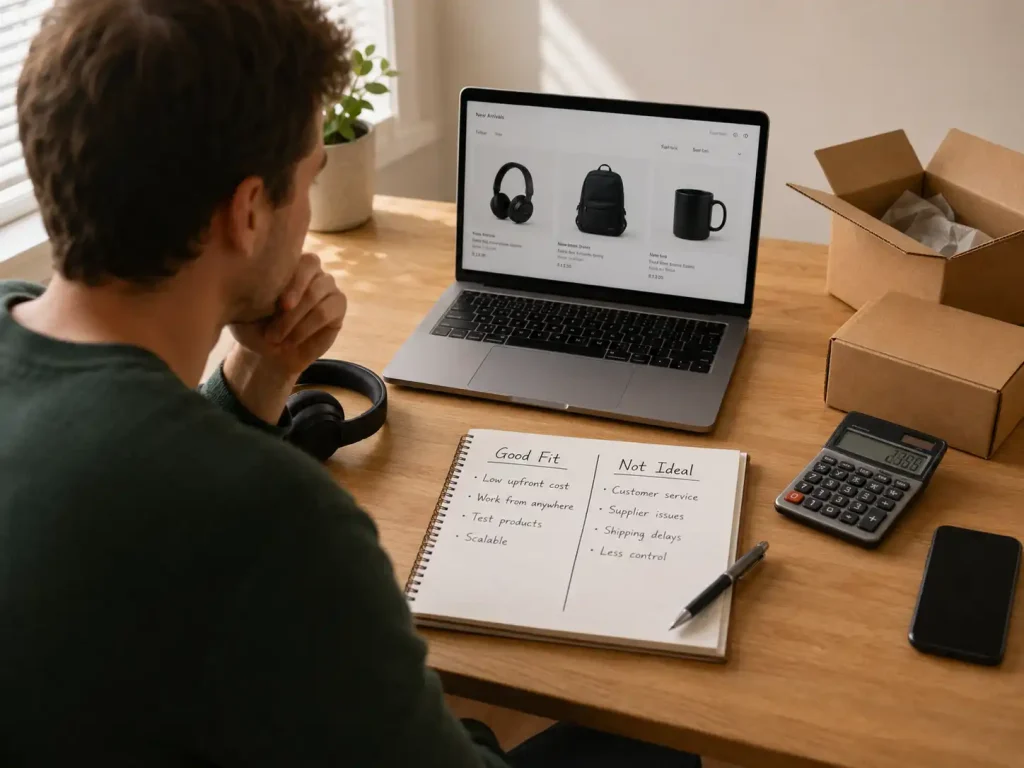
Dropshipping can fit you when you want to test demand without buying bulk inventory and you are willing to develop marketing, merchandising, and customer-service skills. It is a poor fit when you expect passive income, need full control over every parcel from day one, or cannot afford normal testing losses and customer remedies.
If you plan to operate the store alongside a job, the dropshipping side hustle guide explains the time, cash, and daily exception work that still has to fit your schedule.
The main advantages are practical: less cash tied up in unsold stock, no need to operate storage space, and the ability to change an unproven product quickly. The trade-off is less direct control over product quality, packaging, stock accuracy, processing, and delivery.
Before committing, compare those trade-offs against your actual strengths. A strong content creator may accept thinner early margins in exchange for a faster product test. A product designer who needs a unique formula, exact materials, or premium presentation may be better served by samples, a small production run, or another inventory model; compare dropshipping vs wholesale before deciding how much inventory and product control the offer requires.
A useful decision is not “Is dropshipping good?” It is “Can I create demand and keep the customer promise while another business handles the product?” The deeper pros and cons of dropshipping matter most when you compare them with your capital, control needs, and tolerance for service problems.
Key Takeaway: Choose this model for low-commitment market testing, not because it appears effortless. If you cannot explain how you will earn trust and resolve supplier mistakes, you are not ready to launch.
Validate a Market and Product Before Building the Store
Start with evidence that a specific group of people has a recurring need, then choose a product that can meet that need at a workable cost. A product is not validated because it is viral, appears in a research tool, or already has many ads.
Define the customer and the problem
Write one sentence that names the buyer, the situation, and the desired outcome. “Desk workers who want to reduce cable clutter in a small home office” gives you clearer research and messaging than “everyone who likes gadgets.”
Search for the phrases that customer would use, inspect competing product pages, read ordinary reviews, and note repeated complaints. You are looking for stable demand, visible dissatisfaction, and a reason your offer could be clearer or more useful.
Test demand and competition together
Demand without a competitive angle can produce an expensive store that looks identical to dozens of others. Competition without demand can leave you promoting an item nobody wants.
Use Google Trends to compare sustained interest with short spikes, but treat the chart as normalized relative search interest rather than proof that a product will sell. Then inspect current sellers for price ranges, delivery promises, creative angles, reviews, and weak points. Trend research can show how interest changes over time, while a fuller product-selection process helps you examine demand, shipping risk, quality, and margin together.
Shortlist a few products instead of filling a general store with unrelated items. Reject products that are fragile, hard to describe accurately, likely to create safety or compliance problems, difficult to return, or too cheap to support acquisition and service costs.
Before approving a product for the U.S. market, identify the safety requirements that may apply to it. The U.S. Consumer Product Safety Commission’s Regulatory Robot asks product-specific questions and generates a starting report of basic requirements. The video below shows how the tool works.
Calculate the Real Economics Before You Set a Price
Your price must cover every cost caused by an order, not only the supplier’s product quote. A store can show revenue and still lose cash when shipping, fees, advertising, and remedies are missing from the calculation.
Use this first-pass formula:
Unit contribution = selling price − product cost − shipping − payment fees − variable app fees − expected refund or replacement allowance − variable acquisition cost
Unit contribution is the amount left from one order before fixed expenses such as your store subscription, domain, accounting, and general software. If the result is too small to absorb normal variation, a higher sales volume will usually magnify the problem rather than fix it.
Your startup budget also needs more than a storefront:
- business setup required where you operate;
- product samples and test shipments;
- a domain, store plan, and essential apps;
- product photos or original creative;
- a controlled organic or paid traffic test;
- a customer-remedy reserve; and
- cash to pay suppliers before customer payouts reach your account.
Build three cases—expected, worse, and break-even—using your own quotes and test data. Do not treat a competitor’s retail price or a supplier’s “free shipping” label as proof of your margin.
A written dropshipping business plan becomes useful when it turns these assumptions into spending limits, test criteria, and a stop decision.
Key Takeaway: Set a maximum test loss before launch and know the minimum unit contribution you will accept. If the numbers work only when returns, fees, and acquisition cost are ignored, the product does not pass.
Choose and Test a Supplier
Choose a supplier by testing the exact product, destination, shipping method, and support process you plan to sell—not by trusting a catalog badge or the lowest quote. Reliability is a chain of observable behaviors.
Ask each candidate for the same information:
- the exact product variant and current unit price;
- stock-update method and order-processing steps;
- packing method and available branding restrictions;
- shipping options for your target destination;
- tracking availability and how exceptions are handled;
- defect, replacement, and refund procedure; and
- who answers when an order needs urgent correction.
Order a sample to the market you intend to serve. Check the item against the listing, record the packing and tracking experience, photograph any issue, and ask the supplier to resolve one realistic question before you send customer traffic.
A good sample is not permanent proof. Prices, stock, staff, and shipping performance can change, so keep written specifications and repeat checks on important products. Compare provider types and verification criteria in the best dropshipping suppliers analysis rather than assuming one source fits every seller stage.
At low volume, an integrated supplier platform may reduce setup friction. Once a product receives repeat orders, a dropshipping sourcing agent or broader private-agent workflow can become more relevant because stock visibility, product checks, packing consistency, shipping choices, and issue ownership matter more.
Key Takeaway: Approve a supplier only after the sample, written terms, shipping path, and problem-response test all pass. Keep a backup route for a proven product before increasing traffic.
Build a Store That Makes a Clear Customer Promise
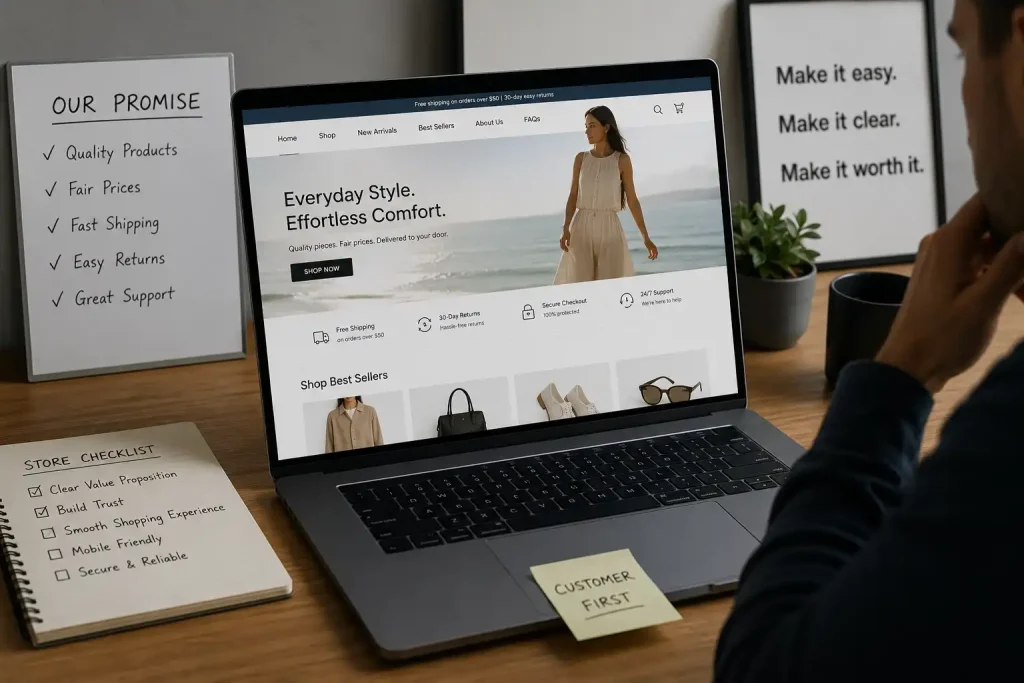
Your store should make the product, price, delivery expectation, and remedy process easy to understand. Design polish cannot compensate for copied descriptions, vague contact information, or promises the supplier cannot keep.
Choose a selling channel that matches how you plan to reach customers. An independent store gives you more control over presentation and customer relationships, while a marketplace may provide built-in demand but imposes its own seller rules and operating limits.
Before accepting orders, complete the essentials:
- an accurate product page with original, verified information;
- clear pricing and payment setup;
- visible shipping, return, refund, privacy, and contact information;
- order confirmations and tracking messages;
- a tested checkout on mobile and desktop; and
- a simple record of orders, costs, customer messages, and supplier actions.
Run a complete test order. Confirm that the right variant reaches the right address, tracking appears, messages arrive, and the total charged cost matches your calculation. Fix that loop before adding more products or automation.
Launch a Small Customer-Acquisition Test
Launch with one main traffic method and a fixed learning goal. Trying paid social, search ads, influencers, short-form video, email, and search content at once makes it hard to know what caused the result.
Choose the method that fits the product and your skills. A visual demonstration may suit short-form video; a product solving an actively searched problem may suit search; a niche with strong communities may respond to creator partnerships or useful content.
Define what the first test must teach you:
- Do the right people stop and engage with the offer?
- Do visitors reach the product page and add the item to cart?
- Do they complete checkout?
- Which questions or objections appear repeatedly?
- Does the resulting acquisition cost leave enough unit contribution?
Change one major variable at a time. If people ignore the creative, changing the supplier will not solve the immediate problem. If they click but do not buy, inspect the offer, trust signals, product page, total price, and delivery promise before simply spending more.
The first sale is evidence of one purchase, not proof that the store can scale. Look for repeatable demand and a stable order experience across a meaningful set of tests before increasing spend.
Key Takeaway: Treat early marketing as controlled research. Scale only after you can name what worked, reproduce it, and still keep a positive contribution after realistic order costs.
Run the First Orders and Know When to Upgrade Operations
Your first orders should follow a written daily routine: confirm payment, check the product and address, send the order to the supplier, capture tracking, update the customer, and record any exception. A simple checklist prevents small mistakes from becoming customer-facing surprises.
Track signals that reveal whether the business loop is healthy:
- order processing matches the promise you made;
- tracking is supplied and remains understandable;
- delivered items match the approved sample and listing;
- customer questions have clear owners and response steps;
- refunds, replacements, and reships are included in the margin record; and
- stock or price changes reach your store before they create bad orders.
Do not automate a broken process. First make the manual workflow dependable, then automate repetitive handoffs while keeping a human exception path.
RuntoDropship is best suited to sellers, mentors, agencies, and operators who already have orders or repeat projects and need more accountable sourcing, product checks, packaging coordination, order execution, shipping arrangement, and after-sales support. A complete beginner should first prove demand and understand the order loop; a growing operation can then decide whether private-agent coordination solves a real bottleneck.
FAQ
Do I need an LLC to start dropshipping?
Not necessarily. An LLC is one legal structure used in the United States, while other countries use different structures and registration rules. The selling model itself does not require that specific structure, but your location, selling channels, payment providers, tax position, and risk exposure may require registration or make professional legal and accounting advice worthwhile.
Can I start without my own website?
Yes, you can sell through a marketplace or another channel that supports product listings and payments. You must follow that channel’s current rules, and you will usually have less control over the customer relationship, presentation, and account risk than with a store you operate.
Can one store use more than one supplier?
Yes, but a mixed order may be split into separate parcels with different tracking events and delivery dates. Test the checkout, shipping charges, customer messages, and support workflow so a buyer is not surprised by multiple packages.
What should I do if the supplier runs out of stock after a customer orders?
Pause the listing, confirm whether a verified replacement or restock date exists, and contact the customer promptly with truthful options. Do not silently substitute another item; obtain the customer’s agreement or provide the remedy required by your store policy and applicable rules.
Is print on demand the same as dropshipping?
Print on demand is a related form of supplier-direct selling in which an item is produced or customized after the order, then shipped to the customer. Traditional product reselling usually uses finished stock that already exists, so the design control, production step, product range, and delivery process differ.
Conclusion
A responsible start is a sequence of small proofs: understand who owns each task, decide whether the trade-offs fit you, validate demand, calculate the full order economics, test the supplier, build an honest store, and acquire customers through a controlled experiment. That sequence gives you evidence for the next decision instead of relying on hype.
When repeat orders expose sourcing, quality, packing, shipping, or after-sales bottlenecks, RuntoDropship can help as your private dropshipping agent. We believe a durable ecommerce business is built by making the customer promise and the backend execution agree; send your product link, target market, current order volume, and main operational problem to discuss the right next test.