

After a busy launch, your store may have weeks with only a few parcels to send. A low pick-and-pack rate looks affordable until the warehouse’s monthly minimum and storage charges arrive together. The best 3PL for small business accepts your goods and required services on terms you can afford during a quiet month, with startup conditions you can meet.
Before comparing pick fees, separate admission from affordability. A warehouse may accept a small account while charging a spending floor that makes its quiet months expensive. Because the providers use different charging bases, use the options below to decide which enquiries deserve a complete written quote.
Which 3PLs should a small business consider?
If you need low-volume fulfillment, eFulfillment Service, Fulfillrite and Fulfyld are three conditional options to investigate through their published terms. The wider 3PL relationship explains the outsourced role; this comparison focuses on the commitments a smaller account would carry.
Compare the published starting positions
These starting points come from the providers’ public statements checked on October 25, 2026. Before you move stock, ask each provider to confirm the products it accepts and the terms for your account.
| Candidate | Published commitment basis | Condition to resolve before proceeding |
|---|---|---|
| eFulfillment Service | Advertises no minimum order volume or monthly spend, with actual usage and storage charges | Whether the goods are accepted and what the complete usage/storage quote includes |
| Fulfillrite | No strict order minimum; a pick-and-pack spending floor and separate account fee apply | Which charges count toward the floor and what remains payable in a quiet month |
| Fulfyld | No-hard-order-minimum wording alongside monthly spending and economic-readiness conditions | Current admission, counted spending, startup charges and applicability of public pricing |
Use these differences to rule out a candidate before comparing headline pick fees.
Use a conditional shortlist
Once you have ruled out a clear mismatch, send each remaining candidate the same brief:
- Actual products, packed sizes and stock-keeping units (SKUs).
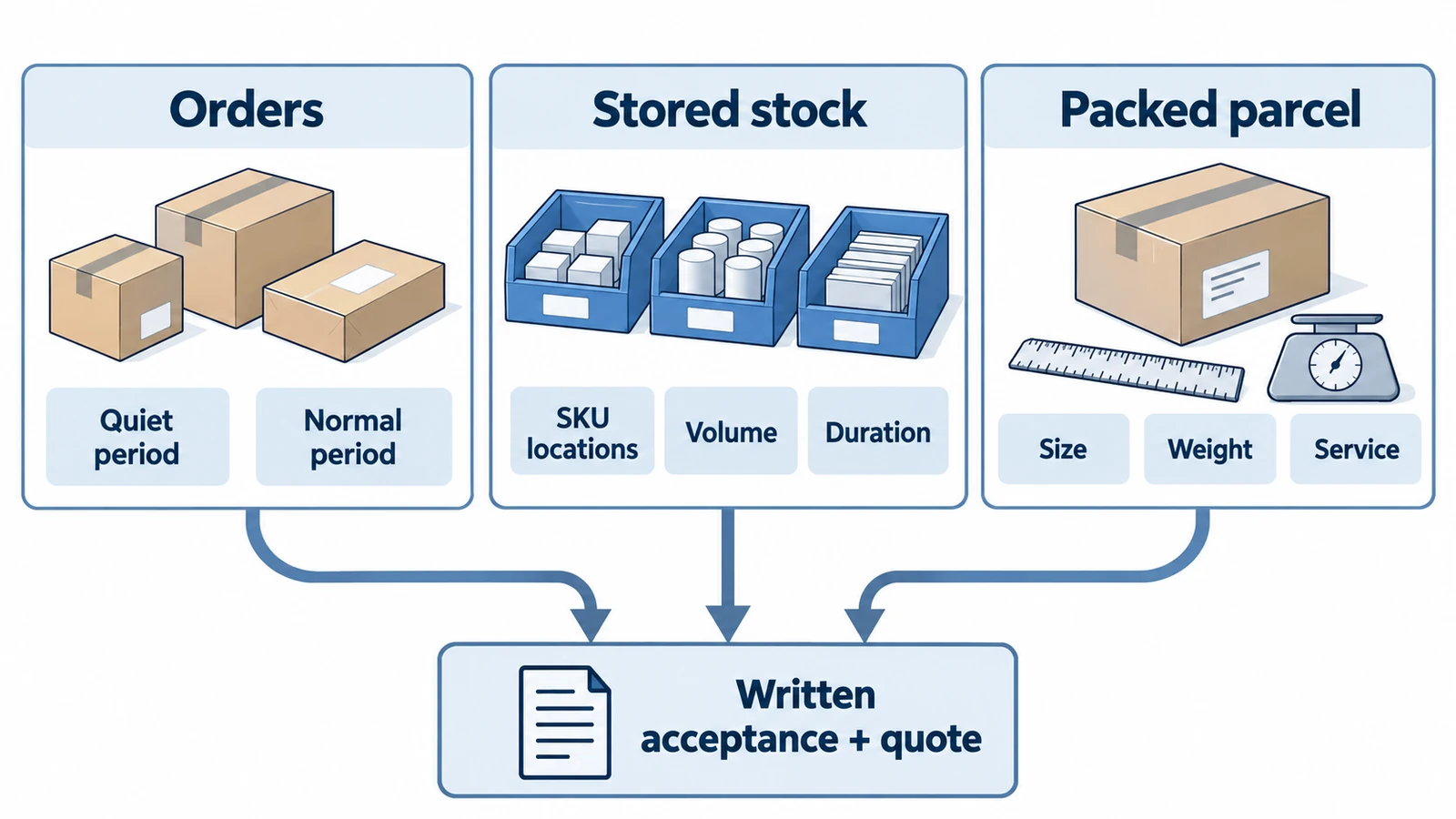
- Quiet and normal order patterns, including any inactive period.
- Stock you expect to retain and the destinations served.
For Fulfyld, request clarification of its differing volume statements before treating a low-volume tier as acceptance. Key Takeaway: Keep a provider on your shortlist only when it accepts your workload and the terms fit your budget. Include any unanswered conditions in the enquiry.
Does no order minimum mean no monthly commitment?
No order minimum does not remove a 3PL’s spending floor, account fee or charges for stock that remains in storage. For this reason, ask for separate answers about admission and the accepted account’s financial obligations.

Separate admission from financial commitment
An order threshold tells you how much volume a provider requires before accepting an account. A spending floor sets the billable amount for a defined service category, even when activity is low. Ask separately about:
- Required order volume and how it is measured.
- The minimum spend and services credited toward it.
- Account, storage or other charges outside that minimum.
For example, Fulfillrite publishes no strict order minimum alongside recurring financial charges. eFulfillment Service expressly advertises both no order-volume minimum and no monthly-spend minimum; that still leaves its usage charges to price.
Keep ambiguous conditions open
Fulfyld’s documentation describes no hard order minimum and a low-volume tier, but later discusses more than 200 monthly orders and more than three SKUs as economic-readiness considerations. Its homepage also describes a higher range of order volumes for its typical customers.
Those statements leave your account’s threshold unclear, so ask which conditions apply to your products and expected workload. Key Takeaway: Obtain both the admission decision and the financial conditions before relying on a “no minimum” claim.
What will you pay in a quiet month?
A quiet month can include an applicable spending floor, separate recurring charges and the actual work or storage used. Even if you send no new orders, retained stock and account charges can still leave a bill.
Separate counted charges from additions
Fulfillrite’s public FAQ lists a $399 monthly pick-and-pack minimum and a separate $59.99 monthly account fee. Since the floor covers pick-and-pack, ask how storage, postage and other work will be charged. Those two amounts do not establish an all-in invoice.
Fulfyld’s public pricing page lists a $499 monthly minimum and describes charging a shortfall using a shipping-cost example. Because the page is undated, ask whether its price still applies to your account and which charges count toward the minimum. Its wording does not establish a pick-and-pack-only floor or prove that every fee counts toward it.
Request comparable quiet and normal-month quotes
For each candidate, request two prospective budgets using matching assumptions:
- Activity credited toward the minimum and any shortfall treatment.
- Separately charged storage, account services, postage and special work.
- The billing period and any first-period or inactive-account conditions.
eFulfillment Service describes weekly invoicing and storage measured by cubic feet and recounted weekly. A calendar month is not automatically four identical billing weeks, so compare the same dates and retained stock. Keep the retained-stock assumptions visible in both budgets, because fewer outbound orders do not by themselves reduce the space occupied by unsold goods. Key Takeaway: Reject a commitment your quiet period cannot support before a low per-order rate influences the decision.
Will your products and stock profile be accepted?
Goods, packed dimensions, SKU footprint and required services can exclude a small 3PL account even when its order count is acceptable. Low volume tells an operator little about the space or handling it must reserve.
Qualify the inventory that needs space
A few large or slow-moving items create different storage work from a compact, fast-moving catalogue. So prepare a profile of the inventory you will keep there:
- Dimensions and weight of the goods and finished parcels.
- SKU count, units retained and expected storage duration.
- Fragility, temperature, value or other handling restrictions.
For example, eFulfillment Service describes a central Michigan operation and excludes refrigerated goods. Fulfillrite describes a focus on small, lightweight parcels and excludes business-to-business (B2B) retail distribution and electronic data interchange (EDI) routing-guide work. Treat these as provider statements and confirm the actual proposed service.
Confirm the actual operating scope
Fulfyld’s published pricing says each SKU requires a unique storage location. That makes catalogue breadth relevant even when few orders leave the warehouse. Request storage assumptions that reflect your variants and retained quantities.
If the required job extends beyond these parcel-service options, the broader comparison of fulfillment and freight operating models helps identify the appropriate type of operator. Key Takeaway: Qualify the physical inventory and required channels before comparing account prices.
When do startup and ongoing charges begin?
Confirm the one-off startup costs and the event that starts ongoing 3PL billing. Free account opening or onboarding does not establish free inbound preparation, retained inventory or later operations.
Identify the first billable event
For instance, eFulfillment Service advertises no setup or integration fees. Fulfillrite states there is no onboarding fee and that billing begins once the first batch of products arrives. However, Fulfyld’s undated pricing table lists a one-off $199 setup fee, whose current applicability needs confirmation.
Before stock moves, ask each operator to distinguish the quote request, account opening, inventory arrival and billable service use. A store with a delayed launch needs to know which costs begin before its first customer shipment. If your first batch arrives partway through a billing period, ask whether the minimum or account fee is prorated and which dates the first charge covers.
Budget for the first period
Next, price the work and materials needed to make stock ready:
- Inbound transport and receiving.
- Shipment notices, packing slips and unit identification.
- Any barcode remediation, packing materials and initial storage.
The eFulfillment Service startup instructions call for an advance shipment notice and scannable unit barcodes. USPS packing guidance, including the tutorial below, can help define the box and protective materials to discuss. Key Takeaway: Budget from the first chargeable stock or service event, rather than assuming billing starts with the first sale.
Do charges stop when you stop sending orders?
Once an account is open, stopping orders does not establish that storage, account charges or notice obligations have ended. You can open an account free or pay a one-off setup charge, then incur ongoing fees when stock arrives or work starts. Ask which event ends each recurring charge and what stock-removal or final-billing steps apply.
Distinguish an inactive account from a closed one
Fulfillrite publishes month-to-month service with a 30-day minimum commitment and requests 30 days’ closing notice. Its no-early-termination-fee statement does not establish an immediate free pause or waived final storage charges.
For eFulfillment Service and Fulfyld, the public terms reviewed here do not settle every account-specific pause or removal condition. Ask for those terms in the proposed agreement instead of assuming that stopping orders closes the account.
Confirm remaining stock and final obligations
Before placing stock, ask what happens when campaigns stop:
- Which charges continue while inventory remains?
- What notice and approvals are needed to close the account?
- Who arranges stock removal, and which final charges apply?
Use the written answers to budget for the period between your last customer shipment and the date the account closes. Key Takeaway: Compare the cost of keeping or closing the account alongside the cost of sending ordinary orders.
What should a product and packing trial confirm?
A limited product and packing trial should confirm that the proposed 3PL service accepts your goods and can prepare the agreed parcel before you commit more inventory. Request physical evidence against the specification you supplied.

Check the physical product and packed parcel
Use representative goods and the final packaging. Ask for:
- Confirmation that the product and handling requirements are accepted.
- An approved sample showing the item, protection and closed package.
- Packed dimensions and weight usable in the shipping proposal.
Once the sample is packed, review the actual pack-out before accepting a materials allowance or parcel-size assumption. Because product-listing dimensions can refer to the item or its retail packaging, ask for measurements of the finished shipping carton.
Separate China-side preparation from US fulfillment
Where stock starts in China, specify what the supplier must prepare before the selected operator receives it. China-side dropshipping fulfillment can involve a separate scope for sourcing coordination, quality checks, identification and packing preparation.
RuntoDropship is a Private Dropshipping Agent in China. Give RuntoDropship the receiving specification so you can discuss any China-side preparation needed to meet it. The chosen US provider must separately confirm the work it will accept. Key Takeaway: Commit more stock after the proposed product, packaging and physical handoff are defined and accepted.
How should you choose a small-business 3PL?
Choose a provider that accepts your goods and required services, with quiet-month costs and startup terms your business can support. Use the three options above to identify the conditions you still need confirmed in writing.
Make the next commitment specific
- Remove candidates whose financial floor or handling scope does not fit.
- Obtain the unresolved account and storage conditions.
- Approve the limited physical preparation before expanding stock.
If China-side sourcing, quality control or fulfillment preparation is the missing step, RuntoDropship can discuss that scope. Share your products, packed profiles, destination market and quiet/normal order pattern. We favor clear commitments and traceable work before promising an outcome.
Key Takeaway: Choose an arrangement you can support during a quiet period as well as a successful launch.
FAQ
Will a bundle count as one pick or several?
It depends on the physical and digital setup. A preassembled case, a virtual bundle and individually picked components can represent different work. Confirm which SKU and unit the quoted pick covers and how components reach the warehouse; do not assume a multipack is one billable pick.
Can I change an order after it reaches the warehouse?
Only if the warehouse can still act at the order’s current stage. A storefront change or cancellation request is insufficient. Obtain its acknowledgement before promising the change; after carrier handoff, use the agreed recall or return process rather than assuming the parcel stopped.
Could storage and occasional handling be enough?
Possibly, if you mainly need storage with infrequent movements rather than daily consumer-order dispatch. Compare that exact service scope. Confirm access, who performs loading or handling, equipment rules and the charges; a storage rental alone does not establish pick-and-pack service.
How can I check a shipment charge on my invoice?
Match shipment-linked charges to shipment or tracking references, the agreed fee type and rate, and the billing period. One order can create multiple shipments. Check storage or account charges separately; flag unexplained lines for clarification rather than assuming a duplicate or recoverable error.
Who will help with exceptions on a low-volume account?
Confirm who handles stock, order and billing exceptions, how to reach that role, its coverage hours and the backup route. A published contact or account-manager label does not establish an agreed response time. Request the actual support scope before relying on it.